
265 Vs 285 Tires: Key Differences Explained
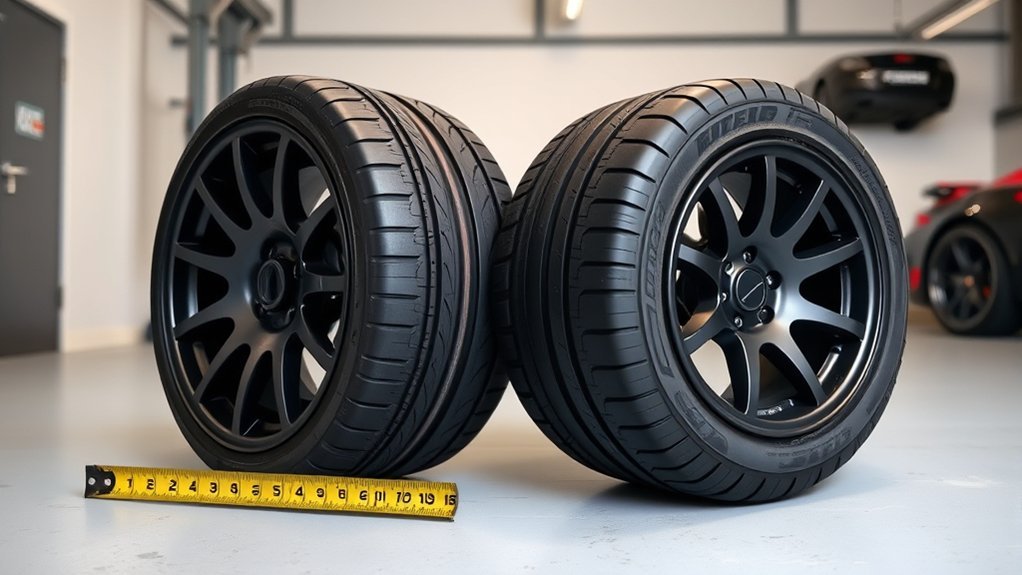
265 tires are about 20 mm narrower than 285s, so they usually steer quicker, feel lighter, and cost less. In contrast, 285 tires give you a larger contact patch for more dry grip, traction, and off-road stability, but they can increase rolling resistance, reduce fuel economy, and sometimes ride harsher. Fitment depends on wheel width, offset, clearance, and load rating, and tire diameter changes can alter speedometer accuracy. Keep going to compare use cases and fitment in detail.
Key Takeaways
- 285 tires are about 20 mm wider than 265 tires, usually giving more grip and a larger contact patch.
- 265 tires typically feel lighter and steer quicker, while 285 tires can feel slower but more stable.
- Wider 285 tires often increase rolling resistance, which can slightly reduce fuel economy.
- Tire fitment depends on wheel width, offset, suspension clearance, and overall diameter, not width alone.
- Changing tire diameter can affect speedometer accuracy, so recalibration may be needed when switching sizes.
[Products Worth Considering]

The Continental Grand Prix 5000 is an allround road bike tire engineered for faster rolling, improved ride comfort, and enhanced puncture protection. It features a Vectran Breaker cut-protection layer, Lazer Grip micro-profile tread for confident cornering control, and Active Comfort Technology to damp vibration for smoother rides. BlackChili compound optimizes grip and speed for everyday performance and long-lasting confidence.

Keep your tires properly inflated with this analog VONDIOR tire pressure gauge, designed for fast, easy readings without batteries. The swiveling, two-axis hose and large glow dial help you measure at any tire angle with instant visibility. Built with a protective rubber shield, it supports durable, low-maintenance use for cars and trucks.
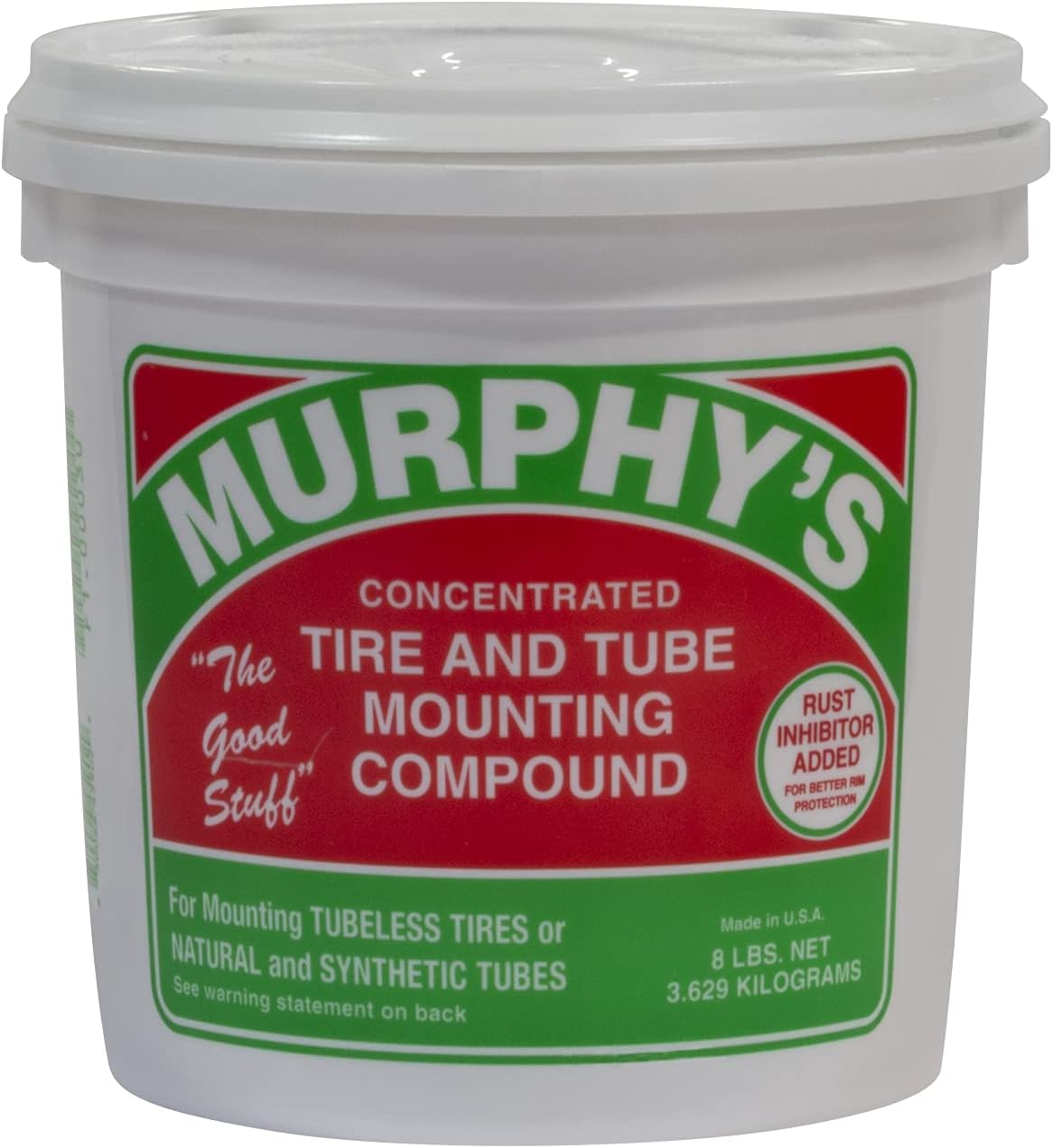
A concentrated tire and tube mounting compound designed to help simplify mounting rubber tires and tubes on passenger, semi truck, construction, and OTR applications. Its ultra-thick formula packs beads effectively and includes rust inhibitors to help protect against corrosion during use.
What’s the Difference Between 265 and 285 Tires?
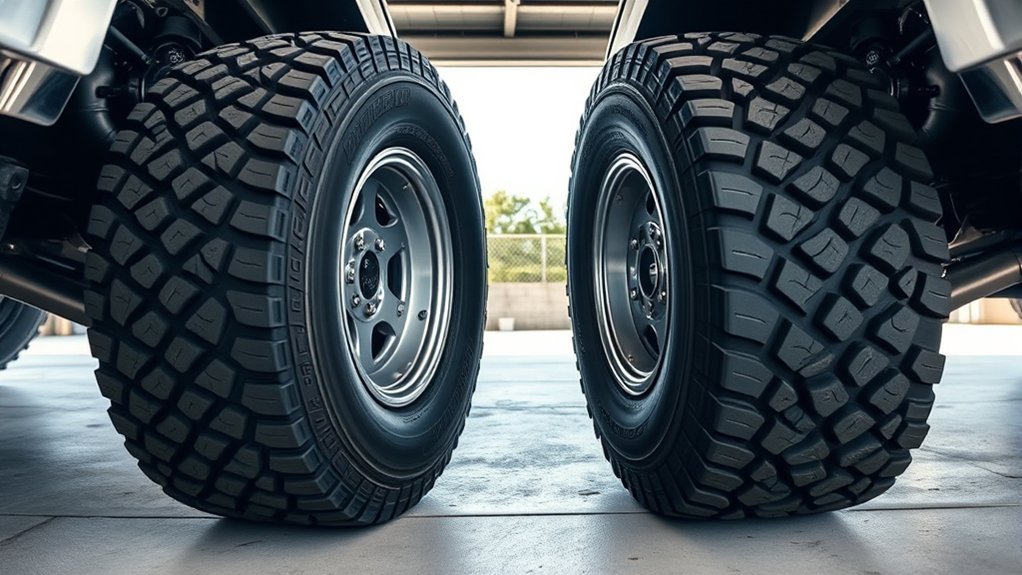
The simplest difference between 265 and 285 tires is width: a 265 tire is about 265 mm wide, while a 285 tire is about 285 mm wide, so the 285 has 20 mm more section width. That extra width gives you a larger contact patch, which can change grip, steering feel, and braking response.
A 285 tire is about 20 mm wider than a 265, which can affect grip and steering feel.
It also usually adds a bit more rolling resistance and can slightly affect fuel economy. Beyond width, you should compare sidewall height, overall diameter, and load rating because those specs can alter ride quality and speedometer accuracy.
Tire pressure matters too: different widths can respond differently to the same PSI, so you should verify pressures with the vehicle and tire maker’s recommendations.
Tread patterns can also vary by model, and they influence traction, noise, and water evacuation more than width alone.
In practice, you’re comparing a narrower tire to a wider one with distinct performance tradeoffs.
Will 285 Tires Fit Your Vehicle?
Whether 285 tires fit your vehicle depends on more than the nominal width alone, because wheel width, wheel well clearance, suspension geometry, offset, and lift or leveling changes all affect fitment.
You should verify tire compatibility against your vehicle specifications, including factory recommended sizes, load rating, and approved rim range. A 285 tire is wider than a 265, so it needs more lateral space at the strut, control arm, inner fender, and outer body lines.
Measure clearance at full steering lock and under compression, not just at ride height. If your wheels use a low offset, the tire may move outward and contact fenders; if the offset is high, it may rub suspension parts.
Compare overall diameter too, since a larger diameter can exceed available space. When in doubt, consult the owner’s manual, tire placard, or a fitment specialist before mounting 285s to avoid interference and maintain proper installation.
How Do 265 Vs 285 Tires Affect Handling?
When you switch from 265 to 285 tires, you’ll usually feel a slightly slower steering response because the wider tread adds more contact patch and rotational mass.
That wider footprint can also increase cornering grip, especially under load, so your vehicle may feel more planted in fast turns.
The exact handling change depends on tire construction, sidewall stiffness, and your wheel width.
Steering Response
Wider 285 tires usually feel a bit less nimble on initial turn-in than 265s because the larger contact patch and increased tread width raise steering effort and can slow response slightly, especially at low speeds or during quick lane changes. You’ll notice this most in responsiveness factors like sidewall stiffness, tire weight, and wheel offset. | Tire Size | Steering Response |
| — | — |
|---|---|
| 265 | Quicker, lighter feel |
| 285 | Slower, heavier feel |
| Both | Steering stability remains predictable |
On-center, 265s typically return to neutral with less input, while 285s may need a firmer hand. If you value steering stability on the highway, the wider tire can feel calmer, but it won’t match the sharper, more immediate feedback you get from 265s in everyday driving.
Cornering Grip
Cornering grip improves with the 285 in most dry conditions because the extra tread width gives you a larger contact patch, which can generate more lateral force before the tire starts to slide.
You’ll usually feel stronger mid-corner stability and a higher limit before understeer, especially on heavier vehicles or when you load the outside tire.
That wider footprint can improve tire performance during aggressive lane changes and fast sweepers, but it also depends on compound, sidewall stiffness, and wheel width.
The 265 often turns in a bit cleaner and can keep more consistent traction characteristics on wet or uneven pavement, where a narrower tread can cut through surface water more effectively.
If you prioritize maximum dry grip, the 285 has the edge.
Which Tire Size Improves Traction More?
Which tire size improves traction more depends on how and where you use the tire, but a 285 usually offers a traction advantage over a 265 because it has a wider contact patch and can transmit more force before slipping. In your traction comparison, you should weigh performance factors like compound, tread pattern, inflation pressure, and vehicle load, since size alone doesn’t decide grip.
| Factor | 265 Tire | 285 Tire |
|---|---|---|
| Contact patch | Smaller | Larger |
| Dry grip | Adequate | Stronger |
| Loose-surface bite | Good | Better |
| Stability under load | Moderate | Higher |
If you prioritize acceleration, towing, or off-road bite, the 285 can help you put power down more effectively. A 265 may still outperform if your setup favors lighter steering response or if the tire’s design is superior. So, you’ll get the best result by matching size to surface, load, and driving demand.
How Do 265 Vs 285 Tires Affect Fuel Economy?
Fuel economy usually drops slightly with 285 tires because their wider tread creates more rolling resistance and aerodynamic drag than 265 tires. You’ll often see a modest rise in fuel consumption, especially in city driving where stop-and-go operation amplifies losses.
On steady highway trips, the gap can narrow, but the 285 still asks the engine to work harder at the same speed.
- Wider contact patch means more energy lost as heat.
- Correct tire pressure helps reduce extra drag and uneven wear.
- Heavier wheel-and-tire setups can further trim efficiency.
If you keep tire pressure at the manufacturer’s spec, maintain proper alignment, and avoid unnecessary load, you can limit the penalty.
In practice, the difference is usually small, but over many miles it adds up. If maximizing mpg matters most, the 265 tire gives you a slight efficiency advantage without changing your driving style.
[Products Worth Considering]

This manual duck head tire changer kit makes tire installation and removal simpler by letting you embed the duck head into the tire with applied pressure. The integrated design and durable steel construction help reduce friction and improve efficiency and safety during use. Suitable for 16–21 inch wheels, it’s convenient for cars, trucks, SUVs, and ATV tires, with 24-hour after-sales support.
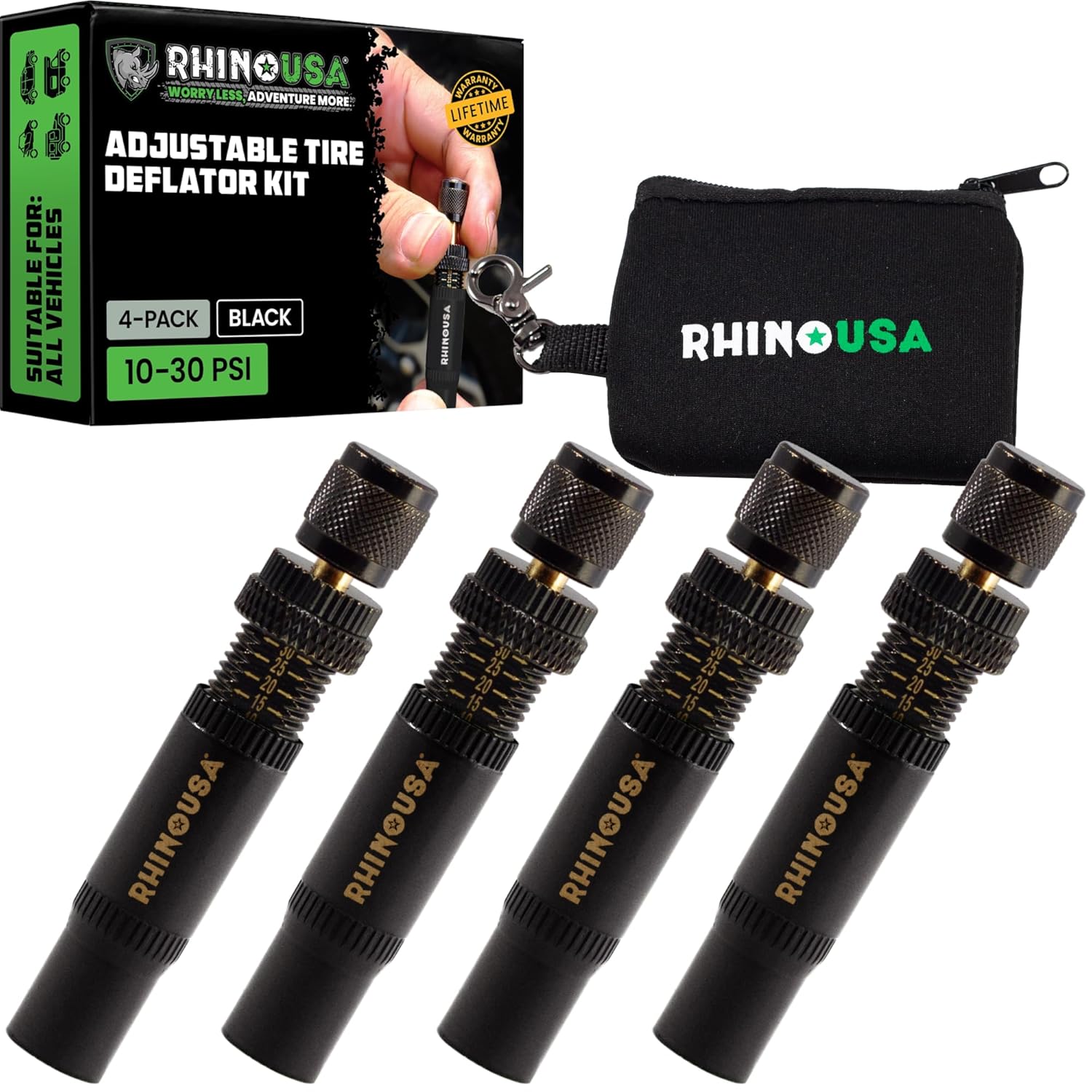
Use the Rhino USA adjustable tire deflators to air down all four tires at once by screwing one deflator onto each valve stem, letting you step away while the tires reach your preset pressure. Each deflator independently adjusts across a 10–30 PSI range with laser-etched indicators for quick setup and verification, making it ideal for beach, sand, and rocky off-road trails.

Clean grills, fenders, fender flares, bumpers, and wheel wells with a long-handled brush built for detailed car washing. The soft, triple-flagged bristles and dense scrub coverage help lift dirt gently while making coverage fast and easy. Use it with your favorite car wash soap for tires and exterior surfaces, and it also works for bike, motorcycle, boat, or RV cleaning.
Do 285 Tires Ride Rougher Than 265 Tires?
Yes, 285 tires can feel a bit rougher than 265 tires, but the difference usually comes more from sidewall height, tire construction, and inflation pressure than width alone.
285 tires can feel rougher than 265s, but sidewall height and pressure usually matter more than width.
If you keep the same wheel diameter, a 285 often uses a shorter sidewall, so it has less air volume to absorb sharp impacts. That can reduce ride comfort over broken pavement and expansion joints.
You may also notice slightly higher noise levels if the wider tread pattern creates more road contact and more pattern resonance, though tread design matters more than width itself.
A 265 with a softer compound, more flexible carcass, or lower load rating can actually ride smoother than a stiffer 285.
To judge comfort accurately, compare the exact tire model, load index, and recommended pressure, not just the nominal width.
Setup matters more than the label alone.
How Does Tire Width Change Speedometer Readings?
When you switch from 265 to 285 tires, the change in overall diameter can alter how far the vehicle travels per wheel revolution, which directly affects speedometer readings.
If the new tire size moves the rolling circumference outside the factory calibration range, you may need to recalibrate the speedometer to keep indicated speed accurate.
In real-world use, that mismatch can make your displayed speed read slightly higher or lower than your actual road speed.
Tire Diameter Effects
Tire width by itself doesn’t directly change your speedometer reading; tire diameter does. When you move from a 265 to a 285, the section width may rise, but the tire height impact depends on aspect ratio and wheel size.
If overall diameter grows, each rotation covers more ground, so your indicated speed can read lower than actual. If diameter shrinks, the opposite happens. You should compare the full mounted diameter, not just tread width, because ride comfort and gearing feel can also shift.
- Taller tires travel farther per revolution.
- Shorter tires make the speedometer read higher.
- Matching diameter keeps readings closer to stock.
Speedometer Calibration Changes
If your 265-to-285 swap changes overall tire diameter, you’ll likely need speedometer calibration to keep the displayed speed accurate.
Your speedometer reads wheel revolutions, not actual road speed, so a larger or smaller circumference changes the signal it interprets. If the 285 tire has a greater diameter, each rotation covers more distance, and your dash will underreport speed and odometer mileage. If diameter decreases, it overreports both.
You can correct this with a scan-tool speedometer adjustment, ECU reflash, or calibration module matched to your axle ratio and tire size. Make the change before judging tire performance, because inaccurate readings can distort gearing, shift timing, and navigation data.
Always verify calibration with a GPS or measured test route after installation.
Real-World Speed Difference
A wider 285 tire can change your speedometer reading only if its overall diameter differs from the 265 you’re replacing. Width alone doesn’t alter speed; circumference does.
If the 285 has a taller sidewall or a different aspect ratio, your actual road speed can drift from the indicated speed, affecting real world performance and speed characteristics.
- Larger diameter = fewer revolutions per mile, so you’ll travel faster than the gauge shows.
- Smaller diameter = more revolutions per mile, so you’ll be going slower than indicated.
- Same diameter but wider tread = nearly no speedometer change, just a different contact patch.
You should verify tire specs before swapping.
Even a 2% diameter change can shift readings enough to matter on highways, especially when you’re tuning for accuracy.
Which Tire Size Is Better for Your Driving Style?
Your driving style should determine whether 265 or 285 tires make more sense, since each width changes how the vehicle responds under load, in corners, and at speed. If you prioritize sharp steering, lighter effort, and consistent behavior on wet pavement, 265s usually suit you better. If you want a broader contact patch and more planted feel, 285s often match that need.
| Tire Size | Best Fit |
|---|---|
| 265 | Commuting, precise handling |
| 285 | Aggressive driving, off road performance |
| 265 | Better winter capabilities |
You’ll notice 265 tires generally load the suspension less and can feel more efficient during daily use. By contrast, 285 tires can support a more assertive chassis response when you drive hard or carry gear. Neither size is universally superior; the better choice reflects how you balance steering accuracy, traction demand, and the road conditions you meet most often.
How To Choose Between 265 And 285 Tires?
Choosing between 265 and 285 tires comes down to fitment, intended use, and how much performance tradeoff you can accept. You should verify wheel width, suspension clearance, and fender space before you buy.
Choosing between 265 and 285 tires comes down to fitment, intended use, and available clearance.
If you haul or tow, compare tire load ratings, because the wider 285 may support similar loads, but its weight and rolling resistance can increase. Choose 265s when you want quicker steering response, better wet-surface efficiency, and lower cost. Choose 285s when you want more contact patch, stronger off-road grip, and modest performance benefits in braking and cornering.
- Check manufacturer fitment charts for your exact vehicle
- Match tire load index to your payload and towing needs
- Consider speedometer error and gearing changes after upsizing
If you mostly drive on pavement, 265s usually make more sense. If you prioritize traction on loose terrain, 285s’re the better option.
Frequently Asked Questions
Can I Mix 265 and 285 Tires on the Same Vehicle?
No, you generally shouldn’t mix 265 and 285 tires on the same vehicle; you’ll create tire compatibility issues, uneven rolling circumference, and handling differences. Keep all four tires matched, unless your manufacturer specifically allows staggered setups.
Do 285 Tires Cost More Than 265 Tires?
Yes, 285 tires usually cost more than 265 tires because they use more material and often target larger-wheel applications. In your price comparison, consider tire performance, load rating, tread design, and brand-specific sizing premiums.
Are 265 Tires Better for Winter Driving?
Yes—if your vehicle’s gearing and load are similar, 265s can give you better winter traction because they’re often narrower, cutting through snow more effectively and improving tire performance on packed, icy roads.
Will Wider Tires Increase Road Noise?
Yes, wider tires often increase road noise because you expose more tread to pavement. You’ll gain tire traction and handling performance, but fuel efficiency may drop, and wear patterns can become more uneven.
How Often Should I Rotate 265 or 285 Tires?
You should rotate them every 5,000–7,500 miles, but watch closely—uneven wear can shorten tire lifespan. Use your vehicle’s rotation patterns, follow staggered setups if needed, and don’t delay when shoulders start wearing faster.
Conclusion
When you compare 265 and 285 tires, you’re really balancing width, grip, comfort, fuel use, and fitment. A 285 tire gives you a larger contact patch, which can improve traction and stability, but it may slightly reduce fuel economy and require more clearance. A 265 tire usually feels lighter and more efficient. So, don’t just guess—measure your needs carefully and choose the size that fits your vehicle and driving style like a glove.
[Products Worth Considering]

This ALL-TOP auto-stop tire deflator valve kit lets you air down off-road tires quickly without watching pressure, automatically stopping when your preset PSI is reached. Each valve is individually calibrated for reliable performance with an acceptable +/- 2 PSI tolerance. The adjustable deflator range covers 10 to 30 PSI and includes four valves plus valve caps and a zipper pouch for easy setup on trucks, SUVs, RVs, UTVs, and powersports.

This Hycline 2-pack mountain bike tire set delivers durable, puncture-resistant performance with a high-grip, aggressive tread designed for traction on hard surfaces and confident handling through mud and soil. Includes matching inner tubes and tire levers for easier everyday maintenance and quicker installation after folding storage. Built for a range of riding conditions with reinforced rubber and nylon cord for wear-resistant reliability.

This metal-free wheel and tire cleaning brush uses dense, fluffy synthetic wool to safely clean rims, spokes, fenders, and engine areas without worrying about damaging surfaces. Its flexible, comfortable design helps you reach detailed areas while maintaining durability, and the extra absorbent fibers work well with wheel spray cleaners for faster cleanup. Reusable and washable performance helps prevent grime and build-up for cleaner vehicles and easier maintenance at home.

Related Articles
How to Choose Tires for 20×10 Wheels
Just how wide should your tires be for 20x10 wheels, and which size best balances fitment, grip, and clearance?
Read More
Q vs T Speed Rating: Which Do You Need?
How do Q vs T speed ratings affect safety and performance, and which one is right for your vehicle?
Read More
12 Ply Vs 14 Ply Tires: What’s the Difference?
What’s the real difference between 12-ply and 14-ply tires, and which one could change your towing performance?
Read More