Tire Dry Performance Explained: Getting the Best Grip From Your RAV4

You’ll get the best dry grip on your RAV4 by fitting high-traction tires (Michelin CrossClimate 2, Pirelli Scorpion AS 3+) in the correct size, keeping pressures near the manufacturer spec (~33 psi), and ensuring proper alignment and suspension health. That reduces braking distances, sharpens cornering, and stabilizes ABS performance. Monitor tread depth, rotate regularly, and trade some tread life for softer compounds if you need ultimate grip — continue for specific tire comparisons, pressures, and maintenance steps.
Quick Answer: Best Tires for Dry Grip on a RAV4

When you want the best dry grip for a RAV4, choose tires engineered for high traction and responsive tread designs. You’ll favor models that translate tire technology into measurable surface contact and lateral stability. Opt for the Michelin CrossClimate 2 for its high-traction tread and UTQG 640 rating, which signals durable compound and consistent dry performance. The Pirelli Scorpion AS 3+ gives strong dry grip while preserving fuel economy, useful if you want efficiency without sacrificing bite. If you value longevity and a quiet ride, the Michelin Defender 2 balances dry traction with low noise and extended service life. The Continental CrossContact LX25 provides predictable handling and a 70,000-mile warranty, reducing replacement frequency. Swapping OEM Yokohama Avid GTs for these premium options acts as a direct performance upgrade: you’ll gain sharper steering response and improved confidence on dry pavement. Choose based on compound, tread pattern, and intended mileage to match your liberation-focused driving goals.
How Dry Performance Changes RAV4 Braking and Cornering
When you fit dry-focused tires, you’ll cut braking distance under load—tests show up to a 30% reduction versus worn or subpar rubber. You’ll also get sharper cornering grip and improved balance, since compounds and tread design keep the contact patch stable through lateral loads. Finally, maintaining correct tire pressure and a footprint that keeps tread depth above 4/32″ maximizes grip for braking, cornering, and overall handling.
Braking Distance Underload
One key factor you can control is tire inflation: on a RAV4 under load, maintaining the recommended ~33 psi keeps the contact patch ideal and minimizes increases in dry braking distance. You’ll leverage braking technology best when tire pressure and tread depth are correct, because electronic aids expect predictable tire behavior. Under load, low pressure reduces the effective contact patch and alters load distribution, which lengthens stopping distance and undermines ABS modulation. You should monitor pressure before heavy cargo or towing, rotate tires regularly, and replace worn rubber promptly to retain designed dry performance. Do this and you free yourself from uncertainty: consistent pressure, healthy tread, and proper load distribution let the RAV4 deliver predictable, minimized braking distances on dry roads.
Cornering Grip And Balance
Having kept your RAV4’s tire pressure and tread in spec to maintain predictable braking, you can now consider how those same factors affect cornering grip and balance. You’ll find the contact patch is central: correct inflation preserves ideal contact area, yielding consistent lateral force and stability through turns. Tire balance governs rotational symmetry; poor balance induces vibration, shifts load distribution, and degrades precise steering feedback. Choose tread patterns and compounds tailored for dry grip dynamics—wider, firmer designs increase lateral bite and responsiveness at speed. Maintain at least 4/32″ tread to maximize mechanical traction and controlled evacuation margins, preventing sudden loss of control during aggressive inputs. Regularly verify pressure, balance, and tread to liberate confident, repeatable cornering performance.
Tire Pressure And Footprint
Although often overlooked, maintaining the RAV4’s recommended tire pressure (about 33 psi) directly shapes the contact patch and therefore how the vehicle brakes and corners on dry pavement. You’ll see immediate tire inflation benefits: the contact patch—or footprint impact—stays balanced across the tread, delivering predictable braking distances and stable lateral grip. Underinflation enlarges the footprint but reduces effective grip, increasing stopping distance and compromising cornering precision. You should check pressure regularly to preserve even wear, fuel efficiency, and consistent handling. Practical steps you can take:
- Monitor tire inflation weekly and before long trips to maintain the designed footprint impact.
- Adjust to 33 psi cold; avoid overinflation, which narrows the contact patch.
- Replace or rotate tires when wear patterns indicate pressure or alignment issues.
Which Tire Features Increase Dry Traction
When you’re choosing tires for dry traction, focus on the rubber compound: softer compounds increase adhesion and flexibility at the pavement interface. Also check contact patch size, since a larger, properly inflated contact patch spreads load and increases available grip. Finally, evaluate tread pattern design—wider ribs and optimized grooves maintain maximum surface contact and stability during cornering.
Tread Compound Grip
Grip starts at the compound: softer, more flexible rubber conforms to pavement microtexture and increases contact area, so you’ll usually get better dry traction from lower durometer compounds. You’ll weigh tire softness impact against tread durability trade offs: softer, high-silica blends raise grip and cut rolling resistance, but they accelerate wear. Choose compounds engineered to balance your liberation—responsive traction without rapid replacement.
- High-silica formulations: boost molecular adhesion for better dry bite and improved fuel efficiency.
- Optimized polymer blends: tune hysteresis for grip while extending service life versus pure soft rubbers.
- Premium engineered compounds: like those in long-life tires, integrate fillers and elastomers to reconcile grip and longevity.
Read specs and test reviews to match compound choices to your driving priorities.
Contact Patch Size
Contact patch size—the actual area of tire rubber touching the road—directly governs dry traction: a larger, properly shaped footprint increases contact pressure distribution and lateral grip, improving cornering stability and braking performance. You’ll pursue contact patch optimization by controlling pressure, compound choice, and tread depth. Keep manufacturer tire pressure to preserve the intended footprint; underinflation creates a larger but inefficient contact area that reduces traction enhancement. Select compounds with higher silica content so the rubber conforms to microtexture, increasing effective contact under load. Monitor and replace tires when tread depth falls enough to shrink the usable footprint—shallower tread can lower contact efficiency and raise slip risk. These adjustments free you from guesswork and deliver measurable gains in dry grip and vehicle control.
Tread Pattern Design
Start by prioritizing tread features that directly shape how the rubber meets the road: wider, aggressive grooves and larger shoulder blocks increase mechanical interlock and lateral bite for cornering, while a continuous center rib sharpens steering response and straight-line stability. You’ll want a directional or asymmetric pattern to maximize the contact patch during acceleration and braking, and silica-enhanced compounds to boost flexibility without accelerating tread wear. Monitor groove depth to balance dry grip with wet evacuation; shallower grooves can improve dry contact but reduce hydroplaning resistance. Choose tires that let you drive confidently and freely, trading off longevity versus pure grip based on use.
- Directional patterns: stronger contact patch for traction.
- Continuous center rib: precise steering.
- Large shoulder blocks: enhanced cornering.
Pick the Best Dry-Grip Tires for Your RAV4 (Size, Ratings, Trade-Offs)

While keeping your RAV4 on the OEM 225/65-17 size, prioritize premium touring tires like the Michelin Defender 2 or Continental LX25 for the best dry handling and traction ratings; the Michelin CrossClimate 2 is a strong alternative if you want higher UTQG treadwear (640) without sacrificing grip. You’ll guarantee tire compatibility by sticking to the OEM size, which preserves suspension geometry, load index, and speed rating. Compare objective performance ratings—dry braking distance, lateral grip, and rolling resistance—to select the best compromise between grip and efficiency. Expect Michelin upgrades to deliver noticeably sharper handling versus original Yokohama Avid GT or Dunlop Grandtrek PT20 fits, with user reports supporting improved safety margins. Be mindful that premium compounds can slightly reduce fuel economy; weigh that against gains in traction, steering precision, and ride comfort. Choose tires that align with your liberation goals: predictable, communicative grip that lets you push limits confidently while maintaining everyday usability.
Compare: Crossclimate 2 Vs Premier LTX Vs Sport-Touring Tires
You’ll compare wet and dry braking performance by examining tread compounds and siping patterns that dictate water evacuation and contact patch behavior. Focus on how the CrossClimate 2’s 640 treadwear compound trades slightly more dry grip and lighter handling for longevity, while the Premier LTX’s tread geometry prioritizes wet braking and high-speed stability. Also evaluate ride comfort versus grip: sport-touring designs soften ride and prioritize comfort, whereas the CrossClimate 2 and Premier LTX bias performance and stability in their respective targets.
Wet And Dry Braking
Because braking performance can be the difference between a controlled stop and an accident, you should prioritize tires that deliver predictable wet and dry stopping power; the Michelin CrossClimate 2 leads this category with a tread design and compound tuned for superior grip and shorter wet stopping distances, the Premier LTX follows with excellent wet traction but slightly longer dry stops geared toward comfort, and generic sport‑touring tires provide balanced but less aggressive wet braking compared with the CrossClimate 2. You’ll evaluate tire composition and performance metrics to choose liberation through control: CrossClimate 2 cuts wet stopping distances in tests and keeps firm dry fade resistance; Premier LTX trades a touch of dry responsiveness for comfort; sport‑touring sits between. Consider:
- Emergency wet braking: CrossClimate 2 best.
- Dry brake feel: CrossClimate 2 > Premier LTX > sport‑touring.
- Durability vs stopping power: CrossClimate 2 balances both.
Tread Design Differences
Although tread patterns may look similar at a glance, their geometric choices drive very different performance trade-offs you should understand when selecting RAV4 tires. You’ll find the CrossClimate 2 uses a directional, multi-radius tread pattern with deep channels and siping to evacuate water, resist hydroplaning and maintain light-snow traction (3PMSF), so it balances grip and tire longevity across seasons. The Premier LTX adopts a more traditional sport-touring layout that prioritizes stability, cornering grip and low noise through optimized block placement and intermediate siping, favoring comfort. Generic sport-touring tires lean toward sharper shoulder edges and stiffer ribs for handling responsiveness, which can accelerate wear versus premium all-season designs. Choose based on whether you want versatile grip or sharper handling with potential tread-life trade-offs.
Ride Comfort Versus Grip
When choosing between the CrossClimate 2, Premier LTX, and generic sport-touring tires, you’ll be trading off ride comfort against grip depending on their design priorities. You want liberation from compromise: CrossClimate 2 gives superior dry grip, low tire noise, and cushioned ride quality with a 640 UTQG for longevity. Premier LTX prioritizes wet grip and water evacuation, slightly reducing softness but still delivering respectable comfort and a 620 UTQG. Sport-touring options balance handling and comfort but often yield a firmer feel and higher perceived tire noise.
- CrossClimate 2: optimized dry traction, low tire noise, plush ride quality, long wear.
- Premier LTX: engineered for wet grip, moderate softness, controlled tire noise.
- Sport-touring: balanced performance, firmer ride, handling-focused.
How Pressure & Load Change Braking and Cornering
If you keep your RAV4 Prime’s tires at the recommended ~33 PSI and account for additional cargo, you’ll preserve the intended contact patch for predictable braking and cornering. You’ll practice tire maintenance and load management that directly affect stopping distance and lateral grip. Underinflation increases sidewall flex, slows response, and lengthens braking; overinflation narrows the patch and reduces traction. Added load enlarges contact area and can boost grip up to the tire’s load rating, but exceeding limits degrades handling and accelerates wear.
| Condition | Effect |
|---|---|
| Proper PSI (~33) | Ideal contact patch, predictable braking |
| Underinflated | Increased stopping distance, sluggish turn-in |
| Overinflated | Reduced traction, harsher ride |
| Excess load | Higher grip until overload, then compromised control |
Check pressures with cold tires, adjust for cargo, and don’t exceed load ratings. That disciplined approach frees you to drive confidently, knowing grip behavior matches intent.
Alignment & Suspension Checks to Boost Dry Grip
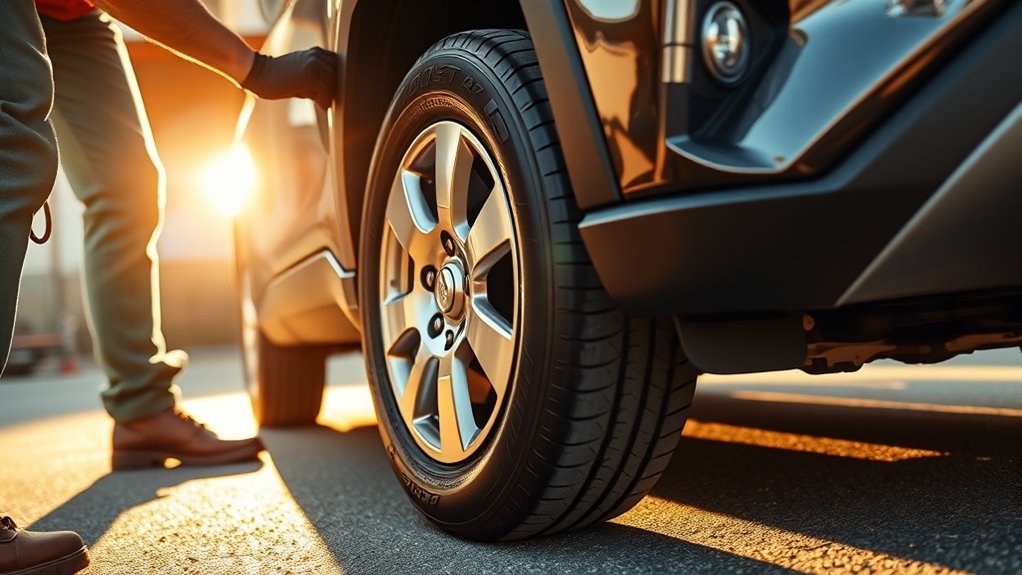
Because precise wheel alignment and healthy suspension parts keep the tire’s contact patch true to design, regular checks are essential for maximizing dry grip and predictable handling. You’ll prevent uneven wear and preserve the full contact area by verifying toe, camber, and caster against factory specs. Inspect struts, shocks, bushings, and mounts so the suspension maintains consistent tire loading through roll and pitch. Consider targeted suspension upgrades if components are fatigued or if you want crisper response; do so with parts that respect ride balance.
- Use alignment tools and a calibrated rack or portable gauges to confirm settings quickly and accurately.
- Check for uneven tread wear patterns and replace or rotate tires before traction is compromised.
- Verify shock/strut damping and bushing integrity; replace worn items to restore even weight distribution.
Routine alignment and suspension inspections extend tire life, sharpen handling, and free you from avoidable grip loss—practical maintenance that liberates confident driving.
Driving Techniques That Maximize Dry Grip Safely
Although subtle in appearance, your inputs behind the wheel directly determine how effectively the RAV4’s tires translate grip into controlled motion, so adopt deliberate, measured steering, throttle, and braking to keep the contact patch engaged. You’ll set driving posture to optimize feedback: sit upright, hands at 9 and 3, and use your core to steer so inputs are smooth and consistent. Maintain recommended tire pressure (about 33 PSI on a RAV4 Prime) to preserve the full contact patch; that pressure yields predictable responses during cornering and acceleration. Apply steering finesse—small, progressive rotations rather than abrupt snaps—to avoid exceeding lateral traction. Accelerate progressively out of corners to minimize slip and load transfer. Brake with metered pressure, trail-braking only when trained; abrupt braking upsets balance and reduces grip. Consider premium touring tires like the Michelin CrossClimate 2 for inherently better dry handling and lower noise, letting you push with confidence while retaining the freedom to explore limits safely.
Maintenance Plan to Preserve Dry Grip (Rotation, Inspection, Tread Targets)
When you follow a disciplined maintenance plan—rotate tires every 5,000–7,500 miles, inspect them monthly, and keep pressures at the manufacturer’s recommendation (about 33 psi for the RAV4 Prime)—you preserve even tread wear and predictable dry grip. You’ll check tread depth to a minimum 4/32 inches, note any irregular patterns, and act before handling degrades. Monitor pressure with a calibrated gauge; temperature changes alter psi and contact patch behavior. Schedule alignment checks after impacts or every 12,000 miles to prevent chronic tire wear and diminished lateral grip. Your plan frees you from reactive fixes and keeps performance consistent.
- Rotate tires front-to-rear and cross-patterns per spec to balance tread life and maintain dry traction.
- Inspect monthly for cuts, blisters, and uneven depth; document readings and replace at or above 4/32″.
- Record pressures, rotation dates, and alignment checks to guarantee objective maintenance and empowered vehicle control.
Quick Troubleshooting: Diagnose and Fix Common Dry-Grip Problems
If your RAV4 feels loose or inconsistent on dry pavement, start by confirming tire pressure and tread depth—inflate to the manufacturer’s ~33 psi and confirm at least 4/32″ remaining—then scan for uneven wear that signals alignment or suspension faults. Next, methodically diagnose causes: use a gauge to verify pressure on all four corners, measure tread with a probe, and note cupping, feathering, or one-sided wear. Uneven wear implies misalignment or suspension play; correct alignment and replace worn components to restore consistent contact patch and grip.
Listen for abnormal tire noise at speed—chatter or humming can indicate uneven wear or a mismatched tire set; resolve by rotating tires every 5,000–7,500 miles and replacing low-UTQG tires with higher-rated options (e.g., Michelin CrossClimate 2). Incorporate seasonal maintenance checks to recalibrate pressures for temperature shifts and keep inspections routine so you stay free and confident on dry roads.
Frequently Asked Questions
What Psi Is Best for Grip?
About 33 psi is best for grip; you’ll maintain ideal tire pressure to balance tire tread contact and grip factors. Check road conditions and load, and adjust slightly as needed to preserve handling and your driving freedom.
Conclusion
In short, choose tires rated for high dry traction (look for A or AA in tests) and keep alignment, suspension, and pressure spot-on to get the most from your RAV4. Properly maintained performance tires can cut wet/dry stopping distances by up to 20% versus worn all-seasons, so don’t skimp. Rotate every 5–8k miles, inspect tread to 4/32″ minimum, and address alignment or shocks promptly to preserve predictable braking and cornering.

Related Articles
Upsizing Wheels on a Toyota RAV4: Pros, Cons, and Considerations
Boost your Toyota RAV4's performance with larger wheels, but discover the hidden trade-offs that could impact your ride before you decide.
Read More
Can I Change Tire Size on My Toyota RAV4? Rules and Recommendations
Are you considering changing the tire size on your Toyota RAV4? Discover the essential rules and recommendations before making a decision.
Read More
What to Do If the TPMS Light Comes On in Your RAV4
Understand the steps to take when the TPMS light illuminates in your RAV4, as overlooking it could lead to serious tire problems.
Read More