
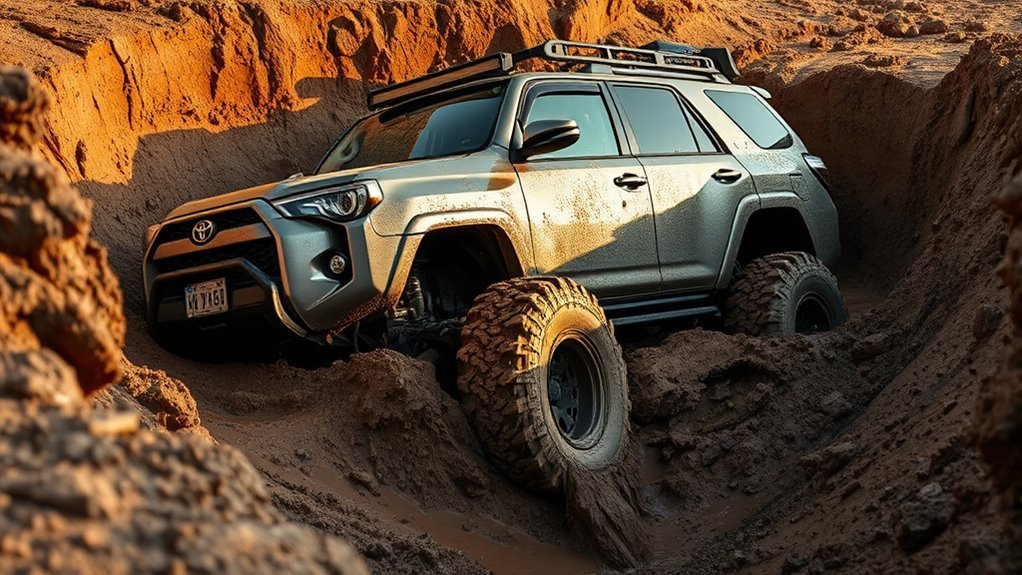
Your 4Runner can be excellent in mud, but traction does not come from tires alone. The best results come from matching the tire to the mud, lowering pressure safely for the trail, using 4L or traction systems when equipped, keeping steady momentum, and carrying recovery gear before the ruts get deep.
Quick Answer
For better 4Runner mud traction, use tires with open shoulder blocks and wide voids, air down only for low-speed trail use, choose 4H or 4L before you lose momentum, and let A-TRAC, Multi-Terrain Select, Crawl Control, or the rear locker help when equipped. Reinflate before pavement.
Key Takeaways
- Mud-terrain tires give the strongest bite in deep, sticky mud, but they are louder and less efficient for daily highway use than most all-terrains.
- Airing down can improve flotation and grip, but it is a trail-only move. Use a gauge, avoid high speed, and air back up to the door-placard pressure before pavement.
- Wide voids, open shoulders, and strong tread blocks matter more in mud than tiny siping alone.
- 4L, A-TRAC, Multi-Terrain Select, Crawl Control, and rear lockers vary by model year and trim, so know your own controls before the trail.
- Recovery boards, a shovel, a compressor, and rated recovery gear are not optional once the mud gets deep.
At a Glance
| Time Required | 15-30 minutes for trail setup; tire selection and installation are separate jobs. |
| Difficulty | Moderate. The technique is simple, but mud recovery can become dangerous fast. |
| Tools Needed | Tire gauge, tire deflator, portable compressor, shovel, traction boards, gloves, recovery strap, and rated recovery hardware. |
| Cost | Low if you are only adjusting pressure and technique; much higher if you are upgrading to new A/T, R/T, or M/T tires. |
Why Your 4Runner Struggles in Mud: It Is Not Just the Tires
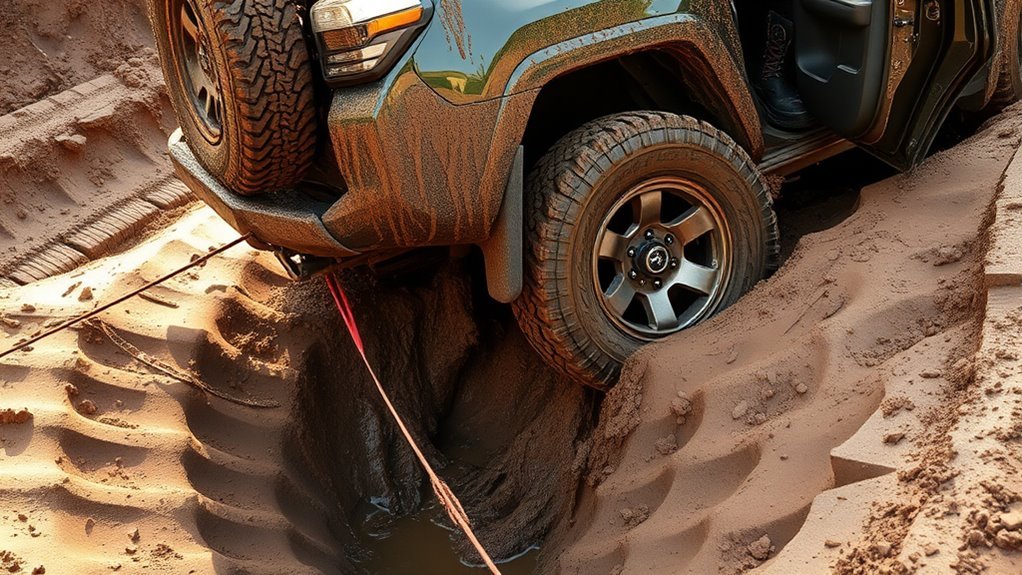
When a 4Runner starts losing steam in mud, tires are only one part of the story. Mud punishes weight, throttle control, clearance, and line choice all at once. Even a strong tire can pack with clay if you spin it too fast or bury the tread before it has a chance to clean itself.
Ground clearance and body angles set hard limits. Toyota lists 2024 4Runner ground clearance from 9.0 to 9.6 inches depending on trim, with approach/departure angles of 30/26 or 33/26 degrees. Toyota also says the 2026 4Runner offers up to 10.1 inches of ground clearance on select configurations. That means deep ruts, raised centers, and buried diffs can stop the truck even when the engine still has plenty to give.
Note: 4Runner equipment changes by year and trim. A 2010-2024 TRD Off-Road does not have the same control layout as a 2025+ 4Runner, and not every 4Runner has a rear locker, A-TRAC button, Crawl Control, or Multi-Terrain Select.
Technique matters just as much as hardware. Stabbing the throttle usually polishes the mud into a slick layer. Sawing the wheel digs the front tires into the rut walls. Loading the cargo area unevenly can also reduce bite at the tires that need it most.
Before blaming the rubber, check these basics:
- Line choice: Avoid the deepest center of the rut when there is a safe shoulder or firmer base nearby.
- Momentum: Use steady, controlled speed. Too slow can bog the truck; too fast can break traction or damage parts.
- Throttle: Keep it smooth. Wheelspin usually means you are digging, not moving.
- Clearance: Watch the belly, skid plates, rear diff, hitch, and running boards.
- Load: Secure heavy gear and avoid overloading the rear or roof.
Tread Pattern Deep-Dive: Void Spaces That Fling Mud Free
Mud is a tire’s worst enemy when it packs solid between tread blocks. Once the voids fill, even aggressive rubber starts acting like a slick. That is why mud-terrain tires focus on open tread, large lugs, and shoulder channels.
A tire such as the BFGoodrich Mud-Terrain T/A KM3 uses large tread blocks and mud-release features designed to shed compacted mud. Toyo’s Open Country M/T uses open, scalloped shoulder blocks that help eject mud and snow through the channels. The theme is the same: give the mud somewhere to go.
In mud, the best tread is not the one with the most lines. It is the one that keeps clearing itself so the next lug can bite clean ground.
Look for these tread traits if mud is a real priority:
- Wide voids: The open spaces between lugs help throw mud out as the tire rotates.
- Open shoulders: Shoulder channels help the tire claw sideways and release packed muck.
- Strong tread blocks: Firm blocks hold their shape under torque instead of folding over.
- Sidewall lugs: Extra sidewall bite can help in ruts where the tire shoulders rub the walls.
- Correct load range: A heavy-duty tire can take abuse, but too stiff a tire may need more careful pressure tuning off-road.
Wide Blocks vs. Deep Sipes: Matching Tire Features to Mud Type
Not all mud behaves the same. Soupy mud asks for flotation and self-cleaning. Sticky clay asks for tread that can shed packed material. Rutted mud asks for sidewall strength, shoulder bite, and careful steering. That is why tire choice should match your real terrain, not just the most aggressive sidewall photo.
[Products Worth Considering]

Measure tyre tread depth precisely with a digital gauge that reads in both MM and inches, helping you monitor safe driving conditions. The large LCD screen is easy to operate, and the compact tool fits for cars, trucks, and motorcycles. It provides high accuracy with a 0-25.4mm range and includes a 1-year warranty for added peace of mind.
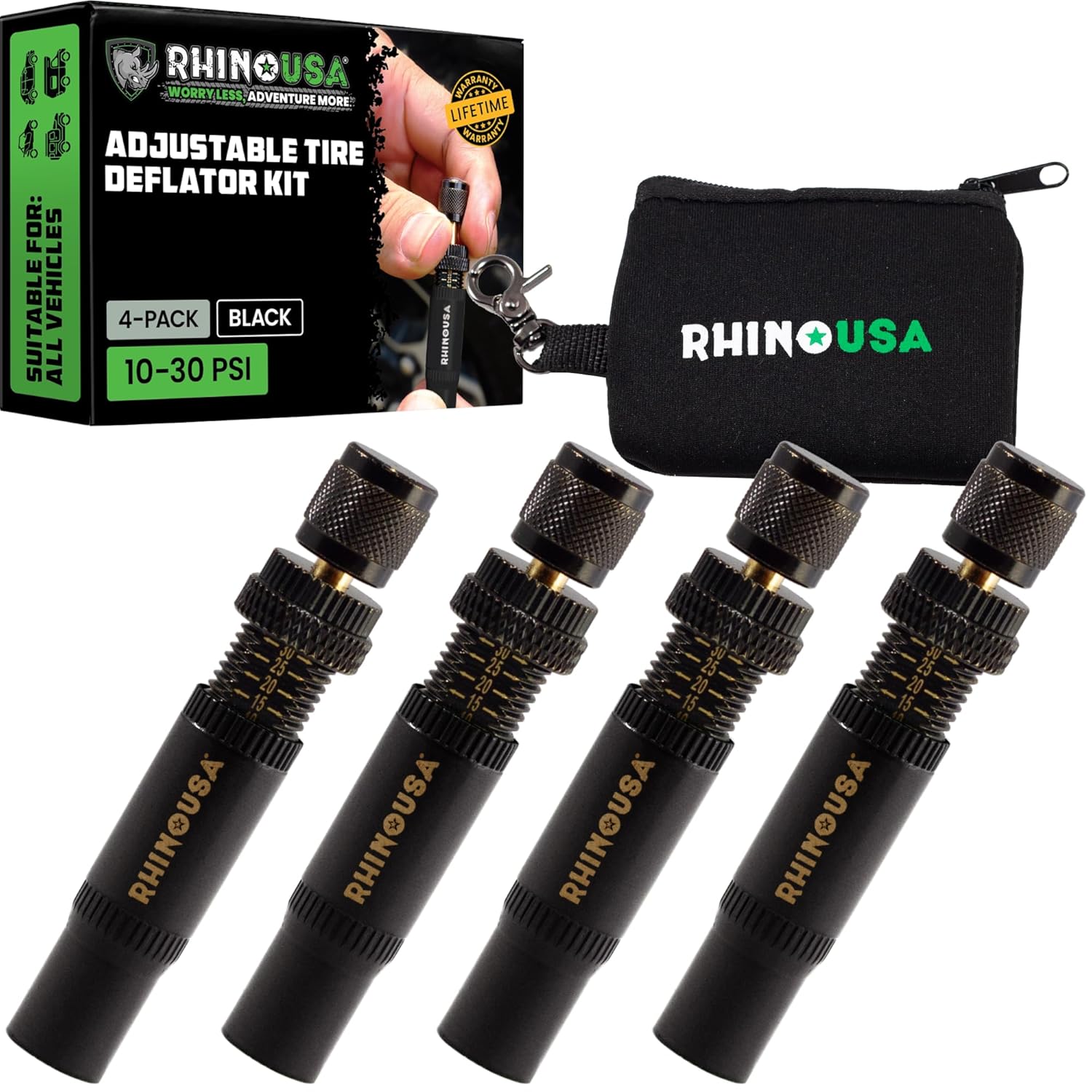
Use the Rhino USA adjustable tire deflators to air down all four tires at once by screwing one deflator onto each valve stem, letting you step away while the tires reach your preset pressure. Each deflator independently adjusts across a 10–30 PSI range with laser-etched indicators for quick setup and verification, making it ideal for beach, sand, and rocky off-road trails.

This ALL-TOP auto-stop tire deflator valve kit lets you air down off-road tires quickly without watching pressure, automatically stopping when your preset PSI is reached. Each valve is individually calibrated for reliable performance with an acceptable +/- 2 PSI tolerance. The adjustable deflator range covers 10 to 30 PSI and includes four valves plus valve caps and a zipper pouch for easy setup on trucks, SUVs, RVs, UTVs, and powersports.
Wide Block Design
Wide, open blocks work best when the mud is deep and loose. They spread the load, maintain a larger contact patch when aired down correctly, and leave room for mud to exit the tread.
| Feature | Mud Benefit |
|---|---|
| Wide voids | Clears packed mud from the tread |
| Open shoulders | Adds side bite in ruts |
| Rigid tread blocks | Maintains bite under torque |
| Sidewall lugs | Helps climb out of rut walls |
Deep Sipe Function
Sipes are the small cuts in tread blocks. They can help on wet pavement, light snow, and slick surfaces, but they are not a magic mud solution. In thick mud, void space and shoulder evacuation usually matter more than tiny cuts.
That does not make siping useless. Toyo notes that deep siping in the Open Country M/T helps maintain grip on wet surfaces. The key is balance: a tire with some siping can be friendlier in rain, while a tire with more open shoulders and voids will usually clean better in mud.
Pro Tip: If your 4Runner sees mostly pavement, gravel, and occasional muddy trailheads, a quality all-terrain or rugged-terrain tire may be smarter than a full mud-terrain. If it regularly sees deep clay, ruts, and slow trail work, a true M/T makes more sense.
All-Terrain vs. Rugged-Terrain vs. Mud-Terrain Tires
This is where many 4Runner owners overspend or underbuy. The right tire is the one that matches how often you actually see mud.
- All-terrain tires: Best for daily drivers that see gravel, snow, forest roads, and occasional mud. Toyota lists 33-inch Toyo Open Country A/T III tires on 2026 TRD Pro and Trailhunter trims, and Toyo describes the A/T III as an all-terrain tire with on-road stability and off-road traction.
- Rugged-terrain or hybrid tires: A middle ground. These usually have more open shoulders than an A/T but better road manners than a full M/T.
- Mud-terrain tires: Best for repeated deep mud, ruts, rocks, and trail abuse. Expect more noise, more rolling resistance, and more compromise on wet pavement or ice than a road-focused tire.
Do not call every aggressive tire a mud tire. The Toyo Open Country A/T III is an all-terrain. The Toyo Open Country M/T is the mud-focused tire. The BFGoodrich Mud-Terrain T/A KM3 is a true mud-terrain. That distinction matters when you are comparing noise, tread life, and real mud performance.
[Products Worth Considering]

Keep your tires properly inflated with this analog VONDIOR tire pressure gauge, designed for fast, easy readings without batteries. The swiveling, two-axis hose and large glow dial help you measure at any tire angle with instant visibility. Built with a protective rubber shield, it supports durable, low-maintenance use for cars and trucks.

Measure tire tread depth quickly and accurately with this LUMITECO dial gauge that reads in 1/32" increments up to 14/32". The color-coded green/yellow/red zones make it easy to judge tire wear and know when replacement is needed. A rugged, compact design with a protective pouch helps keep the gauge ready for use on cars, trucks, motorcycles, and more.

This heavy-duty tire pressure gauge combines measurement, inflation, and deflation in one compact tool for quick roadside and garage use. Its dual-head chuck helps reach inner and outer dual-wheel positions, while the clear indicator bar makes readings easy to see. Built for durability, it supports a wide pressure range and works across cars, trucks, RVs, SUVs, and motorcycles.
The Daily-Drive Tradeoff: Can You Live With Mud Tires Full-Time?
You can daily-drive mud-terrain tires, but you should be honest about the trade. Big tread blocks and wide voids that work in mud are not optimized for quiet commuting. Tire Rack describes all-terrain tires as built for comfort, stability, and smooth on-road use, while off-road maximum traction tires like the KM3 focus on toughness and traction first.
Road Noise Levels
Mud-terrain tires usually hum more on the highway because their large tread blocks slap the pavement with more air space between them. Some modern M/Ts are more livable than old-school designs, but “acceptable” road noise is still not the same as “quiet.”
If you commute every day and only hit mud a few weekends a year, a strong all-terrain or hybrid tire may give you a better balance. If mud is part of your normal trail life, the noise may be worth the grip.
Tread Wear Rates
Mud tires can wear unevenly if you ignore rotation, alignment, and inflation. They also tend to be heavier, which can affect acceleration, braking feel, and fuel economy. The more aggressive the tread, the more important your maintenance habits become.
Keep a simple routine:
- Rotate on schedule.
- Check pressure when tires are cold.
- Inspect sidewalls after every muddy trail.
- Clean packed clay from wheels, brakes, and suspension.
- Rebalance if vibration appears after mud use.
4Runner Owner Reports: Real Upgrades, Real Regrets, Real Traction Gains
The most common win is simple: owners who move from mild highway tires to a better all-terrain, rugged-terrain, or mud-terrain usually notice more bite in loose terrain. The most common regret is just as simple: buying the most aggressive tire available when the truck spends 90 percent of its life on pavement.
For a practical 4Runner setup, think in tiers:
- Daily driver with occasional mud: Quality A/T tire, compressor, gauge, shovel, and recovery boards.
- Weekend trail rig: Aggressive A/T or hybrid R/T tire, stronger sidewalls, recovery strap, rated shackles, and skid-plate awareness.
- Frequent mud and ruts: True M/T tire, careful pressure tuning, recovery gear, and a plan for cleaning brakes and underbody parts afterward.
Also remember that bigger is not automatically better. Oversized tires can rub, reduce clearance in the wheel well, stress driveline parts, change speedometer accuracy, and make the spare tire situation more complicated. Mud traction improves when the whole setup works together, not when one part is chosen for looks alone.
Airing Down for Mud Without Creating a New Problem
Airing down helps because it lengthens the contact patch and lets the tire flex over uneven ground. For mud, a general low-speed trail range is often around 15-20 PSI, depending on mud depth, tire construction, wheel size, vehicle weight, and speed. Use that as a starting point, not a rule carved into the sidewall.
Warning: Do not drive highway speeds on aired-down tires. Low pressure can create heat, poor handling, bead unseating, tire damage, or failure. Air back up to the cold tire pressure listed on your vehicle’s door placard before returning to pavement.
Use this safe process:
- Check your normal cold pressure before leaving pavement.
- Stop in a safe, flat area before the muddy section.
- Air down evenly with a gauge, not by guessing.
- Drive slowly and avoid sharp steering inputs that can unseat a bead.
- Recheck pressure after the obstacle if the trail continues.
- Use a compressor to reinflate before road driving.
When Tires Are Not Enough: 4L, A-TRAC, MTS, Lockers, and Recovery Essentials
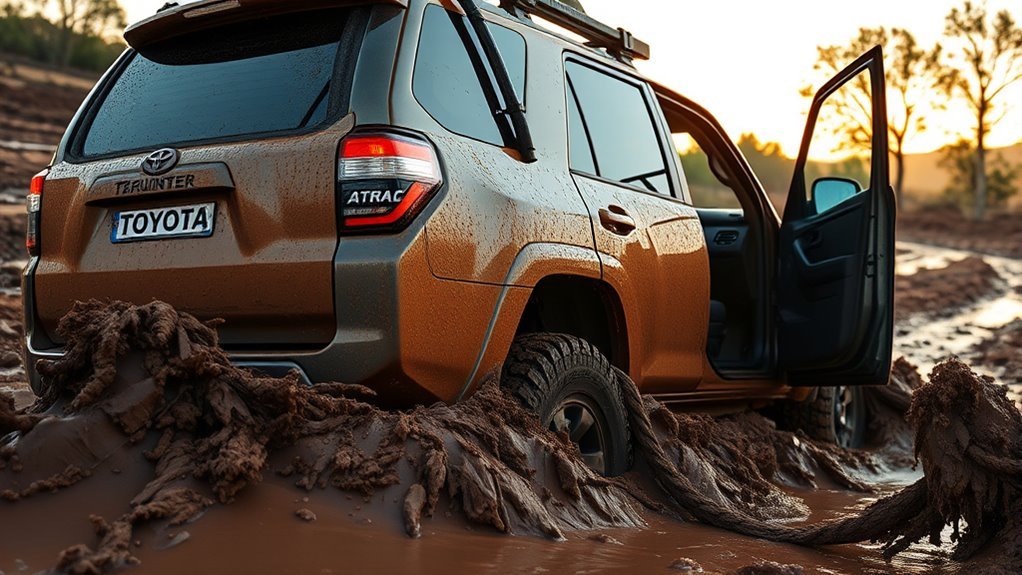
Even great tires have limits. When ruts deepen and clay turns slick, use the 4Runner’s mechanical advantage instead of trying to blast through.
On 2010-2024 4Runner 4WD models, Toyota’s part-time 4WD system uses H2, H4, and L4 on applicable trims. Toyota says L4 is for driving slowly or trekking over difficult terrain. The 2024 brochure also lists Active Traction Control (A-TRAC), Crawl Control, Multi-Terrain Select, and locking rear differential availability by trim, so do not assume your truck has every feature.
On 2025+ 4Runners, the control set changed. Toyota’s 2026 TRD Off-Road listing includes Multi-Terrain Select with Crawl Control, while TRD Pro and Trailhunter are shown with 33-inch Toyo all-terrain tires. The practical advice is the same: learn your exact buttons before you are axle-deep.
[Products Worth Considering]

The SAFELIFE dial tire tread depth gauge measures tread depth in 1/32 inch increments with clear, easy-to-read 2-inch dial face. Color zones using a traffic light system help you quickly judge whether tread is low, marginal, or ample for safer driving. Built with a durable zinc cast body and a metal detect probe for precise, comfortable use across cars, motorcycles, trucks, and buses.
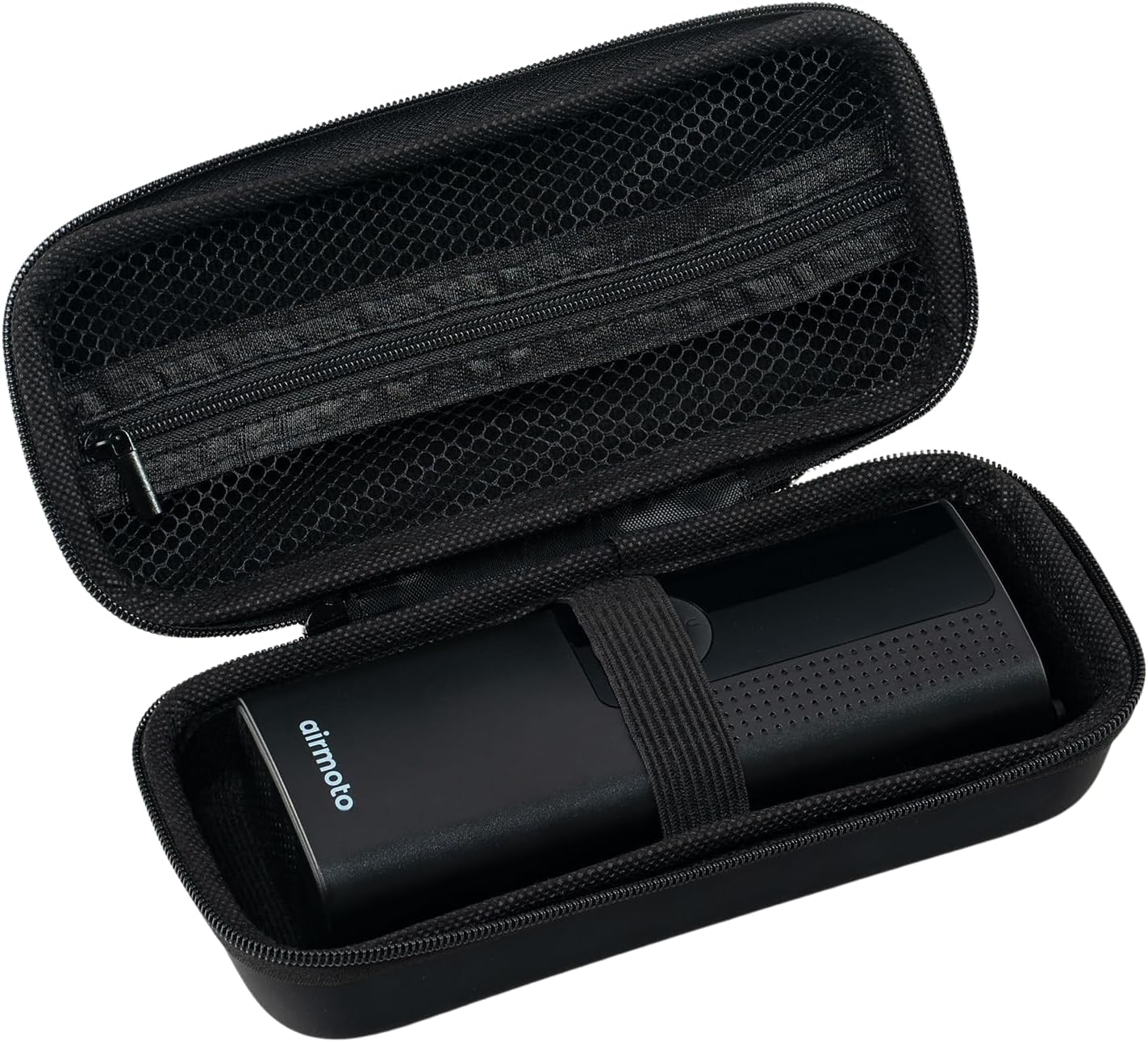
Protect and organize your Airmoto tire inflator with a purpose-designed carrying case made for a precise fit. The durable polyurethane shell and soft interior help guard against cuts, tears, and road wear, while a mesh pocket stores connectors and accessories. This travel box measures 7.5*3.5*2.8 inches and can work with most handheld portable air compressor models; this listing includes the case only.

This all-in-one air compressor accessories kit includes a tire inflator with gauge for car tires and a combined air chuck setup for easier inflation. It also features a durable 1/4 inch polyurethane air hose for connecting compressors to air tools, plus a heavy-duty blow gun and industrial hose fittings for cleaning and routine projects. Ideal for keeping your air system ready for inflating, cleaning, and quick-connect tool use.
Which Mode Should You Use in Mud?
- 4H: Use for loose, shallow, or faster muddy roads where you need more traction but still need some wheel speed.
- 4L: Use for deep ruts, slow crawling, heavy resistance, or controlled recovery. It gives more torque control at low speed.
- A-TRAC, if equipped: Helps limit wheelspin and improve traction on slippery surfaces.
- Multi-Terrain Select, if equipped: Choose the terrain mode that best matches mud, sand, or loose ground.
- Crawl Control, if equipped: Useful for slow, controlled progress when throttle modulation is difficult.
- Rear locker, if equipped: Helps both rear wheels turn together, but use it carefully and only where appropriate. It can widen your turning radius and should not be used on high-traction pavement.
Step-by-Step Mud Driving Technique
- Stop and read the mud first. Look for depth, ruts, hidden rocks, water flow, and a safe exit.
- Pick the straightest clean line. Avoid sharp turns in the deepest section.
- Select the mode before entering. Do not wait until the truck is buried.
- Build gentle momentum. Enter smoothly and avoid sudden throttle spikes.
- Let the tires clean. A little wheel speed can help clear tread, but uncontrolled spinning digs holes.
- Steer lightly. Small left-right inputs can help the lugs find edges, but sawing the wheel kills speed.
- Back out early if progress stops. Spinning until the frame sits on mud turns a simple recovery into a long one.
Recovery Essentials
Carry recovery gear before you need it. At minimum, pack:
- Portable air compressor
- Accurate tire gauge
- Tire deflator
- Shovel
- Traction boards
- Gloves
- Rated recovery strap
- Rated shackles or soft shackles
- Known recovery points on your vehicle
Warning: Never recover from a weak tie-down loop, hitch ball, bumper cover, or unrated hardware. Failed recovery gear can become a projectile. Use rated recovery points and keep bystanders clear of the recovery line.
Frequently Asked Questions
Are 4Runners good for mudding?
Yes, a 4Runner can be very capable in mud when it has the right tires, correct pressure, controlled throttle, and the proper 4WD mode selected. TRD Off-Road, TRD Pro, and Trailhunter-style setups add useful trail hardware, but driver technique and recovery preparation still matter.
How do I get better traction in mud with a 4Runner?
Use tires with open voids and shoulder bite, air down safely for low-speed trail use, select 4H or 4L before entering the mud, keep steady momentum, and avoid excessive wheelspin. If equipped, use A-TRAC, Multi-Terrain Select, Crawl Control, or the rear locker where appropriate.
Should I use 4H or 4L in mud?
Use 4H for shallow, loose, or faster muddy roads where momentum matters. Use 4L for deep ruts, slow crawling, heavy suction, steep sections, or recovery situations where you need more torque control and less speed.
What PSI should I run in mud?
For low-speed trail use, many drivers start around 15-20 PSI in mud, then adjust for tire construction, wheel size, mud depth, vehicle load, and speed. Do not use aired-down pressure on the highway. Reinflate to the vehicle’s recommended cold tire pressure before pavement.
Are mud-terrain tires bad for daily driving?
They are not “bad,” but they are a compromise. Mud-terrain tires usually create more road noise, weigh more, and can feel less refined than all-terrain tires. If your 4Runner spends most of its life commuting, an all-terrain or hybrid tire may be the better full-time choice.
Is the Toyo Open Country A/T III a mud tire?
No. The Toyo Open Country A/T III is an all-terrain tire. It can handle light mud and mixed trail use, but Toyo’s Open Country M/T is the mud-focused option in that lineup.
Conclusion
Better mud traction is not one magic upgrade. It is the combination of a tire that can clean itself, pressure that suits the trail, smooth throttle, smart 4WD mode selection, and recovery gear ready before the truck is stuck. Choose mud-terrain tires if your 4Runner truly lives in ruts and clay. Choose a strong all-terrain or hybrid tire if you need daily comfort with occasional mud confidence.
The goal is not to spin harder. The goal is to keep the tread biting, the truck moving, and the recovery strap packed away.
Sources
- Toyota 2024 4Runner eBrochure — 4WD modes, A-TRAC availability, ground clearance, approach/departure angles, Crawl Control, and trim equipment.
- Toyota 2026 4Runner Official Page — current 2026 trim equipment, ground-clearance claim, MTS with Crawl Control, and 33-inch Toyo all-terrain tire references.
- NHTSA TireWise Tire Safety — cold tire pressure and tire placard safety guidance.
- America’s Tire: How to Air Down Tires — off-road airing-down process, mud PSI range, and reinflation warnings.
- BFGoodrich Mud-Terrain T/A KM3 — mud-terrain tread design and mud-release features.
- Toyo Open Country M/T — mud-terrain features including open shoulder blocks, deep siping, and mud/snow evacuation channels.

![[2026NEW] 5000A Jump Starter with Air Compressor (150PSI)](https://m.media-amazon.com/images/I/71oG4PFNsmL._AC_SL1500_.jpg)