Polyurethane Foam Filled Tires: Benefits & Limitations
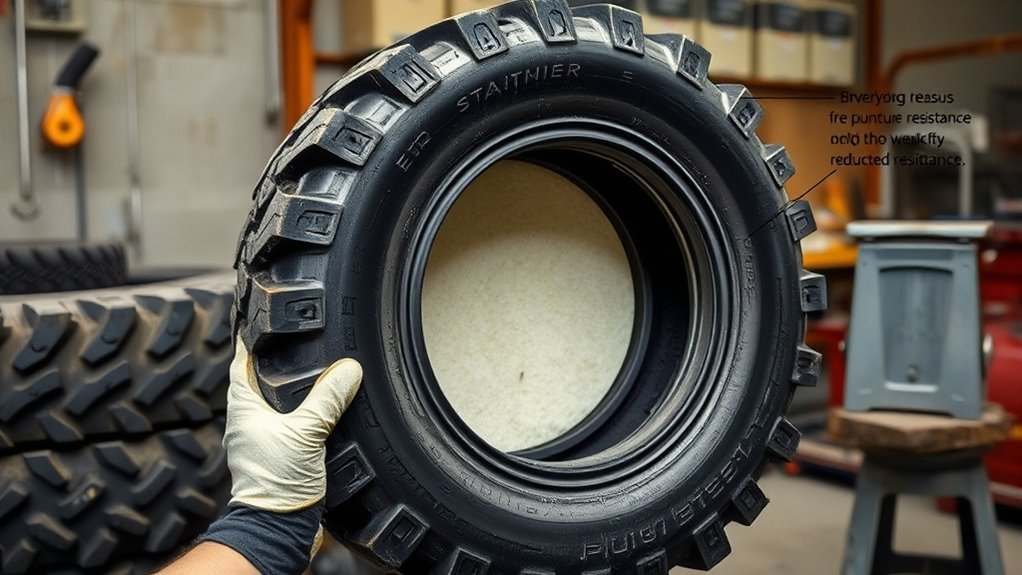
You should consider polyurethane foam‑filled tires when uptime, puncture resistance, and load stability outweigh ride softness and low weight. A liquid PU compound is injected and cured into a closed‑cell foam that supports loads, dampens vibration, and eliminates flats without pressure checks. Trade‑offs include higher unsprung mass, firmer ride, thermal sensitivity, and complex repairs requiring specialized service. They’re ideal for heavy, debris‑ridden or indoor handling fleets; continue for a deeper operational and cost analysis.
Who Should Consider Foam-Filled Tires
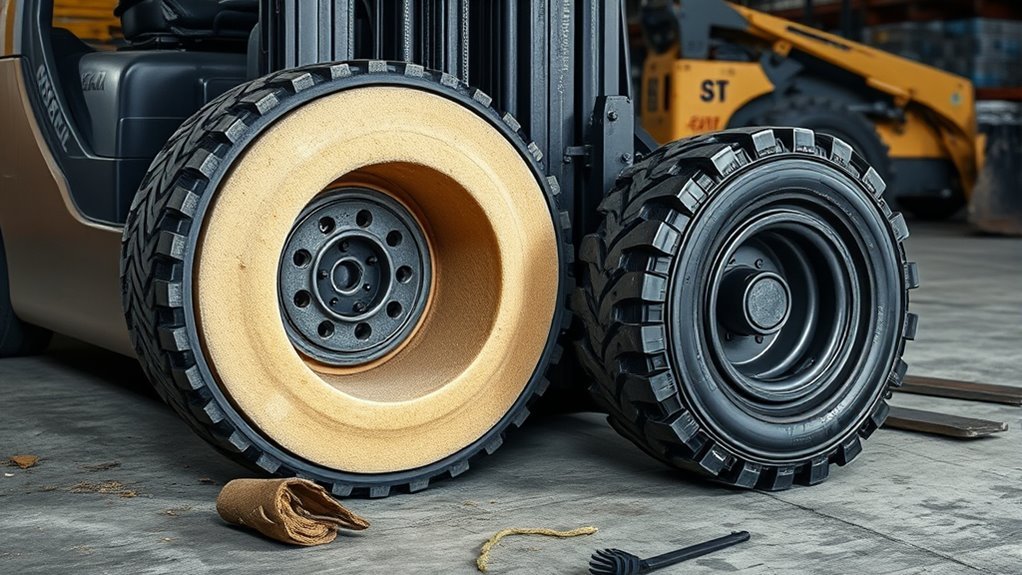
Who needs foam-filled tires? You do if your user needs prioritize uptime, load security, and operator safety in abrasive settings. In construction, mining, recycling, and similar sectors defined by sharp debris and uneven terrain, foam-filled tires address industry trends toward resilience and reduced service intervals. You’ll benefit when puncture resistance translates to fewer unexpected stops, lower maintenance overhead, and predictable fleet availability. If you run heavy loads or equipment exposed to frequent vibration—think aerial work platforms, telehandlers, forklifts—foam filling improves stability and shock damping, enhancing operator control and comfort. Assess total cost of ownership: the capital outlay is higher, but lifecycle analyses often show net savings from extended tire life and diminished replacement frequency. For mission-driven operators seeking operational freedom and fewer constraints from equipment failures, foam-filled tires align technical performance with liberated workflow. Prioritize them where reliability, reduced downtime, and consistent load capacity are non-negotiable.
How PU Foam Filling Works and Why It Prevents Punctures
Having established when foam-filled tires make sense, it helps to understand how polyurethane filling actually works and why it eliminates punctures. You inject a liquid polyurethane compound into the tire cavity; it cures to a dense, continuous foam that replaces the air column. The cured foam preserves external tire geometry and flex while creating a solid medium that arrests puncture propagation.
- Foam characteristics: closed-cell density and elasticity determine load support and shock absorption.
- The cured core distributes load across the casing, reducing local stress concentrations that permit cuts.
- Puncture mechanics change: sharp objects no longer create a pressure-loss pathway because the foam displaces air and mechanically blocks penetration.
- In hazardous sites, the foam core sustains structural integrity under repeated impacts, preventing sudden deflation.
You gain predictable ride stability and puncture immunity without relying on pressure maintenance, freeing you from frequent tire repairs in demanding environments.
Performance Trade-Offs: Ride, Weight, and Heat
Although foam filling eliminates flats, it forces trade-offs in ride dynamics, vehicle weight, and heat management that you need to account for. You’ll notice reduced ride quality because the foam adds mass and limits tire compliance; the tire no longer contributes to suspension the way air does. That mass alters weight distribution across axles, which can affect flotation and handling margins, and in some installations—especially when only fronts are filled—the change may be marginal. Cold temperatures further stiffen the compound, worsening comfort on long runs. Thermal buildup is more contained in a non-flexing carcass, so you must monitor operating temperatures during sustained high loads to avoid accelerated wear or internal degradation. Changing a foam-filled tire is more complex because residual material can adhere to rims; plan service procedures accordingly. You’ll trade puncture immunity for predictable, engineered compromises in dynamics, load capacity, and thermal management—know them and design around them.
Best Applications for Foam-Filled Tires
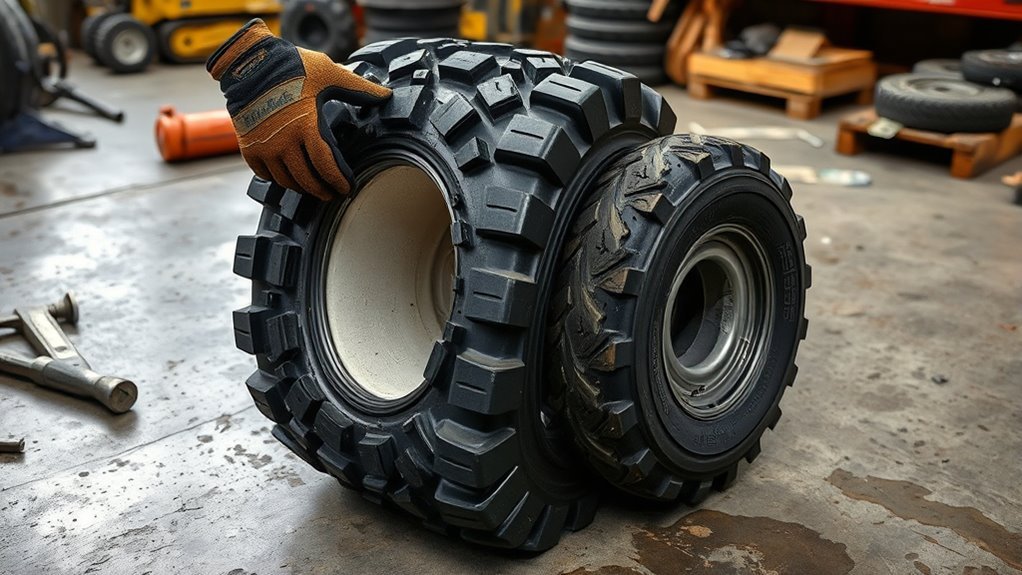
You’ll find foam-filled tires excel where puncture resistance and downtime reduction are priorities, such as heavy-duty construction sites exposed to sharp debris. They’re also ideal for indoor material-handling equipment that needs stable, maintenance-free operation without the risks of flats. In mining and quarry operations their enhanced load capacity and durability extend tire life and maximize fleet uptime.
Heavy-Duty Construction Sites
When your crew operates amid rebar, nails, and other sharp debris, foam-filled tires virtually eliminate punctures and the downtime that follows, delivering consistent stability and higher load-bearing capacity for heavy machinery on uneven terrain. You’ll gain puncture resistance that stops flats before they start and stability enhancement that improves traction and control under load. Foam fill removes inflation checks, lowering maintenance tasks and idle time. Expect extended service life in abrasive environments, turning higher upfront cost into measurable lifecycle savings. You’ll free your fleet from recurring flat-related expenses and keep projects moving without reactive tire changes.
- Unmatched puncture resistance for jobsite hazards
- Improved load-bearing and stability enhancement
- Maintenance-free operation reduces downtime
- Longer service life maximizes investment
Indoor Material-Handling Equipment
For indoor material-handling equipment, foam-filled tires deliver puncture-proof reliability and maintenance-free operation that keep forklifts, pallet jacks, and order pickers running through busy shifts without inflation checks or unexpected downtime. You’ll get puncture resistance for debris-prone warehouses, non-marking compounds to protect floors, and shock absorption that reduces operator fatigue. Prioritize tire selection that balances load capacity and ride comfort to maximize operational efficiency and extend service life, lowering replacement costs and boosting uptime. Embrace these tires to free your crew from routine inflation tasks and to maintain clean, safe aisles. Visualize equipment performance:
| Forklifts | Pallet Jacks | Order Pickers |
|---|---|---|
| High load | Tight turns | Elevated reach |
| Durable | Compact | Operator comfort |
Mining And Quarry Operations
In mining and quarry operations, foam-filled tires deliver puncture-proof reliability and higher load capacity so your equipment keeps moving through debris-strewn, uneven terrain. You’ll gain continuous operation thanks to unmatched puncture resistance and a solid foam core that boosts load-bearing capacity and stability on rugged ground. They cut downtime, lower maintenance costs, and sustain consistent performance under harsh conditions. Operator comfort improves through reduced vibration and shock, which supports sustained productivity.
- Improved uptime by eliminating flats and related repairs
- Enhanced stability for heavy loads on uneven surfaces
- Reduced operator fatigue via vibration damping
- Consistent performance across temperature and terrain
Follow strict safety protocols during tire selection and installation so your liberated workforce operates efficiently and without compromise.
Cost vs. Lifetime Savings for Fleets
You’ll need to weigh the upfront investment—typically about $150 per tire, though some large tires can be filled for as little as $20—against measurable reductions in downtime and repair labor. Foam filling cuts maintenance events and flat-related replacement costs, directly lowering operating expenses and improving uptime. When you calculate total cost of ownership across vehicle life in high-puncture environments, the long-term savings usually justify the higher initial outlay.
Upfront Investment Impact
Although foam-filled tires carry a higher upfront price—roughly $150 per tire and more for larger sizes—fleets can recoup that investment through reduced flats, fewer replacements, and less unscheduled downtime. You’ll weigh initial cost against measurable long term savings: fewer tire swaps, reduced labor, and sustained operational tempo in harsh environments. This choice liberates your fleet from recurrent puncture disruptions and stabilizes budgeting.
- Calculate payback by comparing replacement frequency before and after filling.
- Factor in reduced downtime costs per hour and per vehicle.
- Model service life extension versus conventional tires under your duty cycle.
- Adjust decision thresholds for vehicles with high exposure to puncture risk.
Be pragmatic: prioritize assets where durability returns outweigh initial expenditure.
Maintenance Cost Reduction
Shifting focus from upfront investment, consider how foam-filled tires cut recurring maintenance expenses across a fleet. You’ll run a targeted cost analysis: a one-time foam fill (~$150 per tire) eliminates frequent flat repairs, blowouts, and pressure checks that drive labor and parts spend. That reduction in unplanned downtime boosts operational throughput and frees crews for productive work, aligning with a liberation-focused operational mindset. Because foam enhances tire longevity under harsh conditions, you’ll extend service intervals and defer replacement capital. Calculate savings by comparing repair frequency, labor hours lost to flats, and replacement cycles between pneumatic and foam-filled units. The result: predictable maintenance budgets, fewer emergency interventions, and measurable savings that validate the initial expenditure through extended tire longevity.
Total Cost Of Ownership
When you compare upfront foam-fill costs (about $150 per tire, or as low as $20 for large-volume fills) to ongoing expenses from flats, repairs, and downtime, the lifetime economics typically favor foam in heavy-use fleets. You’ll perform a rigorous cost analysis and financial forecasting to quantify payback periods and net present value, factoring in fewer replacements, reduced maintenance labor, and minimized operational interruption. Foam-filled tires extend usable life in harsh conditions, converting a higher upfront spend into liberated, predictable operating budgets.
- Reduced downtime lowers indirect labor and opportunity costs.
- Fewer repairs cut parts, service, and logistical expenses.
- Extended tire life delays capital replacement cycles.
- Volume fills improve unit economics and shorten payback.
You’ll gain clearer fiscal control and operational freedom.
Maintenance and Repair Challenges With Foam-Filled Tires
Because the foam bonds to the rim and solidifies inside the tire, maintenance and repairs demand different tools and steps than pneumatic tires, and you’ll need to plan for those differences. You must prioritize tire longevity through scheduled inspections and precise damage assessment: inspect tread, sidewall, and foam interface for degradation or delamination that reduces load-bearing capacity. When replacement is required, you’ll face adhesive residues and cured foam that complicate bead seating and rim cleaning, so allocate time and solvent-compatible tools. Repairs aren’t simple—traditional patches and plugs fail against solid fill—so you should expect either re-filling with compatible polyurethane or full tire replacement. Filling requires specialized gear, often a hypodermic needle or dedicated dispense system, and trained personnel to control mix ratios and void elimination. If you operate mixed fleets, note inner tubes can be used only in non-foamed tires and introduce extra maintenance steps. Plan logistics, spare inventories, and trained technicians to maintain operational freedom and minimize downtime.
Foam-Filled vs Pneumatic vs Solid: Quick Comparison
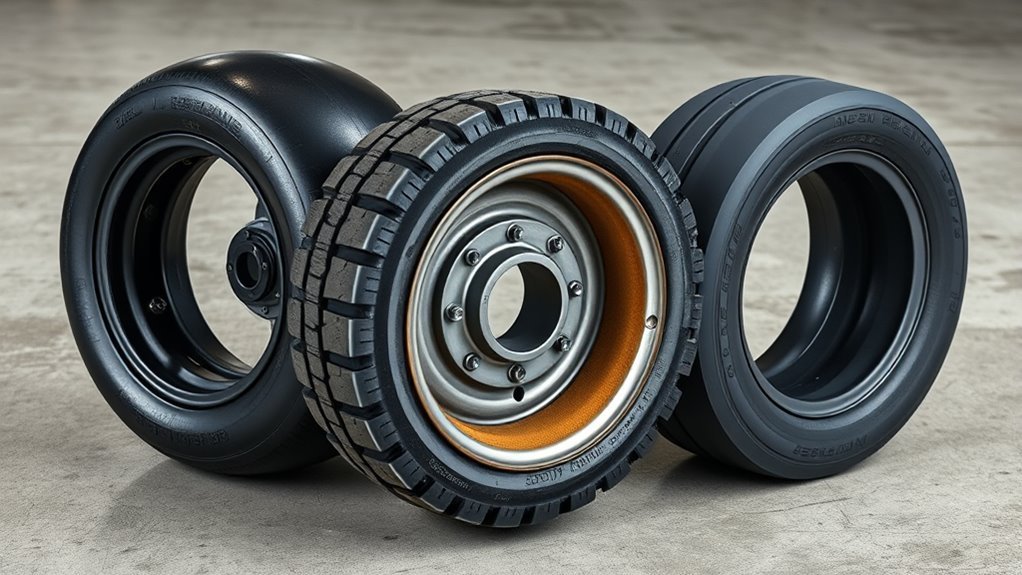
Although each tire type meets specific operational needs, choosing between foam-filled, pneumatic, and solid tires comes down to trade-offs in puncture resistance, ride comfort, durability, weight, and cost. You’ll evaluate tire technology through clear performance metrics: foam-filled tires eliminate flats and extend service life but add weight and stiffness; pneumatic tires maximize comfort and fuel efficiency but need frequent inspection and are puncture-prone; solid tires deliver rugged durability with minimal maintenance at the expense of ride quality.
- Foam-filled: superior puncture resistance, higher upfront cost, increased weight affecting handling and fuel use.
- Pneumatic: best ride comfort and lower weight, vulnerable to punctures and ongoing maintenance.
- Solid: durable, low-maintenance, harsh ride, moderate weight.
- Trade-off summary: prioritize mission-critical uptime and puncture immunity for foam-filled; choose pneumatic for comfort and efficiency; select solid for simple, rugged applications.
You’ll act with intention, choosing tire technology aligned with liberation-focused operational goals and quantifiable performance metrics.
Decision Checklist for Fleet Managers
Why prioritize foam-filled tires for certain assets? You’ll weigh Durability concerns against operational gains: foam filling (~$150 per tire) reduces downtime and repair frequency in debris-heavy sites, yielding savings over time. Check asset mission: prioritize loaders, forklifts, and site vehicles operating in construction, recycling, or demolition where puncture resistance matters.
Run this checklist before committing:
- Cost-benefit: quantify expected downtime reduction, compare to $150/tire initial outlay.
- Environment match: confirm frequent exposure to sharp debris or rough terrain.
- Ride quality impact: evaluate tolerance for a firmer, potentially rougher ride and any front/rear imbalance if only some tires are filled.
- Speed and application limits: exclude high-speed or highway vehicles where foam isn’t suitable.
- Maintenance logistics: guarantee access to specialized services for injection/removal and plan longer tire-change times.
Make decisions that free your operations from preventable stoppages while respecting performance and maintenance trade-offs.
Frequently Asked Questions
What Are the Disadvantages of Foam-Filled Tires?
You’ll face reduced tire performance—harsher ride, heavier weight hurting handling and fuel economy, heat‑related failures, higher upfront cost, and complicated replacements. Include a thorough cost analysis to weigh durability against operational drawbacks and freedom.
What Are the Pros and Cons of Polyurethane Foam?
You get superior puncture resistance, improved load stability, and lower downtime; you sacrifice ride comfort, increased weight considerations, and higher upfront cost. For durability comparison, expect longer life but a harsher, heavier operational feel.
Why Don’t We Use Foam-Filled Tires?
You don’t use foam-filled tires widely because cost considerations and performance factors harm everyday freedom: they add weight, reduce fuel efficiency, worsen ride comfort, limit high-speed safety, and complicate replacement despite puncture resistance.
Conclusion
If you manage equipment that demands uptime, foam-filled tires can be a smart, cost-effective choice—like trading a risk of punctures for predictable maintenance. You’ll sacrifice a bit of ride comfort, add weight, and monitor heat buildup, but you’ll gain fewer flats and less downtime. Weigh initial cost against reduced replacement frequency and labor. In short, choose foam when reliability and operational continuity matter more than peak ride performance.
Related Articles
Valve Stem Length Guide: Choose the Right Size
I need to explain how to choose and extend valve stems for deep-section rims—discover which lengths, types, and tricks prevent leaks and broken cores.
Read More
Trailer Tire Pressure Guide: Load-Based PSI Recommendations
Guide your trailer’s tire inflation by matching load-per-tire to manufacturer charts—discover the step-by-step math, charts, and troubleshooting ahead.
Read More
Tire Pressure for Sand Driving: PSI Tips for Beach & Dunes
Discover how to safely lower tire pressure for sand driving—12–18 PSI guidance, tools, and step-by-step tips await to keep you rolling.
Read More