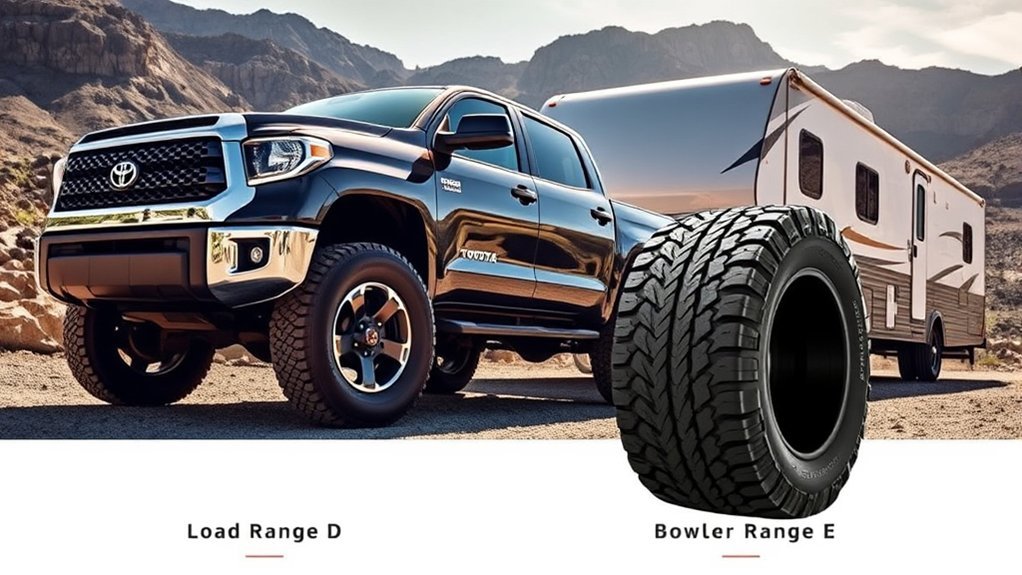
Choosing between Load Range D and E tires for your Toyota Tundra is not as simple as checking the trailer’s total weight. The correct tire must match your truck’s approved size, load rating, wheel limits, inflation requirements, and actual axle loads. A higher load range can provide additional capacity in some tire sizes, but it cannot increase the Tundra’s factory payload or towing limits.
Quick Answer
Choose Load Range D or E by matching the exact tire’s size, load index, and cold-pressure capacity to your Tundra’s door placard, axle loads, and owner’s manual. E-rated tires are not automatically required above a certain trailer weight, and they do not increase the truck’s payload, GAWR, GVWR, or tow rating.
Key Takeaways
- No universal trailer-weight cutoff determines whether your Tundra needs Load Range D or E tires.
- The exact tire’s load index and maximum load are more useful than the load-range letter alone.
- Use the Tundra’s tire placard or approved manufacturer data to set cold pressure. Do not use an arbitrary 40 or 80 PSI setting.
- Load Range E may provide more load reserve in a suitable size, but it may also add weight or firmness.
- Installing stronger tires does not raise Toyota’s payload, axle, hitch, or towing ratings.
Understanding Load Range D vs E Tires
Load range describes a tire’s strength and load-pressure classification. It does not tell you, by itself, the exact number of pounds the tire can carry. That information comes from the tire’s load index, maximum-load marking, and manufacturer load-and-inflation data.
Load Range E is a higher classification than Load Range D within comparable light-truck tire systems. However, two E-rated tires in different sizes can have different load indexes, maximum loads, permitted pressures, weights, and constructions. You must evaluate the complete tire specification rather than relying on the letter alone.
Note: Load range is sometimes described using historical “ply rating” terminology. It does not necessarily equal the physical number of casing plies inside a modern radial tire. Actual construction varies by brand and tire model.
| Factor | Load Range D | Load Range E | What You Should Check |
|---|---|---|---|
| Load class | Lower than E within a comparable LT system | Higher than D within a comparable LT system | Exact load index and maximum load |
| Maximum pressure | Varies by size and tire design | Varies by size and tire design | Sidewall limit and manufacturer load table |
| Actual plies | Not defined by the D letter alone | Not defined by the E letter alone | Manufacturer construction details |
| Ride quality | May be lighter or more compliant in some comparisons | May be heavier or firmer in some comparisons | Tire weight, size, casing, tread, pressure, and vehicle load |
| Best choice | When it meets or exceeds the required capacity and approved fitment | When its added capacity or construction is genuinely required | Placard, manual, axle weights, wheel rating, and operating conditions |
Start With Your Tundra’s Placard and Weight Limits
Before comparing tire letters, check the Tire and Loading Information label on the driver’s door area and the certification label. You should also consult the correct model-year document through the Toyota Owners manuals portal.
Record the following information before shopping:
- The original or Toyota-approved tire size
- The required load index or original tire load capacity
- The required speed rating
- The recommended cold tire pressure
- The truck’s payload limit
- The front and rear Gross Axle Weight Ratings, or GAWR
- The Gross Vehicle Weight Rating, or GVWR
- The Gross Combined Weight Rating and applicable trailer rating
- The wheel’s approved size, load capacity, and pressure limit
USTMA replacement guidance recommends using tires with the size, load index, and speed designation specified by the vehicle or tire manufacturer. Replacement tires should not have less load-carrying capacity than the original specification.
Warning: Load Range E tires do not increase your Tundra’s GVWR, GAWR, payload, hitch rating, GCWR, or maximum trailer rating. Never exceed the limits shown in the owner’s manual and on the vehicle labels, even when the tires have unused load capacity.
How Trailer Weight Affects Your Tundra’s Tires
The trailer’s entire gross weight does not sit on the Tundra’s tires. The load transferred through the hitch or fifth-wheel connection adds weight to the truck, while the trailer axles carry the rest. Passengers, bed cargo, accessories, tools, aftermarket bumpers, a bed cap, and the hitch assembly also consume payload and affect axle loads.
This is why a rule such as “use E-rated tires above 3,000 pounds” does not work. Two Tundras towing trailers of the same weight can have different rear-axle loads because their cab configurations, cargo, passengers, hitch loads, accessories, and weight distribution differ.
The safest tire is not automatically the tire with the highest load-range letter. It is the approved tire that supports the measured load at the correct cold pressure without exceeding any vehicle or wheel limit.
Use Loaded Axle Weights When the Truck Works Hard
For frequent or near-limit towing, weigh the truck in its normal travel configuration. Include the driver, passengers, fuel, cargo, hitch equipment, accessories, and connected trailer.
- Load the Tundra and trailer as they will be used.
- Measure the truck’s front and rear axle weights separately at a suitable public vehicle scale.
- Confirm that neither axle exceeds its GAWR and that the truck remains within GVWR.
- Divide each axle weight by the number of tires supporting that axle to understand the approximate load per tire.
- Compare those loads with the exact tire manufacturer’s load-and-inflation data.
- Maintain a sensible safety margin without exceeding the wheel, tire, or vehicle pressure limits.
Pro Tip: Weighing the loaded axles removes guesswork. A trailer’s advertised empty weight cannot show how much load your passengers, cargo, accessories, and actual tongue weight place on the rear tires.
When Load Range D Can Be Enough
A suitable Load Range D tire may be enough when all of the following are true:
- It is available in a Toyota-approved or professionally verified size.
- Its load index and load capacity meet or exceed the original requirement.
- It supports the measured axle load at an approved cold pressure.
- The wheel can safely handle the tire’s required load and pressure.
- The truck remains within payload, GVWR, GAWR, GCWR, hitch, and towing limits.
- Your road, speed, temperature, and terrain conditions fit the tire’s intended use.
Choosing a D-rated tire can be reasonable when it provides the required capacity without the additional weight or firmness of a specific E-rated alternative. However, you must compare actual products. The D letter alone does not guarantee better comfort, lower weight, or better fuel economy.
[Products Worth Considering]
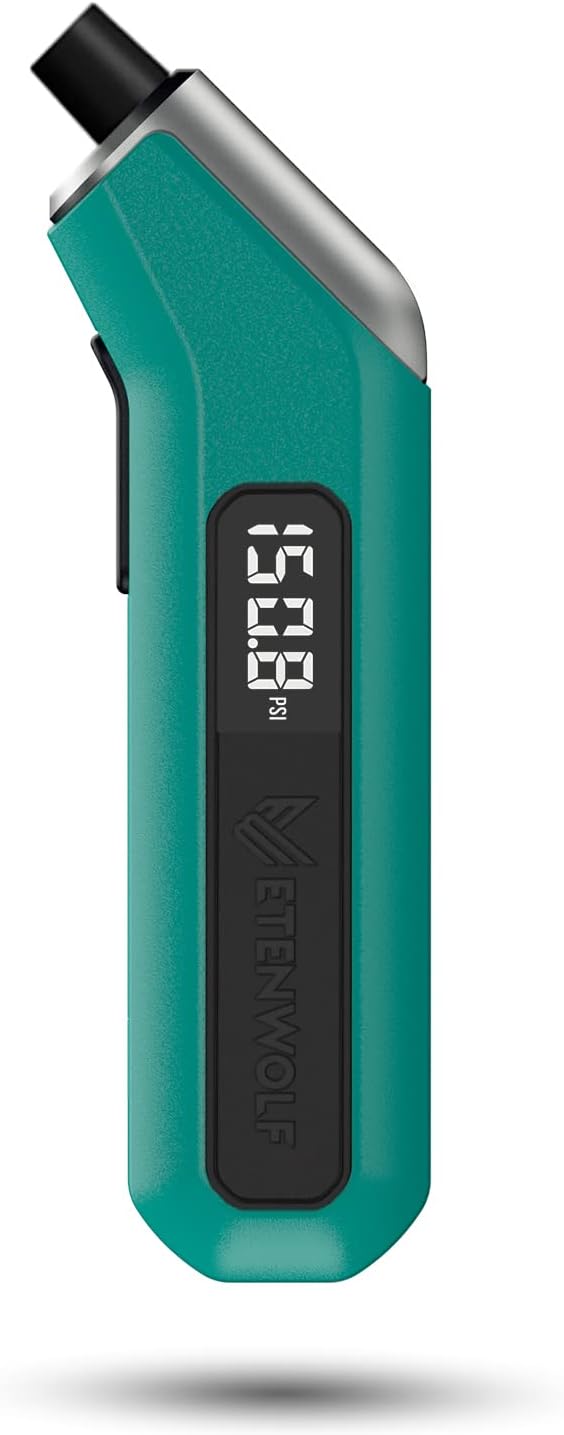
ETENWOLF T300 is a calibrated digital tire pressure gauge designed for reliable readings across low and high pressure ranges. It includes thermal compensation for stable performance in extreme cold or heat, an LED light for visibility, and an auto shut-off to help preserve battery life. Ideal for pickups, RVs, and heavy-duty vehicles, it delivers accurate PSI measurements with sturdy durability.

Keep your tires properly inflated with this analog VONDIOR tire pressure gauge, designed for fast, easy readings without batteries. The swiveling, two-axis hose and large glow dial help you measure at any tire angle with instant visibility. Built with a protective rubber shield, it supports durable, low-maintenance use for cars and trucks.

ETENWOLF T300 is a calibrated digital tire pressure gauge for accurate readings from 3 to 200 PSI across light and heavy-duty vehicles. It includes thermal compensation for reliable performance in extreme cold or heat, with an auto shut-off to extend battery life and an LED for easier reading. The sturdy design supports rugged everyday use, making it ideal for pickups, RVs, and industrial applications.
When Load Range E Makes Sense
Load Range E may be appropriate when the exact E-rated tire is approved for your wheels and vehicle and one or more of these conditions apply:
- The original equipment specification or approved replacement fitment calls for that capacity.
- A D-rated option in the desired size cannot support the required load at an approved pressure.
- Your measured rear-axle load requires the higher load index offered by the E-rated option.
- You tow or carry substantial loads frequently and want additional tire-capacity reserve.
- The specific E-rated tire includes verified casing, tread, or sidewall features suited to your terrain.
Do not select Load Range E only because it sounds stronger. A tire that is unnecessarily heavy, poorly matched to the wheel, or inflated incorrectly can reduce ride comfort and alter steering response without improving the truck’s rated capability.
[Products Worth Considering]

These universal tire valve stem caps help protect valve cores from dust, debris, and moisture while helping maintain stable tire pressure. The corrosion-resistant metal construction and sealed design provide reliable protection in road grime, mud, and winter conditions. Twist-on installation makes them quick to fit on cars, SUVs, trucks, and motorcycles.

This professional wheel and rim cleaning brush set lifts brake dust, grime, and dirt with soft, scratch-free microfiber and synthetic wool fibers. The rim brush bends up to 360 degrees for easy access to hard-to-reach areas around spokes, lips, and faces. Ideal for thorough cleaning of car, truck, motorcycle, bicycle, RV, and more wheel and tire surfaces.

Milton S-921 pencil tire pressure gauge helps you maintain optimal tire pressure for passenger cars with accurate readings in PSI and kPa. It features a built-in deflator valve for convenient pressure adjustments, plus a single chuck head and nylon indicator bar for easy use on the go. Built from durable plated brass and designed for reliable performance, it’s a practical road trip and cold-weather maintenance tool.
Performance and Ride Quality: What to Expect
Ride Comfort
An E-rated tire may feel firmer than a comparable lower-load-range tire because of differences in casing design, tire weight, tread, sidewall construction, and operating pressure. However, the load-range letter cannot predict ride quality by itself. Two E-rated models can ride differently, just as two D-rated models can.
Running more pressure than the truck and tire combination requires can also make the unloaded ride feel harsh and reduce the tire’s ability to absorb small road impacts. Running too little pressure creates heat, excess flex, poor handling, and possible tire damage.
Steering, Braking, and Efficiency
Heavier LT tires can increase unsprung and rotating mass compared with lighter alternatives. Depending on the tire and vehicle, this may influence acceleration, braking feel, steering response, and fuel consumption. The size of the effect varies, so compare the published weight and dimensions of the exact tires rather than assuming every E-rated tire creates the same penalty.
Puncture Resistance and Off-Road Use
Load Range E does not automatically make a tire puncture-proof. Resistance to cuts, impacts, and punctures depends on the specific casing, sidewall reinforcement, tread design, rubber compound, inflation, load, speed, and obstacle involved.
When you drive on gravel, construction roads, or rocky trails, compare verified manufacturer features such as reinforced sidewalls, additional protective layers, stone ejectors, and the tire’s intended service category. Do not substitute the load-range letter for those product details.
Correct Tire Pressure for Load Range D and E Tires
Never assume that both D and E tires should run at 40 PSI. You should also avoid inflating an E-rated tire to its sidewall maximum simply because it can accept that pressure. The sidewall value is an operating limit associated with the tire’s maximum-load conditions, not a universal recommendation for your Tundra.
Michelin’s tire-marking guidance explains that the maximum load and maximum pressure molded on the sidewall are not the vehicle manufacturer’s recommended operating pressure. For approved original-size tires, begin with the cold pressure specified on the Tundra’s placard.
- Check pressure when the tires are cold.
- Use an accurate pressure gauge.
- Check before long trips, towing, or carrying a heavy load.
- Do not bleed pressure from a hot tire simply because the reading increased during driving.
- Never exceed the tire or wheel’s maximum permitted pressure.
- Do not rely on TPMS as your only pressure check.
USTMA recommends regular cold-pressure checks and specifically advises checking before towing, carrying heavy loads, or taking a long trip.
Warning: Switching to a different tire size or from a passenger-type tire to an LT tire may change the pressure needed to support the same vehicle load. Obtain an approved pressure recommendation from the tire manufacturer or a qualified tire professional instead of guessing.
P-Metric vs LT Tires on a Tundra
Before comparing D and E, confirm whether the current and proposed tires are passenger-metric, Euro-metric, or LT-metric. Load Range D and E commonly appear on LT tires, while passenger-type tires use different load designations and load calculations.
Changing from an approved passenger-type tire to an LT tire is not a simple letter upgrade. The LT tire may require a different cold pressure to carry an equivalent load. It may also be heavier and may affect ride, handling, braking, TPMS behavior, and fuel consumption.
Confirm all of the following before making the change:
- The tire size fits without rubbing or clearance problems.
- The load capacity meets or exceeds the original requirement.
- The speed rating is suitable.
- The wheel width, diameter, load rating, and pressure rating are compatible.
- The correct operating pressure has been established.
- All four tire positions remain appropriately matched.
[Products Worth Considering]

These aluminum alloy tire valve stem caps with an O-ring seal help protect valve stems from corrosion while adding a clean, stylish look to your vehicle. The universal fit works across cars, trucks, motorcycles, bicycles, and more, making them an easy upgrade for everyday driving and off-road use. Installation is quick, and the included four-pack keeps all your tires dressed and protected.

This professional wheel and rim brush kit makes it easy to lift brake dust, grime, and dirt from wheels and tires without scratching finishes. The brushes feature soft, metal-free wool heads and a flexible 360-degree rim brush design for reaching hard-to-clean areas. Includes multiple brush types plus accessories for thorough car, motorcycle, and general vehicle detailing.

The Topeak SmartGauge D2 delivers precise digital tire pressure readings for bikes, motorcycles, and sports equipment up to 250 psi (17 bar). Its rotating SmartHead works with both Presta and Schrader valves, so you can check pressure quickly without adapters. The LCD display makes it easy to read results in psi, bar, or kg/cm² with an included CR2032 battery for immediate use.
Tundra Tire Decision Checklist
- Read the placard: Record the approved tire size, load information, and cold pressure.
- Check the manual: Confirm your model year’s payload, GVWR, GAWR, GCWR, towing, and hitch requirements.
- Calculate the real load: Include passengers, cargo, accessories, hitch equipment, and trailer tongue or pin load.
- Weigh the axles: Do this when towing frequently or operating near the truck’s limits.
- Compare exact tire specifications: Check size, load index, maximum load, speed rating, weight, approved wheel width, and pressure requirements.
- Verify the wheels: Make sure they can support the tire’s load and required pressure.
- Choose the lowest suitable specification, not the highest letter: Select a tire that provides adequate capacity and fits your terrain, comfort, and durability needs without exceeding vehicle limits.
Frequently Asked Questions
Do I need E-rated tires for towing with a Tundra?
Not automatically. You need a tire whose approved size, load index, capacity, speed rating, and pressure support your Tundra’s actual axle loads. Load Range E is appropriate when the exact fitment is required or when a suitable lower-load-range tire cannot provide the necessary capacity.
What are the disadvantages of Load Range E tires?
Depending on the model, an E-rated tire may weigh more, cost more, or feel firmer than another suitable option. Extra rotating mass may also affect steering, acceleration, braking feel, or fuel use. These effects vary by tire size, construction, tread, and operating pressure.
Should I inflate E-rated tires to 80 PSI?
No, not unless approved guidance for that exact tire, wheel, load, and vehicle requires it. Some E-rated tires have different maximum pressures, and the sidewall maximum is not a universal operating target. Use the Tundra placard for approved original-size tires or verified manufacturer load-and-inflation guidance for a changed fitment.
Will E-rated tires increase my Tundra’s payload or towing capacity?
No. Tires with additional capacity do not change Toyota’s GVWR, GAWR, payload, GCWR, hitch rating, or maximum trailer rating. The vehicle must remain within every original limit.
Can I replace P-metric tires with LT Load Range E tires?
A conversion may be possible, but it requires verified fitment and pressure guidance. The LT tire must provide adequate load capacity, fit the wheel and vehicle, maintain an appropriate speed rating, and use a pressure that supports the required load. Do not copy the old pressure or inflate automatically to the new tire’s maximum.
Are E-rated tires always better for rough terrain?
No. Load Range E describes a load class, not complete off-road performance. Check the specific tire’s tread, sidewall protection, casing design, compound, traction ratings, and intended service. Correct pressure and speed remain essential on rough surfaces.
Conclusion
Choose Load Range D or E for your Tundra by verifying the complete tire specification, not by applying a generic trailer-weight rule. A suitable D-rated tire can be safe when it meets the required load capacity and approved fitment. An E-rated tire can provide useful reserve when the exact size and load index justify it.
Start with the door placard and owner’s manual, calculate the truck’s real payload, measure loaded axle weights when necessary, and use approved pressure guidance. That process gives you a safer and more dependable answer than automatically choosing the stiffest or highest-rated tire available.
Sources
- Toyota Owners Manuals and Warranties — model-specific tire, payload, axle, and towing requirements.
- NHTSA TireWise — tire sizing, placard information, inflation, loading, age, and safety guidance.
- USTMA: Replacing Tires — replacement size, load index, speed rating, and load-capacity guidance.
- USTMA: Tire Care Essentials — cold-pressure checks, towing checks, TPMS limitations, and maintenance.
- Michelin: Tire Load Rating and Speed Rating — load-index interpretation and replacement-rating guidance.
- Michelin: Tire Markings Explained — sidewall load, pressure, size, and service-description information.