
How Tall Is a 235 75R15 Tire? Exact Height, Width & Dimensions
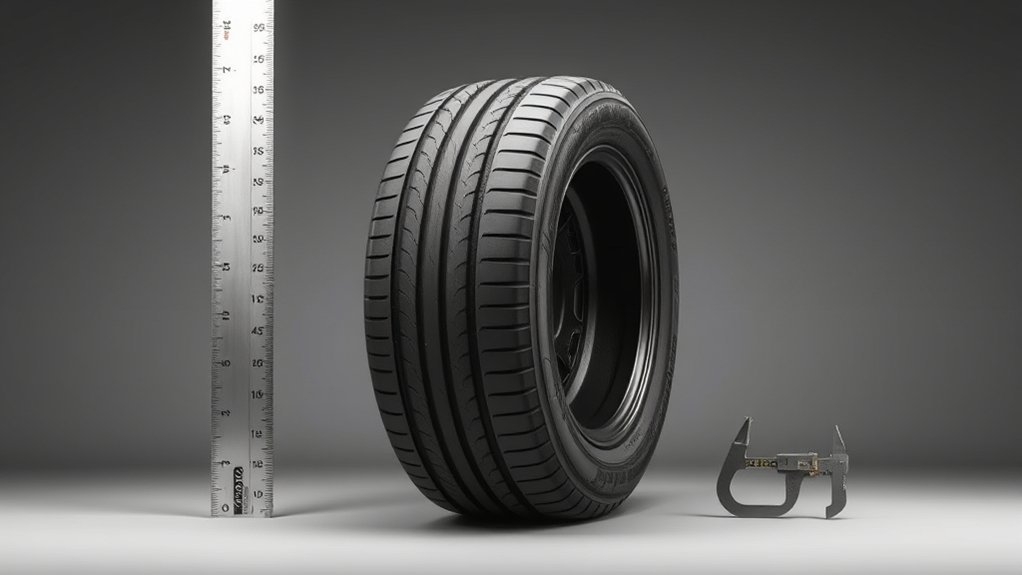
A 235/75R15 tire is about 28.9 inches tall, 9.25 inches wide at the section width, and has a sidewall height of about 6.94 inches. It fits a 15-inch wheel and has a circumference near 90.7 inches, which works out to about 699 revolutions per mile. These numbers help you check clearance, compare nearby sizes, and estimate speedometer changes before you buy.
Quick Answer
A 235/75R15 tire measures about 28.9 inches tall, 9.25 inches wide, and 6.94 inches from rim to tread on each sidewall. It fits a 15-inch rim, rolls about 90.7 inches per revolution, and makes roughly 699 revolutions per mile.
Key Takeaways
- A 235/75R15 tire is about 28.9 inches tall overall.
- The 235 number means 235 mm section width, or about 9.25 inches from sidewall to sidewall.
- The 75 aspect ratio gives it a sidewall height of about 6.94 inches.
- It fits a 15-inch wheel and has a circumference of about 90.7 inches.
- It usually turns about 699 revolutions per mile, so a size change can affect speedometer accuracy.
What Does 235/75R15 Mean?
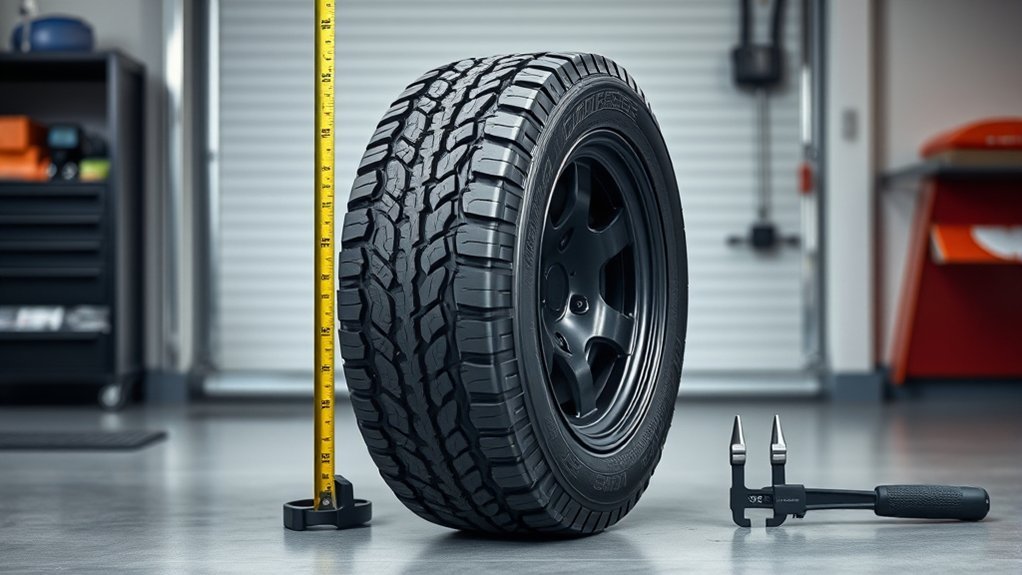
A 235/75R15 tire uses a standard tire-size code. Each part tells you one key measurement or construction detail:
- 235 is the section width in millimeters. It measures the tire from sidewall to sidewall, not the tread width.
- 75 is the aspect ratio. The sidewall height equals 75% of the section width.
- R means radial construction, the common design used on modern passenger and light-truck tires.
- 15 is the rim diameter in inches. This tire mounts on a 15-inch wheel.
That code gives you the basic tire geometry, but it does not tell you everything about fitment. You still need to check the tire’s load index, speed rating, approved rim width, and your vehicle’s tire placard before mounting it.
[Products Worth Considering]

This tire repair kit provides fast emergency puncture repair without removing the tire from the rim, helping you get back on the road quickly. Its screw plug system is designed for punctures in both tread and sidewall and includes a complete patch plug tool set with essential accessories. A portable storage bag makes it easy to carry for cars, trucks, SUVs, motorcycles, and heavy-duty applications.

This tire repair patch tool kit helps you quickly seal small punctures using upgraded mushroom plugs and a built-in roller system that presses for even penetration. The tungsten buffing wheel and HSS twist drill bits prepare the damaged surface for stronger adhesion, while the crown-angle friendly plugs are designed to keep water and debris out. Ideal for puncture repairs on many vehicle types, from cars and trucks to bikes and scooters.

EVOULTES heavy duty tire inflator with an integrated gauge delivers accurate pressure readings from 10–120 PSI, helping you inflate, deflate, and check tires in one tool. The 16.5-inch extended dual-head air chuck with swivel base reaches hard-to-access dual wheel valves on trucks and RVs. A brass trigger core and side-mounted air release valve make operation smooth, with standard 1/4" NPT threading and quick-connect compatibility for easy setup.
235/75R15 Size Chart in Inches and Millimeters
The table below shows the standard calculated dimensions for a 235/75R15 tire. Individual tire models can measure slightly differently because tread design, casing shape, and measuring rim width vary by manufacturer.
| Measurement | 235/75R15 Value |
| Section width | 235 mm / about 9.25 in |
| Aspect ratio | 75% |
| Sidewall height | 176.25 mm / about 6.94 in |
| Overall diameter | About 733.5 mm / 28.9 in |
| Circumference | About 2,304 mm / 90.7 in |
| Revolutions per mile | About 699 |
| Wheel diameter | 15 in |
| Common approved rim width | Often 6–8 in for passenger versions and 6–7 in for LT versions, depending on tire model |
Note: The listed dimensions are nominal. Real mounted measurements can vary slightly by brand, tread pattern, tire pressure, load, and wheel width.
How to Calculate 235/75R15 Tire Height
You can calculate a 235/75R15 tire’s height with a simple formula:
- Convert width to inches: 235 mm ÷ 25.4 = 9.25 inches.
- Find sidewall height: 235 mm × 0.75 = 176.25 mm, or about 6.94 inches.
- Double the sidewall: 6.94 × 2 = 13.88 inches.
- Add the wheel diameter: 13.88 + 15 = 28.88 inches.
That is why most references round a 235/75R15 tire to about 28.9 inches tall. The same tire has a circumference of about 90.7 inches because circumference equals diameter multiplied by pi.
How Wide Is a 235/75R15 Tire?
A 235/75R15 tire has a nominal section width of 235 millimeters, or about 9.25 inches. Section width means the width from one sidewall to the other when the tire is mounted on its measuring rim.
This is not always the same as tread width. Tread width depends on the specific tire model, tread design, and manufacturer. Two 235/75R15 tires can share the same size code but have slightly different tread shapes and measured widths.
Width matters because it affects inner clearance, fender clearance, steering angle, and how the tire sits on the wheel. Before you mount a wider replacement, check the wheel offset, suspension components, brake clearance, and fender space.
What Is the Diameter and Circumference?
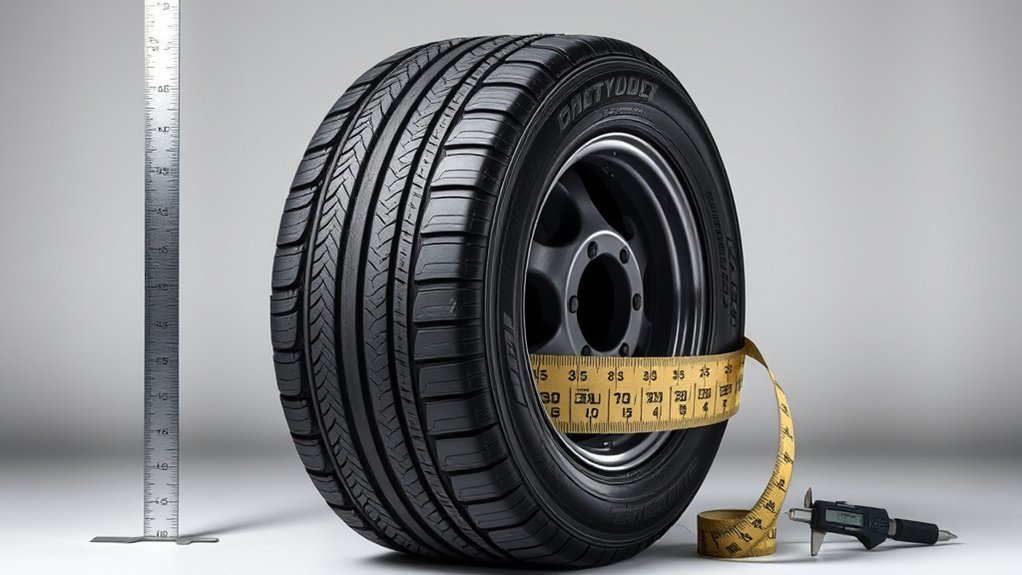
The overall diameter of a 235/75R15 tire is about 28.9 inches. This is the tire’s height from the ground-facing tread to the tread at the top of the tire.
The circumference is about 90.7 inches. This tells you how far the tire travels in one full rotation. Because one mile equals 63,360 inches, you can divide 63,360 by 90.7 to get about 699 revolutions per mile.
A 235/75R15 tire rolls about 90.7 inches per revolution, so it makes roughly 699 revolutions in one mile.
How Does 235/75R15 Affect Speedometer Accuracy?
A 235/75R15 tire can affect your speedometer if it is taller or shorter than the tire size your vehicle was calibrated to use. A taller tire travels farther with each revolution, so the vehicle may travel faster than the speedometer shows. A shorter tire does the opposite.
The exact error depends on your original tire size. Do not assume that every switch to 235/75R15 creates the same speedometer change.
Speedometer Error Formula
Use this formula for a quick estimate:
Actual speed = indicated speed × new tire circumference ÷ original tire circumference
For example, if your vehicle was calibrated for 225/75R15 tires with about 88.8 inches of circumference, switching to 235/75R15 tires with about 90.7 inches of circumference creates about a 2.1% increase. At 60 mph indicated, your actual speed would be about 61.3 mph.
Pro Tip: After changing tire size, verify your speed with a GPS speed reading or have the vehicle recalibrated if your setup allows it. This matters most when moving to a much taller tire.
When Recalibration Matters
Recalibration matters most when the new tire changes overall diameter by more than a small amount. A mild change may only create a small speedometer difference. A larger jump can affect speed readings, odometer readings, shift behavior, cruise control, and driver-assistance systems on some vehicles.
If your vehicle allows tire-size programming, use the tire’s revolutions-per-mile value or overall diameter. If it does not, a tire shop or dealer can tell you whether recalibration is available for your vehicle.
How Does 235/75R15 Compare to 225/75R15 and 265/75R15?
A 235/75R15 tire sits between 225/75R15 and 265/75R15 in both width and diameter. The 225/75R15 is narrower and slightly shorter. The 265/75R15 is wider, taller, and closer to a 31-inch tire.
| Size | Diameter | Width | Circumference | Revs/Mile |
| 225/75R15 | 28.3 in | 8.9 in | 88.8 in | 713 |
| 235/75R15 | 28.9 in | 9.3 in | 90.7 in | 699 |
| 265/75R15 | 30.6 in | 10.4 in | 96.2 in | 658 |
| 31×10.50R15 | 31.0 in nominal | 10.5 in nominal | 97.3 in | 651 |
[Products Worth Considering]

This portable cordless tire inflator delivers up to 160 PSI with fast 17 L/min airflow to help you quickly top up tires and get back on the road. It features dual power mode,...
Width and Diameter Differences
Moving from 225/75R15 to 235/75R15 adds about 0.6 inch of height and about 0.4 inch of width. That is a modest increase, but it can still affect tight wheel wells or vehicles with worn suspension parts.
Moving from 235/75R15 to 265/75R15 is a bigger jump. The 265/75R15 is about 1.7 inches taller and about 1.1 inches wider. That can improve ground clearance, but it can also increase rubbing risk and change gearing feel.
Fitment and Performance Changes
A taller tire can raise ground clearance, lower engine rpm at highway speed, and reduce revolutions per mile. It can also make acceleration feel slightly softer if the tire is much larger than stock.
A wider tire can add contact area, but it may also increase rolling resistance, road noise, steering effort, and clearance problems. Always compare the new size with the factory tire size before buying.
What Vehicles Fit 235/75R15 Tires?
A 235/75R15 tire is common on some older SUVs, light trucks, vans, and off-road builds with 15-inch wheels. Still, you should not choose it by vehicle category alone. Year, trim, wheel width, suspension height, brake size, and wheel offset can all change fitment.
Warning: Do not mount a 235/75R15 tire unless the tire size, rim width, load index, speed rating, and inflation pressure match your vehicle’s requirements. Check the driver-door placard and owner’s manual first.
Use this checklist before choosing 235/75R15 tires:
- Check wheel diameter: The wheel must be 15 inches.
- Check approved rim width: The tire model must be approved for your wheel width.
- Check load index: The tire must meet or exceed the vehicle’s required load rating.
- Check speed rating: The rating should meet the vehicle’s requirements and your driving conditions.
- Check clearance: Inspect inner fender, control arm, sway bar, brake, and bumper clearance.
- Check all four corners: Turn the steering fully left and right, and recheck clearance under suspension compression.
If you have a lift kit, wheel spacers, aftermarket wheels, or a changed suspension setup, do a physical test fit instead of relying only on a tire-size chart.
What Load Ratings and Tire Types Are Available?
235/75R15 tires come in several load and tread categories. Passenger versions may show service descriptions such as 105T or 109T XL. A 105 load index equals 2,039 pounds per tire, while a 109 load index equals 2,271 pounds per tire when properly inflated.
Light-truck versions may use LT sizing and a load range such as C. Load range and load index are related, but they are not the same thing. The safest approach is to read the tire’s full sidewall marking and compare it with your vehicle’s placard and gross axle weight requirements.
Common 235/75R15 tire types include:
- All-season tires: Best for normal highway and daily driving.
- Highway terrain tires: Good for SUVs and trucks that spend most time on pavement.
- All-terrain tires: Better for gravel, dirt, mild trails, and mixed driving.
- Mud-terrain tires: Stronger off-road bite, but usually louder and rougher on pavement.
- Winter tires: Built for cold temperatures, snow, and ice when conditions demand them.
Dimensions tell you whether the tire is the right size. Load rating, tread design, and compound tell you whether it is the right tire for how you drive.
Common 235/75R15 Fitment Mistakes
The biggest mistake is assuming that a tire fits because the diameter looks close. You also need to account for width, wheel offset, load rating, rim width, and suspension movement.
- Ignoring rim width: A tire can be the right diameter but wrong for the wheel.
- Forgetting load rating: A tire that fits physically may still be unsafe if it cannot carry the load.
- Only checking parked clearance: Tires move closer to body and suspension parts during turns and compression.
- Mixing different tire sizes: This can affect handling and may damage some drivetrains.
- Skipping speedometer checks: Even small size changes can affect speed and odometer readings.
If you are upsizing from a smaller tire, measure carefully and compare the new size against the tire your vehicle was designed to use.
Frequently Asked Questions
Which tire is taller, a 65 or 70?
A 70-series tire is taller than a 65-series tire if the section width and rim diameter are the same. The number is the aspect ratio, so a 235/70R15 has a taller sidewall than a 235/65R15. If the widths are different, calculate the sidewall height before comparing.
Are 235/75R15 tires equivalent to 31×10.50R15?
No. A 235/75R15 tire is about 28.9 inches tall and 9.3 inches wide. A 31×10.50R15 tire is about 31.0 inches tall and 10.5 inches wide nominally. The 31×10.50R15 is much closer to a 265/75R15 than a 235/75R15.
Is a 235 the same as a 31-inch tire?
No. The “235” only tells you section width in millimeters. A 235/75R15 tire is about 28.9 inches tall, not 31 inches. To know tire height, you must use the width, aspect ratio, and wheel diameter together.
How much taller is a 235/75R15 than a 205/75R15?
A 235/75R15 tire is about 1.8 inches taller than a 205/75R15 tire. A 205/75R15 is about 27.1 inches tall, while a 235/75R15 is about 28.9 inches tall. The 235 is also about 1.18 inches wider.
Can I replace 225/75R15 with 235/75R15?
Sometimes, but you need to verify fitment first. A 235/75R15 is about 0.6 inch taller and 0.4 inch wider than a 225/75R15. That small increase may fit many setups, but you still need to check rim width, load rating, speed rating, clearance, and speedometer error.
What rim width fits a 235/75R15 tire?
Many passenger 235/75R15 tires are approved for 6- to 8-inch-wide wheels, while many LT versions use a narrower approved range such as 6 to 7 inches. Always check the tire model’s manufacturer specs because the approved range can vary.
Conclusion
A 235/75R15 tire is about 28.9 inches tall, 9.25 inches wide at the section width, and built for a 15-inch wheel. Its 90.7-inch circumference and 699 revolutions per mile make it easy to compare with nearby tire sizes.
Before you buy, compare it with your original tire size and check the driver-door placard, owner’s manual, load index, speed rating, rim width, and clearance. The size may look simple, but the right fit depends on the whole vehicle setup.
Sources
- NHTSA TireWise — supports tire-size safety, placard checks, and inflation guidance.
- Bridgestone: How to Read & Determine Tire Size — supports width, aspect ratio, radial construction, rim diameter, and load index definitions.
- Tire Industry Association: Reading a Tire Sidewall — supports sidewall code definitions and service description guidance.
- TireSize.com: 235/75R15 Tires — supports 235/75R15 diameter, width, circumference, revolutions per mile, and rim-width ranges.
- Goodyear: Tire Load Index — supports load index meaning and load capacities for index 105 and 109.
- BFGoodrich All-Terrain T/A KO2 Specs Notes — supports manufacturer variation in measured tire dimensions and mounting cautions.

Related Articles
How Tall Is a 305 70 R17 Tire? Exact Height, Width & Dimensions
Curious how tall a 305 70 R17 tire really is—and whether it fits your truck?
Read More
Can-Am Defender Tire Size Guide: Stock Specs & Upgrade Options
Just how big can you go on a Can-Am Defender before mods become necessary?
Read More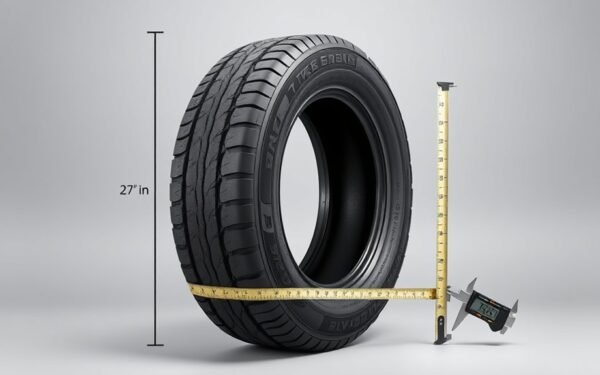
How Tall Is a 275 65 20 Tire? Exact Height, Width & Dimensions
Check the exact height, width, and hidden fitment effects of a 275/65R20 tire before you buy or upgrade.
Read More