
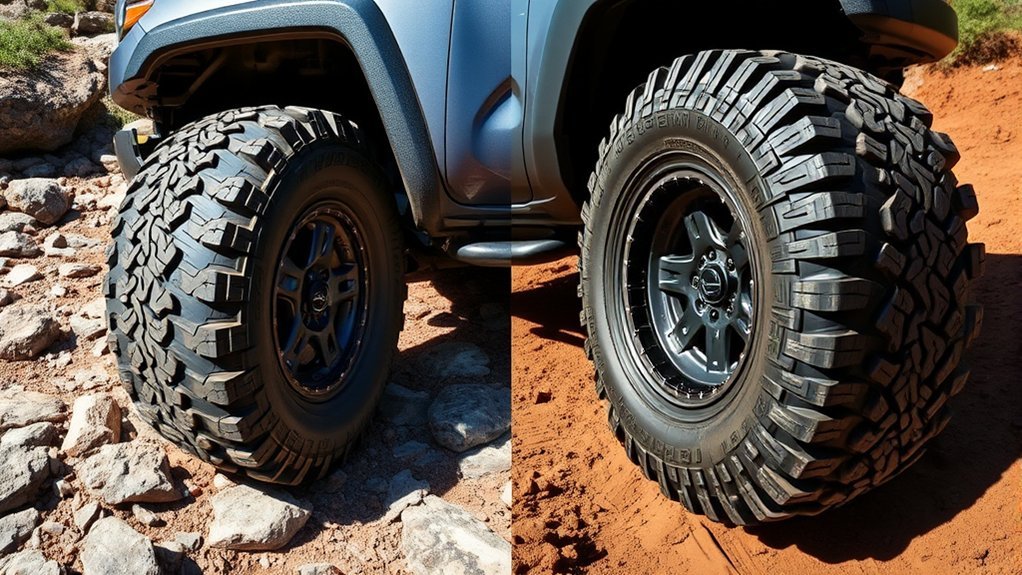
Choosing between all-terrain (A/T) and mud-terrain (M/T) tires for your Toyota Tacoma comes down to how you actually drive, not how aggressive the tire looks. A/T tires make more sense for daily commuting, highway miles, rain, gravel roads, camping trips, and light trails. M/T tires make more sense when your Tacoma regularly sees deep mud, loose dirt, ruts, rocks, and slow technical terrain.
Quick Answer
Choose A/T tires for a Tacoma that spends most of its time on pavement with weekend trail use. Choose M/T tires only if you often drive through deep mud, loose dirt, rocks, or ruts and you accept more road noise, firmer ride quality, faster pavement wear, and possible fuel-economy loss.
Key Takeaways
- A/T tires are the better default for most Tacoma owners because they balance highway comfort, wet-road manners, tread life, and light off-road traction.
- M/T tires give stronger bite in deep mud, loose soil, and rocks, but they usually ride louder and rougher on pavement.
- R/T tires sit between A/T and M/T options if you want a tougher look and more trail bite without going fully mud-terrain.
- Always match tire size, load index, speed rating, and cold pressure guidance to your Tacoma’s Tire and Loading Information Label or owner’s manual.
- Larger tires such as 285/70R17 can require lift, trimming, wheel-offset changes, or careful clearance checks before they fit safely.
At a Glance
| Best Daily Choice | All-terrain tires |
| Best Deep-Mud Choice | Mud-terrain tires |
| Middle-Ground Option | Rugged-terrain tires |
| Main Trade-Off | A/T tires favor comfort and mixed use; M/T tires favor off-road bite over quiet pavement manners. |
| Must Check First | Tire size, load index, speed rating, wheel clearance, spare fitment, TPMS, and cold tire pressure. |
Choosing Between A/T and M/T Tires
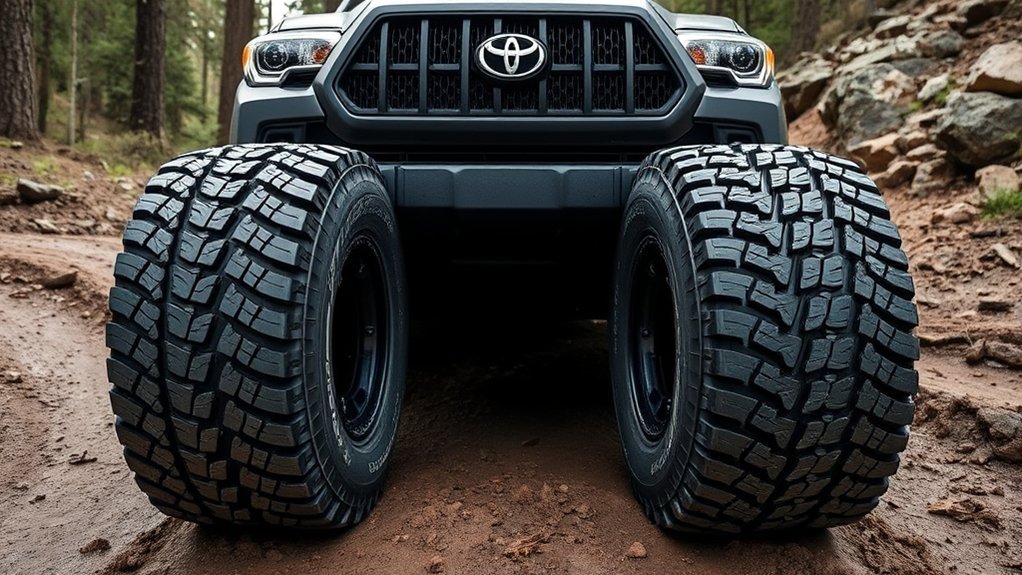
All-terrain tires are built for mixed driving. They use tread blocks, grooves, and siping to balance paved-road stability with traction on gravel, dirt, sand, snow, and lighter trails. The National Highway Traffic Safety Administration describes all-terrain tires as a good compromise between on-road driving and off-road capability, which is why they fit many Tacoma owners well.
Mud-terrain tires use wider voids, larger lugs, and more aggressive shoulder blocks. That design helps the tread dig into soft terrain and clear mud more easily. The trade-off is direct: the same open tread that helps in mud can add noise, vibration, weight, and faster wear on pavement.
If your Tacoma is your daily driver, start with A/T tires. If you spend many weekends in deep mud, clay, loose dirt, rocky trails, or low-speed technical terrain, M/T tires may be worth the compromise. If you want something between the two, rugged-terrain (R/T) tires can offer a more aggressive look and stronger trail grip than many A/T tires without going as extreme as a full M/T tire.
Warning: Use DOT-approved tires for public-road driving. Some extreme off-road tires are built mainly for trail use and may not deliver the braking, speed rating, wet-road grip, or road manners you need on highways.
Note: Tire category alone does not guarantee performance. Compare the exact tire model, size, load index, speed rating, treadwear coverage, winter rating, and owner feedback before buying. A well-designed A/T tire can be safer for daily use than an aggressive tire that does not match your roads.
Which Tire Type Fits Your Driving?
Choose by your normal week, not your most extreme dream trip. A tire that works great for one mud weekend can feel noisy, heavy, and tiring during months of commuting.
- Daily driver with weekend gravel roads: Choose A/T tires. You get better road comfort, better mixed-weather manners, and enough traction for light trails.
- Camping, forest roads, and overlanding: Choose a stronger A/T or mild R/T tire, especially if you carry gear or drive rocky access roads.
- Deep mud, clay, and rutted trails: Choose M/T tires if those conditions happen often, not just once or twice a year.
- Rocky technical trails: Consider M/T tires or tougher R/T tires with strong sidewalls, but confirm load range and wheel clearance first.
- Snow and ice driving: Do not assume M/T tires are better. Look for the Three-Peak Mountain Snowflake symbol if winter traction matters, and use dedicated winter tires in severe winter climates.
- Towing, payload, or work use: Focus on the correct load index and load range before tread style. A tire that cannot carry the load safely is the wrong tire.
Key Tire Specifications for Your Tacoma
Before comparing tread patterns, confirm the correct size and rating for your Tacoma. NHTSA recommends checking the owner’s manual or the Tire and Loading Information Label on the driver-side door edge or post for the correct tire size and pressure guidance. You can also use the official Toyota Owners manual page to find model-year guidance for your truck.
The tire size tells you the width, sidewall height, construction, and wheel diameter. For example, a size such as LT265/70R17 means the tire is a light-truck tire, about 265 mm wide, with a sidewall height equal to 70% of the section width, built for a 17-inch wheel. A larger size such as LT285/70R17 can add ground clearance and a wider stance, but it can also create rubbing at the fender liner, mud flap, cab mount, upper control arm, or suspension area.
Do not choose a larger tire only because it looks better. Check wheel offset, suspension height, brake clearance, spare-tire clearance, speedometer change, TPMS compatibility, and whether trimming is required. If your Tacoma carries camping gear, tools, rooftop tents, trailers, or payload often, pay close attention to load index and load range.
Warning: Do not use the maximum PSI printed on the tire sidewall as your normal pressure target. Use the cold tire pressure listed by Toyota for your truck and tire setup, then work with a qualified tire shop if you changed size, load range, or wheel setup.
[Products Worth Considering]

Keep your tires properly inflated with this analog VONDIOR tire pressure gauge, designed for fast, easy readings without batteries. The swiveling, two-axis hose and large glow dial help you measure at any tire angle with instant visibility. Built with a protective rubber shield, it supports durable, low-maintenance use for cars and trucks.

These aluminum alloy tire valve stem caps with an O-ring seal help protect valve stems from corrosion while adding a clean, stylish look to your vehicle. The universal fit works across cars, trucks, motorcycles, bicycles, and more, making them an easy upgrade for everyday driving and off-road use. Installation is quick, and the included four-pack keeps all your tires dressed and protected.

Accurately measure tire tread depth with a calibrated gauge marked from 0 to 1 inch in 1/32 inch increments. The color-coded bar helps you quickly identify tread condition ranges, supporting safe driving for trucks, motorcycles, automobiles, and passenger vehicles.
Tacoma Fitment Checklist Before You Buy
A tire can have the right tread pattern and still be wrong for your Tacoma if it rubs, overloads the suspension, or changes the way the truck brakes and steers. Run through these checks before ordering a larger A/T, R/T, or M/T tire.
- Door-jamb tire label: Start with Toyota’s listed size and cold pressure for your exact model.
- Wheel offset and width: Aggressive offset can help or hurt clearance depending on tire size and suspension setup.
- Front clearance: Check the fender liner, mud flap, cab mount area, upper control arm, and sway bar.
- Rear clearance: Check inner fender clearance under load and during suspension travel.
- Spare tire fit: Make sure the spare fits under the truck or plan a safe full-size spare solution.
- Load index: Match the tire’s carrying ability to your Tacoma, passengers, gear, tongue weight, and payload.
- Speed rating: Choose a tire rated for your real road use, not just trail use.
- TPMS: Make sure sensors are installed, working, and reset if needed after the tire change.
- Alignment: Get an alignment after major tire, wheel, or suspension changes to prevent uneven wear.
[Products Worth Considering]

Monitor tire tread wear with a smart, color-coded depth gauge that shows clear condition ranges at a glance. The bar is range marked for fast, easy readings, helping you maintain safer traction and performance. Each gauge is portable with a pocket clip, and the set includes 20 units for daily use and sharing.

Milton S-921 pencil tire pressure gauge helps you maintain optimal tire pressure for passenger cars with accurate readings in PSI and kPa. It features a built-in deflator valve for convenient pressure adjustments, plus a single chuck head and nylon indicator bar for easy use on the go. Built from durable plated brass and designed for reliable performance, it’s a practical road trip and cold-weather maintenance tool.

Measure tire tread depth quickly and accurately with this LUMITECO dial gauge that reads in 1/32" increments up to 14/32". The color-coded green/yellow/red zones make it easy to judge tire wear and know when replacement is needed. A rugged, compact design with a protective pouch helps keep the gauge ready for use on cars, trucks, motorcycles, and more.
Load Range and Performance Comparison
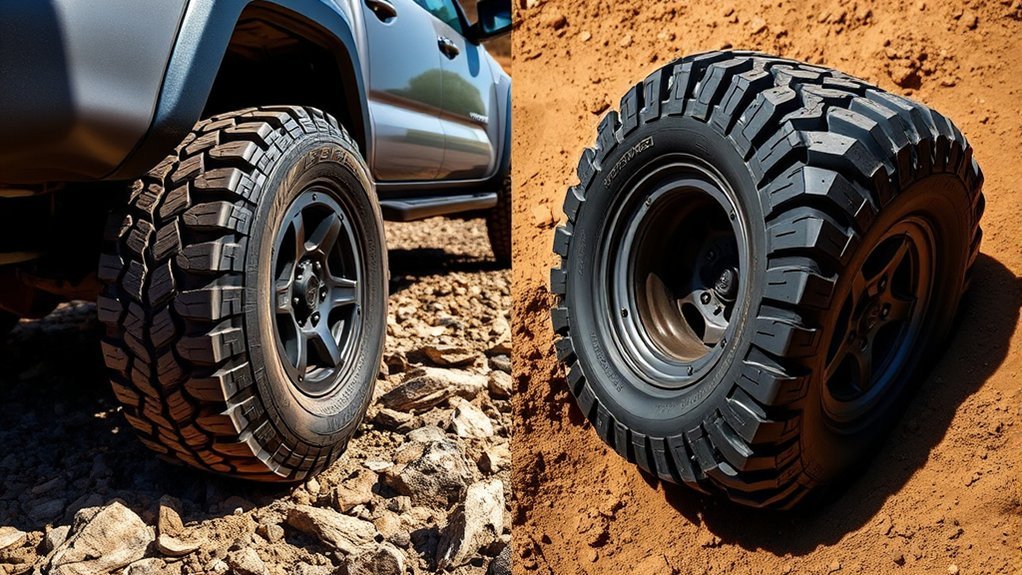
Load range matters because it affects strength, ride feel, tire weight, and how the tire handles payload. Many Tacoma-friendly A/T tires come in Standard Load, C-load, D-load, or E-load versions depending on size. M/T tires often lean heavier because they target harsher trail use, stronger sidewalls, and deeper tread blocks.
[Products Worth Considering]
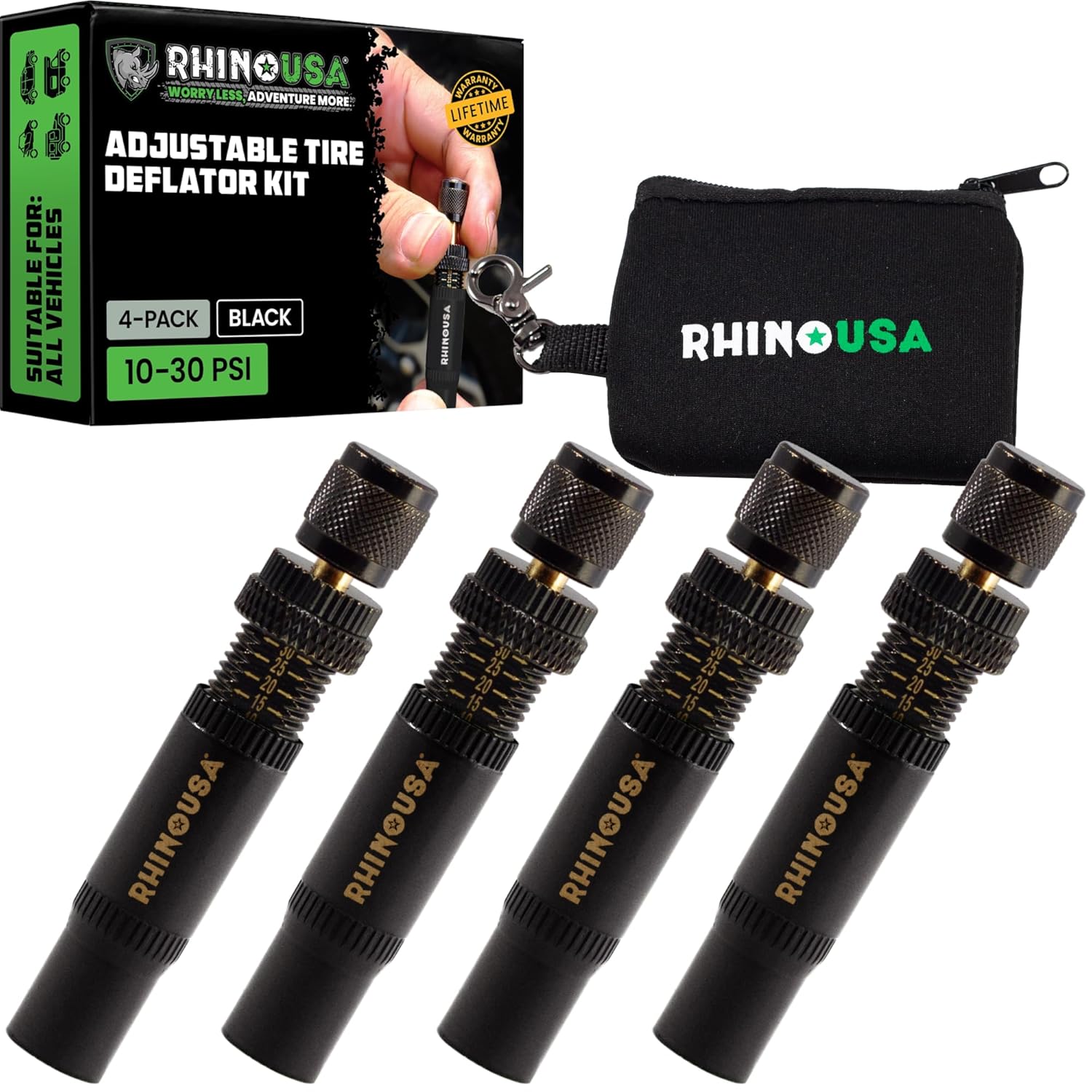
Use the Rhino USA adjustable tire deflators to air down all four tires at once by screwing one deflator onto each valve stem, letting you step away while the tires reach your preset pressure. Each deflator independently adjusts across a 10–30 PSI range with laser-etched indicators for quick setup and verification, making it ideal for beach, sand, and rocky off-road trails.

Upgrade your Toyota’s wheels with durable aluminum alloy valve stem caps that help protect valve cores from corrosion and direct exposure to road grime, clay, water, and snow. Rubber rings improve sealing to help prevent air leakage and maintain stable tire pressure for safer driving. These caps are easy to install or remove without tools and add a unique, stylish look to your car.

The SAFELIFE dial tire tread depth gauge measures tread depth in 1/32 inch increments with clear, easy-to-read 2-inch dial face. Color zones using a traffic light system help you quickly judge whether tread is low, marginal, or ample for safer driving. Built with a durable zinc cast body and a metal detect probe for precise, comfortable use across cars, motorcycles, trucks, and buses.
Load Range Differences
A C-load tire can ride more comfortably on a Tacoma that mostly commutes, explores forest roads, and carries light gear. A D-load tire can add strength while still keeping weight reasonable. An E-load tire can be useful for heavier payload, harsher rocks, and frequent off-road abuse, but it may ride firmer and can reduce fuel economy because of added weight and rolling resistance.
More load range is not always better. If your Tacoma does not need the extra casing strength, a heavy E-load tire can make the truck feel slower, harsher, and less efficient. Match the tire to your actual payload, terrain, and driving speed instead of choosing the strongest option by default.
Performance Under Conditions
Here is the practical difference in common Tacoma driving situations:
- Highway and daily commuting: A/T tires usually ride quieter and smoother than M/T tires because the tread blocks are less open.
- Wet pavement: Many A/T tires have more siping and continuous tread contact than M/T tires, which can help wet-road manners. Still, wet traction depends on the exact tire model, tread depth, compound, and pressure.
- Gravel and forest roads: A/T tires are usually the best match because they offer durability and traction without the harshness of an M/T tire.
- Deep mud and ruts: M/T tires have the advantage because the open voids and shoulder lugs can bite and self-clean better.
- Rocks and technical trails: M/T tires can provide tougher sidewalls and stronger grip at low speed, but the best choice depends on tire construction, load range, terrain, and pressure.
- Snow and ice: Do not assume M/T means better winter traction. Look for a tire with the Three-Peak Mountain Snowflake rating if winter performance matters, and use dedicated winter tires in severe winter climates.
Tread Design: Which Suits Your Driving Needs?
The tread design controls how the tire contacts pavement, clears loose material, and handles water. A/T tires use a more balanced tread pattern. You get more stable highway contact, lower noise, and enough open space for gravel, dirt, and light mud. M/T tires use larger voids and deeper lugs so the tread can dig into soft ground and throw out mud.
| Tire Type | Best For | Trade-Off |
|---|---|---|
| A/T | Daily driving, highway miles, gravel, camping roads, light trails, mixed weather | Less bite in deep mud and very loose terrain |
| M/T | Deep mud, rocks, ruts, low-speed off-road trails, aggressive trail builds | More road noise, firmer ride, heavier weight, and faster pavement wear |
| R/T | Drivers who want a tougher look and stronger trail grip than A/T without a full M/T compromise | Usually louder and heavier than mild A/T tires |
If you drive 90% pavement and 10% trail, a strong A/T tire is usually smarter. If your Tacoma regularly needs to claw through mud holes or climb rocky trails, an M/T tire can make sense. If you want a more aggressive tread but still drive to work every day, compare R/T tires before jumping straight to M/T.
Airing Down A/T and M/T Tires Off-Road
Lowering tire pressure off-road can increase the tire’s footprint and help the tread conform to rocks, sand, and uneven terrain. It can also improve ride comfort on washboard roads. That does not mean you should guess at pressure or drive fast on underinflated tires.
- Air down only for trail conditions: Use lower pressure for slow off-road use, not normal pavement driving.
- Re-inflate before highway speeds: Underinflated tires can overheat, handle poorly, and suffer damage on pavement.
- Carry a gauge and compressor: Do not rely only on TPMS because it may warn after pressure is already far below normal.
- Protect the bead: Very low pressure can unseat a tire from the wheel, especially without beadlock wheels.
- Inspect after the trail: Look for cuts, bulges, missing lugs, punctures, and rocks stuck in the tread.
Pro Tip: Write down the pressure that works for your exact tire, wheel, load, and trail type. A loaded Tacoma on rocky terrain may need a different setup than an empty truck on soft sand.
Tread Life and Maintenance Tips for A/T and M/T Tires
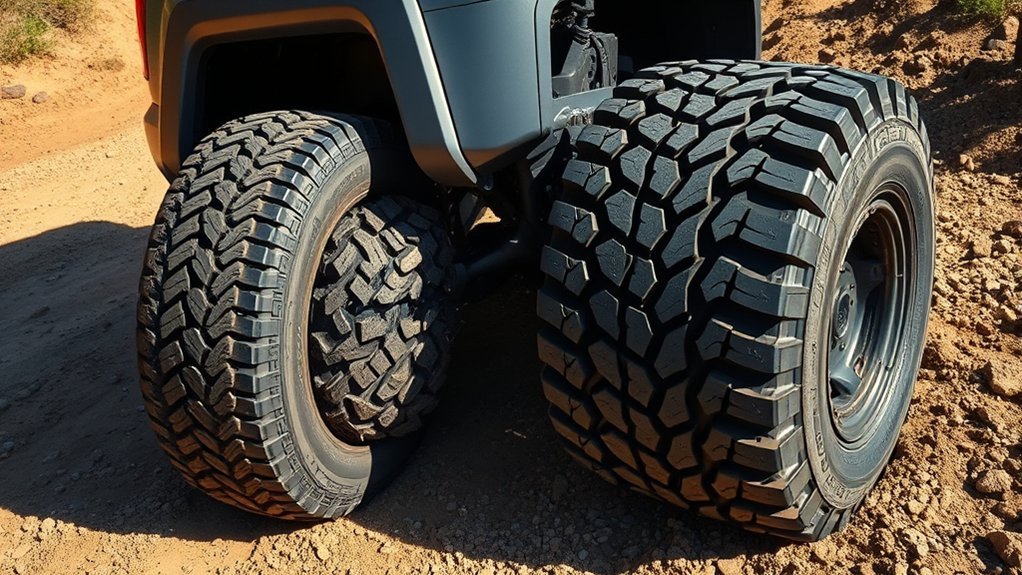
A/T tires often last longer on pavement because they usually use less aggressive tread blocks and a more road-friendly design. M/T tires may wear faster when used mostly on highways because the large lugs can scrub, cup, and feather if pressure, alignment, and rotation are ignored. Still, tread life depends on the specific tire, driving style, road surface, load, pressure, and maintenance.
Tread Life Comparison
Do not treat category mileage estimates as a promise. Some A/T tires include long treadwear warranties, while many M/T tires focus more on off-road toughness than mileage coverage. If long tread life matters, compare the tire’s warranty, treadwear grade where applicable, owner reports, and independent testing before you buy.
NHTSA reports 511 deaths in tire-related crashes in 2024, so tire choice and maintenance are safety decisions, not just appearance upgrades.
Maintenance Best Practices
Good maintenance matters for both A/T and M/T tires. NHTSA recommends checking tire pressure at least once a month when the tires are cold, including the spare. Tire pressure affects safety, durability, and fuel use, so keep a reliable pressure gauge in the truck.
- Check cold pressure monthly: Use the Tacoma’s door-jamb label or owner’s manual, not the maximum pressure on the sidewall.
- Rotate regularly: Follow Toyota’s maintenance schedule. NHTSA notes that if the manufacturer recommends rotation, many vehicles use a 5,000 to 8,000 mile interval or sooner if uneven wear appears.
- Watch tread depth: Replace tires when they reach 2/32 inch tread depth, and consider replacing earlier if wet traction has dropped.
- Inspect for damage: Look for cuts, bulges, exposed cords, sidewall cracking, uneven wear, and punctures after trail use.
- Check alignment and balance: Cupping, vibration, pulling, and uneven shoulder wear usually mean something needs attention.
- Track tire age: Some vehicle and tire makers recommend replacement after six to 10 years, even if tread remains.
- Check recalls: Tires can be recalled like vehicle parts, so record the DOT Tire Identification Number after installation.
Pro Tip: After installing heavier A/T, R/T, or M/T tires, recheck pressure, lug torque, rubbing points, and alignment after the first few drives. Small fitment issues often show up after the tires flex under turning, braking, and trail articulation.
How Fuel Efficient Are A/T and M/T Tires?
A/T tires are usually more fuel-friendly than M/T tires when all else is equal, but there is no guaranteed MPG number. Weight, tread depth, rolling resistance, tire width, pressure, wheel weight, speed, load, and driving style all affect fuel use.
The official FuelEconomy.gov guidance says properly inflated tires can improve gas mileage by 0.6% on average and up to 3% in some cases. It also says underinflated tires can lower gas mileage by about 0.2% for every 1 PSI drop in the average pressure of all tires.
For a Tacoma, the biggest fuel-economy hit often comes from moving to a heavier, wider, more aggressive tire. A mild A/T tire in a sensible size may have a small effect. A heavy E-load M/T tire, especially in a larger size, can make the truck work harder during acceleration, braking, and highway cruising.
Cost Considerations for A/T and M/T Tires
Do not compare A/T and M/T tires only by purchase price. The real cost includes tread life, fuel use, rotations, alignments, possible trimming, wheel changes, spare-tire fitment, TPMS service, and how often you damage tires off-road.
A/T tires often provide better value for mixed driving because they can handle daily pavement and weekend trails without major comfort penalties. M/T tires are worth the higher ownership cost when you actually need their off-road grip. If you mostly buy them for looks, you may pay more for noise, weight, wear, and lower comfort without using their main advantage.
Frequently Asked Questions
Should I get all-terrain or mud-terrain tires for my Tacoma?
Get all-terrain tires if your Tacoma is a daily driver that sees highways, rain, gravel, camping roads, and occasional trails. Get mud-terrain tires if you regularly drive in deep mud, loose dirt, rocks, or ruts and you accept more road noise, firmer ride quality, and faster pavement wear.
Are M/T tires bad for highway driving?
They are not automatically unsafe if they are DOT-approved, properly sized, correctly inflated, and in good condition. Still, they usually feel louder and rougher than A/T tires, and many wear faster when most of their miles happen on pavement.
Are A/T tires good enough for Tacoma overlanding?
Yes, A/T tires are often the best choice for Tacoma overlanding when the route includes pavement, gravel, fire roads, mild rocks, and changing weather. Choose a tougher A/T or mild R/T tire if you carry heavy gear, drive rocky trails, or need stronger sidewall protection.
Can I put 285/70R17 tires on a Tacoma?
A 285/70R17 tire may fit some Tacoma setups, but fitment depends on model year, trim, suspension height, wheel offset, tire shape, and rubbing clearance. Check the fender liner, mud flap, cab mount area, upper control arm, spare location, and alignment needs before buying larger-than-stock tires.
Do E-load tires ride too harsh on a Tacoma?
They can. E-load tires add strength, but they also tend to weigh more and ride firmer than lighter-duty options. They make sense for heavier payload, towing, rocky trails, and frequent off-road use, but many daily-driven Tacomas feel better on a lighter load range.
Do mud-terrain tires hurt gas mileage on a Tacoma?
They can, especially when they are heavier, wider, taller, or more aggressive than the original tire. The exact change depends on tire weight, rolling resistance, pressure, wheel weight, speed, load, and driving style.
When should I replace my Tacoma tires?
Replace them when tread reaches 2/32 inch, when you see sidewall cracks, bulges, exposed cords, serious puncture damage, or uneven wear that cannot be corrected. Also check tire age, because some vehicle and tire makers recommend replacement after six to 10 years regardless of tread depth.
Conclusion
For most Toyota Tacoma owners, A/T tires are the smarter choice because they handle daily driving, wet pavement, gravel, camping roads, and light trails with fewer compromises. They usually ride quieter, feel more stable on pavement, and make more sense for mixed use.
Choose M/T tires when your Tacoma regularly faces deep mud, rocky terrain, ruts, or low-speed off-road trails where aggressive tread matters more than comfort. Before you buy either type, confirm fitment, load rating, pressure guidance, clearance, and road-use suitability. The best tire is not the most aggressive one. It is the one that matches your Tacoma, your terrain, and your real driving habits.
Sources
- NHTSA TireWise — tire type guidance, tire size, tire pressure, tread depth, rotation, tire aging, TPMS, recalls, and tire safety guidance.
- FuelEconomy.gov: Keeping Your Vehicle in Shape — tire pressure and fuel-economy guidance.
- Toyota Owners Manuals and Warranties — official model-year Toyota owner’s manuals and warranty documents.
- USTMA Tire Care Essentials — TPMS, tread depth, tire inspection, and rotation guidance.
- USTMA Technical Information Service Bulletin — severe snow and Three-Peak Mountain Snowflake symbol reference.

