
Honda Accord Wheel Offset Explained in Plain English
Wheel offset is one of the most important numbers to check before putting aftermarket wheels on a Honda Accord. It tells you where the wheel sits in relation to the hub, suspension, brakes, and fenders. The right offset can keep the Accord feeling stable and clean-looking; the wrong one can cause rubbing, steering changes, brake-clearance problems, or uneven tire wear.
Quick Answer
Honda Accord wheel offset should stay close to the original wheel’s offset, but the correct number depends on your year, trim, wheel width, tire size, and ride height. Do not rely on a single universal offset range. Check the wheel stamp, tire placard, brake clearance, suspension clearance, and full-lock fitment before buying.
Key Takeaways
- Wheel offset is measured in millimeters from the wheel centerline to the hub mounting surface.
- Most modern Accords use positive-offset wheels, but the exact safe range changes by generation, trim, wheel width, and tire size.
- A lower offset pushes the wheel outward; a higher offset tucks the wheel inward toward the suspension and brakes.
- Always verify tire size, load rating, bolt pattern, center bore, lug-seat type, brake clearance, and fender clearance before driving.
At a Glance
| Time Required | 15–30 minutes to compare specs; 30–60 minutes for a careful test fit |
| Difficulty | Moderate if measuring yourself; easy with a tire shop test fit |
| Tools Needed | Tape measure, straight edge, calculator, jack/stands if test fitting, and the Accord tire placard or owner’s manual |
| Cost | Free to compare specs; shop test-fit, mounting, balancing, or alignment costs vary |
What’s Wheel Offset and Why Should You Care?
Wheel offset is the distance between the wheel’s centerline and the hub mounting surface. It is normally written as ET followed by a number, such as ET45 or ET50. The number is measured in millimeters.
- Higher positive offset: the wheel sits farther inward, closer to the suspension, strut, brake parts, and inner fender.
- Lower positive offset: the wheel sits farther outward, closer to the outer fender or quarter panel.
- Too much change either way: the tire can rub, the wheel may not clear the brakes, or the steering feel can change.
For a Honda Accord, offset matters because the car was designed around a specific relationship between the wheel, tire, hub, steering geometry, suspension, and brakes. Honda’s owner information says replacement tires should match the original size, load range, speed rating, and cold-pressure rating, and it also says the wheel specifications should match the original wheels.
Warning: Do not choose wheels by diameter and bolt pattern alone. A wheel can bolt onto an Accord and still be unsafe if the offset, center bore, lug seat, tire load rating, brake clearance, or fender clearance is wrong.
[Products Worth Considering]

These universal aluminum tire valve stem caps help protect valve cores from corrosion caused by dirt, water, and snow while helping prevent air leaks to maintain steady tire...
Understanding Positive, Negative, and Zero Offset
Most modern Honda Accord wheels use positive offset. That means the hub mounting surface is toward the front face of the wheel, which tucks more of the wheel inward under the car. Positive offset is common on front-wheel-drive sedans because it helps package the wheel around the suspension and brakes.
Here is the simple breakdown:
- Positive offset: the mounting surface is toward the outside face of the wheel. This pulls the wheel inward.
- Zero offset: the mounting surface lines up with the wheel centerline.
- Negative offset: the mounting surface is toward the back side of the wheel. This pushes the wheel outward and often creates a deep-dish look.
A lower offset can make your Accord look wider and more aggressive, but it can also increase the chance of outer fender rubbing. A higher offset can tuck the wheel inward, but it can reduce inner clearance near the strut, brake caliper, and suspension components.
Note: A “better-looking” offset is not always a better-driving offset. The safest starting point is your original wheel size and offset, then small changes that have been test-fitted on your exact Accord generation and trim.
What Offset Fits a Honda Accord?
There is no single offset number that fits every Honda Accord. The correct fit depends on the model year, market, trim, wheel width, tire size, brake package, suspension height, and whether the car is stock or lowered.
For current U.S.-market Accord context, Honda’s 2026 Accord information lists 17-inch wheels with 225/50R17 tires on some trims and 19-inch wheels with 235/40R19 tires on others. Public Honda trim pages usually publish wheel diameter, width, and tire size more readily than offset, so you should still confirm offset from the wheel stamping or a trusted fitment database before buying aftermarket wheels.
| Accord Example | Common Factory-Style Wheel/Tire Info | Offset Guidance |
|---|---|---|
| 11th-gen Accord, 2023–2026 | 17-inch wheels with 225/50R17 tires or 19-inch wheels with 235/40R19 tires, depending on trim | Often listed around the mid-positive range, commonly near ET45–ET50 depending on wheel width; verify your exact wheel stamp |
| 10th-gen Accord, 2018–2022 | Common factory-style sizes include 17-inch and 19-inch packages, depending on trim | Many fitment references list ranges around 43–52 mm for common factory-style widths; do not assume +53 to +57 mm is correct for every 10th-gen Accord |
| Older Accords | Bolt pattern, wheel width, and tire size can vary by year, engine, body style, and market | Check the exact year/trim. Some older models do not share the same bolt pattern or wheel specs as later Accords |
Pro Tip: Look for the wheel marking on the back of the rim. A marking like 19×8.5J ET50 means a 19-inch diameter, 8.5-inch width, J bead profile, and +50 mm offset.
What Clearance Issues Can Arise From Incorrect Wheel Offset?
When your Honda Accord’s wheel offset is wrong, the most common problems are rubbing, brake interference, steering changes, and extra stress on wheel and suspension parts. These problems can appear only during turns, over bumps, with passengers in the car, or after the suspension compresses.
Potential Tire Rubbing
Tire rubbing can happen on the inside or outside of the wheel well:
- Inner rubbing: often caused by too much positive offset, too much wheel width, or a tire that is too wide. The tire may contact the strut, control arm, inner liner, or brake/suspension parts.
- Outer rubbing: often caused by too little positive offset, a wide wheel, a wide tire, a lowered ride height, or aggressive camber settings. The tire may hit the fender liner or fender lip.
- Loaded-vehicle rubbing: may not appear while parked but can happen with passengers, cargo, bumps, or hard cornering.
A conservative fitment keeps several millimeters of clearance around the brake caliper, suspension, and fender at full steering lock and through suspension travel. Staying close to the original offset is usually the safest starting point, but there is no universal “5 mm guarantee” because wheel width and tire size change the final position.
Suspension Component Interference
Offset changes where the tire contact patch sits in relation to the steering and suspension geometry. That can affect steering feel, scrub radius, and clearance. Suspension design references describe scrub radius as the distance between the wheel centerline and where the steering axis meets the ground; keeping scrub radius small helps avoid excessive steering forces.
| Fitment Issue | What Can Happen | What To Check |
|---|---|---|
| Offset too high | Wheel and tire move inward; possible strut, brake, or inner-liner contact | Inner barrel clearance, spoke-to-caliper clearance, strut clearance |
| Offset too low | Wheel and tire move outward; possible fender or bumper-tab rubbing | Outer fender clearance at full lock and over bumps |
| Wheel too wide | Both inner and outer clearance can shrink even if offset looks close | Wheel width, tire section width, and backspacing |
| Wrong center bore or lug seat | Vibration, poor centering, unsafe clamping, or loose-wheel risk | 64.1 mm hub bore on many modern Accords, correct hub rings if needed, correct lug-nut seat |
Steering Instability Risks
Changing offset can change the Accord’s steering feel. A lower offset that pushes the wheel outward can increase steering feedback, tramlining, and kickback over rough roads. A higher offset can make the wheel sit too close to the suspension and may create clearance problems before the car ever feels better to drive.
The bigger the change from the original wheel position, the more carefully you need to test fit. This is especially true if your Accord is lowered, has aftermarket suspension, uses wider tires, or runs spacers.
How Wheel Offset Impacts Your Accord’s Performance
Wheel offset affects more than appearance. It changes where the wheel and tire sit under the car, which can affect:
- Steering response: large offset changes can alter scrub radius and steering feedback.
- Ride comfort: very aggressive fitments can make the car more sensitive to bumps and road grooves.
- Tire wear: rubbing, poor alignment, or a mismatched tire size can wear tires unevenly.
- Brake clearance: wheel spoke shape matters as much as offset; two wheels with the same ET number can clear brakes differently.
- Suspension stress: pushing the wheel far outward can increase leverage on hubs, bearings, and suspension parts.
Offset is not just a stance number. It is part of the wheel’s relationship with the Accord’s steering, brake, suspension, and tire package.
Key Brake and Suspension Factors for Wheel Selection
Before selecting wheels for your Honda Accord, compare more than diameter and style. The safest wheel choice matches the car’s real fitment requirements.
- Brake clearance: check spoke-to-caliper clearance and inner-barrel clearance. Big-face wheels or concave wheels may fail even when the offset looks correct.
- Suspension clearance: inspect clearance to the strut, control arm, tie rod, and inner fender liner.
- Tire load and speed rating: use tires that meet or exceed the original load and speed rating listed for your vehicle.
- Center bore: many modern Accords use a 64.1 mm center bore. If the aftermarket wheel bore is larger, use quality hub-centric rings when appropriate.
- Bolt pattern: many newer Accords use 5×114.3 mm, but older model years and certain trims/markets can differ. Verify your exact vehicle.
- Lug hardware: use the correct thread, lug-seat shape, and torque procedure from the owner’s manual or wheel manufacturer.
- TPMS compatibility: make sure the wheel supports the correct tire-pressure monitoring setup for your Accord.
Note: The tire and loading label on the driver’s doorjamb lists original tire sizes and proper cold tire pressures. Use that label as a starting point before changing wheel or tire size.
How to Choose the Right Wheel Offset for Your Accord Generation
Choosing the right wheel offset for your Honda Accord starts with your current wheel, not a random online number. Use this process:
- Find your original wheel specs. Look for markings on the back of the wheel, such as diameter, width, and ET offset.
- Check the tire placard. Confirm the original tire size, load rating, and pressure information.
- Confirm bolt pattern and center bore. Do not assume every Accord uses the same bolt pattern.
- Compare width and offset together. A wider wheel with the same offset sits farther both inward and outward than a narrower wheel.
- Use a wheel/tire calculator. Compare inner clearance, outer poke, and tire diameter against your current setup.
- Search real fitment examples. Look for your exact Accord generation, trim, wheel width, tire size, suspension setup, and ride height.
- Test fit before mounting all four. Check the front first because steering and brake clearance are usually more demanding.
As a conservative rule, staying near the original offset is safer than making a large jump. However, “near original” depends on wheel width. For example, moving from a 17×7.5 wheel to a 19×8.5 wheel changes inner and outer position even if the offset number only changes slightly.
Warning: Lowered Accords need extra clearance checks. A wheel/tire setup that clears on stock suspension may rub after lowering springs, coilovers, aggressive alignment, or added spacers.
Tips for Testing and Adjusting Wheel Fitment
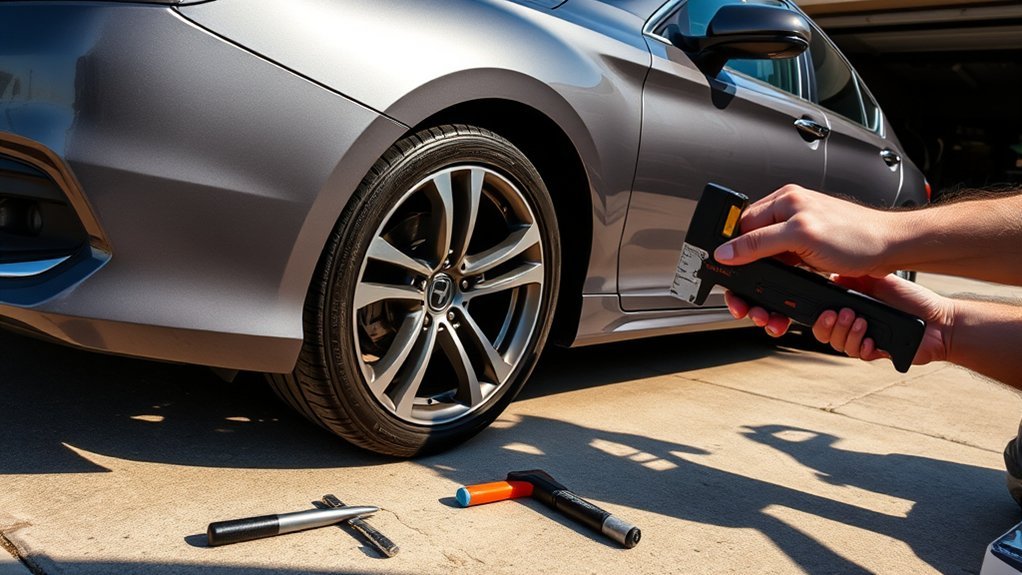
Test fitting is the best way to avoid expensive wheel mistakes. Even reliable fitment charts cannot account for every tire brand, suspension setup, brake package, or alignment change.
Proper Measurement Techniques
Offset and backspacing are related, but they are not the same measurement. Backspacing is the distance from the hub mounting surface to the back lip of the wheel. Offset compares the hub mounting surface to the wheel centerline.
Use this basic formula:
Offset = backspacing − wheel centerline
If measuring manually, lay the wheel face down on a protected surface, place a straight edge across the rear lip, and measure from the mounting pad to the straight edge to get backspacing. Then compare that number to half of the wheel width. Because wheel sizing can be confusing, use a trusted calculator or a tire shop if you are not comfortable with the math.
Test Fit Before Purchase
When test fitting wheels on your Honda Accord, check the front and rear positions carefully. The front needs extra attention because it must clear the brakes and turn through the steering range.
- Install one front wheel without fully committing. Use proper lug engagement and safe lifting practices.
- Check brake caliper clearance. Inspect both the wheel barrel and spoke face.
- Turn full lock left and right. Look for rubbing on the fender liner, bumper tab, and inner suspension area.
- Check strut and suspension clearance. Make sure the tire does not sit too close to the strut or control arm.
- Load the suspension. A wheel can clear while hanging in the air but rub when the car is on the ground.
- Repeat in the rear. Check inner clearance, fender clearance, and tire-to-liner clearance.
- Drive slowly first. Listen for rubbing over dips, turns, and driveway angles before normal driving.
Pro Tip: If you need spacers to clear brakes or suspension, use high-quality hub-centric spacers with proper stud engagement and professional installation. Spacers effectively lower offset and push the wheel outward.
Frequently Asked Questions
What is the offset on Honda Accord wheels?
Honda Accord wheel offset depends on the year, trim, market, and wheel width. Many modern Accord setups use positive offset, often around the mid-positive range, but you should verify your exact wheel stamp or a trusted fitment database instead of using one universal number.
What does +35 offset mean on a rim?
A +35 offset means the hub mounting surface is 35 mm toward the outside face of the wheel from the wheel centerline. On many Accords, +35 will push the wheel farther outward than a factory-style ET45 or ET50 wheel, so fender clearance must be checked carefully.
What does +40 offset mean?
A +40 offset places the hub mounting surface 40 mm outward from the wheel centerline. Compared with a +50 wheel of the same width, a +40 wheel sits about 10 mm farther outward. Whether that fits depends on the Accord’s wheel width, tire size, suspension height, and fender clearance.
What is +20 offset?
A +20 offset is still positive offset, but it pushes the wheel much farther outward than most factory-style Accord setups. It may create an aggressive stance, but it can also cause fender rubbing, steering kickback, and extra stress on suspension and hub components.
Is lower offset better for a Honda Accord?
Not automatically. Lower offset pushes the wheels outward and can improve stance, but it can also increase fender rubbing and steering feedback. A mild change may work, but aggressive low-offset wheels should be test-fitted before purchase.
Can I use wheel spacers to fix Accord offset?
Wheel spacers reduce effective offset by pushing the wheel outward. They can help with inner clearance, but they may create outer fender rubbing and can add load to hubs and bearings if overdone. Use hub-centric spacers and have them installed correctly.
Conclusion
Wheel offset can make or break a Honda Accord wheel upgrade. The safest setup is not the most aggressive-looking one; it is the one that keeps the wheel centered properly around the brakes, suspension, steering geometry, and fenders. Start with your original wheel specs, confirm your tire placard and owner’s manual guidance, compare width and offset together, and test fit before committing to a full set.
If you are unsure, have a tire and wheel professional inspect the setup before driving. A few minutes of checking clearance can prevent rubbing, vibration, uneven tire wear, and unsafe handling.
Sources
- Tire Rack — What Is Wheel Offset? — backs up offset, positive offset, zero offset, negative offset, and backspacing definitions.
- Discount Tire — Wheel Offset & Backspacing — backs up offset/backspacing explanations and measurement context.
- Honda Owner’s Manual — Tire and Wheel Replacement — backs up Honda’s recommendation to match tire and wheel specifications and warning about handling/stability.
- Honda Owner’s Manual — Tire and Loading Information Label — backs up the doorjamb label guidance for original tire sizes and cold tire pressure.
- Honda Info Center — 2026 Accord Wheels and Tires — backs up current Accord 17-inch and 19-inch wheel/tire trim information.
- Wheel-Size.com — Honda Accord Wheel Fitment Database — backs up year-by-year Accord wheel, tire, PCD, center bore, and offset reference checks.

Related Articles
How Tall Is a 305 70 R17 Tire? Exact Height, Width & Dimensions
Curious how tall a 305 70 R17 tire really is—and whether it fits your truck?
Read More
Can-Am Defender Tire Size Guide: Stock Specs & Upgrade Options
Just how big can you go on a Can-Am Defender before mods become necessary?
Read More
How Tall Is a 275 65 20 Tire? Exact Height, Width & Dimensions
Check the exact height, width, and hidden fitment effects of a 275/65R20 tire before you buy or upgrade.
Read More