Do Bigger Tires Affect Toyota Tacoma Towing Capacity
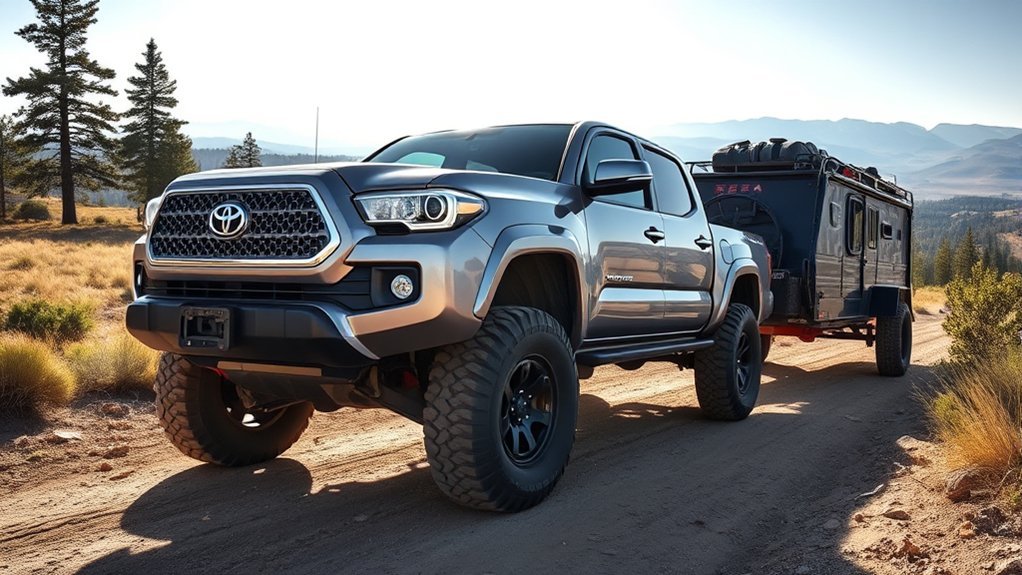
Bigger tires can affect how your Toyota Tacoma tows, but not through a fixed “pounds lost per inch” rule. The main changes involve effective gearing, rotating mass, braking feel, steering response, clearance, speedometer accuracy, and the amount of payload left after heavier wheels and tires are installed. Your Tacoma’s published limits still control the setup.
Reviewed for accuracy: July 17, 2026.
Quick Answer
Yes. Bigger tires can reduce real-world towing performance by making the effective gearing taller, increasing rotating mass, changing braking and steering feel, and sometimes reducing remaining payload. They do not create a universal pounds-per-inch reduction in Toyota’s published tow rating. Your manual, certification labels, axle ratings, and actual scale weights remain the controlling limits.
Key Takeaways
- Larger tires do not reduce Tacoma towing capacity by a fixed number of pounds per inch.
- A larger diameter makes the effective axle gearing taller, which can reduce wheel torque and increase transmission shifting.
- Added wheel-and-tire weight uses some of the truck’s remaining capacity before it reaches GVWR.
- Replacement tires must have suitable load capacity, but tire ratings do not override GVWR, GAWR, GCWR, hitch limits, or Toyota’s trailer rating.
- Verify your final setup with the correct manual, door labels, measurements, recalibration, and axle-by-axle scale weights.
Warning: Do not use an online percentage or tire-diameter formula to create a new tow rating. Never exceed the lowest applicable limit among the truck’s trailer weight rating, GCWR, GVWR, front and rear GAWR, tire capacities, wheel ratings, hitch rating, and trailer ratings.
What Changes and What Does Not
A tire-size change can alter how your Tacoma accelerates, shifts, stops, steers, and responds to a trailer. It may also change the accuracy of the speedometer, odometer, transmission logic, and some electronic systems if the new rolling circumference is not properly accounted for.
However, installing bigger tires does not give you a reliable new trailer rating. Toyota’s published towing limits are tied to a specific vehicle configuration and its tested components. The current U.S. Toyota towing information lists the 2026 Tacoma at up to 6,500 pounds, but that maximum does not apply to every Tacoma.
| Item | Can Bigger Tires Change It? | What Controls the Limit |
|---|---|---|
| Effective gearing | Yes | Stock diameter, new loaded diameter, axle ratio, and transmission gear |
| Acceleration and hill performance | Yes | Effective gearing, tire mass, engine output, cooling, grade, and total combination weight |
| Remaining payload margin | Yes, if the new assemblies are heavier | Actual loaded truck weight compared with GVWR and GAWR |
| Published Toyota tow rating | Not through a universal owner-applied formula | Model year, configuration, equipment, manual, and manufacturer rating |
| GVWR, GAWR, and GCWR | No automatic increase | Vehicle manufacturer labels and documentation |
| Hitch and trailer limits | No automatic increase | Hitch, coupler, ball, receiver, and trailer manufacturers |
Understanding Load Index and Its Importance
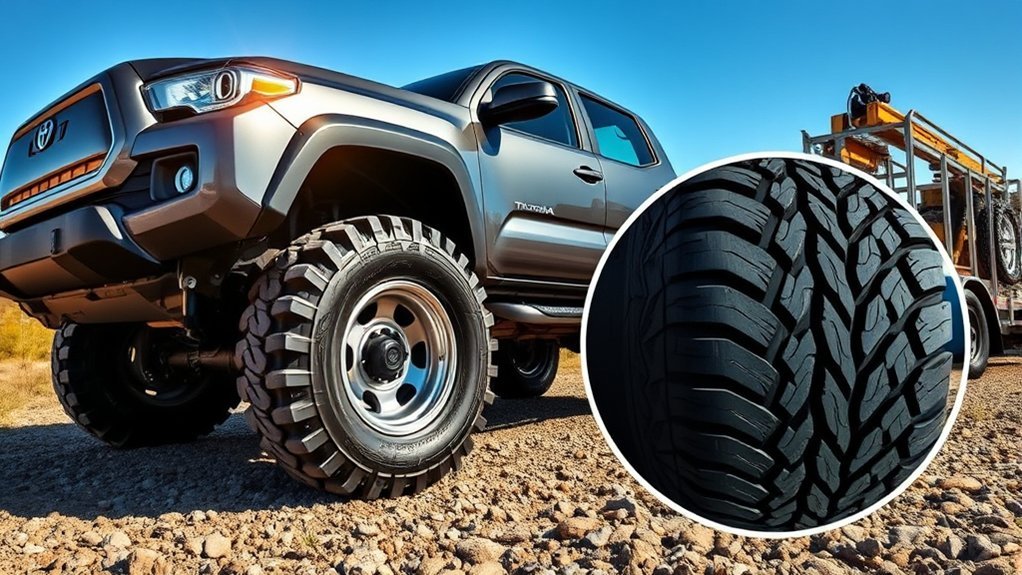
The load index is a numerical code that represents the maximum load a tire can carry under its specified service conditions. For example, a standard load index of 121 corresponds to approximately 3,197 pounds or 1,450 kg per tire, not 3,748 pounds.
When choosing replacement tires, select a tire with load-carrying capability that is appropriate for your Tacoma’s original requirements. NHTSA advises that replacement tires should provide at least equivalent maximum load capacity to the tires originally specified for the vehicle. You should also confirm that the tire is approved for the wheel width, diameter, pressure range, and intended service.
Do not add all four tire ratings together and treat that total as the truck’s payload or towing capacity. A Tacoma is evaluated axle by axle. The combined capacity of the two tires on the front axle must be sufficient for the front GAWR, and the combined capacity of the two rear tires must be sufficient for the rear GAWR. The truck must also remain within GVWR and every other applicable limit.
Note: A tire’s sidewall maximum pressure is not automatically the correct everyday pressure for your Tacoma. Start with the Tire and Loading Information label and owner’s manual, then obtain qualified guidance when a non-original tire size requires a documented load-and-inflation adjustment.
How Do Bigger Tires Impact Towing Capacity?
Bigger tires mainly affect towing through leverage and mass. A taller tire increases the distance from the axle center to the road. That makes the overall gearing taller and reduces the mechanical advantage delivered to the ground in a given transmission gear.
The truck may accelerate more slowly, downshift more often, and work harder on grades. Heavier assemblies can also require more energy to accelerate and decelerate. None of these effects can be converted into a universal number of towing pounds lost.
Tire Size and Towing Capacity
The percentage change in tire diameter can estimate the change in effective gearing. It cannot directly calculate a new tow rating.
Effective axle ratio = original axle ratio × original tire diameter ÷ new tire diameter
For example, a Tacoma with a 3.91 axle ratio and a 30-inch stock tire would have an approximate effective ratio of 3.35 after moving to a 35-inch tire:
3.91 × 30 ÷ 35 = 3.35
This does not physically change the axle gears. It describes how the taller tire changes the overall mechanical advantage at the road.
| Change From a 30-Inch Tire | Effective Ratio Multiplier | Approximate Reduction in Mechanical Advantage | Actual Speed at 60 mph Indicated* |
|---|---|---|---|
| 30 to 31 inches | 0.968 | About 3.2% | About 62 mph |
| 30 to 33 inches | 0.909 | About 9.1% | About 66 mph |
| 30 to 35 inches | 0.857 | About 14.3% | About 70 mph |
*These are simplified diameter-based examples before electronic recalibration. Actual results can differ because advertised diameter, measured diameter, tread wear, inflation, wheel load, and loaded rolling radius are not identical.
A tire-size change alters effective gearing by a percentage. It does not translate into a fixed pounds-per-inch reduction in Tacoma tow rating.
Weight Distribution Considerations
A trailer places tongue weight on the rear of the truck. That load can increase rear-axle weight while removing some load from the front axle. Larger tires do not correct poor trailer loading, excessive tongue weight, an overloaded rear axle, or an incorrectly positioned hitch ball.
A lift or taller tire may also change hitch height. The trailer should remain level or within the trailer manufacturer’s specified attitude when connected. Use the correct ball mount or approved adjustable hitch rather than towing with the trailer noticeably nose-high or nose-low.
How Tire Size Affects Your Vehicle’s Payload Capacity
The payload figure on the truck’s label is based on the vehicle as manufactured. Installing heavier wheels, tires, armor, steps, racks, suspension parts, or towing equipment increases the truck’s actual weight. That leaves less room before the truck reaches GVWR.
The most useful calculation is based on the net weight change of the complete assemblies:
Remaining capacity before GVWR = GVWR − actual loaded truck weight
Tire Weight Considerations
Compare the complete stock wheel-and-tire assembly with the complete replacement assembly. A larger tire may be fitted to a lighter or heavier wheel, so tire weight alone does not show the final change.
For example, if each replacement wheel-and-tire assembly weighs 15 pounds more than stock, four assemblies add about 60 pounds to the truck. Assuming nothing else changes, the truck then has roughly 60 pounds less remaining margin before GVWR.
Rotating mass can also affect acceleration and braking more noticeably than an equal amount of stationary cargo. The exact effect depends on where the mass sits within the assembly, so two setups with the same scale weight may not feel identical.
Load Index Importance
A higher load index can provide more tire capacity, but it does not raise the Tacoma’s GVWR, GAWR, GCWR, hitch rating, or trailer rating. The vehicle’s lowest applicable rating remains the limit.
Also verify the wheel’s load rating. A high-capacity tire mounted on an under-rated wheel does not create a safe high-capacity assembly.
Cargo Capacity Reduction
Passengers, cargo, the hitch, aftermarket accessories, and trailer tongue weight all consume the truck’s available carrying capacity. The trailer’s total weight may be within the trailer rating while the Tacoma’s rear axle or GVWR is already overloaded.
This is why towing calculations should not stop at the advertised trailer weight. You need the truck’s actual front-axle weight, rear-axle weight, total vehicle weight, trailer-axle weight, and combined weight in travel-ready condition.
Effects of Larger Tires on Vehicle Dynamics
Larger tires can change steering response, braking feel, lane-change behavior, and trailer-sway sensitivity. The outcome depends on tire construction, tread pattern, sidewall height, inflation pressure, wheel width, wheel offset, suspension condition, and the amount of lift.
A bigger tire does not automatically have more sidewall flex. An LT tire with a stronger casing may respond differently from a softer passenger-type tire, even when the LT tire is physically larger. Running more pressure than necessary can also reduce grip and ride compliance, while insufficient pressure can increase heat and flex.
Taller tires raise the axle center by roughly half the increase in unloaded diameter. Moving from a 30-inch to a 35-inch tire raises the axle center by about 2.5 inches before accounting for load and deflection. A suspension lift may raise other parts of the truck and its center of mass further.
More height can increase body movement and reduce the stability margin during sudden steering, crosswinds, emergency maneuvers, or trailer sway. Wider wheels and altered offset may also change scrub radius, steering effort, bearing loads, and clearance.
How Tire Upgrades Affect Gear Ratios and Performance
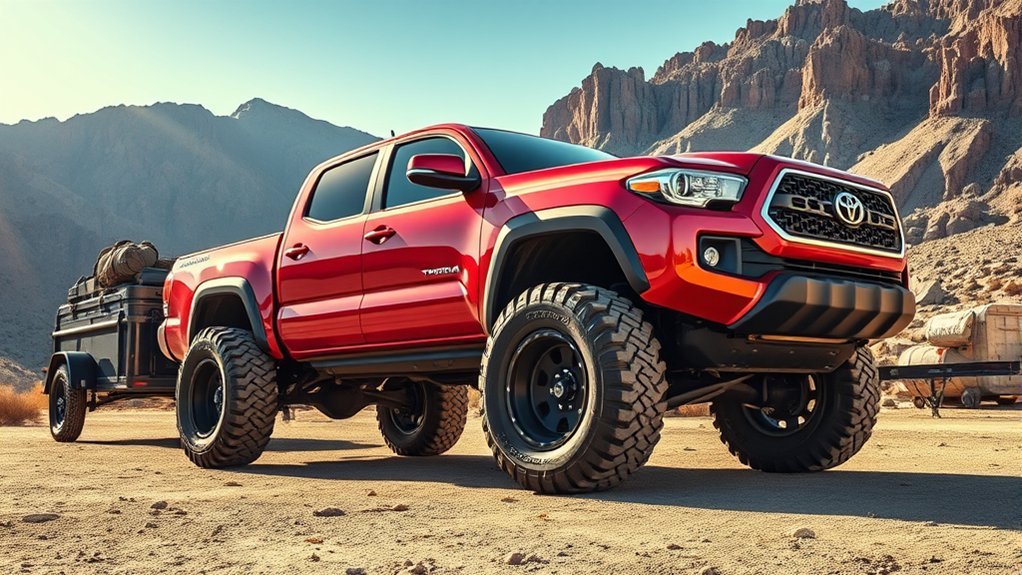
A taller tire reduces engine rpm at a given true road speed when the transmission remains in the same gear. That may sound helpful, but the engine can fall farther from its strongest operating range while pulling a trailer. The transmission may respond by unlocking the torque converter or downshifting more often.
The actual outcome depends on your Tacoma’s model year, engine, transmission, axle ratio, tire size, trailer weight, terrain, temperature, and driving speed. Hybrid and non-hybrid configurations may also respond differently.
Speedometer and Odometer Error
Without recalibration, a larger rolling circumference usually causes the vehicle to travel faster and farther than indicated.
Approximate actual speed = indicated speed × new tire diameter ÷ original tire diameter
A 35-inch tire replacing a 30-inch tire creates a theoretical ratio of 1.167. At an indicated 60 mph, the truck could be traveling close to 70 mph before calibration. The exact result should be checked with measured rolling circumference or a verified road-speed reading.
Can Regearing Restore Performance?
Changing axle gears can bring the effective ratio closer to stock and improve acceleration, grade performance, and shift behavior. It may be useful for a heavily modified Tacoma that regularly runs much larger tires.
Regearing does not strengthen the frame, brakes, hitch, cooling system, axles, wheels, tires, or suspension. It also does not automatically increase Toyota’s published ratings. Treat it as a drivability modification, not permission to tow more.
Pro Tip: Before buying axle gears, record your trailer-ready weights, normal towing route, transmission temperatures if available, shift behavior, and measured tire diameter. That information helps a qualified drivetrain specialist recommend a ratio for your actual use.
Suspension Modifications: What You Need to Know
Larger tires often require trimming, altered wheel offset, a leveling kit, a suspension lift, or a combination of changes. Each modification can affect towing differently.
[Products Worth Considering]

Give your Tacoma the Perfect Blend of Performance, Protection, and Style from Rough Country.

Give your Tacoma the Perfect Blend of Performance, Protection, and Style from Rough Country.
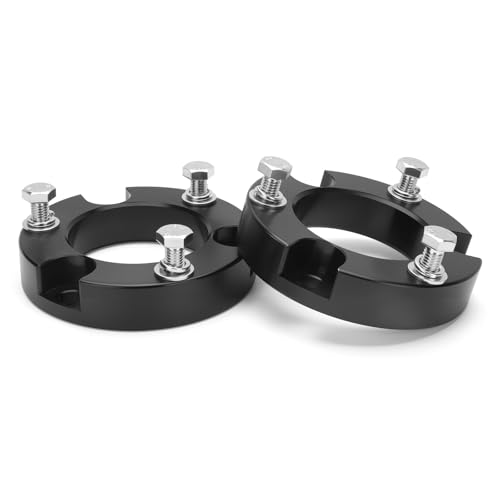
Fits Chart: 2005-2023 Tacoma 2WD 4WD(6-lug wheels) , 2003-2024 4Runner 2WD 4WD and 2007-2015 FJ Cruise 2WD 4WD, *Not fit XREAS Suspension models
Impact on Towing Stability
A lift can increase body roll and change the relationship between the truck, hitch, and trailer. Worn shocks, weak rear springs, incorrect alignment, or soft tire pressure can make those effects more noticeable.
Air springs, helper springs, or stiffer rear components may reduce visible sag, but they do not increase the truck’s GVWR or rear GAWR. A level-looking truck can still be overloaded.
Suspension Geometry Adjustments
| Modification | Possible Towing Effect | What to Check |
|---|---|---|
| Leveling kit | May reduce visible front rake and leave less visual allowance for rear sag | Alignment, suspension travel, loaded headlight aim, and rear-axle weight |
| Suspension lift | Raises body and frame components and may increase body movement | Geometry, driveline angles, braking, hitch height, and component instructions |
| Body lift | Does not raise the axles but can change body, bumper, and hitch relationships | Receiver location, bumper clearance, wiring, and manufacturer restrictions |
| Different wheel offset | Can alter steering geometry, clearance, and bearing leverage | Full-lock clearance, suspension compression, wheel rating, and alignment |
| Helper or air springs | Can reduce sag without increasing legal or manufacturer ratings | Actual axle weights, pressure instructions, and unloaded ride behavior |
Weight Distribution Considerations After Suspension Changes
Check the loaded front and rear axle weights after changing ride height, hitch height, tire size, or suspension components. Visual stance alone cannot tell you whether the front axle has enough load for steering or whether the rear axle is overloaded.
Confirm that the tires clear the body, frame, upper control arms, brake hoses, and suspension components at full steering lock and through suspension compression. A tire that clears in a parking lot may still rub when the truck is loaded and turning over uneven ground.
Why Weight Distribution Hitches Matter for Your Towing Setup
A properly selected weight-distribution hitch can transfer some hitch load from the truck’s rear axle toward the truck’s front axle and the trailer axles. This may improve front-axle load restoration and reduce excessive rear sag when the vehicle, hitch, and trailer manufacturers approve its use.
It does not increase the Tacoma’s trailer rating, GCWR, GVWR, GAWR, tire capacity, receiver rating, or trailer rating. It also cannot compensate for excessive trailer weight, poor cargo placement, insufficient tire capacity, or an unsuitable suspension modification.
Do not apply a universal trailer-weight threshold. Follow the towing instructions for your exact Tacoma model year and configuration, the receiver label, the weight-distribution hitch instructions, and the trailer manufacturer’s requirements.
[Products Worth Considering]

WEIGHT DISTRIBUTION: Hardened steel chains connect the hitch arms to your trailer frame for improved load distribution. The result is improved steering, braking control, and helping to reduce stressful towing situations.

Enhanced Structural Integrity: Forged from high-tensile alloy steel, offering superior deformation resistance. The design ensures structural integrity even in harsh conditions, preventing metal fatigue and fractures. It guarantees all-weather security for long-distance towing, snow-resistant, wind-resistant, and heavy-duty usage.

Allows for easy leveraging of weight distribution hookup brackets
What Are the Common Myths About Towing With Bigger Tires?
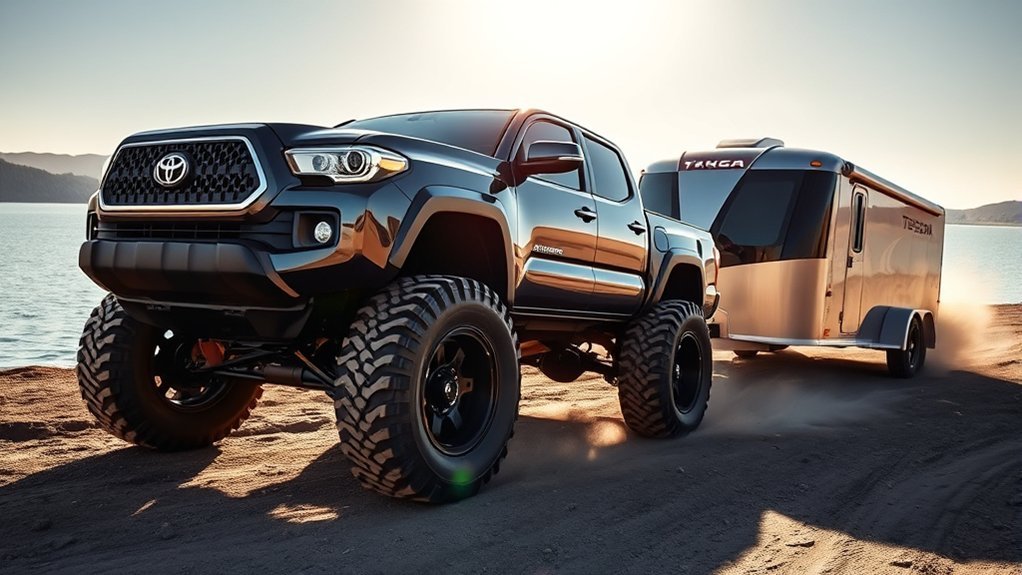
- Myth: Every added inch removes a fixed number of towing pounds.
The effect depends on the original and new loaded diameter, gearing, mass, vehicle configuration, trailer, terrain, and other factors. No universal pounds-per-inch rule applies. - Myth: Bigger tires automatically have more sidewall flex.
Flex depends on construction, load range, aspect ratio, pressure, wheel width, load, and temperature, not diameter alone. - Myth: A high load index raises Tacoma payload or tow rating.
It may provide adequate tire capacity, but it does not raise any vehicle or hitch rating. - Myth: Regearing restores the full original towing setup.
Regearing can restore effective gearing but does not restore stock braking, tire mass, steering geometry, cooling, calibration, or manufacturer testing. - Myth: A weight-distribution hitch lets you tow more.
It redistributes approved tongue load. It does not increase the lowest applicable rating. - Myth: If the truck sits level, it is not overloaded.
Helper springs or air springs can hide sag. Only specifications and actual scale weights reveal the loading condition.
Tips for Choosing the Right Tire Size for Towing
Use the smallest tire-size change that meets your actual clearance or off-road need. A modest change is generally easier to accommodate than a jump that requires extensive suspension, gearing, wheel, and calibration work.
| Check | What to Verify |
|---|---|
| Vehicle limits | Exact trailer rating, GVWR, GCWR, front GAWR, rear GAWR, and payload label for your Tacoma |
| Tire capacity | Load index, maximum load, service type, approved rim width, and pressure requirements |
| Wheel capacity | Diameter, width, offset, load rating, lug compatibility, and brake clearance |
| Physical clearance | Full steering lock, full suspension compression, brake hoses, body mounts, frame, and control arms |
| Assembly weight | Complete replacement wheel-and-tire weight compared with the complete stock assembly |
| Calibration | Speedometer, odometer, transmission behavior, TPMS compatibility, ABS, and stability-control implications |
| Towing behavior | Acceleration, downshifting, braking, sway sensitivity, tire heat, and steering response |
Use tires intended for the expected load, speed, road surface, temperature, and weather. An aggressive off-road tread may add weight, noise, heat, and steering movement compared with a highway-oriented towing tire. A higher load range can also create a firmer ride and does not eliminate the need for correct inflation.
[Products Worth Considering]

Size: 265/70R17,Tire Only - Wheel/Rim Not Included,Dimension (inch): 31.65 X 10.71 X 31.65,weight (lbs): 38.78,Max Pressure (psi): 51; Load Index: 115 ( 2679 lbs for single tire),Speed Rating: T (118 mph); Load Range: SL (Standard Load)

WET-WEATHER TRACTION FOR TRUCKS & SUVs – Deep, wide grooves channel water away from the contact patch to reduce hydroplaning risk on rain-slicked roads. Designed for LT225/75R16 light truck and SUV applications, this all-season highway terrain tire maintains confident grip on wet surfaces so you stay in control when conditions change.
Size: 245/70R16,Tire Only - Wheel/Rim Not Included,Dimension (inch): 29.53 X 9.76 X 29.53,weight (lbs): 32.23,Max Pressure (psi): 51; Load Index: 107 ( 2149 lbs for single tire),Speed Rating: T (118 mph); Load Range: SL (Standard Load)
How to Maintain Safe Towing Performance With Upgraded Tires
- Identify the exact truck configuration. Use the VIN, model year, drivetrain, engine, cab, bed, axle ratio, equipment, and towing package.
- Read the correct Toyota towing instructions. Do not rely only on a general Tacoma maximum advertised online.
- Record all ratings. Include trailer rating, GCWR, GVWR, both GAWR values, tire capacities, wheel ratings, receiver rating, ball rating, coupler rating, and trailer ratings.
- Compare complete assembly weights. Include both the tire and wheel.
- Confirm clearance under load. Check steering lock and suspension compression, not only static parking-lot clearance.
- Correct speed and distance readings. Recalibrate through a supported method where available, then verify the result.
- Set pressure correctly. Use the placard, manual, and qualified load-and-inflation guidance rather than guessing from the tire’s maximum sidewall pressure.
- Load the trailer correctly. Keep the trailer within its limits and follow its manufacturer’s tongue-weight and cargo-placement instructions.
- Weigh the complete combination. Include passengers, fuel, cargo, hitch equipment, and the trailer as used.
- Test conservatively. Start below the limits and evaluate braking, shifting, steering, tire temperature, and stability before a long trip.
How to Verify Your Towing Setup at a Scale
Visit a public vehicle scale with the truck and trailer loaded exactly as they will travel. Include passengers, normal fuel, cargo, tools, hitch equipment, water, batteries, propane, and recreational gear.
- Weigh the truck and connected trailer. Position the truck’s front axle, rear axle, and trailer axles on separate scale platforms where possible.
- Record front-axle weight. Compare it with front GAWR and evaluate how the trailer changes front-axle loading.
- Record rear-axle weight. Compare it with rear GAWR and the combined capacity of the rear tires and wheels.
- Add the truck axles. The result must remain at or below GVWR.
- Add all axles. The complete combination must remain at or below GCWR.
- Determine trailer weight correctly. The trailer’s gross weight includes the load carried by its axles plus the tongue weight carried by the truck.
- Reweigh after adjustments. Changing cargo position or hitch settings can alter several axle readings.
The scale does not replace manufacturer instructions, but it reveals whether your real loaded setup is approaching or exceeding the ratings printed on the truck, hitch, tires, wheels, and trailer.
Frequently Asked Questions
Can a Tacoma really tow 6,500 pounds?
Some properly configured Tacomas can carry a published trailer rating of up to 6,500 pounds. That number does not apply to every model year or configuration. Confirm the limit for your exact truck and reduce available capacity as required for passengers, cargo, accessories, tongue weight, and other equipment.
Do 35-inch tires automatically reduce Tacoma towing capacity by 1,300 pounds?
No. A 30-to-35-inch change creates an approximate 14.3% reduction in effective gearing, but that percentage cannot be converted directly into a 1,300-pound towing loss. Actual performance depends on the truck, gears, tire mass, trailer, terrain, cooling, calibration, and loading.
Does regearing restore the original towing capacity?
Regearing can restore much of the original effective gearing and improve acceleration or shift behavior. It does not change the vehicle’s published GVWR, GAWR, GCWR, hitch rating, brake capacity, tire limits, or manufacturer trailer rating.
Do heavier tires reduce Tacoma payload?
A heavier wheel-and-tire setup increases the truck’s actual weight. That leaves less margin before GVWR and may reduce how much passenger, cargo, hitch, and tongue weight you can add. Compare complete assemblies rather than tire weight alone.
Can a weight-distribution hitch restore capacity lost to bigger tires?
No. An approved weight-distribution hitch may improve axle-load distribution and front-axle load restoration. It cannot increase the Tacoma’s trailer rating, GCWR, GVWR, GAWR, tire capacity, wheel capacity, receiver rating, or trailer rating.
Conclusion
Bigger tires can make a Toyota Tacoma less comfortable or less capable while towing by changing effective gearing, assembly weight, braking response, steering, ride height, and electronic calibration. The amount of change depends on the complete setup, so no fixed pounds-per-inch towing penalty is reliable.
Start with the ratings for your exact Tacoma, choose properly rated tires and wheels, account for every modification, correct the speedometer where possible, confirm clearance, and weigh the travel-ready combination by axle. Regearing, helper springs, and weight-distribution equipment may improve specific behaviors, but none of them raises the truck’s published limits.
Sources
- Toyota Vehicles for Towing — current Tacoma maximum towing information and Toyota’s warning about configuration, occupants, cargo, and added equipment.
- Toyota Tacoma Manuals and Warranties — model-year-specific owner documentation and towing instructions.
- NHTSA TireWise — tire pressure, Tire and Loading Information label, TPMS, inspection, and tire-safety guidance.
- NHTSA Replacement Tire Load-Capacity Interpretation — guidance on selecting replacement tires with adequate maximum load capacity.
- SAE J2807 — performance requirements used to determine tow-vehicle GCWR and trailer weight ratings.
- Continental Tire Load Index Guide — standard load-index definitions and load-capacity conversions.

Related Articles
How Tire Weight Affects Toyota Tacoma Performance
How does tire weight influence your Toyota Tacoma's performance and efficiency? Discover the surprising effects that could change your driving experience.
Read More
Tire Noise Levels by Tire Type on a Toyota Tacoma
A comprehensive look at how tire types affect noise levels in your Toyota Tacoma reveals surprising insights that could enhance your driving experience.
Read More
How To Choose Tires for a Dual Use Toyota Tacoma
Unlock the secrets to selecting the perfect tires for your dual-use Toyota Tacoma, ensuring optimal performance and comfort on every adventure. Discover more inside!
Read More