
Tire Load Ratings and Toyota Hilux Payload: Explained
Choosing the right tire load rating for a Toyota Hilux is not just about buying the toughest tire on the shelf. The safe choice depends on your Hilux model, tire size, load index, wheel rating, cold inflation pressure, and the way you use the truck for cargo, towing, off-road driving, or daily commuting.
Quick Answer
For a Toyota Hilux, choose tires that meet or exceed the original tire size, load index, speed rating, and load capacity shown on the vehicle placard or owner’s manual. Load Range E can be useful for heavy towing or work loads, but it does not increase the Hilux’s legal payload, GVM/GVWR, axle rating, or towing limit.
Key Takeaways
- The load index is the most precise tire weight rating; the load range describes strength class and maximum load-carrying pressure.
- A higher-rated tire can improve stability under load, but it cannot legally raise the Hilux’s payload or towing capacity.
- Use the tire placard, owner’s manual, and tire maker’s load-inflation table before changing size or load range.
- Check pressure when tires are cold, and adjust for loaded or towing use only within Toyota, tire, and wheel limits.
At a Glance
| Time Required | 10–20 minutes to check the placard, sidewall markings, pressure, and load rating |
| Difficulty | Easy for checking; moderate if changing tire size or load range |
| Tools Needed | Tire pressure gauge, tire placard, owner’s manual, tire sidewall markings, and a tire maker’s load-inflation table |
| Cost | Free to inspect; tire replacement cost depends on brand, size, load rating, and fitment |
What Are Tire Load Ratings and Why Do They Matter?
A tire load rating tells you how much weight a tire can carry when it is used at the correct inflation pressure and within its designed limits. For a Toyota Hilux, this matters because the truck may be used for tools, passengers, roof racks, canopy setups, off-road gear, towing, or heavy cargo.
The two terms that cause the most confusion are load index and load range:
- Load index is the number in the tire service description, such as 112, 121, or 125. It gives a specific maximum load capacity for that tire when properly inflated.
- Load range is a strength class, such as C, D, or E on many light-truck tires. It relates to ply rating and maximum load-carrying pressure, but it is not as precise as the load index.
Michelin explains that the load index is shown on the tire sidewall and represents the maximum weight the tire can carry when properly inflated. It also warns that exceeding load and speed limits can create heat buildup and raise the risk of tire damage or failure. Michelin’s load and speed rating guide is a useful reference for this.
Warning: Never fit a tire with a lower load index or speed rating than Toyota specifies for your Hilux unless a qualified tire professional confirms it is safe and legal for your exact model and use case.
[Products Worth Considering]

The JACO FlowPro Tire Inflator measures, inflates, and airs down tires up to 100 PSI with battery-free operation and ±2% accuracy after calibration. It features a glowing pressure dial for night visibility, a heavy-duty steel build with a hybrid hose, and a precision push-to-inflate thumb trigger. The patented Lightning Air Chuck locks on for a secure seal, and the kit includes quick-connect hardware for easy inline use with your air compressor.

EVOULTES heavy duty tire inflator with an integrated gauge delivers accurate pressure readings from 10–120 PSI, helping you inflate, deflate, and check tires in one tool. The 16.5-inch extended dual-head air chuck with swivel base reaches hard-to-access dual wheel valves on trucks and RVs. A brass trigger core and side-mounted air release valve make operation smooth, with standard 1/4" NPT threading and quick-connect compatibility for easy setup.

Keep RV, trailer, or truck dual-axle tires protected with waterproof, UV-resistant covers that help guard against sunlight, snow, rust, and dirt. The dual tire covers are easy to install with a rope/bungee fastener for a stable fit that won’t easily slip. Designed for 27–30 inch diameter wheels, they help maintain tire condition through harsh weather.
The Impact of Load Ratings on Toyota Hilux Performance
The right tire load rating helps the Hilux stay stable, predictable, and safe when it is loaded. The wrong rating can lead to excess sidewall flex, heat buildup, uneven wear, poor handling, and a higher chance of tire failure.
Load rating affects four key areas:
- Payload support: Tires must be able to support their share of the loaded vehicle weight.
- Towing stability: Stiffer light-truck tires can reduce squirm when the rear axle is carrying cargo or tow-ball download.
- Heat control: Underinflated or overloaded tires build heat faster, especially at highway speeds.
- Ride comfort: Higher load range tires can ride firmer, especially when the truck is unloaded.
Do not confuse tire capacity with vehicle capacity. A stronger tire does not increase the Hilux’s legal payload, Gross Vehicle Mass (GVM/GVWR), Gross Combined Mass (GCM/GCWR), axle limits, or towing rating. Toyota states that payload is calculated from GVM minus kerb weight and is affected by occupants, luggage, accessories, and tow-ball download. Current Toyota Australia HiLux specifications also remind owners to consider GVM, GCM, towing capacity, and axle limits before towing. Toyota Australia’s HiLux specifications provide current examples by variant.
A higher load-rated tire may help the tire carry weight safely, but only the vehicle manufacturer’s ratings decide how much the Hilux itself may legally carry or tow.
Understanding the E Load Rating for Hilux Tires
Load Range E is common on heavy-duty light-truck tires. It is often described as a 10-ply rated tire, but that does not mean the tire has ten physical layers. Modern radial tires use stronger materials, so “10-ply” is a strength rating, not a literal ply count.
Many LT Load Range E tires are designed for higher maximum load-carrying pressure than C or D tires. Toyo’s load-inflation data, for example, lists an LT265/70R17 121S E/10 tire with a single-tire capacity of 3,195 lb at 80 psi. That does not mean every E-rated tire carries the same load. The exact capacity depends on tire size, load index, rim, inflation pressure, and tire construction. Use the tire sidewall and a manufacturer’s table such as Toyo Tires’ load and inflation tables to confirm the correct number.
E-rated tires can make sense for a Hilux that regularly carries heavy tools, a canopy, recovery gear, a rooftop tent, or tow-ball weight. They can also be useful on rough tracks where stronger sidewalls are desirable. However, they may be heavier, firmer, and more expensive than standard or lower load range tires.
Pro Tip: If your Hilux is unloaded most of the week and only tows occasionally, compare the original load index with your real loaded axle weights before jumping straight to Load Range E.
Comparing E Load Ratings to Other Tire Ratings for Heavy Loads
Load Range E is stronger than many C and D light-truck options, but the best tire for your Hilux is the one that matches your vehicle rating, wheel rating, tire placard, and driving use.
| Load Range | Common Ply Rating | Typical Use | Hilux Consideration |
|---|---|---|---|
| C | 6-ply rated | Light trucks and lighter loads | May be enough for some setups if it meets the original load index. |
| D | 8-ply rated | Moderate towing or payload use | Often a good middle ground where available in the correct size and load index. |
| E | 10-ply rated | Heavier cargo, towing, work trucks, rough tracks | Useful for heavy Hilux setups, but can ride firmer when unloaded. |
| F | 12-ply rated | Very heavy-duty applications | Usually unnecessary for most Hilux owners unless a professional fitment requires it. |
The load index is still the final check. For example, Toyo’s tables show how two tires with different load indexes can carry different loads even when they share a similar load range. That is why you should never choose by the letter alone.
Tire Rating Comparisons
When comparing tire ratings, start with the original tire shown on your Hilux placard. Then compare the replacement tire’s size, load index, speed rating, construction type, and load range. A tire with a higher load range but the wrong size, wrong rim fitment, or lower speed rating may still be the wrong choice.
For non-original sizes, use a manufacturer load-inflation table and ask a qualified tire professional to confirm the required cold pressure. Toyo notes that replacement tires must have equal or greater load-carrying capacity by inflation compared with the original equipment tire shown on the vehicle placard.
Load Capacity Differences
Load capacity is not a single number for all E-rated tires. It changes with:
- tire size;
- load index;
- inflation pressure;
- single vs dual fitment;
- wheel load and pressure rating;
- tire brand and construction.
For Hilux owners, the safest rule is simple: the tire must support the vehicle’s required axle loads and meet or exceed the original tire’s load capacity. If you tow, remember that tow-ball download adds weight to the rear axle and reduces remaining payload.
Recommended Tire Sizes for the Toyota Hilux
Toyota Hilux tire sizes vary by model year, market, trim, drivetrain, and wheel package. For example, current Toyota Australia HiLux specifications list 265/65R17 and 265/60R18 across many 4×2 and 4×4 variants. Older models and other markets may use different sizes, including commercial-style tires on some work variants.
The right size is the one listed on your vehicle’s tire placard or owner’s manual. If you are changing tire size for off-road clearance or wheel upgrades, confirm all of the following before buying:
- overall tire diameter and legal fitment rules in your region;
- rim width and offset compatibility;
- load index equal to or higher than Toyota’s requirement;
- speed rating appropriate for the vehicle;
- clearance at full steering lock and suspension compression;
- wheel load rating and maximum inflation rating;
- spare tire compatibility.
Popular Tire Options
Hilux owners commonly choose highway-terrain, all-terrain, mud-terrain, or commercial light-truck tires depending on how the truck is used. A work Hilux that carries tools every day may benefit from a different tire than a weekend off-road Hilux that mostly runs unloaded on highways.
- Highway-terrain tires: best for road comfort, fuel economy, and low noise.
- All-terrain tires: a balanced choice for mixed road, gravel, work, and touring use.
- Mud-terrain tires: useful for mud and rough trails, but often louder and heavier.
- Commercial LT tires: useful when durability and load capacity matter more than ride softness.
Size Compatibility Considerations
A larger tire can change gearing, speedometer accuracy, braking feel, fuel use, and suspension clearance. A stronger tire can also be heavier, which may affect acceleration, braking distance, and ride comfort. For a Hilux used near its payload limit, tire strength matters; for a lightly loaded daily driver, too much tire can feel harsh.
Note: Do not rely on a generic tire-size list online. Check the placard on your Hilux, then confirm any non-original size with a tire professional and local road rules.
Why Using the Right Load Rating for Your Hilux Matters
Using the right load rating protects the tire, the vehicle, and everyone around you. It matters most when your Hilux is carrying work gear, towing a trailer, running off-road at reduced pressures, or driving long highway distances in hot weather.
The correct tire load rating helps you:
- Reduce tire failure risk: Overloaded tires flex more, build heat, and wear faster.
- Maintain steering and braking control: A loaded Hilux needs stable tires, especially on the rear axle.
- Protect the sidewall: A suitable LT tire can better resist sidewall damage in work and off-road use.
- Stay within legal limits: Tire rating, GVM/GVWR, axle ratings, GCM/GCWR, and towing limits must all be respected.
The tire load rating is only one part of the system. Suspension upgrades, heavier tires, stronger wheels, or airbags do not automatically increase the manufacturer’s legal GVM or towing rating unless the vehicle is properly certified under the rules in your region.
[Products Worth Considering]
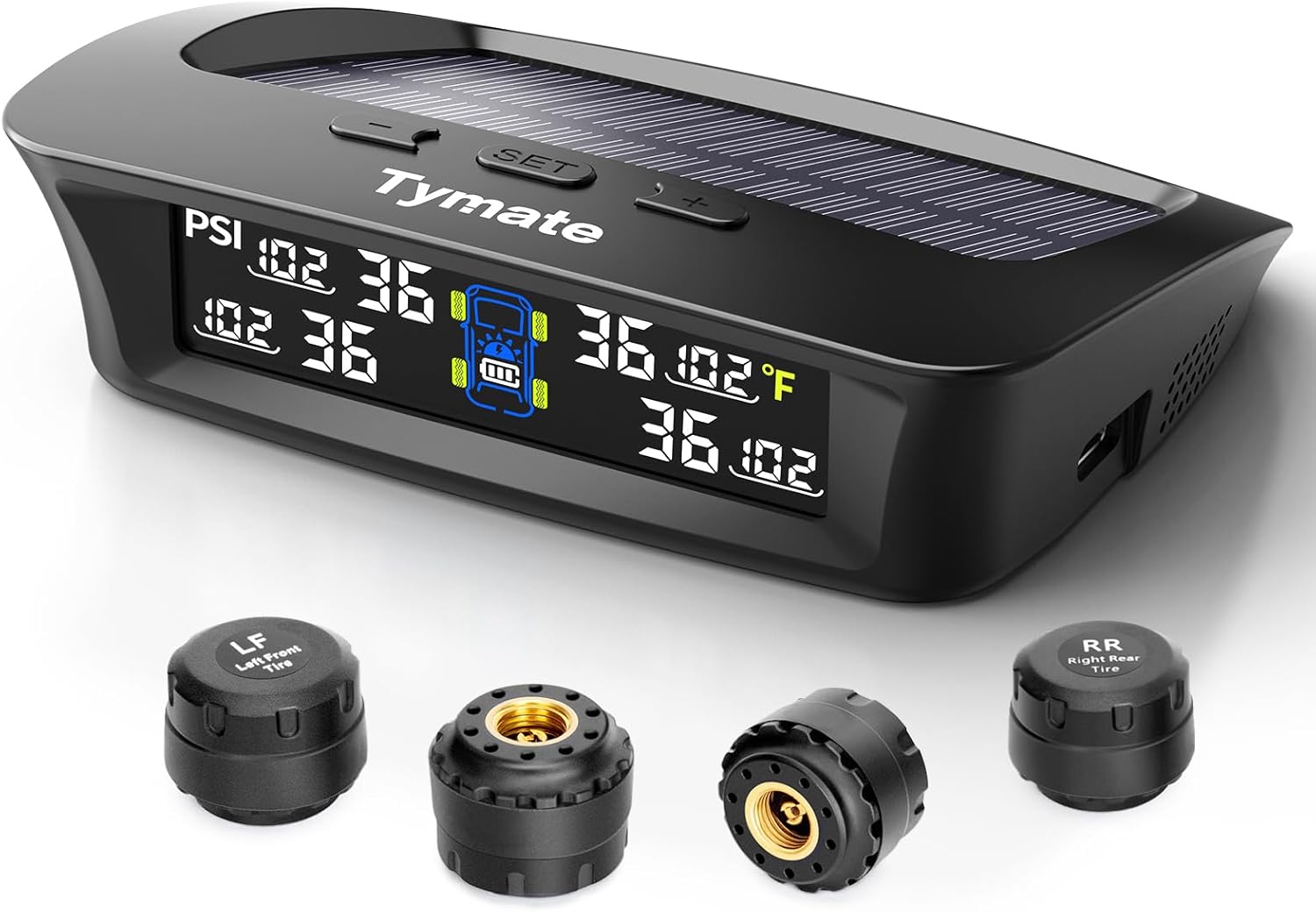
The Tymate TM3 RV TPMS delivers real-time tire pressure monitoring from 0 to 144 PSI with accurate readings and dependable wireless communication. It includes four external sensors with pre-pairing, six alarm modes for rapid leak, pressure extremes, temperature, and signal loss, plus an easy-reference setup for alert thresholds. Solar and USB-C charging help keep the display powered, while the color LCD and adaptive backlight improve visibility for safer driving and towing.

This portable cordless tire inflator delivers fast, efficient inflation for cars, motorcycles, bikes, and sports balls with a digital pressure gauge. Use the one-click PSI preset with auto shut-off for accurate, hands-free topping to your target pressure up to 150 PSI. It’s compact and rechargeable with a built-in emergency LED light plus valve adapters and accessories for quick, ready-to-go use.
Best Practices for Maintaining Tire Pressure on Your Hilux
Correct tire pressure is essential because tire load capacity depends on inflation pressure. NHTSA advises drivers to use the vehicle manufacturer’s recommended cold tire pressure from the tire information placard or owner’s manual, not the maximum pressure molded into the tire sidewall. It also recommends checking tire pressure monthly and when tires are cold. NHTSA TireWise explains that cold means the vehicle has not been driven for at least three hours.
Use this routine:
- Find the tire placard on the door edge, door pillar, glove box area, fuel flap, or owner’s manual.
- Check all tires when cold, including the spare.
- Use the placard pressure for normal use unless Toyota provides a loaded or towing pressure for your exact model.
- If your Hilux is heavily loaded, confirm the correct pressure using Toyota’s guidance and the tire manufacturer’s load-inflation table.
- Never exceed the maximum pressure marked on the tire or wheel.
- Recheck pressure after major temperature changes, before long trips, and before towing.
Warning: Airing down for sand, mud, or rocks reduces load capacity and increases heat risk at speed. Reinflate before highway driving or carrying heavy loads.
How to Select Tires Based on Your Hilux’s Payload Requirements
Start with the vehicle, not the tire. Toyota’s current HiLux specifications show that GVM, GCM, towing capacity, kerb weight, and tire size vary by variant. Toyota also notes that actual payload is reduced by occupants, luggage, accessories, and tow-ball download. That means a fully accessorized touring Hilux may have far less usable payload than the brochure number suggests.
Use this simple process:
- Find your Hilux’s GVM/GVWR: Use the compliance plate, owner’s manual, or official Toyota specs for your exact model.
- Calculate real payload: Payload equals GVM minus kerb weight, then subtract accessories, passengers, cargo, fuel-related additions, and tow-ball download.
- Check axle loads: Weigh the front and rear axle when loaded for travel or work.
- Read the tire sidewall: Confirm size, load index, speed rating, and load range.
- Match or exceed OE capacity: Replacement tires should meet or exceed the original load capacity at the correct pressure.
- Check wheel limits: The wheel must be rated for the load and pressure you plan to use.
- Confirm fitment: Make sure the tire clears the body, suspension, brakes, and spare wheel location.
- Get professional confirmation: For non-original sizes, ask a qualified tire shop to calculate the correct load-inflation pressure.
For a heavily loaded Hilux, an LT tire with a suitable load index and load range may be the right choice. For a standard Hilux used mostly on-road, the original-equipment load index may already be enough. The goal is not the highest rating possible; the goal is the correct rating for your actual load.
Frequently Asked Questions
What is better for a Hilux: 4-ply or 10-ply tires?
It depends on the load and use. A 10-ply rated tire, often Load Range E in LT sizes, is stronger and better suited to heavy loads, towing, work gear, and rough tracks. A lighter tire can ride better and weigh less for normal road use. Always choose by the required load index and Toyota’s placard, not ply rating alone.
What size tires can I put on my Toyota Hilux?
Use the tire size shown on your Hilux tire placard or owner’s manual. Current Toyota Australia HiLux examples include 265/65R17 and 265/60R18 on many variants, but sizes vary by year, market, trim, and wheel package. If changing size, confirm legality, clearance, rim width, load index, speed rating, and spare fitment.
Do E-rated tires increase Toyota Hilux payload?
No. E-rated tires can provide more tire load capacity when correctly fitted and inflated, but they do not increase the Hilux’s legal payload, GVM/GVWR, axle limits, GCM/GCWR, or towing capacity. Those limits are set by the vehicle manufacturer and local regulations.
Should I use the PSI on the tire sidewall?
No. The sidewall shows the tire’s maximum limit, not the recommended pressure for your Hilux. Use the cold pressure on the Toyota tire placard or owner’s manual, then use a tire manufacturer’s load-inflation table for approved non-original fitments or heavy-load calculations.
Can I mix different load ratings on a Hilux?
Avoid mixing different load ratings, sizes, construction types, or tread patterns unless Toyota or a qualified tire professional confirms the setup is safe. For predictable handling, the best practice is to run a matching set that meets the required load index and pressure guidance.
Conclusion
The best Toyota Hilux tire load rating is the one that matches your exact vehicle, real payload, towing setup, wheel rating, and driving conditions. Load Range E tires can be a smart choice for heavy work, towing, touring builds, and rough terrain, but they are not automatically better for every Hilux. Check the placard, read the load index, calculate your loaded weight, and confirm pressures with the owner’s manual and tire maker’s data before changing tire size or load range.
Sources
- Toyota Australia HiLux Specifications — current examples of HiLux GVM, GCM, towing capacity, tire sizes, and payload cautions.
- NHTSA TireWise — cold tire pressure, tire placard guidance, monthly checks, tread, and tire safety practices.
- Michelin Tire Load Rating & Speed Rating Guide — load index, speed rating, sidewall markings, and safety limits.
- Toyo Tires Load & Inflation Tables — how to use tire maker data when replacing tires or changing fitment.
- Toyo Tires Load Inflation Table PDF — LT tire load-inflation examples, E/10 references, and replacement tire capacity cautions.

Related Articles
Toyota Hilux Run-Flat Tires: What You Need to Know
Take control of your safety with Toyota Hilux run-flat tires; discover their benefits and hidden costs that could change your driving experience forever.
Read More
Effects of Underinflated Tires on the Toyota Hilux
Inadequate tire pressure in your Toyota Hilux can lead to serious safety issues and costly repairs; discover how to avoid these pitfalls.
Read More
The Risks of Overinflating Toyota Hilux Tires
Overinflating your Toyota Hilux tires can lead to dangerous blowouts and uneven wear, but understanding the risks is crucial for your safety.
Read More