
Toyota Tundra Tire Size by Year and Trim: Complete Reference Chart
Choosing the right Toyota Tundra tire size depends on the truck’s model year, trim, wheel package, and any suspension or wheel changes. Use the tables below as a practical starting point, but always confirm the exact size on the tire-and-loading placard on your driver-side door jamb before buying tires.
Quick Answer
Most 2000–2006 Tundras use sizes such as 245/70R16, 265/70R16, or 265/65R17. Most 2007–2021 models use 255/70R18, 275/65R18, or 275/55R20. Current 2022–present trucks commonly use 245/75R18, 265/70R18, 265/60R20, 265/50R22, or TRD Pro 285/65R18.
Key Takeaways
- The door-jamb tire placard is the safest source for your exact factory size, cold tire pressure, and load information.
- The 2007–2021 Tundra did not normally come with 33×12.50R17 tires from the factory; common OE sizes are metric 18- and 20-inch sizes.
- A 35-inch tire is usually a modified/lifted fitment on a Tundra, not a simple factory replacement.
- When upsizing, keep overall diameter close to stock, verify wheel offset and load rating, and check for rubbing at full steering lock and suspension compression.
At a Glance
| Time Required | 5–10 minutes to verify your placard and sidewall; longer if comparing upgraded sizes |
| Difficulty | Easy for stock replacement; moderate for lifted or wider tire fitment |
| Tools Needed | Door placard, tire sidewall, tire pressure gauge, tire-size calculator, and a trusted tire shop for modified fitments |
| Cost | Free to verify; tire cost varies by size, load range, brand, and installation |
What You Need to Know About Toyota Tundra Tire Specs
The best tire size for your Toyota Tundra starts with the factory placard, not a generic chart. Toyota notes that the recommended cold tire pressure and tire size are shown on the tire-and-loading information label, which is usually on the driver-side door jamb. You can also verify your size in the owner’s manual or by reading the tire sidewall.
A tire size such as 275/65R18 tells you the width, sidewall ratio, and wheel diameter. The first number is the tire width in millimeters, the second number is sidewall height as a percentage of width, and the number after “R” is the wheel diameter in inches. A flotation size such as 35×12.50R20 is different: it lists approximate overall tire height, width, and wheel diameter in inches.
Factory Tundra tire sizes vary by generation:
| Tundra years | Common factory tire sizes | Bolt pattern | Fitment note |
|---|---|---|---|
| 2000–2006 | 245/70R16, 265/70R16, 265/65R17; some 2006 Double Cab models list 275/55R18 | 6×139.7 | First-gen trucks vary by cab, trim, and package. |
| 2007–2021 | 255/70R18, 275/65R18, 275/55R20 | 5×150 | These sizes are around 32 inches tall; 33×12.50R17 is not the normal factory standard. |
| 2022–present | 245/75R18, 265/70R18, 265/60R20, 265/50R22, 285/65R18 | 6×139.7 | Current trim and package choices matter, especially SR, SR5, Capstone, and TRD Pro. |
Warning: Toyota does not recommend changing the original tire size or suspension. If a problem can be attributed to a tire, wheel, or suspension modification, warranty coverage for the affected components may be impacted.
Tire Sizes for 2000–2006 Toyota Tundra
The first-generation Toyota Tundra commonly used 16- and 17-inch wheels. Exact fitment depends on whether you have a base, SR5, Limited, Access Cab, Double Cab, 2WD, 4WD, or package-specific wheel.
Factory Tire Specifications
Use this table as a quick reference for common 2000–2006 factory tire sizes. Because older trucks may have had wheels swapped over time, always verify the size on your truck’s door placard and wheel.
| Common OE size | Approx. diameter | Typical use |
|---|---|---|
| 245/70R16 | 29.5 in. | Base and SR5 applications |
| 265/70R16 | 30.6 in. | Common SR5 and Limited applications |
| 265/65R17 | 30.6 in. | 17-inch wheel packages |
| 275/55R18 | 29.9 in. | Some 2006 Double Cab wheel packages |
Recommended Upgrade Options
For a stock 2000–2006 Tundra, a mild upgrade should stay close to the original overall diameter and match or exceed the original load rating. Wider or taller tires may look better, but they can rub the upper control arms, fender liners, mud flaps, or pinch welds if the wheel offset is wrong.
Common first-gen upgrade paths include moving from a smaller 245/70R16 tire to an OE-style 265/70R16, or using a comparable 17-inch size if you have properly matched wheels. Larger sizes such as 285/70R17 or 285/75R16 may require careful wheel offset, trimming, a leveling kit, or suspension changes.
Pro Tip: On an older Tundra, inspect the current wheel size and offset before ordering tires. Many first-gen trucks no longer have their original wheels.
Tire Sizes for 2007–2021 Toyota Tundra
The second-generation Tundra moved to larger factory tire sizes and a 5×150 bolt pattern. The common OE sizes are metric sizes, not 33×12.50R17. A 275/65R18 or 275/55R20 is roughly 32 inches tall, which is why some owners casually describe the factory tire height as “around 32 inches.”
| Common OE size | Approx. diameter | Typical wheel | Notes |
|---|---|---|---|
| 255/70R18 | 32.1 in. | 18 in. | Common on SR and some SR5 trims |
| 275/65R18 | 32.1 in. | 18 in. | Common SR5, Limited, 1794, and package size |
| 275/55R20 | 31.9 in. | 20 in. | Common on higher trims and 20-inch wheel packages |
If you want a more aggressive stance on a 2007–2021 Tundra, many owners look at sizes near 33 inches tall, such as 285/70R17, 275/70R18, or 295/70R17 depending on wheels and suspension. These are not one-size-fits-all recommendations. Check the wheel width, offset, load index, and rubbing clearance before purchasing.
Note: Wheels from 2007–2021 Tundras generally do not directly interchange with 2022–present Tundras because the bolt pattern changed from 5×150 back to 6×139.7.
Tire Sizes for 2022–Present Toyota Tundra
The third-generation Tundra uses a 6×139.7 bolt pattern and modern 18-, 20-, and 22-inch wheel packages. Current factory tire sizes vary sharply by trim, so do not assume all 2022–present Tundras use the same tire.
Factory Tire Sizes
| Trim / package | Common factory size | Approx. diameter | Wheel size |
|---|---|---|---|
| SR | 245/75R18 | 32.5 in. | 18 in. |
| SR5 | 265/70R18 or 265/60R20 | 32.5–32.6 in. | 18 or 20 in. |
| Limited, Platinum, 1794 Edition | 265/60R20 | 32.5 in. | 20 in. |
| Capstone | 265/50R22 | 32.4 in. | 22 in. |
| TRD Pro | 285/65R18 | 32.6 in. | 18 in. |
Some 2022 launch-year listings include additional sizes depending on configuration, such as 255/70R18, 275/65R18, or 275/55R20. That is another reason to confirm the placard and not shop by generation alone.
Lift and Leveling Options
A leveling kit can create room for a taller tire, but it does not guarantee every 33-, 34-, or 35-inch tire will fit. Tire brand, tread design, real casing width, wheel offset, alignment settings, mud flaps, and fender-liner clearance all matter.
As a general fitment approach, keep stock trucks near the original diameter and width. Mildly leveled trucks may accept a slightly taller tire if the offset is right. A true 35-inch tire, such as 35×12.50R20, usually belongs in the modified category and may require a lift, trimming, aftermarket wheels, or recalibration.
Warning: Do not judge fitment by height alone. A narrower 34-inch tire may clear better than a wider 33-inch tire, and a small offset change can be the difference between a clean fit and rubbing.
Performance Tire Recommendations
Choose tire type based on how you actually drive the truck:
| Driving use | Best tire type | What to watch |
|---|---|---|
| Daily commuting and towing on pavement | Highway all-season or highway all-terrain | Prioritize load rating, wet grip, ride comfort, and low road noise. |
| Mixed pavement, gravel, camping, light trails | All-terrain | Good balance, but usually louder and heavier than highway tires. |
| Mud, ruts, loose dirt, aggressive off-road use | Mud-terrain or rugged-terrain | Expect more noise, weight, tread wear, and reduced pavement comfort. |
| Snow, ice, and sustained cold weather | Winter tire or severe-snow-rated all-terrain | Look for the three-peak mountain snowflake symbol when winter traction matters. |
How to Choose the Right Tire Size for Your Tundra?
Use this step-by-step process before buying replacement or upgraded tires:
- Check the placard first. Open the driver door and read the tire-and-loading information label. Match the factory tire size, cold pressure, and load information.
- Read the current tire sidewall. If the tire size differs from the placard, your truck may already have non-original wheels or tires.
- Match or exceed load capacity. A full-size pickup needs tires with the correct load index, especially if you tow, haul, or use LT tires.
- Compare overall diameter. Try to stay close to the factory diameter, commonly within about ±3%, unless you have verified clearance and understand speedometer and system changes.
- Check wheel width and offset. A tire can be the right diameter but still rub if the wheel offset or width is wrong.
- Verify bolt pattern. First-gen and third-gen Tundras use 6×139.7; second-gen trucks use 5×150.
- Test full steering lock and compression. Check clearance at full left and right steering lock, in reverse, and with the suspension loaded.
- Align after changes. Any lift, leveling kit, or large tire change should be followed by a proper alignment.
A tire that “fits” while parked may still rub while turning, braking, backing up, towing, or flexing off-road.
[Products Worth Considering]

This portable cordless tire inflator delivers fast, efficient inflation for cars, motorcycles, bikes, and sports balls with a digital pressure gauge. Use the one-click PSI preset with auto shut-off for accurate, hands-free topping to your target pressure up to 150 PSI. It’s compact and rechargeable with a built-in emergency LED light plus valve adapters and accessories for quick, ready-to-go use.
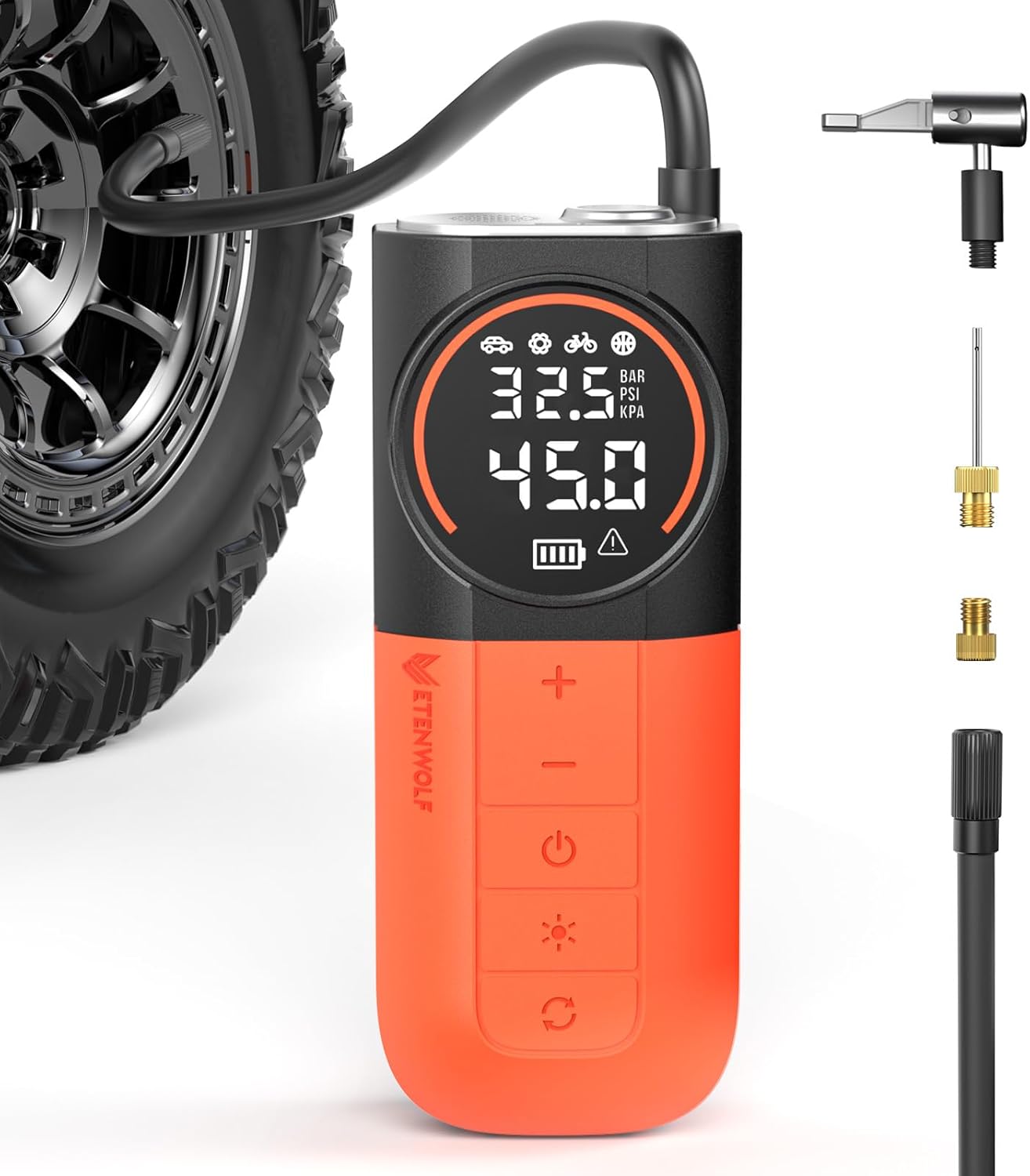
The ETENWOLF S1 cordless tire inflator delivers ultra-fast inflation with up to 160 PSI and a 20 L/min airflow for quicker tire top-offs. Its 5200mAh battery and cooling system support inflating many tires and sports balls on a single charge, while the digital pressure gauge and multi-unit display help you reach the right pressure accurately. With preset modes, pressure memory, an auto-stop feature, and an LED flashlight, it’s built for easy roadside and everyday use.

The JACO FlowPro Tire Inflator measures, inflates, and airs down tires up to 100 PSI with battery-free operation and ±2% accuracy after calibration. It features a glowing pressure dial for night visibility, a heavy-duty steel build with a hybrid hose, and a precision push-to-inflate thumb trigger. The patented Lightning Air Chuck locks on for a secure seal, and the kit includes quick-connect hardware for easy inline use with your air compressor.
Benefits of Common Tire Types for Tundra Owners
Different tire categories change how your Tundra feels, stops, tows, and handles poor weather. The right choice is not always the most aggressive tread.
- Highway tires: Best for quiet daily driving, wet-road stability, towing comfort, and tread life on pavement.
- All-terrain tires: A strong middle ground for gravel, dirt roads, campsites, and occasional trails while still staying livable on the highway.
- Rugged-terrain tires: More aggressive than many all-terrains, with a tougher look and better loose-surface bite, but often more road noise.
- Mud-terrain tires: Built for mud, rocks, and off-road traction, but usually heavier, louder, and less efficient on the street.
- Winter tires: Best for cold-weather grip on snow and ice. If you drive in harsh winter conditions, tire compound matters as much as four-wheel drive.
[Products Worth Considering]

This roadside assistance kit helps drivers and passengers in urgent situations after an accident or breakdown, providing practical support while waiting for help. It includes a lightweight, compact tire inflator for fast inflation of standard vehicle tires, plus reinforced jumper cable protection for safer handling. Ideal for winter weather, road trips, camping, and travel, with everything stowed neatly in a trunk bag.
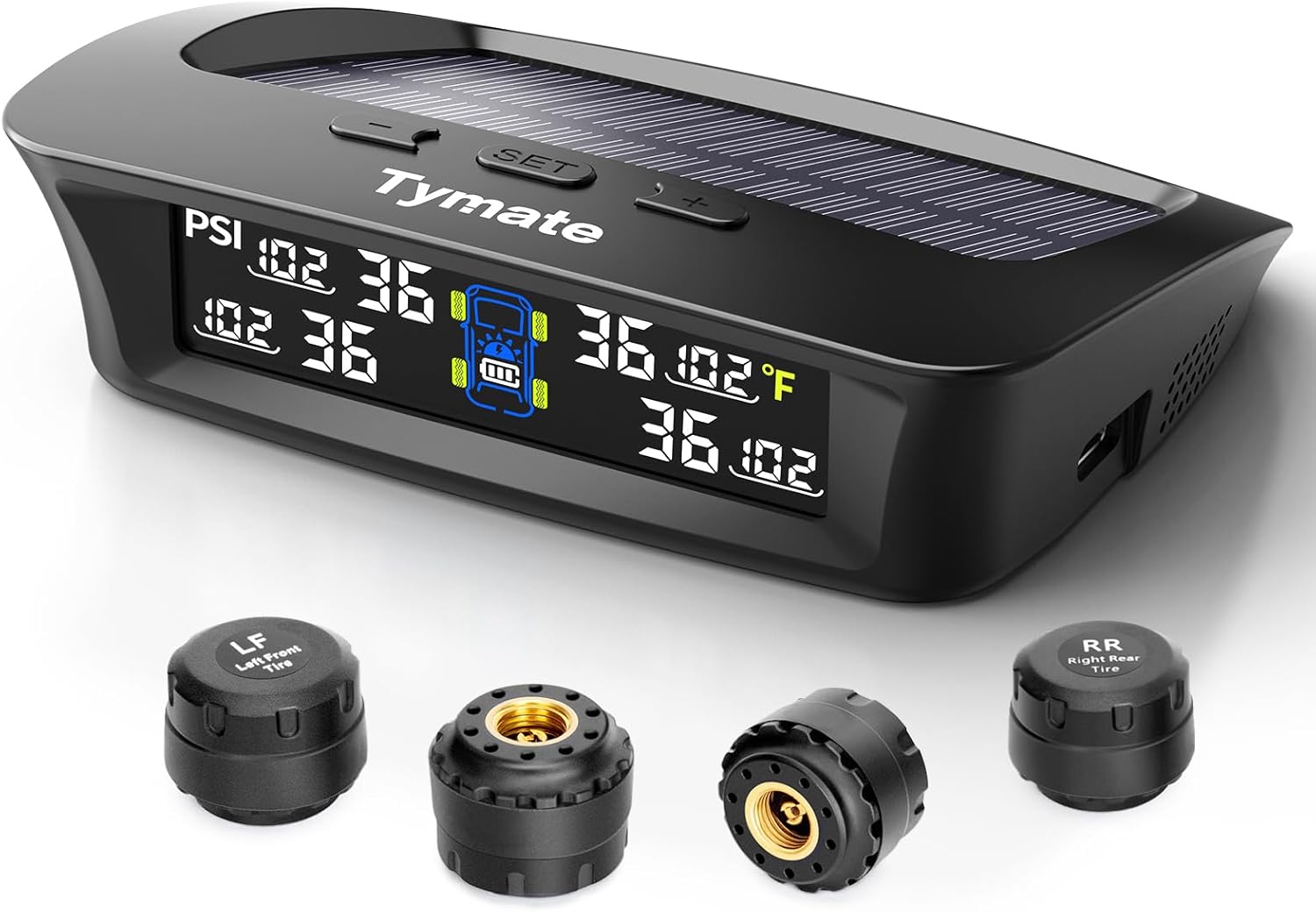
The Tymate TM3 RV TPMS delivers real-time tire pressure monitoring from 0 to 144 PSI with accurate readings and dependable wireless communication. It includes four external sensors with pre-pairing, six alarm modes for rapid leak, pressure extremes, temperature, and signal loss, plus an easy-reference setup for alert thresholds. Solar and USB-C charging help keep the display powered, while the color LCD and adaptive backlight improve visibility for safer driving and towing.

FOUR DEEP GROOVES FOR ALL-WEATHER CONFIDENCE – Four deep grooves channel water and mud out of the contact patch fast, resisting hydroplaning on wet highways and slick trails. A chip-resistant compound stands up to gravel, debris, and rough job-site surfaces, ensuring tough, dependable traction in dry and wet conditions all year round.
Tips for Ensuring Proper Tire Fitment and Performance
Proper fitment is about more than the number printed on the sidewall. Use these checks to avoid rubbing, poor handling, and premature wear:
- Use the correct pressure. Set cold tire pressure to the door placard for stock sizes, or follow professional guidance for load-range changes.
- Do not mix sizes randomly. Keep matching tire sizes, construction, and similar tread depth across the axle, and avoid mismatched sets on 4WD trucks.
- Confirm load index. Never downsize to a tire with a lower load rating than your truck requires.
- Recheck lug torque. After wheel or tire work, follow Toyota’s wheel-nut recheck guidance and your installer’s torque procedure.
- Watch tread wear. Uneven wear may point to alignment, inflation, suspension, or tire-rotation problems.
- Use TPMS correctly. Tire pressure monitoring is helpful, but it is not a replacement for checking pressure with a gauge.
Note: If you tow or haul often, ask your tire installer about load range, inflation, and heat buildup. A tire that is fine for commuting may not be the best choice for heavy payload or trailer use.
[Products Worth Considering]

【EXTENDED REACH DUAL HEAD】LUMITECO 12" pencil-style pressure gauge is designed with the Integrated Straight foot air chuck and 30°reverse chuck. Ideal for dual wheels and other difficult reached valves. Your good choice for checking tire pressure as well as a great father's day gift.

Enhanced Visibility in Low Light: Features a green backlit LCD screen and integrated flashlight, allowing for clear reading of tire pressure even in dark or dimly light conditions.

1. LONG ZINC ALLOY DUAL HEAD DESIGN : Straight foot air chuck are deisghed for inner wheels or difficult reached valve as well as the 30°reverse chuck are for outer wheels.A good choice for testing your tire pressure also a great father's day gift
Frequently Asked Questions
Can I mix different tire sizes on my Tundra?
No, not for normal driving. Use matching tire sizes, construction, and similar tread depth, especially on a 4WD Tundra. Mismatched tires can affect handling, braking, traction control, and drivetrain behavior.
What should I do if my tire size is not listed?
Check the driver-door placard, owner’s manual, and current tire sidewall first. If your truck has aftermarket wheels or suspension, ask a tire shop to verify wheel width, offset, load rating, and rubbing clearance before ordering.
How do I know if tires fit my Tundra?
A tire fits when it matches the wheel diameter and rim-width range, meets the load requirement, clears suspension and body parts, and does not rub at full steering lock or under compression. Diameter alone is not enough.
Are there recommended tire brands for the Tundra?
Popular Tundra tire brands include Michelin, BFGoodrich, Goodyear, Falken, Toyo, Bridgestone, Nitto, and Cooper. The best choice depends on whether you prioritize towing, tread life, winter grip, quiet highway driving, or off-road traction.
Will changing tire size affect my Tundra’s warranty?
It can affect warranty coverage for related components if a problem is traced to the tire, wheel, or suspension modification. Toyota does not recommend changing the original tire size or suspension, so keep records and ask your dealer before major changes.
Can I put 35-inch tires on a Toyota Tundra?
Usually not as a simple stock replacement. A 35-inch tire often needs a lift or leveling setup, correct wheel offset, trimming, alignment, and careful clearance checks. Treat 35s as a modified fitment.
What tire pressure should I use on my Tundra?
Use the cold tire pressure listed on the driver-door placard for your exact truck and tire size. Do not assume one pressure works for every Tundra year, trim, tire size, or load range.
Will 2022–present Tundra wheels fit a 2007–2021 Tundra?
Not directly in most cases. The 2007–2021 Tundra uses a 5×150 bolt pattern, while 2022–present trucks use 6×139.7. Even when bolt pattern matches across other years, offset, center bore, lug hardware, and brake clearance must still be verified.
Conclusion
The right Toyota Tundra tire size is the one that matches your year, trim, wheel package, load needs, and driving style. For a stock replacement, start with the door placard and stay with the listed OE size. For upgrades, compare overall diameter, load rating, wheel offset, and clearance before buying. A careful fitment check protects your Tundra’s handling, towing stability, speedometer accuracy, and long-term tire wear.
Sources
- Toyota Owners — Tundra tire inflation pressure — supports checking the tire-and-loading information label for tire size and pressure.
- Toyota Support — changing tire size — supports the modification and warranty caution.
- TireSize.com — Toyota Tundra tire sizes — supports year and trim tire-size references.
- Wheel-Size.com — Toyota Tundra wheel and tire fitment — supports wheel, bolt-pattern, pressure, and fitment data.
- Tire Rack — plus sizing wheels and tires — supports keeping overall tire diameter close to stock for clearance, gearing, and speedometer accuracy.
- NHTSA TireWise — supports tire safety, pressure checks, tire rotation, tread checks, and tire-care guidance.

Related Articles
Toyota Tundra Tire and Wheel Package: What to Consider Before Buying
Unlock the secrets to choosing the perfect tire and wheel package for your Toyota Tundra—essential tips await to enhance your ride.
Read More
Do Bigger Tires Void a Toyota Tundra Warranty? Magnuson-Moss Act Explained
Bigger tires might not void your Toyota Tundra warranty, but understanding the Magnuson-Moss Act is crucial—discover how to protect your investment effectively.
Read More
Toyota Tundra Tire Rack Setup: Garage Storage Ideas for Seasonal Sets
Better tire storage for your Toyota Tundra awaits—discover essential tips to maximize space and protect your seasonal sets in the garage!
Read More