
What Is a Toyota Tundra Tire Size? Complete Breakdown for Every Model Year
The right Toyota Tundra tire size depends on the truck’s model year, trim, wheel size, load rating, and whether the suspension is stock, leveled, or lifted. Factory sizes are the safest starting point, while larger aftermarket tires can add ground clearance and off-road grip only when the wheel offset, clearance, speedometer, TPMS, and load rating are checked first.
Quick Answer
For a stock Toyota Tundra, use the tire size printed on the driver-door Tire and Loading Information Label or in the owner’s manual. Current third-generation Tundras commonly use 245/75R18, 265/70R18, 285/65R18, 265/60R20, or 265/50R22 depending on trim. Larger sizes such as 35×12.50R20 are aftermarket fitments and need clearance checks.
Key Takeaways
- Always start with the tire placard on the driver-side door jamb; it lists the factory size and cold inflation pressure for your truck.
- Factory tire sizes vary by generation and trim, so a 2006, 2021, and 2026 Tundra may all require different tires.
- Larger tires can improve ground clearance, but they can also cause rubbing, speedometer error, lower fuel economy, and heavier steering.
- Match or exceed the original load index and speed rating, especially if you tow, haul, or drive off-road.
- Use a qualified tire shop for non-OE sizes, suspension lifts, wheel-offset changes, or 35-inch tire upgrades.
At a Glance
| Time Required | 5–10 minutes to confirm factory size; longer if comparing aftermarket fitments |
| Difficulty | Easy for OE replacement; moderate to advanced for oversized tires |
| Tools Needed | Owner’s manual, door placard, tire-pressure gauge, tread-depth gauge, flashlight, and a tape measure for clearance checks |
| Cost | Usually the cost of tires, mounting, balancing, valve stems/TPMS service, alignment if needed, and possible calibration for major size changes |
Understanding Toyota Tundra Tire Specifications
When you read a Toyota Tundra tire size such as 265/70R18, each part of the code tells you something important. The number 265 is the tire’s approximate width in millimeters, 70 is the sidewall height as a percentage of that width, R means radial construction, and 18 is the wheel diameter in inches. The same tire may also include a load index and speed symbol after the size, such as 116T.
Flotation sizes use a different format. A tire marked 35×12.50R20 is about 35 inches tall, about 12.50 inches wide, uses radial construction, and fits a 20-inch wheel. That is not the same format as 265/70R18, so do not read “35” as width or “12.50” as aspect ratio.
Note: The most reliable tire-size source is your own truck’s driver-door Tire and Loading Information Label. It reflects the trim, wheel package, and factory tire configuration for that specific vehicle.
Toyota Tundra OEM Tire Sizes by Generation
Tundra tire sizes changed across generations. Use this table as a starting reference, then confirm the exact size on your tire placard before ordering tires.
| Generation | Model Years | Common Factory / Reference Sizes | What to Know |
|---|---|---|---|
| 1st Generation | 2000–2006 | 245/70R16, 265/70R16, 265/65R17, and some 275/55R18 applications | Sizes vary by cab, drivetrain, trim, and wheel package. |
| 2nd Generation | 2007–2021 | 255/70R18, 275/65R18, 275/55R20 | A 33-inch aftermarket tire may fit some setups, but 33×12.50R17 is not the standard factory size for this generation. |
| 3rd Generation | 2022–current | 245/75R18, 265/70R18, 285/65R18, 265/60R20, 265/50R22 | TRD Pro commonly uses 285/65R18; 22-inch luxury trims commonly use 265/50R22. |
Current Third-Generation Tundra Tire Sizes by Trim
For 2022 and newer Tundras, the factory size depends heavily on trim and wheel package. Current third-generation examples include:
| Trim / Package | Common OE Tire Size | Typical Wheel Size |
|---|---|---|
| SR | 245/75R18 | 18-inch |
| SR5 | 265/70R18 or 265/60R20 | 18-inch or 20-inch |
| Limited, Platinum, 1794 Edition | 265/60R20 | 20-inch |
| TRD Pro | 285/65R18 | 18-inch |
| Capstone / 22-inch wheel packages | 265/50R22 | 22-inch |
Warning: Do not assume a tire from another Tundra trim will fit your truck. Brake clearance, wheel width, offset, load rating, spare-tire fit, and suspension setup can all change the answer.
[Products Worth Considering]

EVOULTES heavy duty tire inflator with an integrated gauge delivers accurate pressure readings from 10–120 PSI, helping you inflate, deflate, and check tires in one tool. The 16.5-inch extended dual-head air chuck with swivel base reaches hard-to-access dual wheel valves on trucks and RVs. A brass trigger core and side-mounted air release valve make operation smooth, with standard 1/4" NPT threading and quick-connect compatibility for easy setup.

This portable cordless tire inflator delivers up to 160 PSI with fast 17 L/min airflow to help you quickly top up tires and get back on the road. It features dual power mode, running on a 21V rechargeable battery or a 12V DC adapter for convenient roadside use. An automatic shut-off with digital pressure gauge helps prevent overinflation, and a built-in LED light improves visibility in low-light conditions.

The JACO FlowPro Tire Inflator measures, inflates, and airs down tires up to 100 PSI with battery-free operation and ±2% accuracy after calibration. It features a glowing pressure dial for night visibility, a heavy-duty steel build with a hybrid hose, and a precision push-to-inflate thumb trigger. The patented Lightning Air Chuck locks on for a secure seal, and the kit includes quick-connect hardware for easy inline use with your air compressor.
How to Choose the Right Toyota Tundra Tire Size
Choosing the right tire size starts with the factory label and ends with a real-world fitment check. Use these steps before buying tires for your Tundra:
- Read the driver-door placard. Confirm the factory tire size and cold tire pressure for your truck.
- Check the tire sidewall. Make sure the current tires match the placard unless a previous owner already modified the truck.
- Match the load index and speed rating. Replacement tires should meet or exceed the original rating, especially for towing and hauling.
- Confirm wheel diameter and width. An 18-inch tire will not fit a 20-inch wheel, and not every tire width is approved for every wheel width.
- Compare overall diameter. A small diameter change is usually easier to manage; a large jump can affect speedometer accuracy, gearing feel, braking, and clearance.
- Check clearance at full steering lock and suspension compression. Look near the fender liner, mud flaps, body mount area, upper control arm, and sway bar.
- Plan for calibration if needed. Larger tires may require speedometer, odometer, TPMS, or driver-assist recalibration depending on size and model year.
Key Tire Specifications
The best tire size is not just the one that looks good. For a Tundra, pay attention to:
- Overall diameter: Affects ground clearance, speedometer readings, gearing, and wheel-well clearance.
- Section width: Wider tires can add grip but may rub suspension or body parts.
- Load index: Shows how much weight the tire can carry when properly inflated.
- Speed rating: Indicates the tire’s tested speed capability and performance category.
- Load range: Common on LT tires and important for towing, hauling, and off-road durability.
- Tread type: Highway, all-terrain, mud-terrain, and winter tires behave differently on pavement, snow, gravel, and mud.
Fitment Considerations
If you stay with the factory size, fitment is usually straightforward. If you upsize, treat every change as part of a system. Tire diameter, tire width, wheel offset, wheel backspacing, suspension lift height, alignment, and mud-flap position all matter.
Pro Tip: Before ordering larger tires, ask the installer to check your exact wheel width, offset, and backspacing. Two Tundras with the same tire size can fit differently if one uses factory wheels and the other uses aggressive-offset aftermarket wheels.
Performance Impacts
Larger tires can improve approach confidence off-road and add a more aggressive stance, but they also add trade-offs. Heavier tires can slow acceleration, increase braking distance, reduce fuel economy, and make steering feel heavier. Wider all-terrain or mud-terrain tires may also create more road noise than highway tires.
A conservative approach is to stay close to the original overall diameter unless the truck has a suspension setup designed for larger tires. Many shops use an approximate 3% diameter change as an initial screening point, but that is only a starting guideline. Final fitment still depends on clearance, load rating, and calibration.
How Tire Size Affects Tundra Performance and Handling
Tire size plays a major role in your Toyota Tundra’s ride, braking, traction, fuel economy, and off-road ability. The right tire should match how you actually drive: daily commuting, towing, highway travel, trail riding, snow driving, or a mix of everything.
Tire Size and Fuel Efficiency
Upsized tires can reduce fuel economy because they may be heavier, wider, and more aggressive than factory highway tires. More rotating mass takes extra energy to move, and more aggressive tread can increase rolling resistance. The actual fuel-economy change depends on tire weight, diameter, tread pattern, inflation pressure, vehicle load, and driving speed.
Impact on Off-Road Capability
A taller tire can increase ground clearance under the axles and help the truck roll over rocks, ruts, and uneven trail surfaces. All-terrain tires can also improve traction on gravel, dirt, and light mud. However, too much tire without enough clearance can cause rubbing at full steering lock or when the suspension compresses.
Handling and Stability Dynamics
Wider tires may increase the contact patch, but they can also follow road grooves, feel heavier at the steering wheel, and stress suspension components if paired with the wrong wheel offset. Taller tires raise the truck slightly, which can change the center of gravity. If you tow or haul, prioritize tire load capacity, inflation pressure, and stability over appearance.
A good Tundra tire upgrade is not just “bigger.” It is the largest tire that still clears safely, carries the required load, keeps the truck predictable, and matches your driving conditions.
Best Aftermarket Tire Options for Your Toyota Tundra
The best aftermarket tire type depends on where your Tundra spends most of its time. Instead of choosing by looks alone, match the tire category to your driving needs.
| Driving Need | Best Tire Type | Why It Works |
|---|---|---|
| Daily driving and highway comfort | Highway all-season or touring truck/SUV tire | Usually quieter, smoother, and more efficient than aggressive off-road tires. |
| Mixed pavement, gravel, and light trails | All-terrain tire | Balances road manners with better dirt, gravel, and campsite traction. |
| Mud, rocks, and frequent trail use | Mud-terrain or rugged-terrain tire | Adds aggressive tread and stronger off-road bite, but usually increases noise and weight. |
| Winter driving | Dedicated winter tire or severe-snow-rated all-terrain tire | Improves cold-weather grip compared with ordinary all-season tires. |
| Towing and heavy hauling | OE-equivalent or higher-load-rated truck tire | Supports payload and trailer tongue weight when inflated correctly. |
[Products Worth Considering]

Upgrade your tires with a set of four aluminum valve stem covers designed to protect the valve from wear and help keep out moisture and debris. The hermetically sealed, screw-in caps are corrosion resistant and provide an attractive, long-lasting anodized finish. Suitable for many vehicle types and installs quickly for everyday convenience.

This tire repair kit provides fast emergency puncture repair without removing the tire from the rim, helping you get back on the road quickly. Its screw plug system is designed for punctures in both tread and sidewall and includes a complete patch plug tool set with essential accessories. A portable storage bag makes it easy to carry for cars, trucks, SUVs, motorcycles, and heavy-duty applications.
Popular Tire Upgrades for Enhanced Tundra Performance
Popular Tundra tire upgrades usually fall into three groups: slightly taller OE-style replacements, leveled-truck upgrades, and lifted-truck upgrades. The safest upgrade is one that keeps the tire close to the original diameter and maintains the correct load index.
- Mild stock-wheel upgrade: Choose the same OE size in a better tread category, such as an all-terrain tire for gravel or snow-rated tire for winter conditions.
- Leveled truck upgrade: A small leveling kit may allow a taller or wider tire, but rubbing depends on wheel offset and alignment.
- 35-inch tire upgrade: Sizes such as 35×12.50R20 are common aftermarket goals, but they are not a simple factory replacement. Expect to verify lift height, wheel offset, fender liner clearance, mud-flap clearance, speedometer calibration, and spare-tire storage.
- TRD-style setup: Factory TRD and TRD Pro wheels can be a good fitment baseline, but they do not automatically guarantee every oversized tire will clear.
Warning: On four-wheel-drive Tundras, avoid mixing tire sizes, tread depths, or tire models across axles. Mismatched rolling diameter can cause driveline binding, traction-control issues, and uneven wear.
[Products Worth Considering]

FOUR DEEP GROOVES FOR ALL-WEATHER CONFIDENCE – Four deep grooves channel water and mud out of the contact patch fast, resisting hydroplaning on wet highways and slick trails. A chip-resistant compound stands up to gravel, debris, and rough job-site surfaces, ensuring tough, dependable traction in dry and wet conditions all year round.

MICHELIN LTX A/T2 delivers all-terrain endurance and long tire life on gravel roads
How to Keep Your Tundra Tires in Top Shape
Good tire maintenance protects ride quality, fuel economy, traction, and safety. Check tire pressure when the tires are cold, meaning the truck has been parked for several hours or driven only a short distance. Use the cold pressure listed on the door placard, not the maximum pressure printed on the tire sidewall.
- Check pressure monthly. Include the spare tire if your Tundra has one.
- Inspect tread and sidewalls. Look for cuts, bulges, exposed cords, nails, and uneven wear.
- Rotate regularly. Follow the owner’s manual; many light trucks are rotated around every 5,000–8,000 miles if recommended and sooner if uneven wear appears.
- Balance new tires. New tires should be balanced at installation to reduce vibration.
- Check alignment. If the truck pulls, the steering wheel is off-center, or the tires wear unevenly, have the alignment inspected.
- Recheck after off-road use. Look for punctures, damaged valve stems, bent wheels, and packed mud inside the wheels.
Frequently Asked Questions
Can I use larger tires on my Toyota Tundra?
Yes, but larger tires should be treated as a fitment project, not a direct swap. Confirm tire diameter, width, wheel offset, load rating, clearance at full steering lock, suspension compression, TPMS compatibility, spare-tire fit, and speedometer accuracy before installing them.
What tools do I need to change Tundra tires?
For a roadside tire change, you need the factory jack, jack handle, lug wrench, wheel chocks if available, and the owner’s manual. For proper installation at home or in a shop, use a torque wrench and tighten lug nuts to the specification listed for your exact model.
How often should I rotate my Tundra tires?
Follow the maintenance schedule in your owner’s manual. As a general safety reference, NHTSA recommends checking the manual and rotating tires every 5,000–8,000 miles if the manufacturer recommends it, or sooner if uneven wear appears.
Are all Tundra tires compatible with four-wheel drive?
No. Four-wheel-drive Tundras should use four matching tires with the same size, construction, load rating, and similar tread depth. Mixing tire sizes or worn and new tires can create different rolling diameters and cause driveline stress.
What is the recommended tire pressure for a Toyota Tundra?
Use the cold tire pressure printed on your driver-door Tire and Loading Information Label or in the owner’s manual. Do not use the maximum PSI printed on the tire sidewall as your normal driving pressure.
Will 35-inch tires fit a Toyota Tundra?
Sometimes, but it depends on generation, suspension height, wheel offset, tire width, and trimming. A 35-inch tire is an aftermarket upgrade, not a universal factory replacement. Have a shop check clearance before installation.
Do larger tires affect the speedometer?
Yes. A taller tire travels farther with each wheel rotation, which can make the speedometer and odometer read inaccurately. Larger changes may require calibration so the truck’s displayed speed and mileage stay close to actual values.
Conclusion
The best Toyota Tundra tire size is the one that matches your model year, trim, wheel package, load needs, and driving conditions. Factory sizes are the safest choice for daily use, towing, and predictable handling. If you want a larger tire for stance or off-road clearance, verify the whole setup first: diameter, width, wheel offset, load rating, tire pressure, rubbing points, TPMS, and speedometer calibration. A carefully chosen tire upgrade can make your Tundra more capable, but a poorly matched tire can make it noisier, less efficient, and less stable.
Sources
- Toyota 2026 Tundra Specifications — current Tundra tire and trim specification reference.
- Toyota 2026 Tundra eBrochure — current Tundra trim and wheel-package reference.
- Toyota 2021 Tundra eBrochure — second-generation Tundra trim and wheel-package reference.
- Toyota Owners Manual: Tundra Tires — tire checking, treadwear, and maintenance guidance.
- NHTSA Tire Safety — tire pressure, replacement-size, rotation, TPMS, treadwear, and safety guidance.
- Tire Industry Association: Reading a Tire Sidewall — tire size code, load index, and speed symbol explanation.

Related Articles
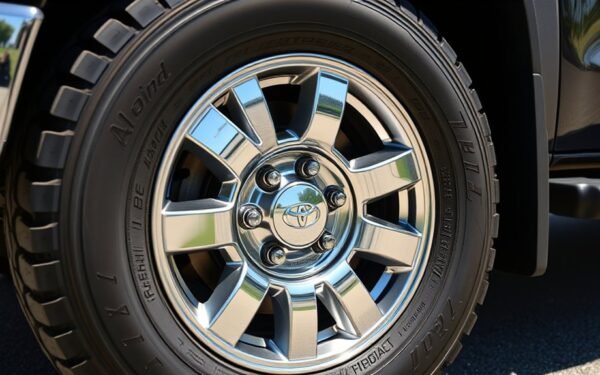
Toyota Tundra Tire and Wheel Package: What to Consider Before Buying
Unlock the secrets to choosing the perfect tire and wheel package for your Toyota Tundra—essential tips await to enhance your ride.
Read More
Do Bigger Tires Void a Toyota Tundra Warranty? Magnuson-Moss Act Explained
Bigger tires might not void your Toyota Tundra warranty, but understanding the Magnuson-Moss Act is crucial—discover how to protect your investment effectively.
Read More
Toyota Tundra Tire Rack Setup: Garage Storage Ideas for Seasonal Sets
Better tire storage for your Toyota Tundra awaits—discover essential tips to maximize space and protect your seasonal sets in the garage!
Read More