
Portable Tire Inflator: 7 Safe Steps to Inflate Tires
What’s in This Article
- Quick How-To: Inflate a Tire With a Portable Inflator
- What to Check Before You Use a Portable Tire Inflator
- Find Your Vehicle’s Recommended Tire Pressure
- Prepare and Charge a Cordless Portable Inflator
- Attach Your Portable Tire Inflator to the Valve Stem
- Set Target Pressure and Start Inflating
- Monitor Inflation and Troubleshoot Common Problems
- Using Sealant and Emergency Repair Kits Safely
- Re-Test and Verify Tire Pressure After Inflation
- Maintain, Store, and Know When to Replace Your Inflator
- Frequently Asked Questions
A low tire can turn a normal drive into a stressful stop. Before you inflate, check that your inflator has enough charge, shows no damage, and matches the tire’s valve stem. You also need your vehicle’s recommended pounds per square inch (PSI), which you can find on the driver’s door jamb sticker or in the owner’s manual.
Clean the valve stem, attach the hose firmly, set the target pressure, and watch the gauge while the inflator runs. If you hear hissing, reseat the hose and test for leaks with soapy water. After inflation, recheck the pressure with a separate gauge and keep the inflator clean, charged, and ready for future use.
Quick Answer
To use a portable tire inflator, check your vehicle’s recommended PSI, connect the hose tightly to the valve stem, set the target pressure, and start the unit. Watch the gauge as the tire fills, then stop at the correct pressure if the unit does not shut off on its own. Recheck the tire with a separate pressure gauge before you drive.
Key Takeaways
- Use the PSI listed on the driver’s door jamb sticker or in your owner’s manual.
- Check tire pressure when tires are cold for the most accurate reading.
- Attach the hose firmly to stop air leaks during inflation.
- Watch the gauge closely so you don’t overinflate the tire.
- Retest pressure after inflation with a separate tire pressure gauge.
Quick How-To: Inflate a Tire With a Portable Inflator
Estimated time: Most tires take about 5 to 15 minutes to check, connect, inflate, and verify, depending on tire size and how low the pressure is.
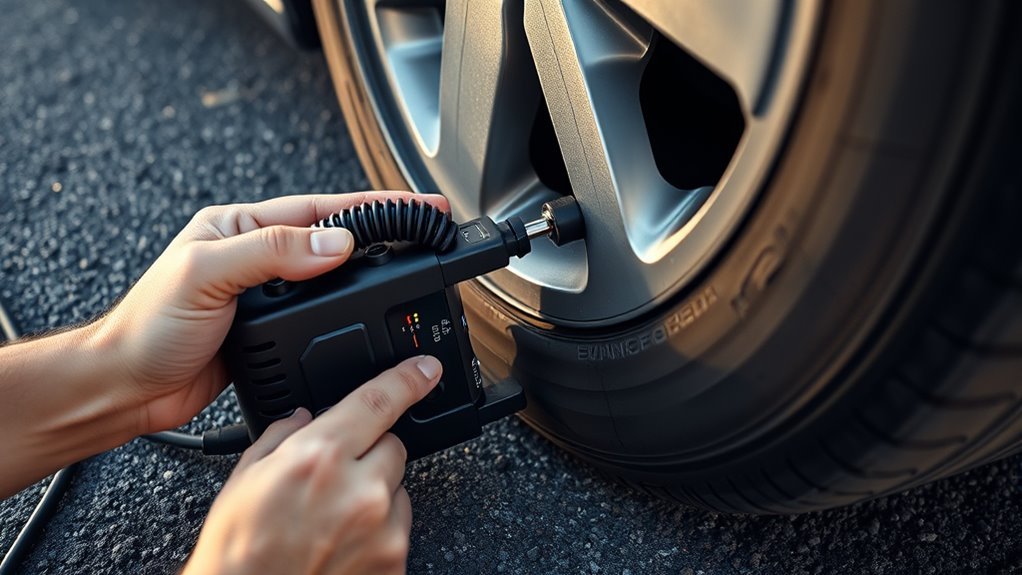
Start by making sure your portable inflator has enough charge and shows no visible damage. Check the tire’s current pressure with a gauge, then compare it with the recommended PSI in your owner’s manual or on the driver’s door jamb sticker.
Attach the inflator hose firmly to the valve stem so you get a tight seal. Set the target pressure on the inflator’s display, confirm the number, and start the unit.
- Check the tire’s current pressure with a reliable gauge.
- Find the recommended PSI on the door jamb sticker or in the owner’s manual.
- Remove the valve cap and attach the hose securely.
- Set the target pressure on the inflator.
- Start the inflator and watch the built-in gauge.
- Stop the unit at the target pressure if it does not shut off automatically.
- Disconnect the hose, replace the valve cap, and retest the pressure.
Check tire pressure monthly and before long trips. Regular checks help maintain safer handling, better braking, and more even tire wear.
[Products Worth Considering]

The Milton 555e digital tire inflator delivers fast, accurate pressure readings with a backlit display and multiple unit options, making tire inflation quick and easy. Its durable 20" EPDM rubber hose and grip‑head chuck provide reliable connection, while the ±1 PSI accuracy ensures precise inflation for cars, bikes, and trucks.

The KeenPower digital tire inflator delivers fast, precise inflation up to 160 PSI with an easy‑to‑read LCD and automatic shut‑off. Featuring four smart preset modes, manual pressure entry, and dual power from a 21V rechargeable battery or 12V DC, it adapts to any vehicle or emergency need. Integrated LED lights with SOS, steady, and strobe options illuminate work in darkness, while the compact handheld design ensures portability and convenience.

The REHOTTOP tire inflator delivers rapid 5X faster inflation with up to 160 PSI and precise ±1% accuracy, making tire inflation quick and safe. Its digital LCD display shows real‑time pressure and offers four selectable modes and auto shut‑off for cars, motorcycles, bicycles, and balls. The all‑in‑one design includes a rechargeable battery lasting up to an hour, LED flashlight, USB power bank, and multiple nozzles, providing versatile emergency support for drivers and outdoor enthusiasts.
What to Check Before You Use a Portable Tire Inflator
Before you start, check your vehicle’s recommended tire pressure so you know the correct target PSI. Make sure the inflator battery has enough charge or that the power cord reaches the outlet you plan to use.
Inspect the hose, fittings, and valve stem for cracks, debris, or loose parts. A clean valve stem helps the hose seat well and reduces air leaks.
Recommended Tire Pressure
Check the recommended tire pressure in your owner’s manual or on the sticker inside the driver’s door jamb. Measure PSI when the tires are cold, since heat from driving can raise the reading.
Correct PSI helps your tires carry the vehicle’s weight as designed. Underinflation can reduce fuel economy, increase tire heat, and raise the risk of tire damage.
- Safety: Correct pressure supports predictable handling and braking.
- Savings: Proper inflation helps reduce uneven tire wear.
- Confidence: A known target PSI removes guesswork.
- Control: Regular checks help you spot slow leaks early.
Inflator Battery Status
After you know the correct PSI, make sure the inflator can finish the job. Check the battery status indicator before you start, since a weak charge can stop inflation halfway through.
If your inflator has no battery indicator, run it briefly before connecting it to the tire. Inspect the charging cable and adapter for frays, loose connectors, or bent plugs.
Follow the manufacturer’s charging time and storage guidance. Charge the inflator after use, and store it away from heat, moisture, and freezing conditions when possible.
Inspect Hose and Valve
Give the hose and valve a quick once-over before you inflate. Look for cracks or stiffness in the hose, clear debris from the connectors, and confirm that the attachment fits your tire’s valve stem.
- Examine the hose for cracks, hard spots, or leaks.
- Clean the connectors so the hose can seal well.
- Check hose length and flexibility before reaching each wheel.
- Match the attachment to the valve stem before pumping.
Warning: Do not use a hose with cracks, frayed wiring, or a fitting that leaks around the valve stem.
Find Your Vehicle’s Recommended Tire Pressure
Look for the tire pressure sticker on the driver’s side door jamb or check your owner’s manual. Use the listed cold tire pressure as your target when inflating with a portable inflator.
Check Door Jamb Sticker
The driver’s side door jamb sticker gives the recommended PSI for your vehicle’s tires. Some vehicles list different values for front and rear tires, so check each line before inflating.
- Open the driver’s door and locate the pressure sticker.
- Note the PSI values for the front and rear tires.
- Compare the current tire pressure with the listed value.
- Set your inflator to match the correct number.
Use the door jamb sticker as your main quick reference. Do not use the maximum PSI printed on the tire sidewall as your normal target.
Consult Owner’s Manual
Your owner’s manual gives the recommended tire pressures for your specific vehicle. It may also include notes for heavy loads, towing, spare tires, or different front and rear settings.
Cross-check the manual with the driver’s door jamb sticker. Record the recommended PSI for all four tire positions so you can set the inflator without guessing.
Note Cold Tire Pressure
Recommended PSI values apply to cold tires. Check pressure before you drive or after the vehicle has sat for at least three hours.
Many passenger cars use tire pressures around 30 to 35 PSI, but your vehicle may need a different value. Always follow the number listed for your vehicle, not a general range.
- Relief: Proper PSI helps reduce the chance of tire trouble.
- Savings: Correct inflation can help your tires wear more evenly.
- Confidence: Proper pressure supports stable handling and braking.
- Longevity: Regular checks help you catch slow pressure loss.
Prepare and Charge a Cordless Portable Inflator
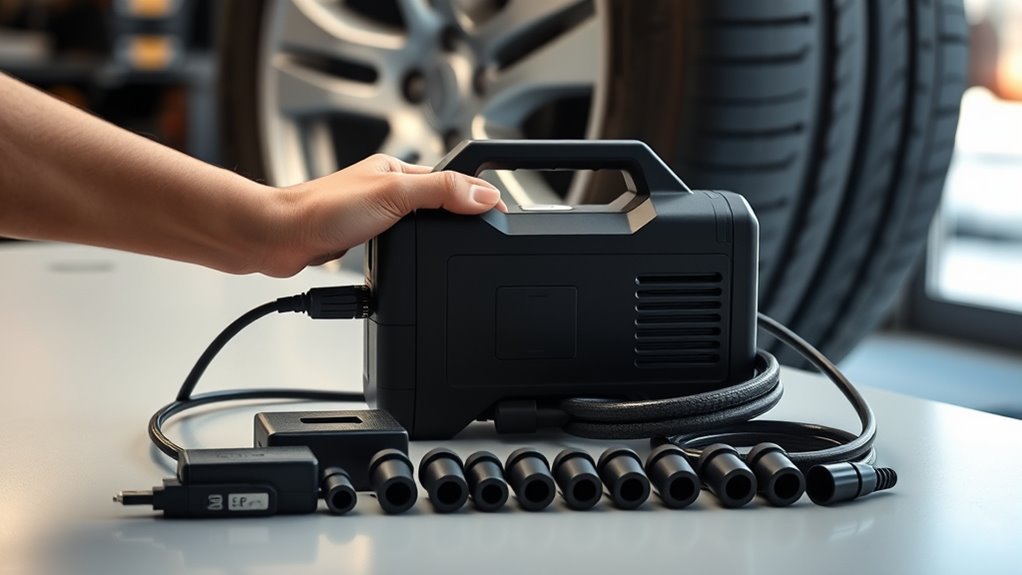
Before you use a cordless inflator, make sure it’s fully charged. Connect the provided cable to the correct power source, watch the indicator, and unplug the unit when the manual says charging has finished.
Check the housing, cables, and connectors for visible damage before operation. Follow the user manual’s specific charging instructions, including charge time, approved power sources, and storage advice.
Keep the air hose, nozzle adapters, and spare connectors together in the case. Organized accessories help you set up faster and reduce the chance of using the wrong adapter.
Pro tip: Test your inflator at home before a long trip so you know the battery, hose, and gauge work.
[Products Worth Considering]

This digital tire pressure gauge combines a sturdy pistol grip inflator with a backlit 0.1 PSI display for quick, accurate readings in any lighting condition. Its 360° swivel gauge and 20" rubber hose make it easy to use and store, while the integrated inflate/deflate trigger and ¼" NPT air inlet provide fast, reliable tire maintenance.

ADVANCED TRUEGAUGE SCREEN: This battery tire inflator includes updated sensor technology, capable of collecting pressure data from tire inflators at a frequency of 200 times per second. Its valid data rate is higher than 80%, which is 60% better than the market average. From routine maintenance to roadside emergencies, its accurate readings ensure confident pressure checks and a safer driving experience.Suitable as a Father's Day gift for your dad.

QUICK & ACCURATE: Built with the highest quality materials, Airmoto is a portable tire inflator for car, trucks, SUVs, motorcycles, and bicycles. Quickly inflate your vehicle's tires in just minutes with precision accuracy up to 120 PSI. Small and compact car air pump that fits in your glove box or trunk.
Attach Your Portable Tire Inflator to the Valve Stem
With the inflator charged and the accessories ready, locate the tire’s valve stem. It usually sits on the wheel near the outer edge, where you can remove the small valve cap.
Check the valve stem for visible damage and wipe away dirt. A clean stem helps the hose seal and keeps debris out of the valve.
- Remove the valve cap and place it where it won’t roll away.
- Align the air hose straight with the valve stem.
- Push the connector onto the valve and tighten it as directed.
- Give the hose a gentle tug to confirm a secure fit.
- Listen for hissing before you start the inflator.
If you hear air escaping, remove the hose and attach it again. A poor seal can slow inflation and give you a false pressure reading.
Set Target Pressure and Start Inflating
Set the correct target pressure by checking your vehicle’s owner’s manual or the door jamb sticker. Dial that value into the inflator’s controls before you press the power button.
Confirm the selected pressure on the display. This step helps prevent overinflation and keeps the tire within the vehicle maker’s recommended range.
Use the inflator’s features, such as preset buttons, a digital readout, or auto shutoff, when available. Watch the built-in gauge as pressure rises, and turn off the unit when it reaches the target.
Disconnect the hose carefully so you lose as little air as possible. Replace the valve cap right away to help protect the valve from dirt and moisture.
Monitor Inflation and Troubleshoot Common Problems
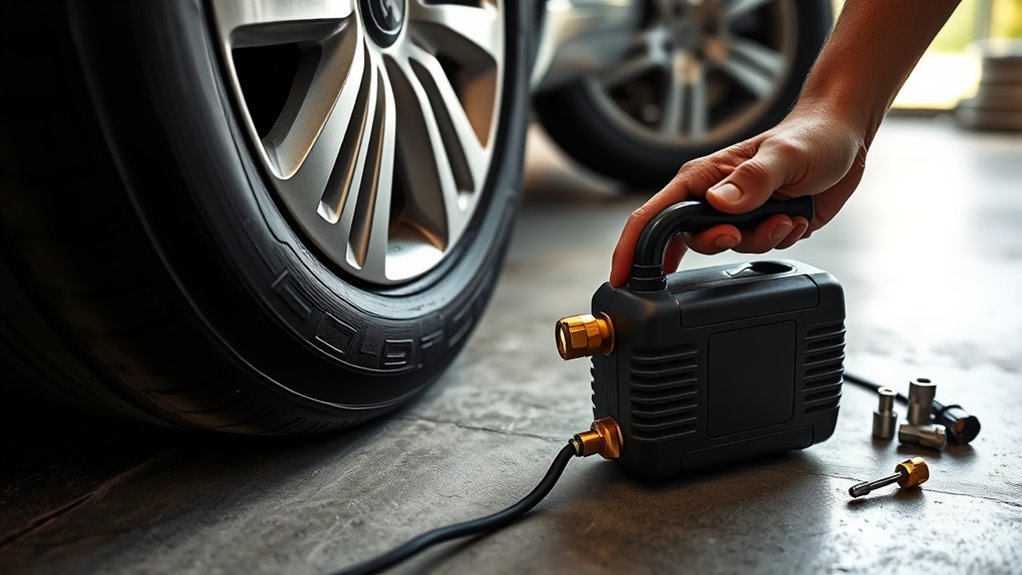
Watch the built-in gauge or digital display as pressure rises. Stop at the target pressure if your inflator does not stop on its own.
If inflation stalls or you hear hissing, check the valve connection and inspect for leaks. If the unit won’t run, verify the power source, charge level, fuse, or 12-volt connection.
[Products Worth Considering]
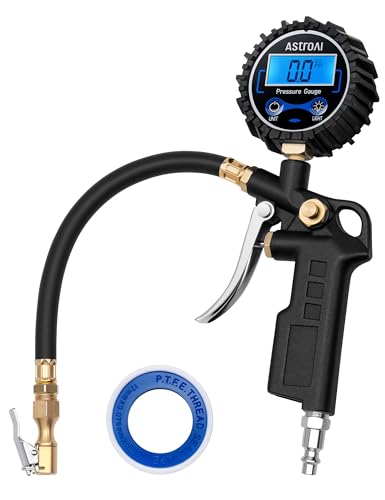
COMPATIBLE WITH both ¼” and ½” NPT air compressors outputs. COMPATIBLE WITH Standard Schrader Valves.

ALL-IN-ONE Feature: The LED backlit screen features measurements in PSI, KPA, Bar, and Kg/cm²; Includes an inflation gun, chuck, gauge, Thread seal tape roll, and bleed valve, all in one unit; Compatible with ¼" NPT air compressor's output
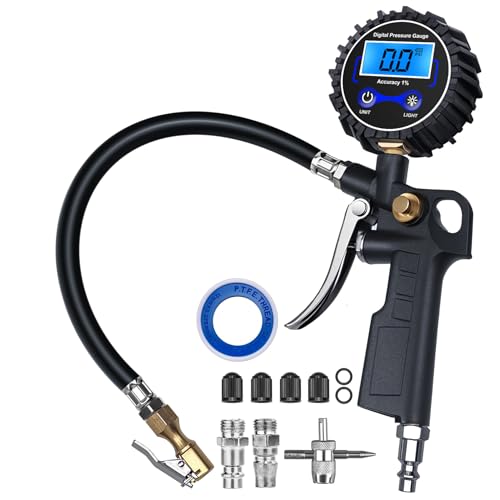
【Accuracy】The digital tire pressure gauge has 4 different measurement units: PSI, KPA, BAR, KG/CM². It reads within 1% of the exact tire pressure, with a resolution of 0.1 PSI and the measuring range is 3-250 PSI (0.2-17.2 Bar; 20-1724 Kpa; 0.2-17.5 kg/cm^2)
Monitor Pressure Progress
While you’re inflating, keep a close eye on the gauge or digital readout. Listen for unusual sounds that could signal a leak, poor connection, or blocked hose.
Use pressure monitoring to track progress. If pressure stops rising, turn off the inflator and reseat the hose on the valve stem.
- Hissing: Stop and check the hose connection.
- Stalled pressure: Reseat the chuck and inspect the valve.
- Fast pressure drop: Check the tire for a puncture or damaged valve.
- Auto shutoff: Let the feature stop the unit at the set PSI.
Identify Common Leaks
If the inflator struggles or you hear a hiss, stop and check for leaks. Apply soapy water around the valve stem, hose fitting, and visible tire damage.
Bubbles can show where air escapes. Reseat the hose if bubbles form at the connection, and seek tire repair if bubbles come from the tread, sidewall, or valve stem.
After you reach the target pressure, remove the hose and recheck with a separate gauge. If the tire loses pressure again, do not rely on inflation alone.
Resolve Inflator Malfunctions
Inspect the inflator and its fittings before each use so you catch wear or damage early. During use, watch the pressure readout and stop the unit if it fails to reach your target.
If the inflator won’t power on, check the charge, 12-volt connection, plug, and fuse. If you hear odd sounds or feel strong vibration, shut it off and inspect the hose for kinks or blockages.
- Hissing hose: Check for loose fittings or damaged seals.
- Power loss: Recharge the battery or check the vehicle power outlet.
- Blocked airflow: Clean the nozzle and inspect the hose.
- Bad readings: Compare the display with a separate pressure gauge.
Using Sealant and Emergency Repair Kits Safely
Sealant and plug kits can help you get moving in an emergency, but treat them as temporary tools. Use them only when the tire and kit instructions say the repair type is appropriate.
Follow sealant precautions closely. Use the sealant setting only if your inflator supports it, follow the manufacturer’s directions, and replace expired or used sealant canisters.
Sealant can leave residue inside the tire and make later repairs harder. After using sealant or a plug kit, have a tire professional inspect the tire and make a permanent repair when possible.
Warning: Do not use sealant or a plug kit on sidewall damage, large punctures, or a tire that looks unsafe to drive.
Re-Test and Verify Tire Pressure After Inflation
After inflating, wait a few minutes and use a tire pressure gauge to confirm the pressure. Match the reading to the value in your owner’s manual or on the driver’s door jamb sticker.
If pressure remains low, inspect for leaks or visible damage. Persistent loss often points to a puncture, damaged valve stem, or loose valve core.
Recheck tire pressure monthly and after large temperature changes. Record readings after each check so you can spot repeat pressure loss early.
Let tires settle, then check pressure with a gauge. Recheck monthly, after temperature changes, and before long trips.
- Relief: A verified reading helps you know the tire is ready.
- Confidence: Accurate inflation supports safer handling.
- Alertness: Tracked readings can reveal hidden leaks.
- Safety: Correct pressure helps reduce tire damage risk.
Maintain, Store, and Know When to Replace Your Inflator
When you’re not using your portable inflator, store it in a cool, dry place. Keep the hose and fittings clean so the unit stays ready for the next low tire.
Coil hoses without sharp bends, store attachments in their case, and avoid heat or moisture. Wipe connections with a dry cloth, remove debris from nozzles, and inspect seals for cracks.
Test the unit periodically, especially before long trips. Replace the inflator if you find frayed wires, intermittent power, damaged switches, weak performance, or persistent leaks.
Frequently Asked Questions
Can a Portable Inflator Damage My Tire’s TPMS Sensor?
Yes, misuse can damage a tire pressure monitoring system (TPMS) sensor. Avoid striking the valve stem, forcing the connector, over-tightening adapters, or using fittings that do not match the valve.
Can I Inflate a Motorcycle Tire With a Car Inflator?
Yes, you can inflate a motorcycle tire with a car inflator if the pressure range, valve adapter, and gauge work for the tire. Follow the motorcycle maker’s pressure specs and monitor PSI closely to avoid overinflation.
How Long Does a Battery-Powered Inflator Battery Typically Last?
Many battery-powered inflators run long enough to top off several tires, but runtime varies by model, battery size, and tire pressure. Extend battery life by charging as directed, storing the unit properly, and avoiding deep discharges.
Are Inflators Safe to Use in Extreme Cold or Heat?
You can use many inflators in hot or cold weather, but check the manual for the safe operating range. Keep batteries away from direct sun, freezing surfaces, and moisture, and monitor pressure carefully.
Can I Inflate a Tire While It’s Still on the Car Jack?
You can inflate a tire while the vehicle sits on a jack if the vehicle is stable and the jack rests on solid, level ground. Secure the vehicle first, avoid getting under it, and never overload or shift the jack during inflation.
Conclusion
A portable inflator works best when you know the correct PSI, attach the hose securely, and verify the final pressure. Check the door jamb sticker or owner’s manual before every inflation job.
Use sealant only as directed, and treat it as a temporary fix until a tire professional can inspect the tire. Keep the inflator charged, clean, and stored with its accessories so it’s ready when you need it.
With a few careful steps, you can turn a low-tire warning into a quick, controlled repair.

Related Articles
What Does THE P Stand For on a Tire? Full Meaning Explained
I’ll explain what the “P” on a tire really means and why it could change how you choose your next set.
Read More
How to Use a Tubeless Tire Repair Kit: Complete Field Guide
Learn how to fix tubeless tire punctures fast with the right kit, because one small mistake can leave you stranded on the trail.
Read More
How to Tell a Tire’s Diameter: Easy Guide to Reading Tire Size
Want to decode tire sidewall numbers and find the right diameter, but wonder what those hidden digits really mean?
Read More