
How Often Does a Hyundai Sonata Need a Tire Alignment?

Your Hyundai Sonata should have its tire alignment checked about once a year or around every 12,000 miles, and sooner if the car pulls to one side, the steering wheel sits crooked, the tires wear unevenly, or you recently hit a curb or pothole. Tire rotation is a separate maintenance item, and many Hyundai manuals list rotation around 7,500 to 8,000 miles depending on model year.
Quick Answer
For most Hyundai Sonata drivers, have the alignment checked every year or about every 12,000 miles. Do it sooner after a hard pothole hit, curb strike, new tires, suspension repair, uneven tire wear, pulling, vibration, or an off-center steering wheel.
Key Takeaways
- A wheel alignment adjusts the suspension angles so the tires meet the road correctly.
- Use 12,000 miles or once a year as a practical alignment-check baseline, then shorten the interval for rough roads, potholes, curb hits, or uneven wear.
- Tire rotation is not the same as alignment. Hyundai owner materials commonly list rotation around 7,500 or 8,000 miles, depending on the specific Sonata model year.
- A professional alignment should include before-and-after measurements, not just a verbal recommendation.
At a Glance
| Time Required | 5–10 minutes for a home symptom check; about 45–60 minutes for a professional alignment service. |
| Difficulty | Easy to inspect symptoms at home; professional equipment is needed to set alignment accurately. |
| Tools Needed | Tire pressure gauge, tread depth gauge or penny, flashlight, and a safe flat parking area for inspection. |
| Cost | Home check: $0 if you already have a gauge. Professional alignment: varies widely by shop, location, and whether suspension repairs are needed. |
What Is Tire Alignment and Why Is It Important?

Tire alignment is the adjustment of your Sonata’s wheel and suspension angles to match the manufacturer’s specifications. The main angles are toe, camber, and caster. When those angles drift out of spec, the tires may scrub the road instead of rolling cleanly.
Good alignment helps your Hyundai Sonata track straight, steer predictably, and wear tires evenly. Poor alignment can cause a crooked steering wheel, pulling, feathered tread, shoulder wear, and reduced tire life. AAA explains that when alignment is outside the vehicle’s specified range, steering can become difficult and tires can wear unevenly.
Note: Alignment, tire rotation, and tire balancing are different services. Rotation moves tires to different positions, balancing reduces wheel vibration, and alignment adjusts suspension angles.
[Products Worth Considering]

The Ziopetru adjustable magnetic wheel alignment tool helps you check and restore camber and caster positioning after removing and reinstalling undercarriage components. With a clear leveling/bubble measurement system and an easy zeroing adjustment knob, it supports precise horizontal angle checking. The strong magnetic base mounts to metal surfaces for convenient use at home on cars, motorcycles, trucks, vans, and SUVs.

Measure tire tread depth quickly and accurately with this LUMITECO dial gauge that reads in 1/32" increments up to 14/32". The color-coded green/yellow/red zones make it easy to judge tire wear and know when replacement is needed. A rugged, compact design with a protective pouch helps keep the gauge ready for use on cars, trucks, motorcycles, and more.

Monitor tire tread wear with a smart, color-coded depth gauge that shows clear condition ranges at a glance. The bar is range marked for fast, easy readings, helping you maintain safer traction and performance. Each gauge is portable with a pocket clip, and the set includes 20 units for daily use and sharing.
How Often Should a Hyundai Sonata Get a Tire Alignment?
As a practical baseline, have your Hyundai Sonata’s alignment checked about once a year or around every 12,000 miles. You should also ask for an alignment check whenever you buy new tires, replace steering or suspension parts, or notice a change in how the car drives.
This is not the same as tire rotation. Hyundai owner materials commonly recommend rotating tires around 7,500 miles or 8,000 miles, depending on the Sonata model year and manual. Check your exact owner’s manual because tire sizes, model year, drivetrain, and tire type can change the recommended interval.
Pro Tip: Pair a quick alignment symptom check with every tire rotation. Look for uneven tread, shoulder wear, cupping, vibration, and a steering wheel that no longer sits straight.
Signs Your Sonata Needs Tire Alignment
Mileage is only a guide. Symptoms matter more. If your Sonata shows any of the signs below, schedule an alignment inspection instead of waiting for the next mileage interval.
Uneven Tire Wear
Uneven tire wear is one of the clearest signs that something is wrong. Look for extra wear on the inner edge, outer edge, or a feathered pattern across the tread. Hyundai’s tire rotation guidance notes that abnormal wear may be caused by incorrect tire pressure, improper wheel alignment, out-of-balance wheels, severe braking, or severe cornering, so the tire condition should be inspected before blaming alignment alone.
If the tread is very low, the tire may need replacement instead of just alignment. NHTSA recommends checking tire pressure and tread at least once a month and using the pressure listed by the vehicle manufacturer, not the maximum pressure printed on the tire sidewall.
Steering Wheel Misalignment
A steering wheel that sits off-center while the car is driving straight often points to an alignment issue. A slight crown in the road can cause minor drift, but steady pulling on a flat road should be inspected.
Also pay attention to vibration. Vibration can come from alignment, but it can also come from tire balance, bent wheels, tire damage, or worn suspension parts. A good shop should inspect the tires, suspension, steering components, and wheel balance before recommending an alignment.
When to Get Alignment Sooner Than the Normal Interval
Do not wait for the annual check if your Sonata has had a hard impact or shows a sudden change in steering. Get the alignment checked sooner after:
- Hitting a deep pothole, curb, or road debris
- Installing new tires
- Replacing struts, control arms, tie rods, ball joints, or other steering and suspension parts
- Noticing the car pulling left or right
- Seeing uneven tire wear after rotation
- Feeling new steering wheel vibration or wandering
- Carrying heavy loads often or driving rough roads daily
Warning: If you see exposed cord, sidewall bulges, deep cuts, or a tire that is losing air, do not treat it as a simple alignment problem. Have the tire inspected before driving far or at highway speed.
How Different Driving Conditions Impact Tire Alignment Needs
Driving conditions can change how often your Hyundai Sonata needs an alignment check. Smooth highway driving is easier on suspension geometry than broken pavement, construction zones, steep driveways, and frequent curb contact.
- Potholes and curbs: A sharp impact can knock toe or camber out of spec immediately.
- Rough winter roads: Ice heaves, hidden potholes, and salt-damaged pavement can accelerate alignment problems.
- Heavy loads: Repeated heavy cargo changes suspension load and may reveal tire wear problems sooner.
- High-mileage driving: More miles mean more wear on bushings, ball joints, tie rods, and struts, all of which can affect alignment.
If your Sonata drives straight, the steering wheel is centered, and the tires wear evenly, you may only need routine checks. If the symptoms change, the schedule changes with them.
Benefits of Regular Tire Alignment for Your Sonata

Regular alignment checks help protect your tires, steering, suspension, and fuel economy. The biggest benefit is simple: a properly aligned Sonata is less likely to chew through tires early from uneven wear.
Enhanced Tire Longevity
When the wheels are aligned correctly, each tire contacts the road more evenly. That helps reduce shoulder wear, feathering, and heat buildup caused by scrubbing. Alignment is especially important after new tire installation because it helps the new set start with the correct contact pattern.
Tire rotation still matters. Hyundai recommends rotating tires to help equalize tread wear, and NHTSA says rotation can reduce irregular wear and help tires last longer when performed according to the owner’s manual.
Improved Fuel Efficiency
Misalignment can increase drag because the tires may scrub instead of rolling straight. That can hurt efficiency, but it is better to avoid exact fuel-savings promises unless your shop provides specific measurements.
For a documented fuel-economy maintenance step, focus on tire pressure. FuelEconomy.gov states that keeping tires inflated to the proper pressure can improve gas mileage by 0.6% on average and up to 3% in some cases. Proper pressure also helps tires last longer and drive safer.
A straight-tracking Sonata with even tire wear, correct pressure, and balanced wheels is easier to steer, easier on tires, and less likely to surprise you with premature tire replacement.
Check Your Tire Alignment at Home
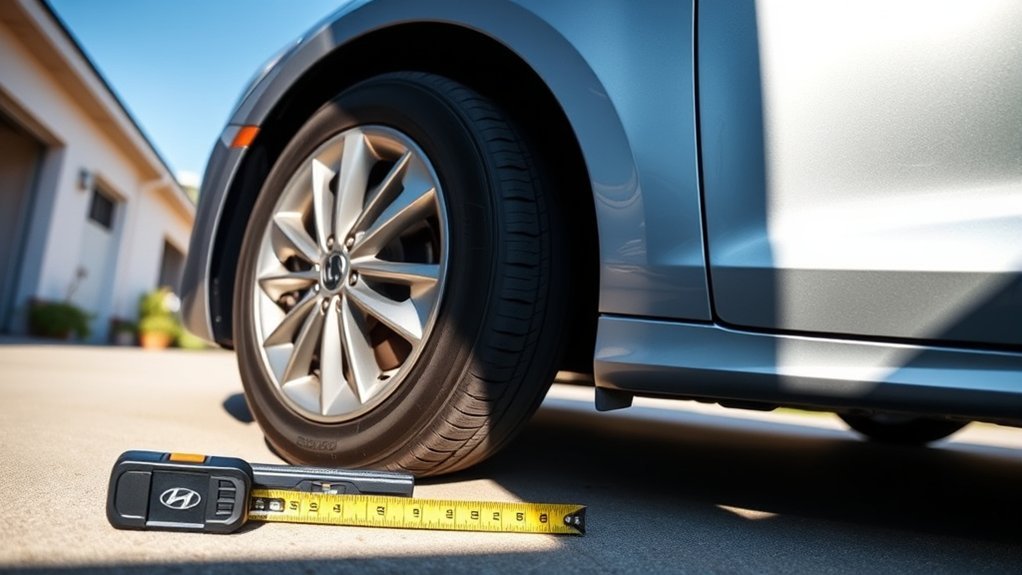
You cannot accurately set a Hyundai Sonata’s alignment at home without professional alignment equipment, but you can check for warning signs in a few minutes.
- Park safely on level ground. Turn the steering wheel straight and make sure the tires are cool before checking pressure.
- Check tire pressure. Use the PSI on the driver-side door placard or owner’s manual, not the maximum PSI printed on the tire.
- Inspect tread wear. Look across each tire for inner-edge wear, outer-edge wear, feathering, cupping, bald spots, cuts, or bulges.
- Check tread depth. Replace tires that are at or below 2/32 inch tread depth, and consider replacement earlier if wet traction is poor.
- Drive on a safe, flat road. Notice whether the car pulls, the steering wheel sits crooked, or vibration appears at certain speeds.
- Compare after rotation. If a tire develops the same odd wear pattern again, ask for an alignment and suspension inspection.
If the car pulls hard, the steering feels loose, or the tires show sudden severe wear, stop guessing and get a professional inspection.
[Products Worth Considering]

Keep your tires properly inflated with this analog VONDIOR tire pressure gauge, designed for fast, easy readings without batteries. The swiveling, two-axis hose and large glow dial help you measure at any tire angle with instant visibility. Built with a protective rubber shield, it supports durable, low-maintenance use for cars and trucks.

Accurately measure tire tread depth with a calibrated gauge marked from 0 to 1 inch in 1/32 inch increments. The color-coded bar helps you quickly identify tread condition ranges, supporting safe driving for trucks, motorcycles, automobiles, and passenger vehicles.

The SAFELIFE dial tire tread depth gauge measures tread depth in 1/32 inch increments with clear, easy-to-read 2-inch dial face. Color zones using a traffic light system help you quickly judge whether tread is low, marginal, or ample for safer driving. Built with a durable zinc cast body and a metal detect probe for precise, comfortable use across cars, motorcycles, trucks, and buses.
What to Expect From Your Tire Alignment Service
A professional alignment service should measure your Sonata’s wheel angles and compare them with Hyundai specifications. Most modern shops use computerized or laser alignment equipment. The technician adjusts the relevant suspension points so camber, caster, and toe fall within spec.
Ask for a before-and-after alignment printout. The printout should show which measurements were out of range and where they ended after adjustment. If the shop says the alignment cannot be brought into specification, ask whether a worn or bent suspension part needs repair first.
A complete alignment visit may include:
- Initial road test or symptom discussion
- Tire pressure and tread inspection
- Suspension and steering component check
- Wheel angle measurement
- Toe, camber, or caster adjustment where adjustable
- Steering wheel centering
- Final printout and road test
Tire Alignment Costs for Your Sonata
Hyundai Sonata alignment cost depends on your location, shop type, labor rate, and whether your suspension needs parts before alignment can be completed. A basic alignment at a tire shop may cost less than a dealer visit, but pricing can vary widely.
RepairPal’s wheel alignment estimator lists a national average of $189 to $277, excluding taxes, fees, location differences, and related repairs. Local tire shops, chains, and dealerships may quote outside that range, so compare prices and ask what the service includes.
Before approving extra work, ask three questions:
- Which alignment measurements are out of specification?
- Can I see the before-and-after printout?
- Is any part worn or bent, or is this only an adjustment?
A free alignment check can be useful, but the printout matters. Do not approve an alignment only because it was suggested during an oil change unless there is a symptom, tire wear issue, new tire installation, suspension repair, or measurement showing it is needed.
Maintaining Optimal Tire Health Beyond Alignment
Alignment is only one part of tire care. To keep your Hyundai Sonata’s tires healthy, also maintain pressure, rotate on schedule, balance when needed, and inspect for damage.
- Check pressure monthly: NHTSA recommends checking all tires, including the spare, at least once a month when cold.
- Rotate tires on schedule: Follow your Sonata owner’s manual; many Hyundai manuals list 7,500 or 8,000 miles depending on model year.
- Balance when needed: If vibration appears at speed, balancing may be the fix rather than alignment.
- Inspect tread depth: Check tread monthly and before long trips.
- Repair suspension problems first: Worn tie rods, ball joints, bushings, or struts can prevent a good alignment from holding.
Good tire care gives you the best chance of smooth handling, longer tire life, and predictable braking in your Sonata.
Frequently Asked Questions
How much is an alignment on a Hyundai Sonata?
The price depends on your area and the shop. A professional alignment can range from budget tire-shop pricing to higher dealership pricing. RepairPal lists a national wheel alignment average of $189 to $277, excluding taxes, fees, location differences, and related repairs.
Is an alignment necessary at 15,000 miles?
Not always. If the Sonata drives straight, the steering wheel is centered, and the tires wear evenly, 15,000 miles may simply be a good time to check alignment. Get service sooner if the car pulls, the wheel is off-center, tires wear unevenly, or you hit a curb or pothole.
Does a Hyundai Sonata need alignment after new tires?
It is smart to have the alignment checked after installing new tires. If the old tires wore unevenly, skipping alignment can cause the new set to develop the same wear pattern.
Can I align my Sonata at home?
You can inspect tire wear, pressure, steering position, and pulling at home, but accurate alignment requires professional equipment. Home methods are not precise enough to match factory specifications.
Is vibration always an alignment problem?
No. Vibration may come from tire balance, bent wheels, damaged tires, brake issues, or worn suspension parts. Alignment is one possible cause, but the tires and suspension should be inspected before deciding.
Conclusion
Your Hyundai Sonata does not need an alignment on every oil change, but it should not go unchecked forever. Use once a year or about 12,000 miles as a practical baseline, follow your owner’s manual for tire rotation, and act quickly when the car pulls, the steering wheel sits crooked, or the tires wear unevenly. A timely alignment check can protect your tires, improve steering feel, and help your Sonata drive the way it should.
Sources
- Hyundai Owner’s Manual — Tire rotation, 7,500 miles — supports Hyundai rotation interval and abnormal wear causes.
- Hyundai Owner’s Manual — Tire rotation, 8,000 miles — supports model-year interval variation.
- AAA Car Maintenance Guide — Tires and wheel alignment — supports alignment check interval and symptoms.
- NHTSA TireWise — Tire safety — supports monthly pressure/tread checks, alignment safety, and rotation guidance.
- FuelEconomy.gov — Keeping your vehicle in shape — supports documented fuel economy benefit from proper tire pressure.
- RepairPal — Wheel alignment cost estimate — supports current alignment cost context.
[Products Worth Considering]

This universal wheel alignment tool helps you accurately restore tire tilt angles after tire or suspension repairs using an adjustable camber gauge. It features a powerful magnetic base that firmly attaches to brake rotors for stationary, slip-free readings, improving consistency during measurement. Built from durable PC plastic, it resists wear and corrosion and is compact enough for car, truck, RV, and motorcycle alignment tasks.

This manual duck head tire changer kit makes tire installation and removal simpler by letting you embed the duck head into the tire with applied pressure. The integrated design and durable steel construction help reduce friction and improve efficiency and safety during use. Suitable for 16–21 inch wheels, it’s convenient for cars, trucks, SUVs, and ATV tires, with 24-hour after-sales support.

Steelman white tire marking crayons provide high-contrast, semi-permanent marks for repairing and inspecting tires and equipment. They write on wet or dry, smooth or coarse surfaces including rubber, metal, glass, and wood, making them ideal for puncture location and damage outlining. The lead- and zinc-free crayons resist weather and fading yet wipe away when you no longer need the marks.

Related Articles

Danger of Using Summer Tires in Winter on a Hyundai Sonata
Potentially perilous, using summer tires in winter on your Hyundai Sonata can compromise safety—discover the hidden dangers that await you on icy roads.
Read More
Can You Mix Nitrogen and Air in Hyundai Sonata Tires? Answered
Discover the implications of mixing nitrogen and air in your Hyundai Sonata tires—are the benefits worth the risks? Explore the answer inside!
Read More
How to Tell If Hyundai Sonata Tires Are Too Old to Use Safely
Understand how to assess the age of your Hyundai Sonata tires and discover crucial signs of deterioration that could compromise your safety on the road.
Read More