
How to File a Hyundai Tire Warranty Claim: Step-by-Step Guide

Filing a Hyundai tire warranty claim starts with one key question: is the tire covered by Hyundai, by the tire manufacturer, or by a separate road-hazard or campaign reimbursement program? For most original-equipment tires that came on a new Hyundai, the tire maker handles defect warranty coverage, while Hyundai or the Hyundai dealer can help you find the right claim path.
Quick Answer
To file a Hyundai tire warranty claim, identify the tire brand and DOT/TIN code, have the tire inspected by a Hyundai dealer or authorized tire dealer, gather your VIN, mileage, receipt, photos, and maintenance records, then file through the tire manufacturer or dealer. Use Hyundai’s reimbursement form only for qualifying campaigns or warranty extensions.
Key Takeaways
- Hyundai’s new-vehicle warranty generally sends original-equipment tire defects to the tire manufacturer’s warranty.
- Start with a Hyundai dealer or authorized tire dealer so the tire can be inspected and documented.
- Road-hazard damage, poor inflation, misalignment, improper repair, and worn-out tread can lead to denial.
- Hyundai’s online reimbursement form is mainly for recall, service campaign, warranty extension, or class-action reimbursement—not every tire defect claim.
At a Glance
| Time Required | 30–60 minutes to gather documents; several days to several weeks for inspection and claim review. |
| Difficulty | Moderate, because the correct claim path depends on tire brand, damage type, and warranty terms. |
| Tools Needed | Phone camera, tire pressure gauge, tread depth gauge or coin, VIN, DOT/TIN, receipts, and service records. |
| Cost | Inspection may be free or dealer-priced. Approved claims may be free replacement, pro-rated credit, or reimbursement depending on the warranty. |
Before You Start: Hyundai Warranty vs. Tire Manufacturer Warranty
Do not assume every tire issue is handled by Hyundai’s standard vehicle warranty. Hyundai’s U.S. warranty handbook states that tires originally equipped on Hyundai vehicles are warranted directly by the tire manufacturer, and Hyundai’s new-vehicle warranty exclusions direct owners to the separate tire manufacturer’s warranty for tires. You can review Hyundai’s current warranty handbook here: Hyundai Owner’s Handbook & Warranty Information.
That means your claim path usually depends on the tire brand printed on the sidewall, such as Hankook, Kumho, Continental, Michelin, Goodyear, or another original-equipment supplier. A Hyundai dealer can still help by inspecting the tire, documenting the concern, and pointing you to the correct authorized tire dealer or manufacturer process.
Note: Warranty terms vary by model year, tire brand, tire line, purchase date, tread depth, and whether the tire was original equipment or a replacement tire. Always check your Hyundai warranty booklet and the tire manufacturer’s warranty for your exact tire.
[Products Worth Considering]

The JACO FlowPro Tire Inflator measures, inflates, and airs down tires up to 100 PSI with battery-free operation and ±2% accuracy after calibration. It features a glowing pressure dial for night visibility, a heavy-duty steel build with a hybrid hose, and a precision push-to-inflate thumb trigger. The patented Lightning Air Chuck locks on for a secure seal, and the kit includes quick-connect hardware for easy inline use with your air compressor.

This multi-function tire valve stem removal tool set makes it fast to remove, install, bleed, and clean valve cores for easier tire maintenance. It includes valve core removers, a 4-way spool tool, replacement valve caps, and spare cores to handle replacements and repairs with confidence. Universal compatibility suits cars, trucks, motorcycles, bicycles, and more for roadside convenience.

This compact capsule-style tire repair kit helps you quickly fix punctures and plug flats with minimal effort. The rugged stainless steel shell protects the contents for reliable roadside use, while the simple plug assembly makes repairs fast and tool-free. Suitable for motorcycles, cars, ATVs, UTVs, and even mountain bikes.
Quick Steps to File a Hyundai Tire Warranty Claim

- Stop driving if the tire looks unsafe. A sidewall bulge, exposed cords, tread separation, fast air loss, or severe vibration should be inspected before you keep driving.
- Identify the tire brand and DOT/TIN. The DOT/TIN is molded into the tire sidewall and helps identify the tire for warranty, recall, and manufacturing-date checks.
- Check who handles the claim. Original-equipment tire defects usually go through the tire manufacturer or an authorized dealer. Hyundai campaign reimbursement is a separate process for qualifying campaigns, warranty extensions, or class-action repairs.
- Schedule an inspection. Start with your Hyundai dealer, the dealer that sold the vehicle, or an authorized dealer for the tire brand.
- Gather your proof. Bring the VIN, current mileage, purchase documents, service history, tire photos, DOT/TIN photo, and any repair invoice.
- Submit through the correct channel. The dealer or tire manufacturer may handle a tire adjustment claim. Use Hyundai’s campaign reimbursement form only when the issue qualifies for that program.
- Track everything. Save the inspection report, claim number, photos, receipts, emails, and names of anyone you spoke with.
Warning: Do not keep driving on a tire with a bulge, separated tread, visible cords, or rapid air loss just to preserve evidence. Take clear photos, then have the tire inspected or replaced safely.
Check Hyundai Tire Warranty Eligibility
Eligibility starts with the type of tire and the type of damage. If the tire came on the vehicle when new, it is usually an original-equipment tire. Hyundai says original-equipment tires are warranted by the tire manufacturer, so the tire brand’s policy controls the final decision.
Before filing, check these points:
- Original-equipment status: Confirm whether the tire came on the Hyundai when new or was purchased later as a replacement.
- Tire brand and model: Write down the exact brand, tire model, size, load rating, and DOT/TIN code from the sidewall.
- Remaining tread: Many tire warranties end when the tire reaches the end of usable tread, commonly 2/32 inch.
- Damage type: Manufacturing defects may be considered; road hazards, punctures, cuts, impact breaks, curb damage, and improper repairs are often excluded unless you bought separate road-hazard coverage.
- Maintenance history: Keep rotation, alignment, pressure-check, and service records. Irregular wear from poor maintenance can weaken or void a claim.
- Ownership rules: Some original-equipment tire warranties apply only to the original owner and may not transfer.
For examples of how different tire makers handle original-equipment coverage, review official warranty resources such as Hankook Tire Warranty FAQ, Kumho Original Equipment Tire Warranty, and Continental New Vehicle Tire Warranty Overview.
Gather Required Documents (VIN, Tire Serial, Receipt, Photos)
Gather the required documents before submitting the claim so you can avoid delays and answer the dealer’s questions quickly.
- Vehicle Identification Number (VIN): Hyundai describes the VIN as a unique 17-character vehicle number. You can usually find it on the driver’s side dashboard, inside the driver’s door jamb, on your insurance card, or on the vehicle title.
- Current mileage: Take a photo of the odometer on the day you report the issue.
- Tire DOT/TIN code: Photograph the full DOT/TIN from the sidewall. The federal tire identification rules are designed to help identify tires and support recall notification, as explained in 49 CFR Part 574.
- Purchase proof: Use your vehicle purchase paperwork for original-equipment tires or your tire invoice for replacement tires.
- Photos of the issue: Take clear photos of the sidewall, tread, DOT/TIN, damaged area, and whole tire. Add a coin, tread gauge, or ruler for scale when useful.
- Service records: Include tire rotations, alignments, pressure checks, repair invoices, and dealer inspection notes.
- Written description: Note when the issue started, driving conditions, tire location on the vehicle, and whether air pressure changed.
Pro Tip: Photograph the tire before it is removed from the vehicle, then photograph it again after removal if the dealer finds inner-liner damage, bead damage, or impact marks.
What Dealers Inspect and Why During a Warranty Check
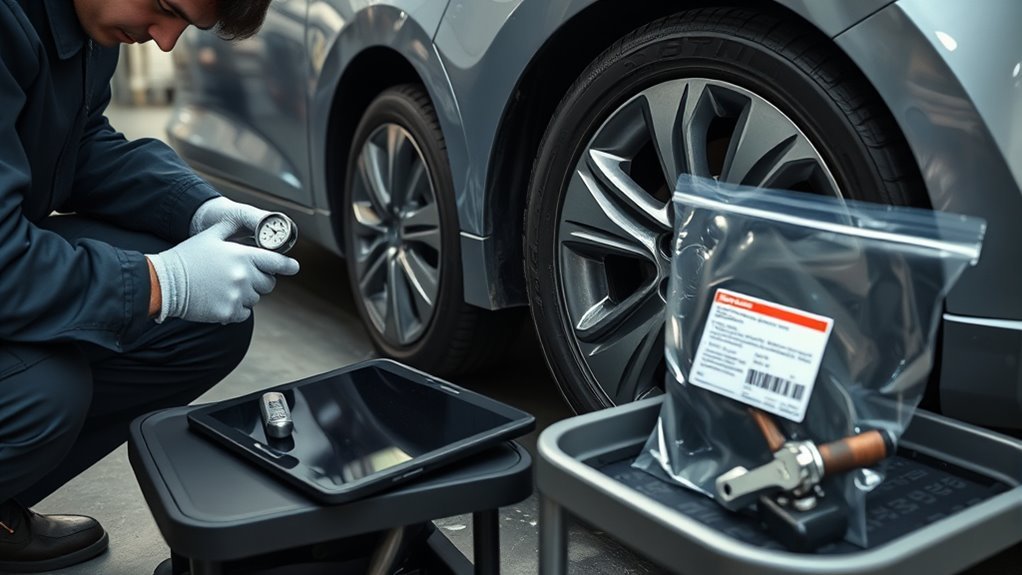
During a warranty inspection, the dealer is trying to separate a possible manufacturing defect from wear, impact damage, road hazard damage, or poor maintenance. Expect the inspection to focus on:
- Tread depth: The technician measures remaining tread. Tires worn to the tread-wear indicators or 2/32 inch are commonly treated as fully worn out.
- Wear pattern: One-sided wear, cupping, feathering, or center-edge wear may point to alignment, suspension, inflation, or rotation problems.
- Sidewall condition: Bulges, cuts, scuffs, bruises, and impact marks may suggest curb or pothole damage rather than a factory defect.
- Bead and rim area: Mounting damage, rim bends, bead leaks, or sealant-related damage can affect eligibility.
- Repair history: An improper plug, patch, or sidewall repair can lead to denial.
- Maintenance records: The dealer may ask for rotation and service history to confirm the tire was maintained properly.
Ask for a written inspection report or repair order showing the tire position, tread depth, air pressure, visible condition, and the dealer’s conclusion. This report is useful whether the claim goes to the tire manufacturer, Hyundai Customer Care, or a reimbursement program.
How to Submit Your Claim and Choose Reimbursement or Replacement
The right submission method depends on the claim type. Do not use one form for every tire problem.
[Products Worth Considering]

EVOULTES heavy duty tire inflator with an integrated gauge delivers accurate pressure readings from 10–120 PSI, helping you inflate, deflate, and check tires in one tool. The 16.5-inch extended dual-head air chuck with swivel base reaches hard-to-access dual wheel valves on trucks and RVs. A brass trigger core and side-mounted air release valve make operation smooth, with standard 1/4" NPT threading and quick-connect compatibility for easy setup.

This tire repair kit provides fast emergency puncture repair without removing the tire from the rim, helping you get back on the road quickly. Its screw plug system is designed for punctures in both tread and sidewall and includes a complete patch plug tool set with essential accessories. A portable storage bag makes it easy to carry for cars, trucks, SUVs, motorcycles, and heavy-duty applications.
If It Is an Original-Equipment Tire Defect Claim
For most original-equipment tire defects, start with a Hyundai dealer, the selling dealer, or an authorized dealer for the tire brand. Hankook says the warranty process is handled through authorized dealers and retailers, and Kumho says original-equipment warranty claims are facilitated by the original seller or a participating dealer. Continental also says authorized dealers handle inspection and replacement for covered conditions.
The dealer may submit the tire adjustment claim, contact the manufacturer, or give you instructions for the tire maker’s claim process. If approved, the remedy may be a free replacement, pro-rated credit toward a comparable tire, or another adjustment allowed by that brand’s warranty.
If It Is a Hyundai Campaign, Warranty Extension, or Recall Reimbursement
Use Hyundai’s online reimbursement form only if your tire-related expense is tied to a qualifying Hyundai recall, service campaign, warranty extension, or class-action reimbursement. Hyundai’s campaign reimbursement form asks for details such as name, email, VIN, current mileage, date of repair, reimbursement preference, a written note, repair order, proof of payment, proof of ownership, and supporting files. The form allows most document, photo, and video formats with a combined total up to 50MB and a 10-file maximum. See the official MyHyundai Campaign Reimbursement page for the current form.
If you already submitted a Hyundai campaign reimbursement claim, Hyundai provides a separate campaign reimbursement status page where you can check using the information from your submission.
Reimbursement Versus Replacement
For tire manufacturer claims, “replacement” usually means an adjustment through a dealer. If the tire is still in the free-replacement period, the tire maker may cover a comparable tire according to its policy. After that, many warranties calculate a pro-rated credit based on remaining usable tread, while you may still owe mounting, balancing, taxes, or upgrade costs.
For Hyundai campaign reimbursement claims, “reimbursement” usually means money back for an eligible repair you already paid for. Hyundai’s form may let you choose electronic payment or check by mail, but that choice applies to the Hyundai reimbursement case—not necessarily to a tire manufacturer warranty claim.
Required Documentation Checklist
- VIN and current mileage
- Tire brand, model, size, and DOT/TIN photo
- Photo of the tire damage or defect
- Photo of the full tread and sidewall
- Purchase paperwork or vehicle purchase document
- Repair order, inspection report, or dealer notes
- Maintenance records for rotations, alignments, and pressure checks
- Proof of payment if requesting reimbursement
- Claim number, case number, or manufacturer reference number
Common Reasons Hyundai Tire Warranty Claims Are Denied
A denial does not always mean the tire was not damaged. It usually means the reviewer believes the damage is outside the warranty terms. Common reasons include:
- Road hazard damage: Nails, glass, potholes, curb hits, cuts, punctures, and impact breaks are often excluded from defect warranties.
- Improper inflation: Underinflation and overinflation can cause heat buildup, shoulder wear, center wear, or structural damage.
- Misalignment or suspension issues: Uneven wear can make a claim look like a vehicle maintenance issue instead of a tire defect.
- Failure to rotate: Missing rotation records can hurt claims involving irregular tread wear.
- Improper repair: Sidewall repairs, unsafe plugs, sealant damage, or repairs outside industry guidelines may void coverage.
- Tread below warranty limit: Many warranties end when the tire reaches the end of usable tread, commonly 2/32 inch.
- Wrong claim channel: A tire defect claim sent to Hyundai’s campaign reimbursement form may be rejected if it is not tied to an eligible Hyundai campaign.
After the Claim: Timelines, Tracking, Denials, and Records
After submission, keep a simple claim log. Record the date, dealer name, tire brand, claim number, person contacted, phone number, email, and next step. Save copies of photos, receipts, inspection reports, and emails in one folder.
If the claim is approved, confirm what is covered before authorizing work. Ask whether you owe mounting, balancing, disposal fees, taxes, or the price difference for a more expensive replacement tire.
If the claim is denied, ask for the reason in writing. Compare that reason with the tire maker’s warranty exclusions. If the denial cites missing documents, send the missing proof quickly. If it cites road hazard, impact damage, or improper maintenance and you disagree, ask whether the tire can be reviewed by the tire manufacturer’s warranty department or a regional representative.
For Hyundai-related warranty questions in the United States, Hyundai lists Customer Care at (800) 633-5151. For campaign reimbursement questions, Hyundai lists (844) 475-2215. For a disabled vehicle or roadside help, Hyundai lists Roadside Assistance at (800) 243-7766.
Frequently Asked Questions
What documents do I need for a Hyundai tire warranty claim?
You usually need the VIN, current mileage, tire brand, tire model, DOT/TIN photo, purchase proof, tire photos, inspection report, repair order, proof of payment if seeking reimbursement, and maintenance records such as rotations or alignments.
Does the Hyundai warranty cover tire replacement?
Usually not under Hyundai’s standard new-vehicle warranty. Hyundai’s warranty handbook says original-equipment tires are warranted directly by the tire manufacturer. A covered tire defect may still qualify for replacement or pro-rated credit through the tire maker’s warranty.
How do I make a warranty claim on a Hyundai tire?
Start by identifying the tire brand and DOT/TIN, then have the tire inspected by a Hyundai dealer or authorized tire dealer. The dealer may submit the tire manufacturer claim or give you brand-specific instructions. Use Hyundai’s online reimbursement form only for qualifying campaign or warranty-extension reimbursement.
Can road-hazard damage be covered?
Road-hazard damage is usually excluded from a manufacturer defect warranty. However, if you bought replacement tires through a Hyundai Tire Center or another dealer, you may have separate road-hazard coverage. Check your tire purchase invoice and protection-plan terms.
What if my tire warranty claim is denied?
Ask for the denial reason in writing. If the issue is missing paperwork, send the missing receipt, inspection report, or maintenance record. If you disagree with the inspection finding, ask whether the tire manufacturer can review the tire or whether a second authorized dealer inspection is allowed.
Conclusion
The fastest way to file a Hyundai tire warranty claim is to choose the correct path before submitting anything. For original-equipment tires, start with the tire brand and an authorized dealer inspection because the tire manufacturer usually controls defect coverage. For Hyundai campaign or warranty-extension reimbursement, use the MyHyundai reimbursement process and keep every document, photo, claim number, and dealer note until the case is fully resolved.
Sources
- Hyundai Owner’s Handbook & Warranty Information — confirms Hyundai’s tire warranty direction and new-vehicle warranty exclusions.
- MyHyundai Campaign Reimbursement — supports Hyundai reimbursement form fields, required documents, payment preference, and file upload limits.
- MyHyundai Campaign Reimbursement Status — supports claim-status tracking and Hyundai contact numbers.
- Hankook Tire Warranty FAQ — supports dealer-handled warranty process for Hankook tires.
- Kumho Original Equipment Tire Warranty — supports OE tire warranty terms, usable tread, exclusions, and dealer inspection requirements.
- Continental New Vehicle Tire Warranty Overview — supports coverage limits, 2/32-inch tread limit, exclusions, and authorized dealer handling.

Related Articles

Danger of Using Summer Tires in Winter on a Hyundai Sonata
Potentially perilous, using summer tires in winter on your Hyundai Sonata can compromise safety—discover the hidden dangers that await you on icy roads.
Read More
Can You Mix Nitrogen and Air in Hyundai Sonata Tires? Answered
Discover the implications of mixing nitrogen and air in your Hyundai Sonata tires—are the benefits worth the risks? Explore the answer inside!
Read More
How to Tell If Hyundai Sonata Tires Are Too Old to Use Safely
Understand how to assess the age of your Hyundai Sonata tires and discover crucial signs of deterioration that could compromise your safety on the road.
Read More