
Tire Load Range Explained: B-F Letters Guide
Tire load range (letters B–F) tells you a tire’s construction strength, ply-equivalent, maximum inflation, and safe carrying capacity. This helps you match tires to your payload and towing needs. Higher letters indicate a stronger construction, a higher maximum PSI, and a greater weight limit per tire. However, stiffer tires require correct inflation and can affect ride comfort. Use range B or C for light to moderate loads, D for frequent heavy use, and E or F for extreme towing. Always check your vehicle specifications before upgrading.
What Is Tire Load Range (Letters B–F) and Why It Matters
The tire load range indicates the tire’s rated carrying capacity. This letter code (typically B through F) on the sidewall shows how much weight the tire can support at a specific inflation pressure. The letters B–F correspond to ply-equivalent ratings. For example, B equals a 4-ply rating, while F is a 12-ply rating. Higher letters mean greater strength and durability. Choosing the right load range is crucial for tire safety and load management. Higher load ranges need exact inflation pressure to safely carry their rated weight. Always check your vehicle manufacturer specifications, especially if you tow or carry heavy payloads. This protects your vehicle’s towing capacity and helps prevent blowouts. Regular tire maintenance and pressure checks keep your tires safe and reliable.
Which Tire Load Range Should You Buy? Quick Rules
When buying tires, match the load range to how you use your vehicle. Choose C for standard light-truck hauling, D for heavier loads and regular towing, and E for heavy-duty trucks or trailers. Always follow the vehicle manufacturer’s load recommendations found on the driver’s side door placard or in the owner’s manual. Dropping below the recommended load range increases the risk of blowouts. For optimal tire safety, select a load range that meets or exceeds the required capacity without overloading the axle. Maintain correct tire pressure according to the manufacturer’s guidelines. Higher load ranges need higher air pressure to reach their maximum capacity. Check your tire pressure, sidewalls, and tread wear regularly. If you are unsure, talk to a tire professional.
How Load Range Differs From load index: And Why Both Matter
Both terms relate to weight capacity, but load range and load index measure different things. Load range describes the tire’s structural strength (its ply-equivalent). Load index is a number that states the exact maximum weight the tire can hold at its proper inflation pressure. You need both numbers to ensure tire safety, vehicle performance, towing capacity, and correct weight distribution.
- Load range indicates durability and how well the tire handles sustained stress.
- Load index provides the exact per-tire weight limit (found on loading charts).
- Match or exceed the manufacturer’s load index and load range to avoid failure.
- Proper inflation pressure is required to reach the load index capacity. Underinflation reduces both capacity and lifespan.
Use both values together when buying tires for heavy loads.
What Load‑Range Letters Mean (Ply Equivalent & Max PSI)
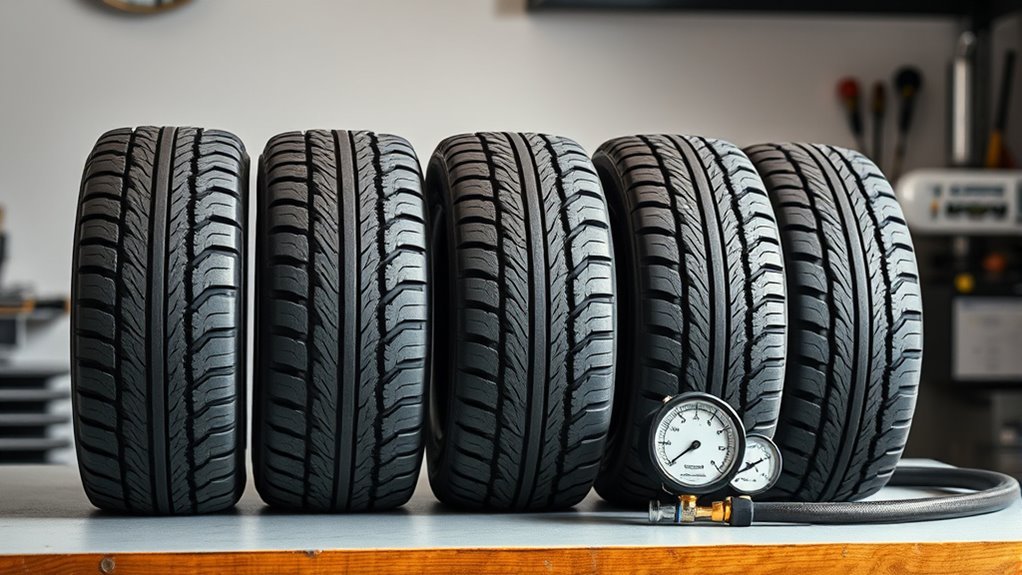
Each load‑range letter signifies a specific capacity and maximum inflation limit. The letters B through F map to ply‑equivalent ratings (B=4, C=6, D=8, E=10, F=12). These ratings correspond to progressively higher maximum inflation pressures. Choosing the correct letter ensures your tires can handle the weight and pressure needed for safe driving.
Load Range Letter Meaning
Load-range letters provide a quick reference for a tire’s construction strength and maximum inflation pressure. Manufacturers assign letters B through F to show increasing ply-equivalent strength (B=4, C=6, D=8, E=10, F=12) and their corresponding maximum PSI (for example, C is usually 50 PSI, and E is 80 PSI). The letter tells you if the tire’s construction matches your vehicle’s weight demands. This directly impacts load capacity and overall safety. The tire must be inflated to its rated PSI to carry the maximum load safely.
- B = entry-level strength, lower load limit, and lower PSI.
- C = moderate load, roughly 50 PSI maximum capacity.
- D = heavy-duty, higher PSI (usually 65 PSI maximum).
- E/F = maximum load capacity, highest PSI ratings (80–95 PSI maximum).
Ply Rating Equivalents
Load-range letters translate directly into ply-equivalent and PSI numbers. For instance, B is a 4-ply equivalent, C is a 6-ply equivalent (common for light trucks), D is an 8-ply equivalent (up to 65 PSI), and F is a 12-ply equivalent with a much higher PSI limit. Understanding these ply ratings helps you match your tires to the vehicle manufacturer’s specifications. Tire durability and heavy load suitability depend heavily on correct inflation. Underinflation, or using the wrong ply-equivalent, reduces your truck’s performance and shortens the tire’s lifespan. Refer to manufacturer charts to ensure your tires meet safety standards for your specific towing and driving conditions.
Max Inflation Pressure
The load-range letter on the tire sidewall maps to a ply-equivalent and a maximum inflation pressure. This pressure determines how much weight the tire can safely carry. Use the letter to follow inflation guidelines based on your payload. Letters B through F indicate higher ply-equivalents and higher maximum PSI limits.
- B: lower capacity, max ~35 psi, for light loads.
- C: 6-ply equivalent, moderate duty, max ~50 psi.
- E: 10-ply equivalent, heavy duty, max ~80 psi.
- F: 12-ply equivalent, highest capacity, max ~95 psi, for severe loads.
Always follow manufacturer specs. Overinflating a tire past its maximum rating risks tire failure.
How to Read Load Range on a Tire Sidewall
To find the load range, look at the tire sidewall. The load range letter is typically located near the tire size. This single letter (B, C, D, E, or F) is the manufacturer’s code for the tire’s maximum load capacity. Verify that this letter meets your vehicle’s required load index for your payload or towing needs. Only upgrade to a higher load range if your vehicle specifications or frequent heavy hauling require the extra capacity.
Typical Tire Load Ranges for Light Trucks (B, C, D, E, F) and Use Cases
Load range letters B through F indicate increasing capacity and typical inflation pressures. For example, load range B supports around 1,100 pounds per tire at a lower PSI for light use. Range C supports about 1,400 pounds for occasional towing. Range D handles about 1,750 pounds for frequent hauling, and E supports roughly 2,300 pounds for heavy-duty work. Choose the lowest load range that still safely meets your rated axle load and towing specs. Only upsize if you regularly exceed those limits.
Load Range Letter Meanings
These letters represent specific maximum-load and pressure specs. Match them carefully to your payload, towing, or durability needs:
- B: ~1,100 lbs capacity at 35 psi — suitable for light-duty passenger or compact trucks.
- C: ~1,400 lbs at 50 psi — moderate loads for vans and light trucks.
- D: ~1,750 lbs at 65 psi — ideal for heavier light trucks and regular towing.
- E/F: E is ~2,200+ lbs at 80 psi; F is ~2,750+ lbs at 95 psi — meant for heavy-duty trucks, trailers, and high-tow applications.
Do not under-spec your tires, or you risk reduced control and premature wear.
Typical PSI And Capacity
Because the load range letters link construction to a specific inflation pressure and maximum load, you must match the letter to your vehicle’s actual demands. Load range B typically maxes out at 35 psi and supports roughly 1,110 pounds per tire for light-duty use. Range C (6‑ply equivalent) handles light towing with a max of 50 psi. Range D (8‑ply equivalent) handles regular cargo at 65 psi. Range E operates up to 80 psi and can carry over 3,000 pounds per tire on some sizes. Range F (12‑ply equivalent) provides the highest capacity for heavy towing and off‑road stress at 95 psi.
Best Uses And Recommendations
Match the load range to your typical payload to get the capacity you need without making the ride unnecessarily stiff. Use B for minimal cargo, C for moderate hauling, D for frequent heavier loads, and E or F for extreme-duty use. Follow these best practices:
- Assess your normal driving conditions and towing needs before upgrading.
- Check your vehicle’s manual to ensure compatibility.
- Check tire pressure and monitor tread wear regularly.
- Expect a firmer, bumpier ride if you upgrade to a higher load range.
Pick the Right Load Range for Towing, Hauling, or Off‑Road Gear
If you regularly tow heavy trailers or haul off-road gear, select an E or F load range. These tires provide higher ply ratings and greater durability under stress. Confirm compatibility with your vehicle’s manual, then match the tire load limits to the combined weight of your vehicle, cargo, and trailer. Focus on towing stability and proper weight distribution to avoid overloading a single axle. For off-road driving, pick a load range that resists punctures and heat buildup. Follow the exact inflation guidelines for your chosen load range to maximize safety and tire lifespan.
How Load Range Impacts Ride, Handling, and Inflation Needs
Upgrading to a higher load‑range tire (C through F) means you will get firmer sidewalls. This changes how the truck rides and handles. While you gain load capacity and handling stability when towing, the tradeoff is a much stiffer ride quality. Higher load ranges also allow for higher inflation pressure (up to 95 psi for load range F), which prevents the tire from flexing too much under a heavy load.
- Firmer sidewalls improve stability during cornering and towing.
- Higher inflation pressure preserves load capacity and reduces heat buildup.
- If you drive without a load, highly inflated heavy-duty tires will feel harsh and bumpy.
- Check pressures regularly; incorrect inflation reduces safety and tire life.
Top Load‑Range Mistakes and a Quick Matching Checklist
Watch out for common mistakes that affect tire safety. Avoid choosing a lower load range than the vehicle requires. Do not assume a higher letter is automatically better for your daily commute. Never ignore your vehicle’s load index requirements or the manufacturer placard. Finally, never mix different load ranges across the same axle.
Quick checklist:
- Check your vehicle placard or owner’s manual for the recommended load range and load index.
- Match the load range (B–F) to your actual towing and hauling weight.
- Make sure tires on the same axle use identical load ranges.
- Confirm the ply-equivalent rating meets your capacity needs.
- Adjust your tire pressure to match the load you are carrying.
Frequently Asked Questions
Is Load Range B or C Better?
Load range C is better if you carry heavier loads or tow, as the stronger construction improves stability. Choose load range B for lighter, everyday passenger driving to improve ride comfort, as long as it meets your vehicle’s minimum requirements.
What Load Range Tire Is F?
Load range F is a heavy-duty tire specification. It is a 12-ply equivalent tire that can hold up to 95 PSI. It is built for severe towing and hauling applications on heavy-duty trucks and trailers.
How Much Weight Can a Load Range B Tire Carry?
A load range B tire can typically carry between 1,100 and 1,400 pounds when properly inflated to its maximum PSI (usually 35 PSI). Always check the exact load index number on the sidewall for the precise weight limit.
Is Load Range F 10 Ply?
No, load range F is a 12-ply equivalent. Load range E is the 10-ply equivalent. Load range F offers stiffer sidewalls and higher inflation limits (up to 95 PSI) than an E-rated tire, making it ideal for the heaviest towing needs.
Final Thoughts on Tire Load Ratings
Choosing the correct tire load range requires matching the tire’s capacity to your specific workload. If you tow, haul, or carry heavy gear, select higher letters (D–F) and follow the max PSI guidelines. Never overinflate a tire for extra capacity, and never underinflate a heavy-duty tire. Always check your sidewall markings and your vehicle’s load index to keep your truck performing safely.

Related Articles

What Does THE P Stand For on a Tire? Full Meaning Explained
I’ll explain what the “P” on a tire really means and why it could change how you choose your next set.
Read More
How to Use a Tubeless Tire Repair Kit: Complete Field Guide
Learn how to fix tubeless tire punctures fast with the right kit, because one small mistake can leave you stranded on the trail.
Read More
How to Tell a Tire’s Diameter: Easy Guide to Reading Tire Size
Want to decode tire sidewall numbers and find the right diameter, but wonder what those hidden digits really mean?
Read More