
What Does 104H Mean on a Tire? Load, Speed & Rating Guide
When you see 104H on a tire sidewall, you are looking at the tire’s service description. The number tells you how much weight the tire can carry, and the letter tells you its tested speed capability. Both matter because your vehicle was designed around a specific tire size, load rating, and speed rating.
Quick Answer
A 104H tire has a 104 load index, which equals 1,984 pounds / 900 kg per tire when properly inflated and used as specified. The H speed rating means the tire is rated for up to 130 mph / 210 km/h under controlled test conditions.
Key Takeaways
- 104 is the load index, equal to 1,984 lb / 900 kg per tire.
- H is the speed rating, equal to 130 mph / 210 km/h under specified test conditions.
- A 104H tire must still match your vehicle’s tire size, load requirement, speed rating, and inflation guidance.
- Do not replace 104H tires with a lower load index or lower speed rating unless your vehicle manufacturer specifically allows it.
- Your safe everyday tire pressure comes from the driver-door placard or owner’s manual, not the tire’s sidewall maximum pressure.
What Does 104H Mean on a Tire?
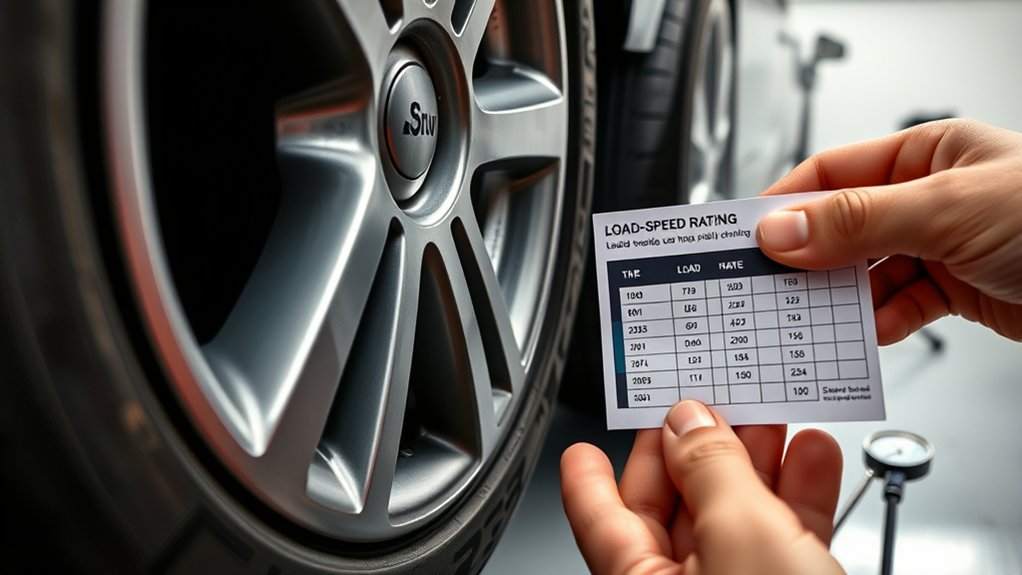
A tire marked 104H combines two important ratings:
- 104 is the load index. It means one tire can carry 1,984 pounds / 900 kg when properly inflated and used within its rated conditions.
- H is the speed rating. It means the tire is designed to handle up to 130 mph / 210 km/h under controlled test conditions.
You will usually see this code at the end of a full tire size, such as 235/65R17 104H. In that example, 235/65R17 describes the tire’s physical size, while 104H describes its load and speed capability.
Warning: A tire speed rating is not permission to drive at that speed. Always follow posted speed limits, vehicle manufacturer guidance, road conditions, and tire condition. A damaged, overloaded, underinflated, or overheated tire may fail well below its rated limit.
[Products Worth Considering]

BAURATTI tire valve stem caps provide corrosion-resistant protection using anodized aluminum alloy with a plastic liner to help prevent rust and cracking. Designed for universal compatibility with standard Schrader valve stems, they install easily by hand and fit cars, SUVs, trucks, RVs, motorcycles, and bikes. Each pack includes 8 caps to support everyday replacement and sharing.

BESKAR foot scrubber mat lets you clean, exfoliate, and massage your feet in the shower or bathtub without bending or straining. Hundreds of flexible bristles scrub between toes and help remove dead skin and calluses, while suction cups keep the mat securely in place. The large silicone design provides a spacious area to reach pressure points and soothe tired, achy feet.

Yasiby’s 16-piece brass and ABS valve adaptor kit makes it easy to inflate bikes, motorcycles, and vehicles by converting between Presta and Schrader/Dunlop valve types. The set also includes ball needles and tapered inflatable nozzles for sport balls, balloons, and swim rings. Corrosion-resistant threads and durable parts help you keep inflating smoothly at home, on the road, or with a compressor or mini pump.
How to Read 104H in a Full Tire Size
The service description comes after the tire size. Here is a common example:
| Code Part | What It Means |
|---|---|
| 235 | Tire width in millimeters |
| 65 | Aspect ratio; sidewall height is 65% of tire width |
| R | Radial construction |
| 17 | Wheel diameter in inches |
| 104 | Load index: 1,984 lb / 900 kg per tire |
| H | Speed rating: up to 130 mph / 210 km/h under specified conditions |
The tire sidewall markings also include other important details, such as the DOT date code, tire type, construction, maximum sidewall pressure, and sometimes markings such as XL, SL, M+S, or the Three-Peak Mountain Snowflake symbol.
What Tire Load Index 104 Means
The load index is a standardized number that maps to a maximum weight per tire. For a 104 load index, the value is 1,984 pounds / 900 kg per tire.
| Load Index | Max Load Per Tire | What It Suggests |
|---|---|---|
| 100 | 1,764 lb / 800 kg | Lower capacity than 104 |
| 102 | 1,874 lb / 850 kg | Still below 104 |
| 104 | 1,984 lb / 900 kg | Common for many SUVs, crossovers, and heavier passenger vehicles |
| 106 | 2,094 lb / 950 kg | Higher capacity than 104 |
Load index is not the same as your vehicle’s total payload rating. Your vehicle still has its own gross vehicle weight rating, axle ratings, and payload limits. A 104 tire can carry a certain amount, but that does not mean your vehicle can safely carry the combined maximum of all four tires.
Note: The tire’s sidewall may show maximum load and maximum pressure, but those numbers are not the same as your vehicle’s recommended everyday inflation pressure. Use the driver-door tire placard or owner’s manual for normal cold tire pressure.
What the H Speed Rating Means
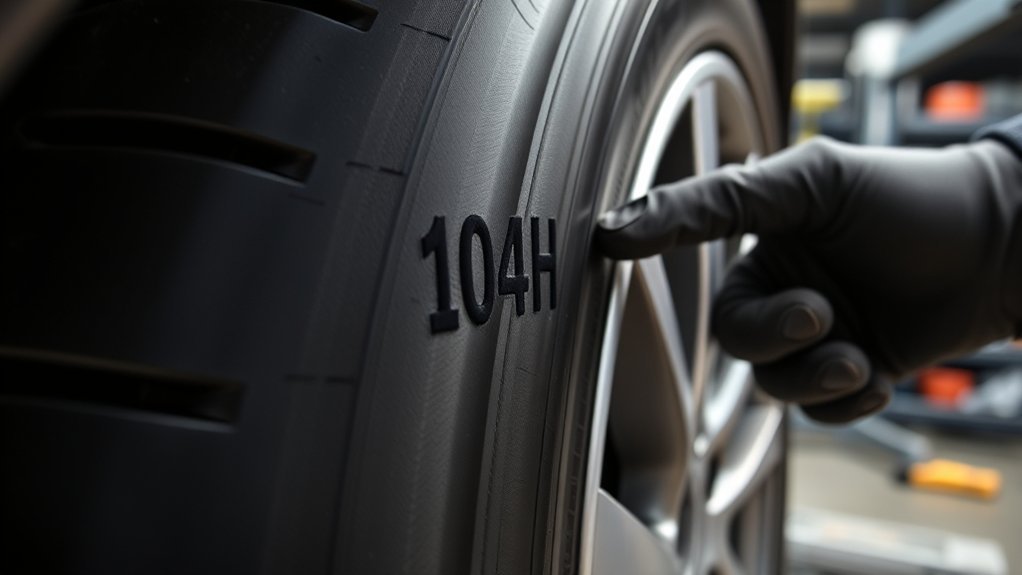
The H speed rating means the tire is rated for up to 130 mph / 210 km/h while carrying its rated load under specified test conditions. It is part of the tire’s service description and appears right after the load index.
| Speed Rating | Maximum Speed | Compared With H |
|---|---|---|
| S | 112 mph / 180 km/h | Lower |
| T | 118 mph / 190 km/h | Lower |
| U | 124 mph / 200 km/h | Lower |
| H | 130 mph / 210 km/h | Rated code in 104H |
| V | 149 mph / 240 km/h | Higher |
Speed rating can also relate to handling feel because tires with different speed ratings may use different construction, sidewall stiffness, tread compounds, and heat-resistance features. That is why the best replacement tire is not just the same size; it should also match or exceed the original equipment load and speed rating unless your vehicle manufacturer says otherwise.
Why 104H Tires Affect Safety
A 104H tire affects more than the number printed on the sidewall. It helps determine how the vehicle carries weight, handles heat, responds to steering, and behaves under braking.
Load Capacity Limits
A 104 load index gives each tire a rated load capacity of 1,984 lb / 900 kg. Exceeding that limit can increase heat, sidewall stress, uneven wear, and the risk of tire failure. The risk grows if the tire is also underinflated, damaged, overloaded, or used at high speed.
Speed Rating Safety
The H speed rating means the tire has been designed and tested for a defined speed capability. It does not guarantee safety in every real-world condition. Heat, road damage, old tire age, low tread, underinflation, and heavy cargo can all reduce safety margins.
Balanced Tire Handling
Your vehicle’s suspension, braking, traction control, and stability systems are designed around tires with compatible size, load capacity, speed rating, and construction. When all four tires are matched, steering response, braking balance, and traction are more predictable.
104H vs. SL, XL, and Load Range
You may see extra markings near the 104H code. These do not replace the load index or speed rating, but they add useful detail:
- SL means Standard Load. It is common on many passenger tires.
- XL, Extra Load, or Reinforced means the tire is built to carry more load at a higher inflation pressure than a standard-load tire of the same size.
- Load Range is more common on light-truck and trailer tires. It is not the same system as passenger-tire load index, though both relate to carrying capacity.
- 104/101 on some light-truck tires means one load index for single-wheel use and another for dual-wheel use.
If your original tire was marked 104H XL, do not replace it with a standard-load 104H tire unless your vehicle manufacturer or tire professional confirms it is appropriate. The same size and service description can still differ in construction.
Can You Mix Different Tire Ratings?
Mixing tire ratings is not ideal. For best safety and handling, all four tires should usually match in:
- Size
- Load index
- Speed rating
- Construction type
- Tire category, such as all-season, winter, summer, or all-terrain
- Tread pattern and tread depth, especially on AWD and 4WD vehicles
If tires with different speed ratings are installed, the vehicle’s safe speed capability is limited by the lowest-rated tire. Mixed ratings can also change steering feel, braking balance, traction control behavior, and wet-road stability.
Pro Tip: When replacing only two tires, ask the tire shop to follow your vehicle manufacturer’s guidance. Many tire makers recommend keeping the best-matched pair on the same axle, and AWD or 4WD systems may require all four tires to be very close in size and tread depth.
[Products Worth Considering]

A portable bicycle repair bag built for on-the-go maintenance, pairing a scalable mini tire pump with a multi-tool, crank and bone wrenches, tire levers, and self-adhesive glueless patches. The included patch set helps you quickly seal punctures using the integrated prep/rasp step, while the waterproof nylon bag keeps tools organized and easy to access. Ideal for road, mountain, and home bike emergencies, repairs, and routine adjustments.

The Big Rig Defense Tire Thumper is a truck tire pressure checker that lets you quickly check multiple tires by giving them a firm whack. Listen for a reassuring thump and feel the stick bounce when a tire is fully inflated, helping you get back on the road safely. It features a comfortable, glove-friendly handle and a secure wrist strap for confident use on busy routes.

This PXZBLG bike repair kit helps you tackle common tire and on-the-ride issues with a compact, ride-ready tool collection. It includes a mini tire pump supporting both Presta and Schrader valves, a 16-in-1 bike multitool, tire levers, glueless patches with a plastic box, plus 4mm and 5mm Allen wrenches. A convenient bike bag stores everything so you can mount it on your road bike or mountain bike for lightweight, portable preparedness.
How to Choose the Right 104H Tire
To choose the right 104H tire, start with your vehicle’s required tire size and service description. Do not shop by price or tread pattern alone.
- Check the driver-door placard. This usually lists the original tire size and recommended cold tire pressure.
- Check the owner’s manual. It may include approved alternate sizes or special guidance for towing, winter tires, or high-speed driving.
- Match the size first. A 104H rating does not help if the tire size is wrong for the wheel or vehicle.
- Match or exceed the load index. Replacing 104 with 102 lowers rated capacity and may be unsafe unless approved by the manufacturer.
- Match or exceed the speed rating. Replacing H with T, S, or R may reduce performance and heat resistance.
- Match SL or XL construction when required. If the vehicle came with XL tires, use equivalent replacements unless approved otherwise.
- Compare traction, temperature, treadwear, and warranty. These do not replace load and speed ratings, but they help compare tire models.
- Install a matched set when possible. Four matching tires give the most predictable handling and rotation options.
Is a Higher Rating Better?
A higher load index or speed rating can be acceptable if the tire still matches the correct size, construction, and vehicle requirements. For example, a tire rated 106H has more load capacity than 104H, and a 104V tire has a higher speed rating than 104H.
That does not automatically make the tire better for your vehicle. Higher-rated tires may cost more, ride firmer, create more road noise, or wear differently depending on the tire design. The best tire is the one that meets the vehicle manufacturer’s specifications and matches your driving conditions.
Common 104H Mistakes to Avoid
- Thinking 104H is the tire size. It is only the load and speed rating. The full tire size is printed before it.
- Using sidewall max pressure as daily pressure. Use the vehicle placard or owner’s manual for normal cold inflation pressure.
- Buying a lower load index to save money. A lower rating can reduce load capacity and safety margin.
- Mixing ratings across the vehicle. Different speed ratings, load indexes, tread types, or constructions can affect handling.
- Ignoring tire age and condition. A tire can have the correct 104H rating and still be unsafe if it is old, cracked, worn, punctured, or unevenly worn.
Frequently Asked Questions
Should I buy H-rated or T-rated tires?
Buy the rating your vehicle manufacturer recommends. An H-rated tire is rated up to 130 mph / 210 km/h, while a T-rated tire is rated up to 118 mph / 190 km/h. If your vehicle came with H-rated tires, do not switch to T-rated tires unless the owner’s manual or tire professional confirms it is acceptable.
What does the H stand for on a tire?
The H is the tire’s speed rating. It means the tire is rated for up to 130 mph / 210 km/h under specified test conditions. It appears after the load index in the tire’s service description, such as 104H.
Which is better, S or H speed rating?
An H rating is higher than an S rating. S is rated up to 112 mph / 180 km/h, while H is rated up to 130 mph / 210 km/h. But “better” depends on your vehicle. Use the speed rating recommended by the manufacturer.
Which is better, 95H or 95V?
Both have the same 95 load index, but V has a higher speed rating than H. A 95H tire is rated up to 130 mph, while a 95V tire is rated up to 149 mph. Choose the rating that matches or exceeds your vehicle’s required specification.
Can I replace 104H tires with 102H tires?
Usually, no. A 102 load index carries less weight than a 104 load index. Use a lower load index only if your vehicle manufacturer lists it as an approved replacement.
Can I use 104V instead of 104H?
In many cases, a 104V tire can replace a 104H tire because it keeps the same load index and has a higher speed rating. Still, confirm the tire size, SL/XL construction, vehicle placard requirements, and tire category before buying.
Does 104H mean the tire is for an SUV?
Not always. A 104H rating is common on many SUVs, crossovers, minivans, and heavier passenger vehicles, but the code itself only tells you load index and speed rating. The full tire size and vehicle placard determine whether it fits your vehicle.
Conclusion
A 104H tire combines a 104 load index with an H speed rating. In plain terms, that means 1,984 lb / 900 kg per tire and a tested speed rating of 130 mph / 210 km/h. The safest choice is to match the full tire size, load index, speed rating, SL/XL construction, and pressure guidance listed by your vehicle manufacturer.
Sources
- NHTSA TireWise — tire safety ratings, UTQG, and tire maintenance guidance.
- Tire Rack Load Index Guide — load index chart showing 104 equals 1,984 lb / 900 kg.
- Michelin Tire Load Rating & Speed Rating — explanation of load index, speed rating, and H = 130 mph.
- Michelin Tire Markings Explained — sidewall markings, load/speed ratings, pressure markings, and DOT code guidance.
- Tire Industry Association: Reading a Tire Sidewall — service description, load index, speed symbol, and DOT/TIN explanation.
- Discount Tire Speed Rating Chart — speed rating chart and mixed-rating safety guidance.
[Products Worth Considering]

Protect your inner tube with this universal bike tire liner designed to block thorns, glass, nails, and sharp trail debris. It installs easily by measuring and trimming to fit, creating a durable barrier between tire and tube. Lightweight polyurethane construction helps reduce sudden flats for more confident rides.

These waterproof RGB LED bike spoke lights deliver bright, eye-catching visibility for safer night rides. With 14 LEDs and up to 30 pattern options, the light effects change every few seconds and create striking wheel designs. Motion-sensor automatic mode and a manual switch offer flexible control, while IP66 water resistance supports riding in wet conditions.

Black Magic Tire Wet delivers a deep wet-look shine that makes tires appear dark, rich, and freshly detailed. Its long-lasting formula helps resist rain, dust, and road grime for weeks of glossy protection, not days. Apply by spraying onto clean, dry tires—no buffing or wiping required—with a low-sling design to reduce splatter on paint and wheels.

Related Articles
Who Makes Kumho Tires? Brand and Factory Guide
From South Korea to global factories, find out who really makes Kumho tires—and why their production story may surprise you.
Read More
Are Michelin Tires Worth the Price?
Do Michelin tires justify their premium price, or are you paying for a badge; discover what really drives their value and decide for yourself.
Read More
Where Are Continental Tires Made?
Originating from a global network of advanced factories, Continental tires are made in surprising places—find out which plant could be behind yours.
Read More