
Wide vs Narrow Tires: Ultimate Grip vs MPG Guide

Wide tires offer maximum dry grip and high-speed cornering stability. Narrow tires, on the other hand, provide lower rolling resistance and better winter performance. A wider tire creates a shorter, broader contact patch. This raises peak lateral grip by 10–15% and shortens braking distances, but it can also increase fuel use by 2–5%. Narrow tires exert higher local pressure on the road, slicing through snow and reducing hydroplaning risk. Keep reading to see the tradeoffs, fitment limits, and how to choose the right size for your vehicle.
Quick Answer: When to Choose Wide vs Narrow Tires

Choose wide tires when you need maximum dry-surface grip and high-speed cornering stability. These are ideal for sports cars and track days because they improve traction and control during aggressive maneuvers. Opt for narrow tires on daily drivers to reduce rolling resistance and improve gas mileage. In winter, narrow profiles easily slice through snow and concentrate the vehicle’s weight to bite into ice. Remember to adjust your tire pressure to match the tire width and load. Consider your driving style, vehicle type, and local weather when balancing grip and efficiency.
[Products Worth Considering]

The Milton 555e digital tire inflator delivers fast, accurate pressure readings with a backlit display and multiple unit options, making tire inflation quick and easy. Its durable 20" EPDM rubber hose and grip‑head chuck provide reliable connection, while the ±1 PSI accuracy ensures precise inflation for cars, bikes, and trucks.

This digital tire pressure gauge combines a sturdy pistol grip inflator with a backlit 0.1 PSI display for quick, accurate readings in any lighting condition. Its 360° swivel gauge and 20" rubber hose make it easy to use and store, while the integrated inflate/deflate trigger and ¼" NPT air inlet provide fast, reliable tire maintenance.

The WORKPRO digital tire pressure gauge with inflator offers precise 0.1 PSI resolution and ±1% accuracy for reliable tire inflation across vehicles and inflatables. Built with heavy‑duty aluminum alloy, brass, and rubber, it resists rust and drops while delivering deflation, inflation, and pressure checking functions. The kit includes valve caps, adapters, a twist‑on chuck, screwdriver, nozzles, needle, seal tape, and a storage bag with batteries, making it a versatile, portable solution for on‑the‑go tire maintenance.
How Width Reshapes the Contact Patch and Affects Grip
To understand how tire width changes performance, you need to look at the contact patch (the part of the tire touching the road). Width completely alters this footprint. Wider tires create larger, shorter patches that spread the vehicle’s weight laterally. Narrow tires form longer, narrower patches that concentrate pressure from front to back.
- Wider patch: Increases surface area and lateral load capacity. This improves traction during cornering and heavy braking but raises rolling resistance.
- Narrow patch: Maintains higher linear pressure. This cuts through water and snow more effectively and lowers rolling resistance, which improves efficiency.
- Pressure distribution: Balancing the patch shape and pressure profile is key. A mismatched width can cause uneven wear or compromised stability.
Choose a tire width that matches your primary driving goal: pure grip, predictable handling, or daily efficiency.
Why Wider Tires Boost Dry Cornering and Braking
When you fit wider tires, the larger, shorter contact patch spreads lateral loads across more tread. This reduces localized deformation, resulting in a noticeable increase in cornering grip and braking bite on dry pavement. You can expect up to 10–15% more lateral grip, crisper steering, and shorter stopping distances. The reduced squirm of a short, wide patch sharpens steering response, giving you better feedback and control at high speeds. Wider tires raise your car’s lateral stability, allowing for higher cornering speeds without sacrificing predictability. This improved control comes down to simple physics.
| Metric | Narrow Tire | Wide Tire |
|---|---|---|
| Peak lateral grip | Baseline | +10–15% |
| Braking distance | Longer | Shorter |
| Steering precision | Moderate | Higher |
Use wider tires when dry performance and sharp cornering dynamics are your top priorities.
Why Narrow Tires Often Beat Wide Ones in Snow and Slush

A narrower tire concentrates the vehicle’s weight onto a smaller contact patch, which increases the ground pressure per square inch. This higher pressure allows the tread to cut through surface snow and slush to reach the firmer snow-pack below. Because it relies on mechanical interlock rather than floating on top of the snow, a narrow tire usually provides better traction in snowy conditions and shorter stopping distances.
Narrow Tires Cut Through
It might seem counterintuitive, but narrower tires outperform wider ones in winter weather. Because the contact patch is reduced, the ground pressure increases. This lets the tire cut through slush and pack rather than hydroplaning over it.
- Narrower footprint: Concentrates load to slice through snow, enhancing braking and traction.
- Slush evacuation: The narrower profile channels water and slush easily, significantly lowering hydroplaning risk.
- Winter-focused design: Narrower winter tires optimize tread blocks to maximize grip in cold conditions.
This results in precise, confident handling in tough winter environments.
Higher Contact Pressure
Think of contact pressure as a narrow tire’s biggest advantage. By putting the vehicle’s weight onto a smaller footprint, narrow tires increase the pounds-per-square-inch (PSI) at the road surface. You gain measurable benefits: this local pressure improves traction for acceleration and braking. The tire bites through the snow instead of floating, reducing the chance of getting stuck. If you want the best possible winter performance, choosing narrower winter tires yields superior stability and handling.
Improved Snow-Pack Penetration
Because narrow tires concentrate the vehicle’s load, they punch through snow-pack and slush more effectively than wider tires. The concentrated pressure prevents floating, allows the tire to grip packed snow, and pushes displaced snow away. Real-world testing consistently shows better acceleration and shorter braking distances with narrow rubber in winter.
- Penetration: Higher PSI breaks the surface crust, increasing mechanical bite.
- Channeling: Reduced width expels slush, stabilizing your steering.
- Pressure distribution: A concentrated load yields predictable slip angles and better maneuverability.
How Tire Width Affects Rolling Resistance and Fuel Economy
Wider tires generally increase rolling resistance. A larger contact patch causes more energy dissipation as the tire rolls, which translates to a 2–5% drop in fuel economy compared to narrower tires. Conversely, narrower tires reduce this resistance and can improve gas mileage, provided you maintain proper tire pressure. Under-inflated tires—especially wide ones—will completely erase these efficiency benefits. You are essentially trading traction for fuel consumption. Wide treads require more engine work to sustain speed. Choose your tire width based on your primary goal. If range and efficiency matter most, favor narrower, properly inflated tires. If grip is essential, accept the slight fuel penalty and check your tire pressure regularly to avoid wasting energy.
Steering Feel and Tramlining: What Wider Tires Change
While wider tires increase high-speed stability by enlarging the contact patch, they drastically change how your steering feels. You’ll notice firmer steering feedback and altered handling. The larger contact patch boosts lateral grip, but it also increases the physical effort required to turn the wheel.
- Tramlining sensitivity: Wider tires track the grooves and ruts in the road more readily. This produces pronounced tramlining, requiring frequent steering corrections.
- Urban responsiveness: Narrower tires deliver lighter, more direct steering feedback. This makes the car feel more agile in city traffic.
- Vehicle fitment: The ideal width depends on the vehicle type. Choose a width that balances handling dynamics with everyday ride comfort.
Wide vs Narrow Tires: When Width Helps Acceleration and Launches

During a hard launch, wider tires provide a larger contact patch that increases traction and stabilizes the car. Tire compound is also a major factor. Softer, stickier compounds found on performance tires amplify the grip advantage of extra width. Wider tires can reduce wheelspin by spreading the load and improving power transfer, but the added rotational weight of a wider wheel and tire combo can offset some of those acceleration gains.
Launch Traction Advantages
For maximum off-the-line acceleration, wider tires give you more usable traction by distributing the launch load across a larger tread area. You can reduce wheelspin and convert engine torque into forward motion much faster. For high-powered cars, wider rubber consistently improves 60-foot times and overall launch performance.
- Contact patch: A larger area lowers local slip and spreads the load during initial acceleration.
- Weight distribution: A broader tread stabilizes the chassis and minimizes power loss from spinning tires.
- Trade-off: Greater rolling resistance helps the tire grip the road but reduces everyday fuel efficiency.
Tire Compound Role
Wider tires often utilize softer, more adhesive rubber compounds to fully exploit their larger contact patch. This soft compound improves initial grip and heat management, though it usually results in faster tread wear. Narrow tires often use formulations that minimize rolling resistance. On slick or cool surfaces, these stiffer compounds can actually yield quicker acceleration by preventing energy loss. Choose based on your needs: if you want the best possible launches, favor wider rubber with flexible compounds and accept the faster wear rate.
Wheelspin And Weight
While wider tires don’t guarantee better acceleration in every scenario, they usually reduce wheelspin by spreading launch loads evenly across the tread. Wider tires also aid in weight distribution across the footprint, which helps stabilize heavier vehicles when you step on the gas.
- Drag launches: Wider tires maximize the traction area, giving you cleaner power transfer.
- Heavy vehicles: Broader contact patches improve weight distribution and prevent sudden wheelspin.
- Poor surfaces: Narrow tires bite better in snow or mud, but under heavy throttle on dry pavement, they will spin faster than wider alternatives.
Safely Upsizing Tire Width: Fit, Clearances, and Risks
If you plan to increase your tire width, always confirm the new tire and wheel will clear the wheel wells, suspension components, and steering rack. Check this under full suspension compression and steering lock. Rubbing can cause rapid tire wear, broken suspension components, and a loss of vehicle control. A good rule of thumb is to stay within +20 mm of your stock tire width. You must also adjust the aspect ratio to preserve the overall tire diameter; otherwise, your speedometer and gear ratios will be inaccurate. Consult manufacturer guidelines or a local tire professional before making a drastic change.
| Fear | Hope | Action |
|---|---|---|
| Rubbing damage | Wider grip | Measure clearances |
| Speedometer error | Better traction | Preserve diameter |
| Poor handling | Confident control | Limit to +20 mm |
| Uneven wear | Optimized setup | Check wheel offset |
| Fuel penalty | Better efficiency | Seek pro advice |
[Products Worth Considering]

The Milton 507KIT delivers fast, accurate tire inflation, deflation and pressure measurement with a backlit LCD gauge and 14" rubber hose. Its 3‑in‑1 design meets ANSI/ASME standards and provides readings from 0‑250 PSI with 0.1 PSI resolution. The ergonomic pistol‑grip body and brass lock‑on chuck make one‑handed operation effortless, while the auto‑off feature conserves battery life.
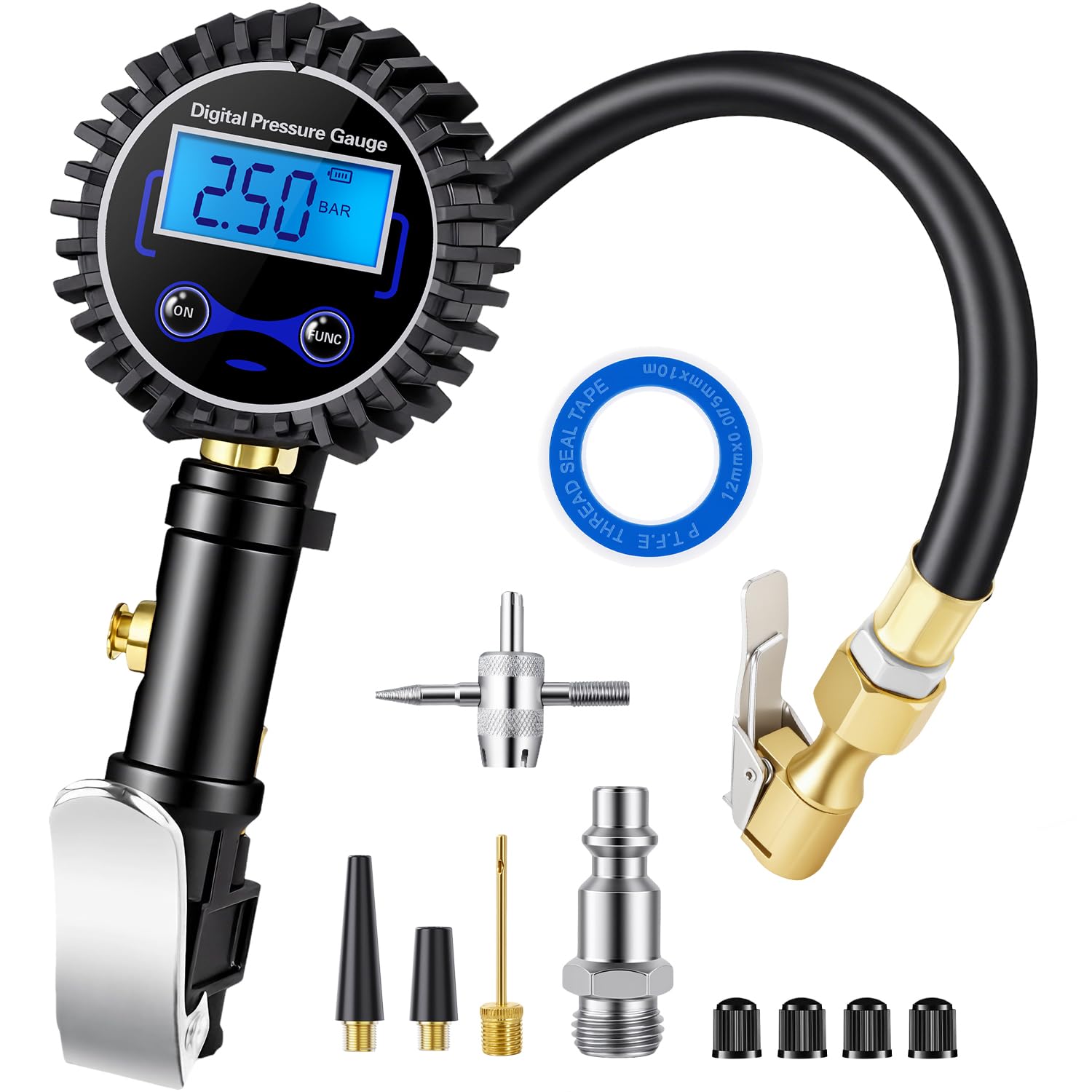
The Digital Tire Pressure Gauge with Inflator offers precise pressure readings with a high‑resolution LED display and four unit options, making tire maintenance quick and accurate. Built from stainless steel and brass, it includes a durable rubber hose, quick‑connect coupler, and a 3‑year warranty for reliable, everyday use across cars, RVs, bikes, and inflatables.

PORTABLE AND ACCURATE - Tire balancer measuring tool with high exactness and you can work efficiently. And the measuring tool has compact structure and light weight, convenient to carry.
Choosing the Right Width for Your Mix: Daily, Track, and Winter (Quick Checklist)
Balancing daily comfort, track performance, and winter safety requires clear priorities. Narrower tires cut rolling resistance and noise for standard commuting. Wider tires boost lateral grip for the track. Intermediate or narrow sizes improve snow penetration in the winter.
Choose tire widths by priority: narrow for efficiency, wide for grip, and intermediate for snow. Stay near stock sizes and maintain your pressures regularly.
- Daily driving: Favor narrower, fuel-efficient tires to reduce road noise and fuel consumption.
- Track-focused: Adopt wider rubber for a greater contact patch and lateral grip. Ensure your suspension can handle the clearance.
- Winter readiness: Choose narrow treads for snow penetration. Prioritize a dedicated winter tire compound over extreme width adjustments.
[Products Worth Considering]
![Mastertrack M-TRAC GT Ultra High-Performance All-Season Tire Set (4 Tires) 275/25ZR28 101W XL | 5-Year Warranty+3 Year Road Hazard Protection+Dual Tread Design for Sports Cars [TIRE ONLY] UTQG 460 A A](https://m.media-amazon.com/images/I/4154dRag0CL._SL500_.jpg)
🔧 Dual Tread Technology: 4-Groove (narrow) & 5-Groove (wide) configurations adapt to wheel widths - Wider spacing reduces hydroplaning by 22% while maintaining sporty visual appeal.

Three Peak Mountain Snowflake certified for use in moderate to severe winter weather conditions

Three Peak Mountain Snowflake certified for use in moderate to severe winter weather conditions
Does Wheel Diameter Matter When Changing Width?
When upsizing your tire width, you often have to consider wheel diameter. If you choose a wider tire on a larger wheel (commonly called “plus-sizing”), you must reduce the tire’s sidewall height to keep the overall diameter the same. While shorter sidewalls improve steering response, they also make the ride significantly harsher and leave your wheels more vulnerable to pothole damage.
Frequently Asked Questions
Do Wider Tires Increase Road Noise Inside the Cabin?
Yes, wider tires put more rubber in contact with the road, which increases tire drone and cabin noise. If you upgrade to a wide performance tire, expect a louder ride.
How Does Tire Width Affect Hydroplaning Risk in Heavy Rain?
Wider tires raise your hydroplaning risk because the larger surface area has a harder time displacing standing water. Tire design and tread patterns must work overtime to channel water away safely.
Are Wider Tires More Expensive to Replace Than Narrow Ones?
Yes. Wider tires require more material, often feature expensive performance compounds, and cost more to manufacture. Better performance almost always comes with a higher replacement cost.
Do Insurance Premiums Change With Different Tire Widths?
Generally, insurers do not adjust premiums solely for tire width. However, extreme performance upgrades or nonstandard tires that cause an accident due to poor fitment can indirectly influence your coverage.
Can Tire Width Influence Ride Comfort Over Potholes?
Wider tires can sometimes spread the impact of a pothole, but ride comfort is mostly determined by the tire’s sidewall height. A wide tire with a very thin sidewall will result in a harsh, uncomfortable impact.
Conclusion
Ultimately, choosing the right tire width is about balancing tradeoffs. Wider tires improve dry grip, cornering, and braking by enlarging the lateral contact area. However, they can increase rolling resistance, cause tramlining, and reduce wet-weather performance. Narrower tires cut rolling resistance and easily penetrate slush, improving fuel economy and winter traction, but they sacrifice ultimate dry grip. Match the tire width to your vehicle, local weather, and driving habits to get the best performance without unexpected compromises.

Related Articles

What Is a Fat Tire? Complete Guide & Best Options
I’ll show you what makes fat tires different, which setups work best, and why the right choice could change your ride.
Read More
What Does W Mean on a Tire? Load, Speed & Rating Guide
Huh, what does W on a tire really mean, and why could choosing the wrong rating affect your safety and performance?
Read More
What Does Tire Flipping Work? Muscles, Benefits & Workout Guide
Strong tire flips hammer your entire body, but which muscles and benefits matter most?
Read More