
Foam Filled vs Air Filled Tires: When Each Makes Sense
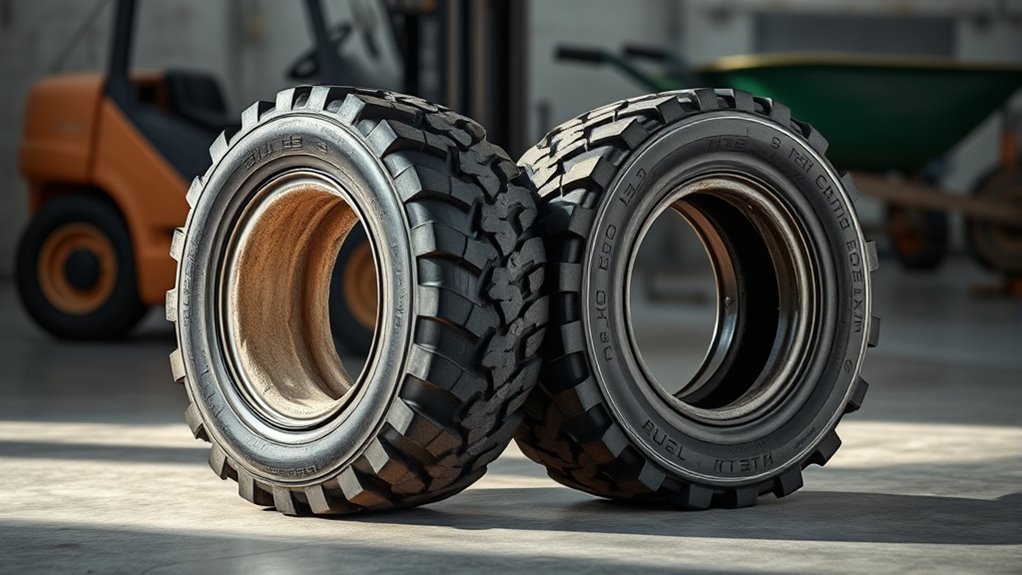
Choose foam-filled tires when punctures, downtime, sharp debris, and heavy-load stability are your biggest problems. Choose air-filled tires when ride comfort, lower weight, easier field repair, and smoother travel matter more. The right telehandler tire is not the one with the best brochure claim; it is the one that matches your surface, load, speed, maintenance capacity, and downtime cost.
Quick Answer
Foam-filled tires are usually best for telehandlers working on demolition sites, scrap yards, recycling areas, rocky ground, and debris-heavy jobs where a flat tire stops production. Air-filled tires are better for lower-risk surfaces where operator comfort, traction on soft ground, lighter transport, and easier repair are more important than puncture immunity.
Key Takeaways
- Pick foam-filled tires for sharp debris, frequent punctures, heavy lifts, and jobs where downtime costs more than the tire upgrade.
- Pick air-filled tires for better ride comfort, lower tire weight, softer surfaces, easier repair, and lower upfront cost.
- Foam fill is not the same as a solid tire. It starts with a pneumatic tire casing filled with polyurethane, while solid tires are built as solid rubber or resilient compounds.
- Always confirm OEM requirements for tire size, ply or star rating, load rating, rim compatibility, speed limits, and approved fill type before changing tire configuration.
Short Answer: Which Tire for a Telehandler?
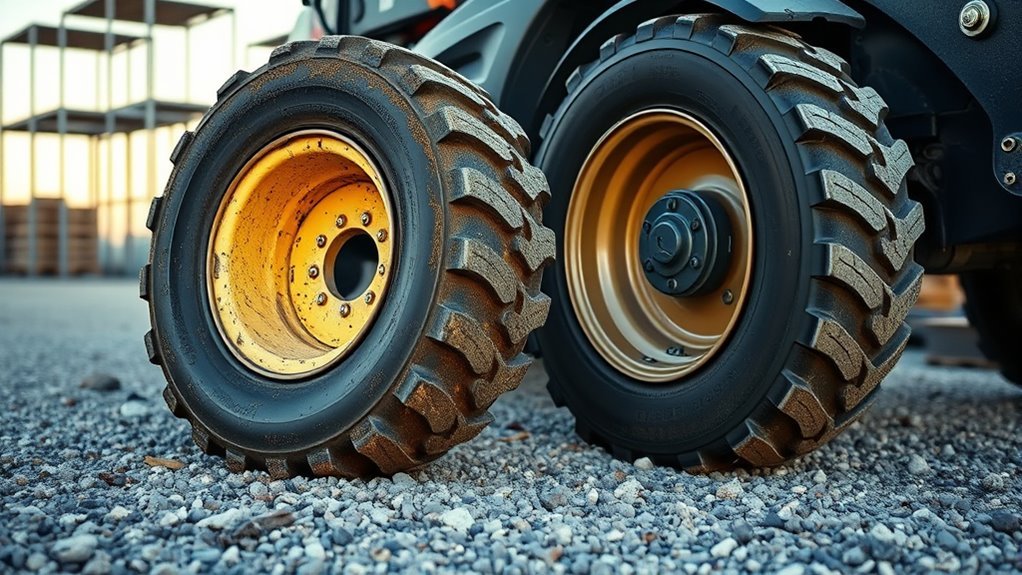
If your telehandler works on debris-laden, uneven, or high-risk job sites, foam-filled tires are usually the stronger choice because they remove the most common failure point of a pneumatic tire: air loss. A polyurethane-filled tire keeps operating after nail, scrap metal, glass, or sharp stone damage that would normally flatten an air-filled tire.
If your telehandler runs on cleaner yards, packed soil, farms, nurseries, warehouses, or mixed surfaces where punctures are less common, air-filled tires can be the better fit. They cushion the machine more naturally, reduce vibration, weigh less, and are easier to patch or replace when damage happens.
A practical rule is simple: choose foam when uptime and puncture resistance are worth the higher upfront cost; choose air when comfort, lighter handling, and lower entry cost matter more.
Note: Foam-filled tires still use a tire casing and rim. They are flat-proof against ordinary punctures, but they are not indestructible. Severe sidewall cuts, casing separation, rim damage, heat damage, or use outside the tire’s rating can still require replacement.
[Products Worth Considering]

Malco tire mounting and demounting lubricant is a ready-to-use tire lube formulated to reduce friction during tire installation for passenger cars, light trucks, farm tires, and heavy-duty equipment. It provides rust-inhibiting protection to help reduce corrosion on rims and wheels, and helps support proper tire bead seating during inflation to reduce air leakage. The silicone-free, soap-free formula is whitewall safe to help prevent discoloration on whitewall tires and sensitive sidewall markings.
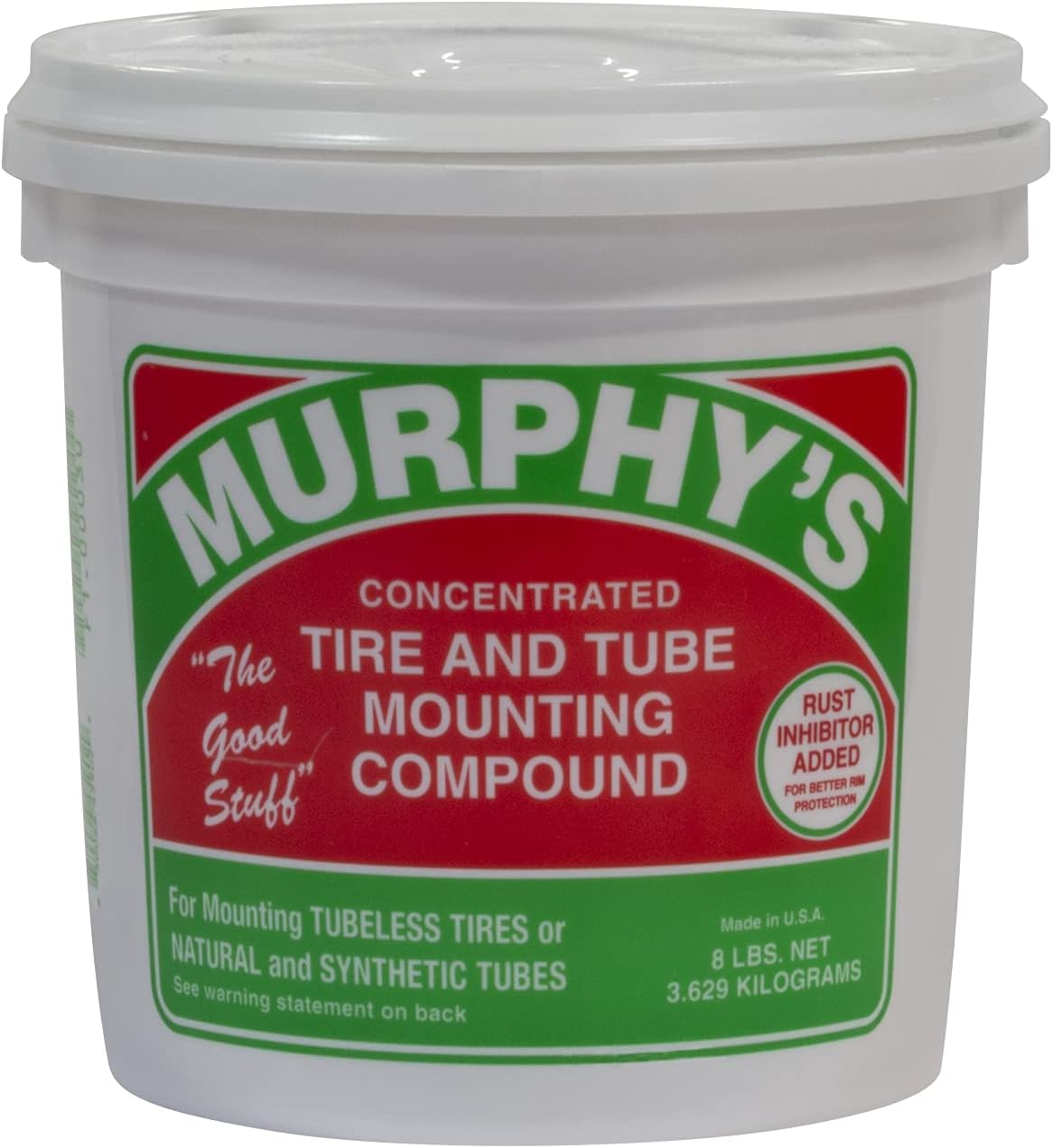
A concentrated tire and tube mounting compound designed to help simplify mounting rubber tires and tubes on passenger, semi truck, construction, and OTR applications. Its ultra-thick formula packs beads effectively and includes rust inhibitors to help protect against corrosion during use.
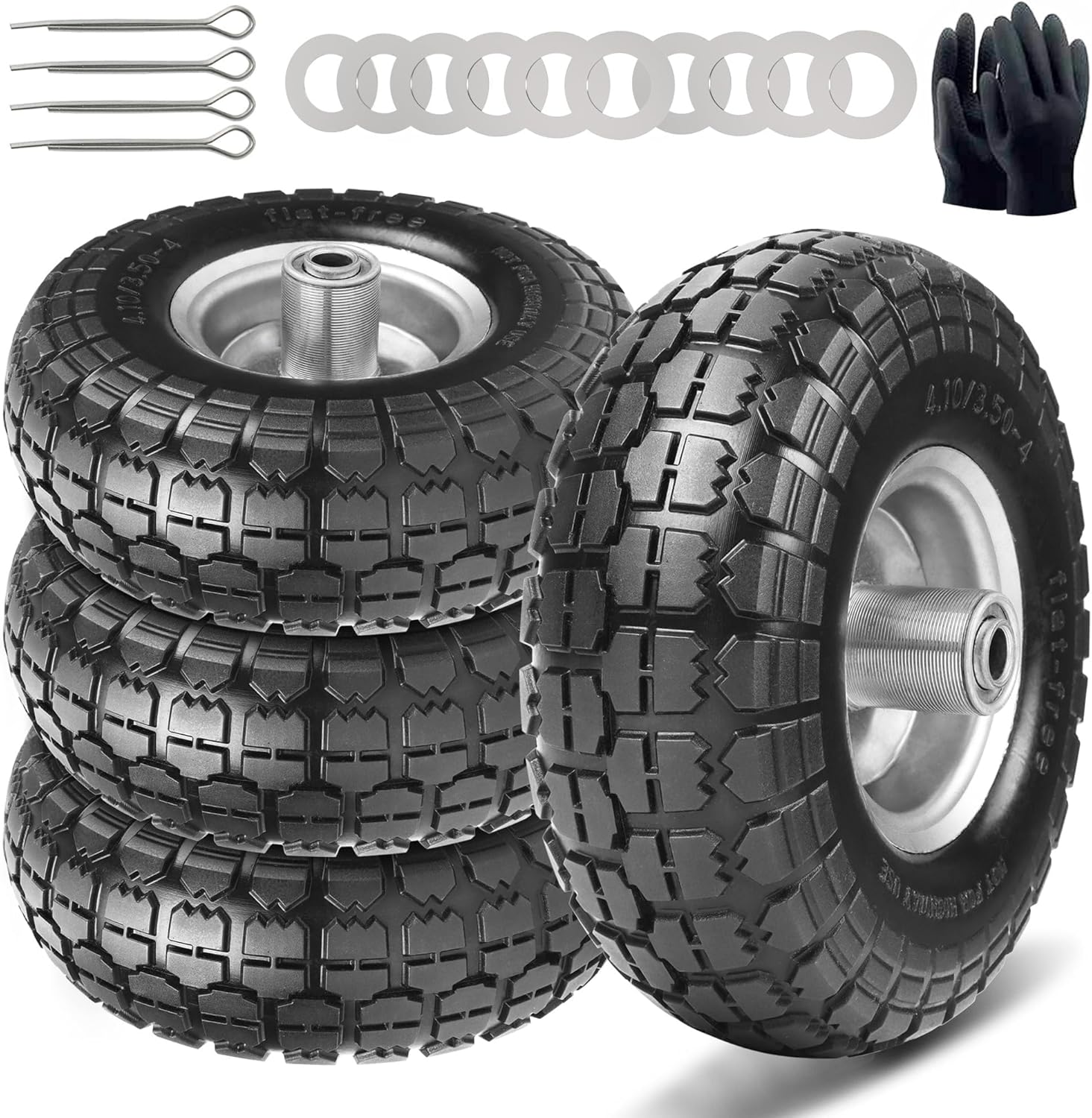
Upgrade your hand truck, garden cart, or yard wagon with flat-free solid rubber tires that eliminate blowouts and maintenance. The serrated tread delivers excellent traction and stable rolling, while double sealed bearings help keep movement smooth on many terrains. Heavy-duty steel rims and 200kg max load support durable performance for demanding outdoor use.
30-Second Decision Guide: Pick This If…
| Choose Foam-Filled Tires If… | Choose Air-Filled Tires If… |
|---|---|
| Your site has nails, rebar, scrap metal, broken concrete, thorns, or demolition debris. | Your site is mostly clean, packed, paved, grassy, or low-risk for punctures. |
| A flat tire creates expensive downtime, delayed lifts, or emergency service calls. | You can tolerate routine pressure checks, patching, and occasional tire repair. |
| You need predictable load support and less tire deflection during heavy work. | Operator comfort and vibration reduction are top priorities. |
| You run in scrap yards, recycling yards, demolition, waste transfer, rental fleets, or rough construction sites. | You run in agriculture, landscaping, warehouses, smoother yards, or general material handling. |
| You prefer fewer daily tire-pressure tasks and fewer flat-related service interruptions. | You want the lowest upfront cost and easiest tire service. |
Quick Terrain Match
Terrain is the fastest way to narrow the choice. Hazardous, sharp, uneven, or debris-heavy terrain favors foam-filled tires. Cleaner, softer, or comfort-sensitive terrain favors air-filled tires. Camso, a construction tire manufacturer, describes pneumatic telehandler tires as comfortable with strong traction on soft-mixed surfaces, while foam-filled pneumatic tires help reduce downtime and keep operation more predictable.
Use this match-up:
- Demolition, recycling, scrap, waste transfer: foam-filled tires.
- Rocky construction sites: foam-filled tires, or solid tires for the harshest applications if approved by the machine manufacturer.
- Farms, turf, landscaping, nurseries: air-filled tires when soil protection and ride comfort matter.
- Warehouses and paved yards: air-filled, foam-filled, or solid tires depending on load, debris, and speed.
- Rental fleets: foam-filled tires often reduce customer downtime and callouts, especially when the machine’s next job site is unpredictable.
Downtime Vs Cost
Foam-filled tires cost more to buy and install, but they can lower total operating cost when flats are common. Air-filled tires cost less upfront, but their real cost includes pressure checks, repairs, service calls, spare inventory, technician time, and lost production when a tire fails.
| Metric | Foam-Filled Tires | Air-Filled Tires |
|---|---|---|
| Puncture downtime | Very low | Higher on debris-heavy sites |
| Initial cost | Higher | Lower |
| Pressure checks | Not required after fill | Required regularly |
| Ride comfort | Firmer | Smoother |
| Repairability | Usually replace when casing fails | Often patchable or serviceable |
| Best value | Harsh, high-downtime jobs | Cleaner, comfort-focused jobs |
Pick foam when time equals money. Pick air when capital cost, comfort, and easy repair matter more than flat-proof uptime.
How Foam-Filled Tires Work and What They Solve
Foam-filled tires start as pneumatic tires. Instead of leaving the tire filled with air, a technician fills the cavity with a polyurethane compound. The compound cures into a resilient core that supports the tire from the inside. That means the tire no longer depends on air pressure to carry the load.
This solves three major problems:
- Puncture-related air loss: nails, metal, glass, thorns, and debris can damage the casing, but they do not create a flat the way they do in an air-filled tire.
- Pressure inconsistency: the operator does not need to maintain daily inflation pressure once the tire is properly foam-filled.
- Load deflection: foam can reduce sidewall collapse and help the machine feel more stable under demanding work, especially compared with an underinflated pneumatic tire.
The trade-off is that foam adds weight, increases rolling resistance in many applications, creates a firmer ride, and usually makes the tire less repairable once the casing is damaged beyond use.
Pro Tip: When comparing quotes, ask whether the price includes the tire, foam fill, mounting, disposal of old filled tires, valve service, freight, and downtime. Foam-filled tires are heavy, so handling and disposal can change the real installed cost.
When Air-Filled Tires Outperform Foam
Air-filled tires outperform foam when comfort, lighter tire weight, and serviceability are more important than puncture immunity. Because air compresses and rebounds easily, a pneumatic tire can absorb bumps, vibration, and chatter more smoothly than a foam-filled tire of the same size and tread type.
Better Ride Comfort
Air-filled tires use the air chamber as a cushion. That helps reduce shock transfer into the cab, frame, boom, and load. For long shifts, frequent travel, or tasks that require steady handling, the smoother ride can reduce operator fatigue and improve control.
This matters most when the telehandler travels across mixed but not extremely hazardous terrain: packed soil, gravel, paved yards, agricultural sites, and smoother construction areas. On these surfaces, air-filled tires can give the operator a more forgiving ride without the extra weight and firmness of foam fill.
Lower Weight Impact
Foam fill adds weight to each tire. That extra weight may improve ballast and traction in some slow, heavy-duty applications, but it can also reduce transport efficiency, increase fuel use, and add stress to driveline, hub, and suspension components if the tire choice is not approved for the machine.
Air-filled tires are lighter, which can help with:
- easier transport and handling,
- lower rolling resistance in many clean-surface applications,
- better acceleration and maneuverability,
- less unsprung weight, and
- easier replacement in the field.
Easier Repair and Replacement
An air-filled tire can often be patched, plugged, tubed, or replaced more easily than a foam-filled tire. Foam-filled tires typically need specialized equipment for filling and handling, and once the casing is worn or severely damaged, the entire filled assembly often becomes a disposal and replacement job.
For businesses with on-site tire service, spare wheels, and low puncture exposure, that repairability can make air-filled tires the more practical option.
Durability & Maintenance: Punctures, Service Time, Lifecycle Cost
Foam-filled tires are best understood as a downtime-control upgrade. They reduce the routine maintenance linked to air pressure and flats, but they do not remove the need for tire inspections. Operators still need to check for casing cuts, exposed cords, uneven wear, chunking, wheel damage, loose lug nuts, and tread separation before use.
Air-filled tires need more routine care. Tire pressure must be checked against the equipment and tire manufacturer’s requirements. Incorrect inflation can reduce stability, increase heat buildup, accelerate wear, and raise the risk of tire failure. Michelin’s pressure guidance for off-road and infrastructure equipment emphasizes matching pressure to the machine and application, and Bridgestone publishes load and inflation resources for commercial and off-the-road tires.
Warning: Never change tire size, tire type, foam-fill density, ply rating, star rating, rim, or inflation pressure based only on a generic article. Telehandlers rely on tire capacity and stability. Always follow the machine’s operation manual, tire manufacturer data, and a qualified tire service provider.
To compare real cost, track these numbers over time:
- purchase price per tire,
- foam-fill cost per tire,
- mounting and freight cost,
- average tire life in hours,
- number of flat repairs per month,
- technician labor per repair,
- lost production time per tire event,
- replacement interval, and
- disposal cost for worn foam-filled assemblies.
If your site has frequent flats, foam-filled tires often win on lifecycle cost. If flats are rare, air-filled tires may remain cheaper and more comfortable.
Ride, Traction, Load & Stability: Performance Trade-Offs
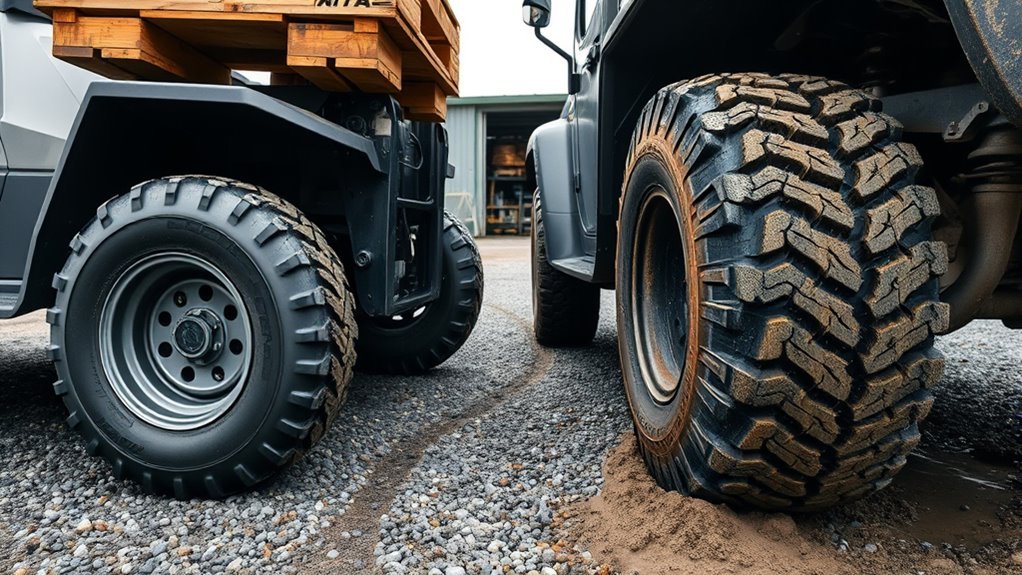
Foam-filled and air-filled tires can both deliver strong traction when the tread pattern, compound, size, and load rating match the job. The difference is how each tire behaves under impact, load, and damage.
Foam-filled tires trade softness for uptime and consistency. Air-filled tires trade puncture immunity for comfort, lower weight, and easier repair.
Ride Comfort
Air-filled tires usually provide the best ride because air compresses more easily than cured foam. Foam-filled tires are firmer, especially on hard surfaces, washboard yards, broken concrete, and long travel routes.
Traction
Traction depends heavily on tread design and ground condition. A foam-filled tire can maintain traction after a puncture because it does not deflate. An air-filled tire can deliver excellent traction on soft or mixed terrain, but traction drops quickly if the tire loses pressure.
Load Stability
Foam-filled tires can feel more stable under heavy load because the tire is less likely to squat from low pressure or sudden air loss. This can be helpful for heavy lifts, uneven yards, and rental fleets. However, tire stability is only one part of telehandler stability. Boom angle, load center, ground slope, attachment type, tire rating, and machine setup all matter.
Speed and Heat
Foam-filled tires can generate more heat than air-filled tires in some applications, especially with long travel, higher speeds, heavy loads, or continuous hard-surface use. Follow the tire and machine manufacturer’s limits for speed, load, and application. Bridgestone’s off-the-road tire data resources note that tire application, load, inflation, speed, and operating conditions must be matched correctly.
Cost: Upfront Price vs Total Cost of Ownership
The biggest cost mistake is comparing only sticker price. A cheaper air-filled tire can become expensive if it causes repeated downtime. A more expensive foam-filled tire can be a poor investment if the machine works on clean surfaces where flats are rare.
Use this simple total-cost formula:
| Total tire cost | Tire + fill or tube + mounting + repairs + labor + downtime + freight + disposal |
| Cost per hour | Total tire cost ÷ machine hours delivered by that tire set |
Foam-filled tires tend to make sense when one flat can delay a crew, interrupt a concrete pour, stop a lift plan, or trigger an expensive service call. Air-filled tires tend to make sense when the machine works on safer ground and you can manage pressure checks and repairs without major productivity loss.
[Products Worth Considering]

Upgrade your garden cart, wagon, trolley, or hand truck with solid puncture-guarded tires that help prevent flats for worry-free pushing. Textured tread improves stability, grip, and shock absorption for smoother, safer travel over outdoor surfaces. Built with strong polyurethane and durable bearing components for long-lasting performance and confident handling.

Vigorder rubber cement glue delivers superior adhesion and cures quickly within about 30 seconds for seamless rubber bonding. Once cured, it helps provide a strong, durable, waterproof seal that holds up to vehicle weight, pressure, and heat. Suitable for cars, motorcycles, trucks, bicycles, and off-road tires, it’s designed for emergency patch and maintenance repairs.

This manual duck head tire changer kit makes tire installation and removal simpler by letting you embed the duck head into the tire with applied pressure. The integrated design and durable steel construction help reduce friction and improve efficiency and safety during use. Suitable for 16–21 inch wheels, it’s convenient for cars, trucks, SUVs, and ATV tires, with 24-hour after-sales support.
Best Tire by Equipment & Environment: Telehandlers, Skid Steers, Casters, Yards
Different machines stress tires in different ways. Match the tire to the machine, not just the job site.
- Telehandlers: foam-filled tires are useful for puncture-heavy construction, demolition, recycling, and rental work. Air-filled tires are better where comfort, flotation, and cleaner surfaces matter.
- Skid steers: foam-filled or solid tires are common in demolition, scrap, and waste work. Air-filled tires are better for softer ground, landscaping, and comfort-sensitive jobs.
- Industrial casters and carts: foam-filled pneumatic casters can reduce flats while keeping some cushioning compared with hard solid wheels.
- Outdoor yards: foam-filled tires help when the yard has nails, pallets, scrap, broken concrete, or sharp stone. Air-filled tires work well in cleaner yards with regular maintenance.
- Aerial lifts and scissor lifts: many applications use foam-filled or solid non-marking tires to control flats and support predictable indoor or slab work, but the machine manual should always decide the approved tire type.
Practical Buying Checklist: Specs, Compatibility, and Supplier Questions
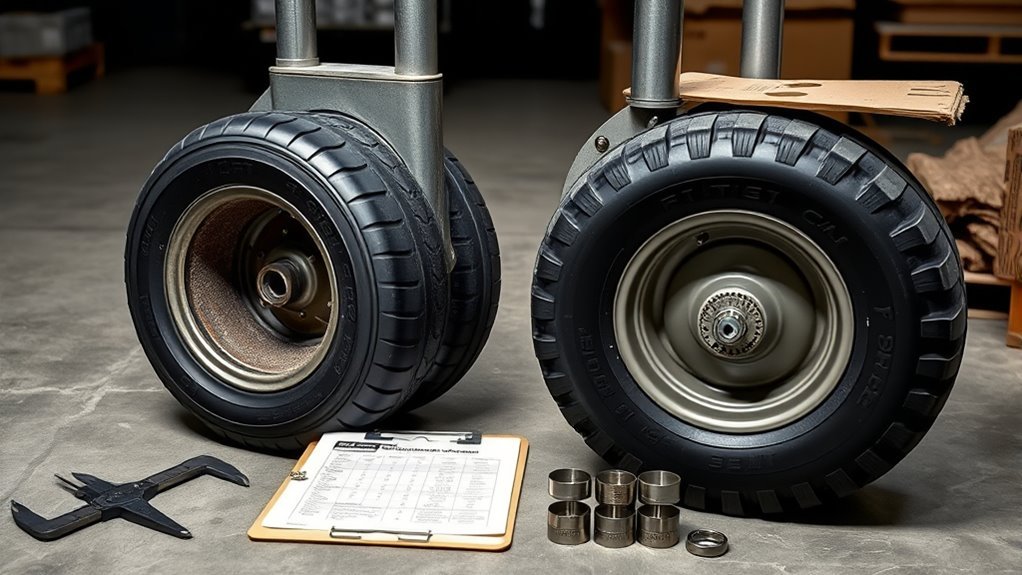
Before ordering foam-filled or air-filled telehandler tires, confirm every specification against the machine manual, tire data sheet, and supplier recommendation. JLG’s telehandler operation manuals, for example, publish model-specific safety, operation, and tire information and advise owners to use current manufacturer information because specifications can change.
Specs to Confirm Before Buying
- Tire size: diameter, width, rim diameter, and approved replacement sizes.
- Load rating: ply rating, star rating, load index, or manufacturer capacity chart.
- Rim compatibility: rim width, bead seat, wheel condition, valve type, and wheel rating.
- Tread pattern: traction lug, block, smooth, turf, non-marking, or application-specific tread.
- Fill type: pneumatic, foam-filled, liquid ballast, solid, or other approved configuration.
- Foam density: match density to load, ride, heat, and application requirements.
- Speed rating: confirm maximum travel speed for the tire and fill.
- Clearance: check frame, fender, steering, axle, and attachment clearance.
- Warranty: ask what is covered for casing defects, foam fill, workmanship, and premature failure.
- Disposal: confirm who handles worn foam-filled tires and what it costs.
Questions to Ask the Supplier
- Is this tire and fill type approved for my exact telehandler model and serial range?
- What load chart or tire data supports this recommendation?
- What foam density will be used, and why?
- Will the foam-filled tire change ride height, machine weight, or stability behavior?
- What is the expected service life in my application?
- What are the speed and heat limits?
- Can you provide mounted weight per tire?
- What happens if the casing is cut or damaged?
- Is field repair possible, or is replacement required?
- Are mounting, freight, disposal, and downtime included in the quote?
Common Mistakes to Avoid
- Buying by price only: the cheapest tire can cost more if it creates frequent downtime.
- Ignoring OEM guidance: the wrong tire size, fill, or rating can affect stability and safety.
- Assuming foam is always best: foam is excellent for puncture control, but not ideal for every surface, speed, or comfort requirement.
- Ignoring tire pressure on air-filled tires: underinflation can damage tires, increase heat, reduce stability, and shorten tire life.
- Forgetting disposal costs: worn foam-filled tires can be harder and more expensive to handle than ordinary pneumatic tires.
- Mixing tire types incorrectly: mismatched tire diameter, construction, or fill type can affect driveline stress and machine behavior.
Frequently Asked Questions
What are the disadvantages of foam-filled tires?
Foam-filled tires cost more upfront, weigh more, ride firmer, can create more heat in some applications, and are usually harder to repair once the casing fails. They also require proper equipment for filling, mounting, handling, and disposal.
Are foam-filled tires worth it?
Foam-filled tires are worth it when punctures and downtime are frequent or expensive. They are usually less worthwhile on clean, low-risk surfaces where air-filled tires provide enough reliability with better comfort and lower upfront cost.
Why don’t all telehandlers use foam-filled tires?
Not every job needs puncture-proof tires. Foam fill adds weight, cost, and ride firmness. For clean yards, agricultural work, landscaping, and lower-risk travel, air-filled tires may be more comfortable, more efficient, and easier to service.
Can foam-filled tires still go bad?
Yes. Foam-filled tires do not go flat from ordinary punctures, but the casing, tread, sidewall, bead, or wheel can still wear out or fail. Severe cuts, exposed cords, chunking, rim damage, or heat damage can require replacement.
Do foam-filled tires ride like air-filled tires?
No. Foam-filled tires usually ride firmer than air-filled tires because cured polyurethane does not cushion impacts the same way compressed air does. Some foam densities are more forgiving than others, but air-filled tires generally provide the smoother ride.
Are foam-filled tires the same as solid tires?
No. A foam-filled tire is a pneumatic tire casing filled with polyurethane. A solid tire is built from solid rubber or resilient compounds. Solid tires are usually used for the harshest flat-free applications, while foam-filled tires offer a middle ground between pneumatic comfort and solid-tire durability.
Conclusion
Foam-filled tires are the better choice when puncture immunity, predictable uptime, and heavy-duty site reliability matter most. Air-filled tires are the better choice when the job site is cleaner and you want a smoother ride, lower weight, easier repair, and lower upfront cost.
The best decision comes from total cost, not tire price alone. Match the tire to the terrain, load, speed, OEM requirements, and maintenance reality. Then ask suppliers for real load data, foam density details, mounted weight, warranty terms, lead times, and disposal costs before you buy.
Sources
- Camso Telescopic Handler Tires — supports pneumatic telehandler tire comfort, traction, foam-filled downtime reduction, and solid tire application guidance.
- Michelin Commercial Tire Pressure Management — supports the need to match off-road tire pressure to equipment and application.
- Bridgestone Commercial Load and Inflation Tables — supports checking load and inflation data for commercial and off-the-road tire use.
- JLG Service, Operator and Parts Manuals — supports using current OEM manuals for model-specific telehandler tire and safety information.
- OSHA 29 CFR 1910.178 Powered Industrial Trucks — supports the broader requirement for safe maintenance and operation of powered industrial trucks in applicable workplaces.
[Products Worth Considering]

Replace worn tires quickly with this universal 4.80/4.00-8 tire and inner tube set designed for wheelbarrows and outdoor utility carts. The ribbed tread helps reduce turf damage while the natural rubber construction supports longer service life. Compatible with 15.5-inch outer diameter, 4-inch width, and 8-inch rim diameter wheels, it uses a straight TR-13 valve stem for easy installation. For best results, inflate with a manual pump and do not exceed 25 PSI.

This metal-free wheel and tire cleaning brush uses dense, fluffy synthetic wool to safely clean rims, spokes, fenders, and engine areas without worrying about damaging surfaces. Its flexible, comfortable design helps you reach detailed areas while maintaining durability, and the extra absorbent fibers work well with wheel spray cleaners for faster cleanup. Reusable and washable performance helps prevent grime and build-up for cleaner vehicles and easier maintenance at home.

These pre-assembled 15x6.00-6 front tire and wheel assemblies are designed for quick replacement on riding lawn mowers and lawn tractors. Built with natural rubber pneumatic tires and turf-friendly tread for solid traction and improved shock absorption. A thickened welded rim and 3/4" sintered iron bushing help provide stable, heavy-duty support for everyday mowing use.

Related Articles

Are Expensive Tires Worth It? Cost vs Performance
More than just price, expensive tires can change safety, grip, and long-term value in surprising ways.
Read More
Why Do EV Tires Wear Out Faster?
I reveal why EV tires wear out faster, from instant torque to extra weight, and show what’s secretly chewing through your tread.
Read More
What Are Run-Flat Tires and How Do They Work?
Need a tire that keeps you moving after a puncture? Discover how run-flat tires work and why their hidden limits matter.
Read More