26 Vs 27.5 Vs 29 Inch Tires: Which Wheel Size & Why
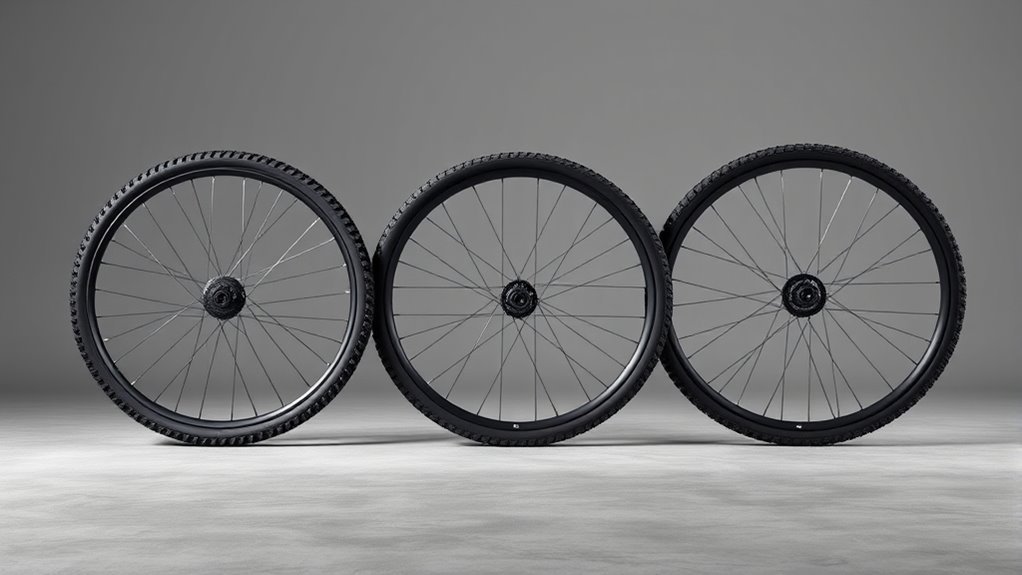
Pick wheels by height, terrain, and handling goals. If you want instant acceleration and razor-sharp flicks choose 26″ for tight, technical riding. Go 27.5″ for a balanced compromise—quick steering with added stability for trail and park laps. Choose 29″ when rollover, traction, and momentum over rough ground matter most, especially for taller riders and endurance terrain. Each size changes acceleration, traction, and geometry, so try setups and fit before buying to find the best match.
What This Guide Helps You Decide
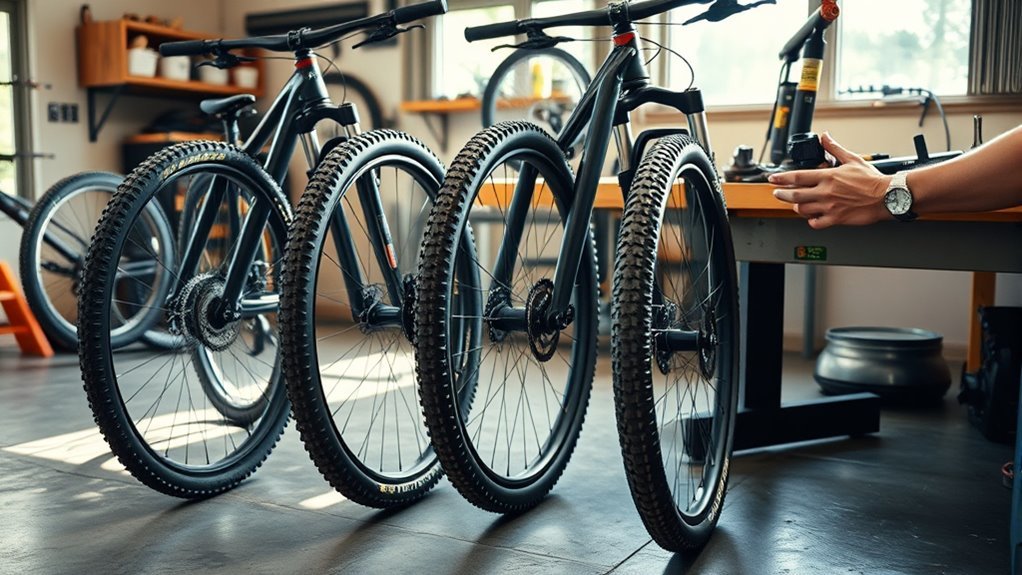
While choosing a wheel size you’ll weigh rollover ability, stability, acceleration, and maneuverability to match your terrain and riding style. This guide helps you decide by mapping 26, 27.5, and 29-inch tire behaviors to practical outcomes. You’ll see that 29-inch wheels maximize rollover and straight-line stability, keeping speed over obstacles for XC and enduro efforts. You’ll learn that 27.5-inch wheels balance agility and quicker acceleration, suiting tighter, technical trails and smaller riders who seek nimble handling. You’ll also get the historical context: the shift from 26-inch to larger sizes and how contemporary frames and geometry improved performance. Practical sections compare how wheel diameter interacts with tire pressure and different terrain type, showing trade-offs for cornering, braking, and momentum. The guide empowers you to choose based on objective performance metrics and your riding goals, not trends—so you can free your line and refine control with confidence.
Quick Answer: Which Wheel Size Fits Your Riding and Height
Match wheel size to your height and ride: if you’re under 5’6″ you’ll likely prefer 27.5″ for fit and maneuverability, while taller riders often benefit from 29″ stability. Consider trail style—choose 27.5″ for tight, technical lines and rapid accelerations, 29″ for rollover capability and efficient climbs. Factor in your skill and experience, since personal preference and handling proficiency ultimately determine the best fit.
Rider Height Match
Wheel size matters for fit and control, so pick one that suits your height and riding goals: if you’re under about 5’5” you’ll likely find 26″ or 27.5″ wheels easier to handle and fit, riders between 5’5″ and 6’0″ often benefit from 27.5″ for a balance of agility and stability, and those over 6’0” typically prefer 29″ for superior rollover and high-speed stability—always weigh personal comfort and riding style, since individual preferences can override these guidelines.
Match height-driven ergonomics to your intended terrain. If you’re shorter, 26″ or 27.5″ improves maneuverability and lowers standover height. Mid-height riders get the most rider preferences and wheel benefits tradeoff from 27.5″. Taller riders gain momentum and traction with 29″. Test bikes to confirm cockpit fit and control before committing.
Trail Style Fit
You’ve already seen how height guides fit and control; now focus on how trail style and riding goals should steer your wheel-size choice. Choose 27.5″ for tight, technical sections and flow trails where agility and rapid direction changes matter; choose 29″ for endurance, long climbs and rough descents where rollover and momentum maintenance dominate. If you’re moving from 26″, 27.5″ feels familiar; 29″ alters trajectory and handling. Control tire pressure to tune grip versus speed across terrain types. Your preference and liberation on the trail decide the tradeoffs — there’s no universal best.
| Wheel Size | Strength | Best Terrain |
|---|---|---|
| 27.5″ | Agility | Tight/technical |
| 29″ | Momentum | Long/rough |
| 26″ | Nimbleness | Retro/park |
Skill And Experience
Although experience level and body size steer your choice, 27.5″ wheels typically suit beginners and smaller riders by offering easier maneuverability and quicker acceleration in technical sections, while 29″ wheels favor taller or more experienced riders seeking rollover, stability, and sustained speed on rough or long climbs. You’ll find beginner preferences lean toward 27.5″ because it lowers the learning curve: quicker steering, faster changes of direction, and confidence through tight obstacles. If you’re taller or chasing sustained momentum, 29″ delivers predictable tracking and smoother roll over roots and rock. Experienced insights note that aggressive, technical riders may still choose 27.5″ for nimbleness and punch, while endurance riders prefer 29″ for efficiency. Ultimately, fit and comfort determine your liberation on trail.
Quick Compare: 26 Vs 27.5 Vs 29 (At-A-Glance)
Three common mountain-bike diameters—26″, 27.5″, and 29″—deliver distinct trade-offs in handling and performance: 26″ (≈559 mm) gives fastest acceleration and the most nimble responsiveness, 27.5″ (≈584 mm) balances agility with improved stability, and 29″ (≈622 mm) maximizes rollover, momentum retention, and traction at speed. You want clear choices: 26″ for instant responsiveness and playful control; 27.5″ for an adaptable compromise; 29″ for confidence, speed, and better grip on loose terrain. Consider wheel performance and riding comfort together—smaller wheels free you to flick and maneuver, larger wheels free you to charge and maintain pace.
| Attribute | Impact |
|---|---|
| Acceleration | 26″ excels |
| Stability | 29″ dominates |
| Versatility | 27.5″ balances |
| Market trend | 27.5″/29″ preferred |
Pick the wheel that liberates your intent: nimble precision, balanced capability, or sustained momentum.
How Wheel Physics Affect Ride Feel
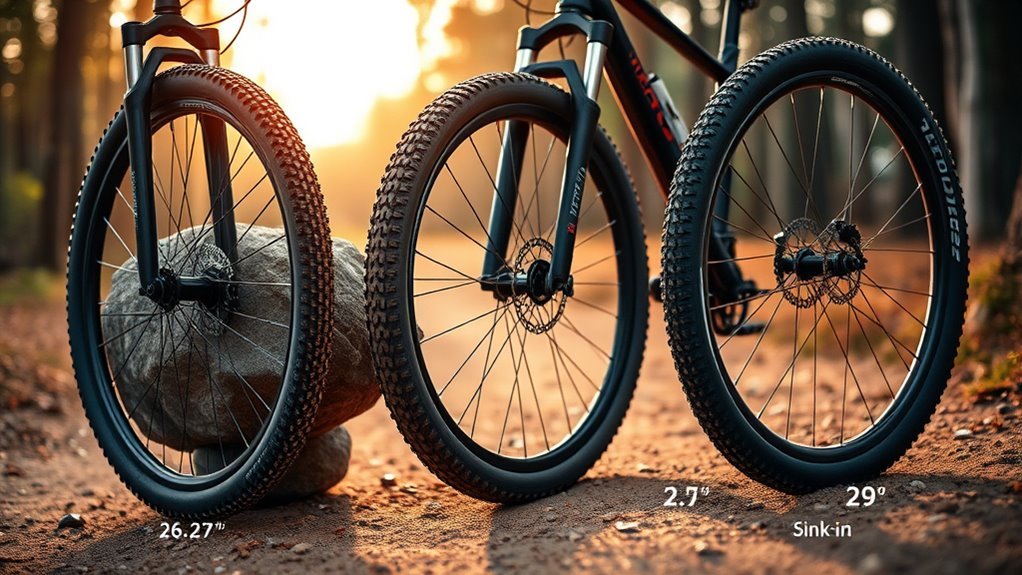
You’ll notice larger wheels improve rollover, letting bumps and roots be absorbed with less speed loss so you maintain momentum on rough trails. That same increase in diameter raises rotational inertia, so 29-inch wheels demand more torque to accelerate and feel less flickable than 27.5s. Understanding the trade-off between rollover efficiency and rotational inertia helps you match wheel choice to terrain and riding style.
Rollover And Momentum
When you roll a larger-diameter wheel, its greater moment of inertia and expanded contact patch let it more easily climb and track over obstacles, so a 29-inch setup preserves speed and traction across rough terrain while 27.5- and 26-inch wheels trade that preservation for quicker acceleration and lower rotating mass. You’ll notice tire performance improves with the larger contact patch: traction stays steadier, braking and cornering feel more planted, and momentum carries you through ruts and roots. Smaller wheels respond faster to pedal inputs, giving you nimble handling and quicker bursts. Choose based on terrain adaptability and mission: if you seek sustained speed and smoother lines for liberation from stops, 29s win; if you crave agile acceleration and flickable handling, 27.5 or 26 suit you.
Rotational Inertia Effects
Although larger-diameter wheels carry more rotational inertia, they reward you with steadier momentum once up to speed, so a 29-inch setup needs more torque to accelerate but resists speed loss over obstacles. You’ll feel clear rotational dynamics: moment of inertia scales with diameter and mass distribution, so 29-inch wheels demand greater input to change angular velocity. That higher inertia implications translate to sustained momentum and reduced rider fatigue on long rides and technical rocky sections. Conversely, 27.5-inch wheels offer lower rotational inertia, quicker acceleration, and more agile direction changes—ideal when you crave nimble, liberating handling on tight trails. Choose based on mission: prioritize sustained roll and traction with 29s or prioritize responsiveness and quick bursts with 27.5s.
26-Inch Wheels: Who Still Rides Them and Why

Why would anyone still choose 26-inch wheels? You value 26 inch nostalgia and the lightweight advantages that deliver nimble, immediate handling on tight, technical trails. You ride or restore older frames, race downhill/slalom, or seek playful maneuverability where quick acceleration and low rotational inertia matter.
| Rider Type | Reason | Typical Use |
|---|---|---|
| Racers | Rapid acceleration, responsive steering | Steep, twisty courses |
| Enthusiasts | Vintage compatibility, collector appeal | Restoration, show rides |
| Trailists | Tight-space agility, playful control | Tech trails, urban lines |
You’ll find niche manufacturers and custom builders keeping 26s alive for targeted performance. Choose them when you prioritize precise flicks, short-wheelbase control, and minimal rotating mass over rollover and momentum. The platform liberates your line choices and rewards aggressive, technical riding. If you demand compact geometry and instant feedback, 26-inch wheels remain a valid, high-performance option despite market decline.
27.5-Inch Wheels: Agility, Acceleration, and Best Uses
Think of 27.5-inch wheels as the middle ground that gives you decisive agility and quick acceleration without the sluggishness of larger hoops. You get a wheel that responds to inputs instantly; its smaller diameter lowers rotational inertia so you accelerate with minimal torque. That translates to sharper corner entry, faster direction changes, and confident exits on short climbs.
You’ll exploit handling techniques that favor quick weight shifts and precise line choices; the lighter wheelset lets you flick the bike and recover faster. Terrain adaptability is strong: flow trails, bike parks, and technical singletrack reward the balance of nimbleness and enough rollover to smooth small obstacles. Availability is waning, but when liberation matters—when you want control over raw speed—you’ll prefer these wheels. They sacrifice some momentum and ultimate roll-over of larger hoops, but they free you to attack tight, technical terrain with superior acceleration and focused handling.
29-Inch Wheels: Rollover, Momentum, and When They Win
When you ride 29-inch wheels, their larger diameter and longer contact patch let them roll over roots, rocks, and ruts with noticeably less speed loss, so you sustain momentum and expend less energy on rough terrain. You get superior wheel stability and terrain adaptability: long straights, chunky descents, and endurance laps favor 29s because they preserve speed and reduce rider fatigue. You sacrifice some acceleration and tight-trail nimbleness versus 27.5s, so align your choice with rider preference and trail profile. Use speed control via gearing and suspension tuning to offset slower initial acceleration. Choose 29s when momentum and obstacle rollover matter; choose 27.5s when quick direction changes and explosive climbs dominate.
| Trait | When it wins |
|---|---|
| Rollover capability | 29-inch |
| Momentum maintenance | 29-inch |
| Acceleration responsiveness | 27.5-inch |
| Trail maneuverability | 27.5-inch |
Mullet Setups: Why Mix Sizes and When to Choose One
Although it mixes wheel sizes, a mullet setup gives you a deliberate performance compromise: a 29-inch front for improved rollover, tracking, and momentum, paired with a 27.5-inch rear for quicker acceleration, snappier handling, and easier clearance in tight sections. You gain mullet advantages by combining wheel size benefits: the front stabilizes, so you hold speed and line over obstacles; the rear lets you flick, accelerate, and clear steep, technical shifts. This isn’t fashion—it’s targeted performance tuning used in downhill and eMTB racing where control and speed matter.
- Enhanced rollover and traction up front (29″) increases confidence and momentum.
- Smaller rear (27.5″) delivers faster rotational acceleration and tighter geometry response.
- Mixed setup reduces rear snagging, aids weight distribution, and simplifies rear clearance.
Choose a mullet when you demand liberated control without sacrificing agility. It’s a technical solution that optimizes trade-offs for varied terrain and aggressive riding styles.
Choose by Trail & Discipline: XC, Trail, Enduro, DH, Park
Because each discipline demands different control and speed priorities, you should pick wheel size to match the terrain and riding style: favor 29″ for XC and stability, 27.5″ for quick handling in trail, DH, and park settings, and consider a mullet for enduro to blend rollover and agility. For XC, 29″ wheel size advantages give you superior speed efficiency and rollover capability on varied terrain, boosting endurance-focused performance with clear stability factors. On mixed trail riding, 27.5″ delivers nimble cornering responsiveness and quicker acceleration, matching rider preferences for technical lines and agile handling characteristics. In enduro, choose based on course bias: full 29″ for composure on steep descents, or mullet to balance downhill confidence with rear agility—an explicit performance trade offs decision. For DH and park, prioritize 27.5″ for jump performance, tight turn control, and responsive handling characteristics that free you to push limits with precision and liberation.
Fit & Geometry Checklist: Match Wheel Size to Your Body and Bike
Match wheel size to your frame size to preserve intended geometry: smaller frames typically pair with 27.5″ wheels for maneuverability, larger frames with 29″ for stability. Confirm rider reach and standover clearance so cockpit fit and center of mass remain correct with the chosen wheel and tire combo. If you’re unsure, test both sizes on the bike to validate handling and comfort.
Frame Size Compatibility
When choosing wheel size, think about how your body and frame geometry interact: riders under about 5’6″ usually fit 27.5″ wheels better because the smaller diameter reduces standover and cockpit reach, while 29″ wheels lengthen the wheelbase and can introduce clearance and handling trade-offs. You need to assess frame size and compatibility challenges: some frames accept both 27.5 and 29 wheels, but that versatility alters suspension kinematics and chainstay length.
- Check manufacturer notes for multi-wheel compatibility and any required headset or shock adjustments.
- Verify rear triangle clearance, brake mount positions, and tire width limits before swapping.
- Anticipate handling shifts: shorter chainstays improve flickability; longer wheelbases add high-speed stability.
Make decisions that free your ride without compromising safety or geometry.
Rider Reach & Standover
Although wheel diameter isn’t the only factor, you should prioritize standover clearance and reach when matching wheel size to your body and bike. Measure standover clearance (aim 1–2 inches) and confirm frame reach aligns with your torso and arm length; that guarantees rider comfort and control. Smaller riders often prefer 27.5″ for better fit and handling, while taller riders may gain stability and rollover from 29″. Wheel size interacts with frame geometry—don’t assume bigger is better. You want liberation through precise fit: confident weight distribution, predictable steering, and unhindered movement.
| Measurement | Guideline |
|---|---|
| Standover clearance | 1–2 inches |
| Reach fit | Match torso/arm length to frame reach |
| Wheel suggestion | 27.5″ small, 29″ tall |
Frequently Asked Questions
Are 27.5 Wheels Being Phased Out?
Yes — you’re seeing 27.5 wheels being phased out as manufacturers shift to 29ers; you’ll weigh 27.5 wheel advantages against 27.5 market trends, so choose based on agility needs and long-term parts availability.
How Tall Should You Be for 29 Inch Wheels?
Ironically, you don’t need to be a giant: if you’re 5’8″ to 6’2″, you’ll get 29 inch benefits like stability and rollover. That’s the Ideal height range, though personal preference and fit still govern final choice.
Conclusion
Choose wheel size that matches your riding, body, and terrain: 26 for nimble, playful shorter-travel bikes; 27.5 for balanced agility and rollover; 29 for speed, stability, and rough ground. Remember mullet setups when you want the best of both. Let geometry and reach be your compass—wheel size is a tool, not a rule. Like a well-tuned gearbox, the right wheel translates intent into motion; pick what amplifies your control and confidence.
Related Articles
Tire Width & Rim Width Compatibility: Fitment Rules
Optimal tire-to-rim fit depends on matching ETRTO widths and pressures—discover safe ratios, handling effects, and exceptions before riding.
Read More
Tire Section Width Meaning: First Number on Your Tire
Broaden your understanding of tire section width—the first tire number that dictates fitment, handling, and clearance—discover how it truly affects performance.
Read More