
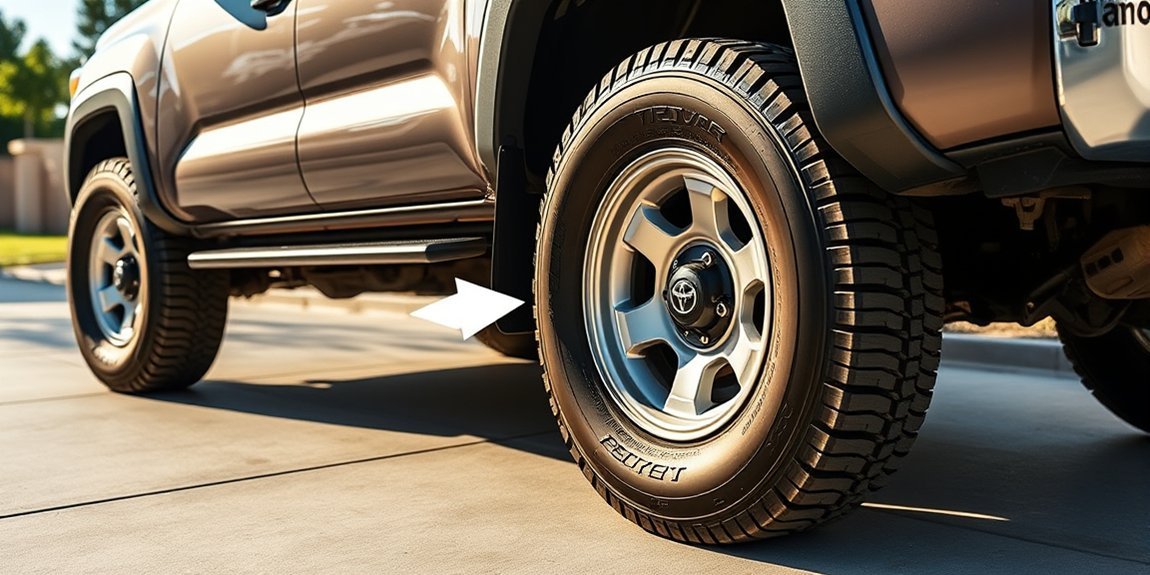
Rotating the tires on a Toyota Tacoma 4WD is a simple maintenance job, but the right pattern depends on your exact tires, wheels, and owner’s manual. For most Tacoma owners, the goal is the same: keep tread wear even, protect handling, and catch tire problems before they become expensive.
Quick Answer
For a Toyota Tacoma 4WD, follow your owner’s manual and tire sidewall first. If your Tacoma has four matching, non-directional tires, the common 4WD industry pattern is the X-pattern, also called Double-X: right front swaps with left rear, and left front swaps with right rear.
Key Takeaways
- Use your Tacoma owner’s manual as the final authority, especially for newer model years and special tire setups.
- For four matching, non-directional tires, an X-pattern/Double-X rotation is commonly used on 4WD and AWD vehicles.
- Directional tires should stay on the same side of the truck and move front-to-rear unless they are dismounted and remounted.
- Toyota’s Tacoma maintenance schedule calls for tire rotation at 5,000-mile service intervals, or about every six months for low-mileage drivers.
- Always inspect tread depth, pressure, sidewalls, lug nuts, and uneven wear during every rotation.
At a Glance
| Time Required | 30–60 minutes for a DIY four-tire rotation |
| Difficulty | Moderate; safe lifting and correct wheel-nut tightening are essential |
| Tools Needed | Owner’s manual, wheel chocks, lug wrench or breaker bar, floor jack, jack stands, torque wrench, tire pressure gauge, tread depth gauge |
| Cost | DIY: $0 if you already have the tools; shop service is usually a small labor charge and may be bundled with maintenance |
What Is Tire Rotation and Why Is It Essential for Your Tacoma?
Tire rotation means moving each wheel and tire to a different position on the truck. This matters because the front and rear tires do different jobs. Front tires handle steering loads, braking forces, and shoulder wear. Rear tires carry load differently, especially when towing, hauling, or driving off-road.
For a Tacoma 4WD, even tread depth is especially important because the drivetrain works best when all four tires are close in size and rolling diameter. Regular rotation helps maintain balanced traction, smoother handling, and more predictable braking.
Toyota’s Tacoma Warranty & Maintenance Guide lists tire rotation at regular 5,000-mile maintenance intervals. Tire-industry guidance also recommends regular rotation to help maximize tread life and performance.
Note: Your Tacoma’s owner’s manual, tire sidewall markings, and wheel setup override any generic tire rotation pattern. Check those first before choosing a pattern.
How Often Should You Rotate Your Tacoma’s Tires?
For most Toyota Tacoma owners, a smart baseline is every 5,000 miles or six months, whichever comes first. This lines up well with Toyota’s scheduled maintenance rhythm and makes tire care easier to remember.
Recommended Rotation Interval
Use these timing rules:
- Normal driving: Rotate around every 5,000 miles or six months.
- Off-road driving: Inspect tires after trail use and rotate sooner if wear looks uneven.
- Towing or heavy loads: Check tread and pressure more often because added weight can speed up wear.
- New tires: Do the first rotation on time. Early rotations help establish an even wear pattern.
Driving Habits That Change the Schedule
Rotate sooner if your Tacoma sees rough roads, gravel, dirt, deep ruts, heavy payloads, towing, hard braking, or aggressive acceleration. These conditions can increase shoulder wear, cupping, feathering, and front-to-rear tread differences.
Also check tire pressure at least monthly and before long trips. Underinflation, overinflation, and mismatched pressure can cause uneven wear even when the rotation pattern is correct.
Best Tire Rotation Pattern for Your Toyota Tacoma 4WD
The best tire rotation pattern for your Toyota Tacoma 4WD is the one shown in your owner’s manual for your exact model year and tire setup. If your manual does not give a clear pattern and your Tacoma has four matching, non-directional tires, the common 4WD/AWD industry pattern is the X-pattern, also called Double-X.
[Products Worth Considering]

The VEHLIVE SU-50448 II TPMS relearn tool provides a fast activation reset to restore accurate tire pressure monitoring after sensor replacement or tire rotation. It supports 315 MHz and 433 MHz GM series sensors and helps clear dashboard pressure warnings. With simple two-button operation and horn-confirmed relearning order, you can reprogram sensors conveniently at home.

These aluminum alloy tire valve stem caps with an O-ring seal help protect valve stems from corrosion while adding a clean, stylish look to your vehicle. The universal fit works across cars, trucks, motorcycles, bicycles, and more, making them an easy upgrade for everyday driving and off-road use. Installation is quick, and the included four-pack keeps all your tires dressed and protected.

Monitor tire tread wear with a smart, color-coded depth gauge that shows clear condition ranges at a glance. The bar is range marked for fast, easy readings, helping you maintain safer traction and performance. Each gauge is portable with a pocket clip, and the set includes 20 units for daily use and sharing.
X-Pattern / Double-X for Matching Non-Directional Tires
Use this pattern only when all four tires and wheels match in size and the tires are non-directional:
- Right front moves to left rear.
- Left front moves to right rear.
- Right rear moves to left front.
- Left rear moves to right front.
The Tire Industry Association describes this as the recommended Double-X pattern for four-wheel-drive and all-wheel-drive vehicles. Many tire shops use “X-pattern” and “Double-X” to describe the same diagonal swap.
If Your Tacoma Has Directional Tires
Directional tires have arrows or rotation markings on the sidewall. These tires are designed to roll in one direction. Do not cross them to the opposite side unless the tire is dismounted and remounted on the wheel by a tire professional.
For directional tires, rotate front-to-rear on the same side:
- Right front moves to right rear.
- Right rear moves to right front.
- Left front moves to left rear.
- Left rear moves to left front.
If Your Tacoma Has Staggered Wheels or Different Tire Sizes
If the front and rear tires are different sizes, or the wheels have different offsets, do not use a standard X-pattern. A staggered setup may require side-to-side rotation only, front-to-rear only, or no rotation unless the tires are dismounted and remounted. Check the tire manufacturer’s instructions or ask a qualified tire shop.
Should You Include the Spare Tire?
Only include the spare if it is a matching full-size spare with the same tire size, construction, load rating, and wheel type as the four tires on the ground. Do not include a temporary spare, a mismatched spare, or a spare with very different tread depth.
Tire Rack notes that a matching full-size spare can be included in a rotation program and that keeping tread depths close matters on 4WD/AWD vehicles. If you are unsure whether your spare qualifies, leave it out and have a tire professional inspect it.
How to Rotate Tacoma Tires at Home
You can rotate Tacoma tires at home if you have the right tools, a safe work area, and a torque wrench. Do not attempt the job on a slope, soft ground, or with only the factory jack supporting the truck.
Warning: Never place any part of your body under a vehicle supported only by a jack. Use properly rated jack stands on solid, level ground and follow the jack points in your Tacoma owner’s manual.
- Check the manual and tire sidewalls. Confirm whether your tires are directional and whether your owner’s manual specifies a pattern.
- Park safely. Use level pavement, shift to Park or gear, set the parking brake, and chock the wheels that stay on the ground.
- Loosen the lug nuts slightly. Break them loose before lifting, but do not remove them yet.
- Lift the truck at approved jack points. Support it with properly rated jack stands.
- Remove and inspect each wheel. Check tread depth, sidewall cracks, bulges, embedded nails, cuts, uneven wear, and valve stems.
- Move the tires to the correct positions. Use the pattern that matches your tire type and owner’s manual.
- Hand-start the lug nuts. Make sure each nut threads smoothly. Do not force a cross-threaded lug nut.
- Lower the truck enough for tire contact. Tighten the lug nuts in a star pattern with a torque wrench to the specification in your owner’s manual.
- Set cold tire pressures. Use the tire placard on the driver-side door jamb or the owner’s manual, not the maximum pressure printed on the tire sidewall.
- Check TPMS and tire-position display. Some Tacomas may need time driving, a wheel-set selection, or TPMS initialization after tire service.
Pro Tip: Mark tire positions with chalk before removing the wheels. Write RF, LF, RR, and LR on the tread or masking tape so the rotation pattern stays clear while the truck is lifted.
[Products Worth Considering]

Measure tire tread depth quickly and accurately with this LUMITECO dial gauge that reads in 1/32" increments up to 14/32". The color-coded green/yellow/red zones make it easy to judge tire wear and know when replacement is needed. A rugged, compact design with a protective pouch helps keep the gauge ready for use on cars, trucks, motorcycles, and more.

This 1/2-inch drive breaker bar delivers powerful leverage for loosening and tightening stubborn lug nuts and automotive fasteners. The 180-degree flex head helps you reach tight spaces at the angle you need, making tire and brake jobs easier. A spring-loaded ball detent design holds 1/2-inch sockets securely while the chrome-moly head provides durable strength for everyday use.

Accurately measure tire tread depth with a calibrated gauge marked from 0 to 1 inch in 1/32 inch increments. The color-coded bar helps you quickly identify tread condition ranges, supporting safe driving for trucks, motorcycles, automobiles, and passenger vehicles.
Signs Your Tacoma Needs a Tire Rotation Now
Do not wait for the next mileage interval if the tires are already showing uneven wear. Rotate, inspect, or schedule service if you notice any of these signs:
- Uneven tread depth: One tire or one axle is wearing faster than the others.
- Vibration at highway speeds: This may point to uneven wear, imbalance, or a damaged tire.
- Pulling to one side: Pulling can come from tire wear, tire pressure, alignment, or brake issues.
- Cupping or scalloping: Patchy dips in the tread may signal suspension, balance, or alignment problems.
- Increased road noise: A humming or droning sound may come from irregular tread wear.
- Visible shoulder wear: Worn inner or outer edges often mean pressure or alignment needs attention.
How Uneven Tire Wear Affects Your Tacoma’s Performance

Uneven tire wear can reduce traction, increase road noise, and make the steering feel less stable. On a Tacoma 4WD, uneven tread depth can also make the truck feel less predictable on gravel, snow, mud, and wet pavement.
Rotation helps spread wear across all tire positions, but it does not fix the root cause of abnormal wear. If you see cupping, feathering, one-sided wear, or repeated pressure loss, inspect alignment, balance, suspension parts, and wheel condition.
Tire rotation is not just about moving tires. It is also your best routine chance to inspect tread depth, tire pressure, sidewall damage, valves, lug nuts, and early warning signs.
What to Check During Every Tire Rotation
Use each rotation as a mini tire inspection. Look for:
- Tread depth: Use a tread depth gauge. Replace tires at or before the legal minimum of 2/32 inch, and consider earlier replacement for frequent rain, snow, or off-road driving.
- Treadwear indicators: If the wear bars are flush with the tread, the tire is worn out.
- Sidewall damage: Replace or professionally inspect tires with bulges, deep cuts, exposed cords, or cracks.
- Embedded objects: Nails, screws, glass, and stones can cause slow leaks or tread damage.
- Pressure: Set all tires cold to the placard pressure.
- Valve stems and caps: Missing caps allow dirt and moisture into the valve area.
- Wheel condition:
[Products Worth Considering]

This ecocstm ratchet wrench is designed to make emergency and routine tire changes faster with a 360° rotating head and quick forward/reverse switching. The extended handle provides extra leverage to reduce effort and hand fatigue, while the adapter helps fit many scissor jacks on cars, SUVs, trucks, and vans. Built for reliable performance with durable construction, it’s a practical travel essential for on-the-road preparedness.

Measure tyre tread depth precisely with a digital gauge that reads in both MM and inches, helping you monitor safe driving conditions. The large LCD screen is easy to operate, and the compact tool fits for cars, trucks, and motorcycles. It provides high accuracy with a 0-25.4mm range and includes a 1-year warranty for added peace of mind.

Upgrade your wheels with MIKKUPPA M12x1.5 mag seat lug nuts built for secure, corrosion-resistant performance. These closed-end chrome lug nuts are a direct replacement for select Toyota models, including Camry, Corolla, RAV4, Sienna, Avalon, Highlander, Matrix, Venza, and Prius. Triple-chromium plating and cold-forged, heat-treated steel help deliver strength for daily driving and replacement needs.

1 thought on “Toyota Tacoma 4WD Tire Rotation Pattern Explained”