Keeping your Toyota Camry tires in good shape is mostly about small, repeatable habits: check the pressure when the tires are cold, rotate on schedule, watch tread depth, fix uneven wear early, and choose the right tire type for your climate. Do those things consistently, and your Camry will ride smoother, stop more predictably, use fuel more efficiently, and avoid many preventable tire problems.
Quick Answer
Maintain Toyota Camry tires by checking cold tire pressure at least monthly, using the PSI on the driver-side Tire and Loading Information label, rotating tires according to your maintenance guide, inspecting tread and sidewalls often, correcting vibration or pulling quickly, and replacing tires when tread, age, or damage makes them unsafe.
Key Takeaways
- Check all tires, including the spare if equipped, at least once a month when they are cold.
- Use the Camry’s door-jamb Tire and Loading Information label for PSI, tire size, and load information; do not use the sidewall maximum as your target pressure.
- Rotate tires on the schedule in your Toyota maintenance guide, and inspect tread, sidewalls, and wear patterns at the same time.
- Balance tires for vibration and align wheels for pulling, off-center steering, or uneven tread wear.
- Replace tires at 2/32 inch tread depth, when damage appears, or by the tire maker’s age limit even if tread still looks usable.
At a Glance
| Time Required | 5–10 minutes for a pressure check; 15–20 minutes for a visual tread and sidewall inspection; shop time varies for rotation, balancing, or alignment. |
| Difficulty | Easy for pressure and tread checks; professional service recommended for mounting, balancing, alignment, and tire repair. |
| Tools Needed | Tire pressure gauge, air source, tread depth gauge or penny, flashlight, gloves, and your Camry owner’s manual or maintenance guide. |
| Cost | Pressure and tread checks are low-cost DIY tasks. Rotation, balancing, alignment, repair, and replacement costs depend on tire size, shop rates, and tire model. |
Follow a Toyota Camry Tire Maintenance Schedule
Start with the maintenance guide for your exact Camry model year. Toyota’s current 2025 Camry maintenance guide uses a 5,000-mile or six-month maintenance rhythm, whichever comes first, and includes tire rotation in the maintenance log. Older Camrys can differ by year, tire type, drivetrain, and operating conditions, so use your own guide as the final authority.
| Monthly | Check cold tire pressure, inspect tread and sidewalls, and look for nails, cuts, bulges, or uneven wear. |
| Every maintenance visit | Rotate tires when your Toyota maintenance guide calls for it, and inspect for abnormal wear while the wheels are off. |
| As needed | Balance for vibration, align for pulling or uneven wear, and have a tire inspected after a hard pothole hit or curb impact. |
| Before long trips | Recheck pressure, tread depth, sidewalls, valve stems, and the spare tire or inflation kit if your Camry has one. |
NHTSA reported 511 traffic fatalities in tire-related crashes in 2024, and says poor tire maintenance, including low pressure and skipped rotations, can lead to flat tires, blowouts, or tread separation.
Check Your Camry Tire Pressure Monthly
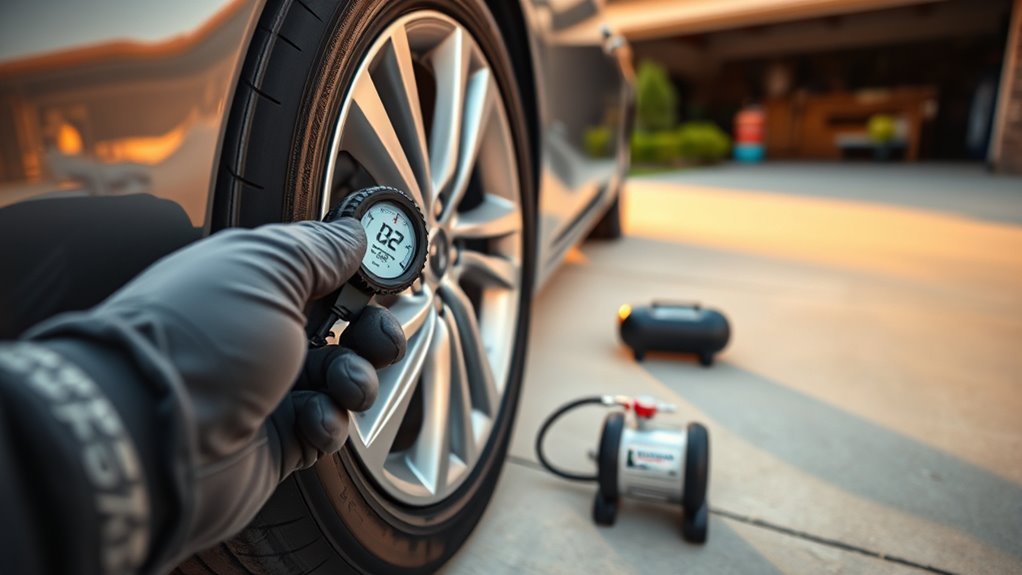
Check your Toyota Camry’s tire pressure at least once a month, before long trips, and whenever the weather changes sharply. The correct PSI is on the Tire and Loading Information label on the driver-side doorjamb or in your owner’s manual, not on the tire sidewall. The sidewall number is the tire’s maximum pressure, not the Camry’s recommended cold inflation pressure.
- Park the Camry for at least three hours so the tires are cold.
- Find the recommended PSI on the driver-side Tire and Loading Information label.
- Remove the valve cap and press a tire pressure gauge firmly onto the valve stem.
- Add air if the reading is low, or release air slowly if it is high.
- Recheck the PSI after adjusting, then reinstall the valve cap.
- Repeat the check on all four tires and the spare tire if your Camry has one.
Note: A Tire Pressure Monitoring System warning light usually appears only after a tire is significantly underinflated. It is not a replacement for a monthly pressure check with a gauge.
Underinflation increases heat, rolling resistance, and shoulder wear. Overinflation can reduce ride comfort and concentrate wear near the center of the tread. Keeping pressure near the manufacturer’s cold PSI helps your Camry maintain steadier handling, braking, and fuel economy.
Rotate Your Camry Tires on Schedule
Rotate your Camry tires according to your Toyota maintenance guide. On many Camry schedules, tire rotation lines up with routine maintenance, often around 5,000 miles or six months. Rotation matters because front and rear tires do different jobs. Front tires handle more steering force, and on front-wheel-drive models they also transmit power, so they often wear faster than the rear tires.
Use the Right Rotation Pattern
The correct tire rotation pattern depends on drivetrain, tire direction, and tire size. Many front-wheel-drive Camrys use a front-to-rear pattern with crossing as specified in the manual. AWD models may use a different pattern. Directional tires must stay on the same side of the vehicle unless they are dismounted and remounted. Staggered tire sizes may not be rotatable front to rear.
Pro Tip: During every rotation, ask the technician to mark unusual wear on the invoice. A simple note such as “inside shoulder wear on front tires” helps you spot alignment or pressure problems before the next service.
Check for Damage During Rotation
Rotation is also the right time to inspect each tire closely. Look for nails, cuts, sidewall bubbles, exposed cords, cracked rubber, uneven tread depth, missing wheel weights, and bent wheels. If one tire is wearing much faster than the others, do not just rotate and ignore it. Find the cause.
Get a Wheel Alignment When the Camry Needs It
A wheel alignment adjusts the wheel angles so the tires contact the road correctly. You do not need to align a Camry every few thousand miles without a reason, but you should schedule an alignment check promptly if the car pulls to one side, the steering wheel sits off-center, the tires show one-sided wear, or the vehicle recently hit a curb or pothole hard.
- One shoulder of the tire wears faster than the other.
- The Camry drifts or pulls on a straight, level road.
- The steering wheel is crooked when driving straight.
- The car feels unstable after a pothole, curb strike, or suspension work.
- New tires are installed after the old set wore unevenly.
Correct alignment helps your Camry track straight, reduces scrub across the tread, and can prevent a new tire set from inheriting the same uneven wear pattern as the old one.
Balance Your Tires to Prevent Vibration
Tire balancing corrects uneven weight distribution in the wheel-and-tire assembly. If your steering wheel shakes, the seat vibrates, or the ride gets rough at highway speeds, a tire may be out of balance. Balancing is also needed when new tires are mounted, when a wheel weight falls off, or when a technician finds imbalance during service.
Vibration Warning Signs
- Steering-wheel shake at certain speeds.
- Seat or floor vibration on smooth highways.
- Uneven cupping or patchy tread wear.
- New vibration after tire installation or rotation.
- Noise that changes with vehicle speed.
Warning: Do not ignore strong vibration, sidewall bubbles, exposed cords, or a tire that loses air repeatedly. Stop driving as soon as it is safe and have the tire inspected by a qualified technician.
Drive Smoothly to Reduce Tire Wear

Driving style affects tread life. Hard acceleration, late braking, sharp cornering, and quick lane changes force the rubber to scrub harder against the road. Smoother inputs help the tire work evenly and reduce heat buildup.
- Accelerate gently from stops.
- Brake early and steadily instead of waiting until the last moment.
- Slow down before corners rather than braking hard mid-turn.
- Avoid potholes, broken pavement, and curb strikes when possible.
- Remove unnecessary cargo instead of carrying extra weight every day.
Smooth driving also makes tire problems easier to notice. If your Camry suddenly starts pulling, vibrating, or humming, the change is more obvious when the car is normally quiet and stable.
Inspect Tread Depth and Uneven Wear
Check your Camry’s tread depth monthly and before long trips. The legal minimum is not the only thing that matters, but it is the hard safety floor: tires should be replaced when tread reaches 2/32 inch. You can use a tread depth gauge for the most accurate reading, or use the penny test as a quick check.
- Place a penny into the tread groove with Lincoln’s head upside down.
- If you can see the top of Lincoln’s head, the tire is at or near the replacement point.
- Check several grooves across the tire, not just one spot.
- Compare inner, center, and outer tread depth to find uneven wear.
| Wear Pattern | Common Cause | What to Do |
|---|---|---|
| Both shoulders worn | Underinflation or heavy cornering | Set cold PSI correctly and inspect more often. |
| Center worn faster | Possible overinflation | Recheck pressure against the door-jamb label. |
| One edge worn | Alignment issue or worn suspension part | Schedule an alignment and suspension inspection. |
| Cupping or scalloping | Imbalance, worn shocks/struts, or suspension wear | Have the tires balanced and suspension inspected. |
Avoid Overloading Your Camry
Too much weight shortens tire life and can raise the risk of tire failure. Your Camry’s Tire and Loading Information label lists the vehicle’s capacity weight, and the owner’s manual gives additional loading guidance. Stay within those limits, and spread cargo evenly instead of stacking heavy items on one side.
- Check the driver-side label before carrying heavy cargo.
- Place heavy items low and near the center of the trunk.
- Do not exceed the combined passenger and cargo limit.
- Recheck tire pressure before long trips with passengers and luggage.
- Remove unnecessary items from the trunk after the trip.
Overloading makes tires run hotter, increases sidewall flex, and can make the Camry feel less stable during braking or quick maneuvers.
Choose Camry Tires for Your Climate

Choose replacement tires by size, load rating, speed rating, driving conditions, and climate. The correct tire size and load information are on the Camry’s Tire and Loading Information label and in the owner’s manual. For seasonal performance, Michelin notes that winter tires stay flexible below 45°F, while all-season tires fit moderate climates and summer tires are designed for warmer roads.
| Driving Climate | Best Tire Choice | Why It Fits |
|---|---|---|
| Mild or moderate weather | All-season | Balanced dry and wet performance with light snow capability. |
| Frequent snow, ice, or sustained cold | Winter tire or 3PMSF-rated all-weather tire | More cold-weather grip than standard all-season tires. |
| Warm climates with no freezing or snow | Touring, grand touring, or summer tire depending on trim and driving style | Can improve warm-weather handling, braking, or ride comfort when matched correctly. |
Note: M+S marking is not the same as the Three-Peak Mountain Snowflake symbol. If you regularly drive in real winter conditions, look for the 3PMSF symbol or ask a tire professional for a Camry-compatible winter setup.
[Products Worth Considering]

Accurately measure tire tread depth with a calibrated gauge marked from 0 to 1 inch in 1/32 inch increments. The color-coded bar helps you quickly identify tread condition ranges, supporting safe driving for trucks, motorcycles, automobiles, and passenger vehicles.

Monitor tire tread wear with a smart, color-coded depth gauge that shows clear condition ranges at a glance. The bar is range marked for fast, easy readings, helping you maintain safer traction and performance. Each gauge is portable with a pocket clip, and the set includes 20 units for daily use and sharing.

Measure tire tread depth quickly and accurately with this LUMITECO dial gauge that reads in 1/32" increments up to 14/32". The color-coded green/yellow/red zones make it easy to judge tire wear and know when replacement is needed. A rugged, compact design with a protective pouch helps keep the gauge ready for use on cars, trucks, motorcycles, and more.
Store Seasonal Tires Properly
Seasonal tires need clean, dry storage so the rubber does not age faster than necessary. Michelin recommends storing tires indoors in a clean, cool, dry, dark location away from direct sunlight, heat, ozone sources, grease, gasoline, solvents, and oils.
- Wash tires with water and let them dry fully before storage.
- Remove stones and debris from the tread grooves.
- Mark each tire’s previous position so you can rotate correctly next season.
- Store mounted tires stacked or hung; do not store mounted tires upright for long periods.
- Store unmounted tires upright; do not hang or stack them flat for long periods.
- Keep tires away from electric motors, hot pipes, heaters, gasoline, oil, and solvents.
Before reinstalling stored tires, inspect each sidewall and tread area for cracking, flat spots, bulges, punctures, or age-related damage.
[Products Worth Considering]

The SAFELIFE dial tire tread depth gauge measures tread depth in 1/32 inch increments with clear, easy-to-read 2-inch dial face. Color zones using a traffic light system help you quickly judge whether tread is low, marginal, or ample for safer driving. Built with a durable zinc cast body and a metal detect probe for precise, comfortable use across cars, motorcycles, trucks, and buses.

Steelman white tire marking crayons provide high-contrast, semi-permanent marks for repairing and inspecting tires and equipment. They write on wet or dry, smooth or coarse surfaces including rubber, metal, glass, and wood, making them ideal for puncture location and damage outlining. The lead- and zinc-free crayons resist weather and fading yet wipe away when you no longer need the marks.

Keep your tires properly inflated with this analog VONDIOR tire pressure gauge, designed for fast, easy readings without batteries. The swiveling, two-axis hose and large glow dial help you measure at any tire angle with instant visibility. Built with a protective rubber shield, it supports durable, low-maintenance use for cars and trucks.
Replace Old Tires Before They Fail
Do not judge a tire by tread depth alone. Rubber ages from time, heat, ozone, sunlight, impacts, and storage conditions. Michelin recommends a professional inspection after five years of service and replacement at ten years from the manufacture date as a precaution. Bridgestone also recommends taking tires manufactured ten years prior or longer out of service, including spare tires.
Find the tire’s age by reading the DOT Tire Identification Number on the sidewall. The final four digits show the week and year of manufacture. For example, a code ending in 3520 means the tire was made in the 35th week of 2020.
| Check | Replace or Inspect When |
|---|---|
| Tread depth | Replace at 2/32 inch or when treadwear indicators are flush with the tread. |
| Age | Inspect annually after five years of service; replace by ten years from the DOT manufacture date unless your tire maker says sooner. |
| Sidewalls | Replace for bulges, bubbles, deep cracks, exposed cords, or sidewall punctures. |
| Performance | Inspect if wet traction drops, vibration appears, or the car pulls after an impact. |
[Products Worth Considering]

The Kurgo Seasonal Tire Tote helps protect your car interior, clothes, and garage from tire grime, brake dust, and residue during seasonal tire changes. Its universal design fits most passenger tires between 22" and 31" in diameter, making storage and transport simpler with less mess. Built for rugged, repeated use, it’s machine washable for easy care and comes with a lifetime warranty.

Milton S-921 pencil tire pressure gauge helps you maintain optimal tire pressure for passenger cars with accurate readings in PSI and kPa. It features a built-in deflator valve for convenient pressure adjustments, plus a single chuck head and nylon indicator bar for easy use on the go. Built from durable plated brass and designed for reliable performance, it’s a practical road trip and cold-weather maintenance tool.

AstroAI’s heavy-duty digital tire pressure gauge delivers quick, accurate readings with 0.1 increments and a secure valve-stem seal. It features a green backlit LCD and built-in flashlight for easy use in low light, plus an ergonomic non-slip stainless-steel design. The wide 0–230 PSI range works across common vehicle tires, with unit selection and an auto shut-off to save battery.
What to Do After a Pothole, Pull, or Vibration
A hard impact can damage a tire, bend a wheel, knock off a wheel weight, or shift alignment. After a pothole or curb strike, park safely and inspect the tire and wheel before continuing at highway speed.
- If the tire is losing air: install the spare or call roadside assistance.
- If you see a sidewall bulge: do not continue normal driving; the tire may have internal damage.
- If the steering wheel shakes: have the tire and wheel inspected for balance, wheel damage, or tire separation.
- If the Camry pulls: schedule an alignment and suspension inspection.
- If a puncture is in the sidewall: replace the tire; sidewall punctures should not be repaired.
Frequently Asked Questions
How many miles should tires last on a Toyota Camry?
There is no single mileage number for every Camry tire. Tire life depends on the tire model, treadwear rating, driving habits, road conditions, climate, inflation pressure, rotation schedule, alignment, and load. Many replacement tires have mileage warranties, but your actual result can be shorter or longer depending on use and maintenance.
What tire pressure should I use for my Camry?
Use the PSI listed on the Tire and Loading Information label on the driver-side doorjamb or in your owner’s manual. Do not use the maximum PSI printed on the tire sidewall as your target pressure.
How often should I rotate Toyota Camry tires?
Follow the maintenance guide for your exact model year. Many Camry schedules align tire rotation with routine maintenance, often around 5,000 miles or six months. If your tires are directional, staggered, or part of an AWD setup, confirm the correct pattern before rotating.
Do I need an alignment every time I rotate tires?
No. Rotation and alignment are different services. Rotate tires on schedule, but align the wheels when the Camry pulls, the steering wheel is off-center, tires wear unevenly, or the vehicle has hit a pothole or curb hard.
When should I replace Camry tires?
Replace tires when tread reaches 2/32 inch, when treadwear indicators are flush, when sidewalls show bulges or serious cracks, when cords are exposed, when a sidewall is punctured, or when the tire reaches the manufacturer’s age limit. Many tire makers recommend professional inspection after five years and replacement by ten years from the DOT manufacture date.
Are all-season tires enough for a Camry in winter?
All-season tires can work in mild climates and light snow, but they are not the best choice for frequent snow, ice, or sustained freezing temperatures. In real winter conditions, use dedicated winter tires or 3PMSF-rated all-weather tires in the correct Camry size and load rating.
Conclusion
Your Camry’s tires are the only parts of the car touching the road, so treat them like safety equipment. Check cold pressure monthly, rotate on schedule, inspect tread and sidewalls, correct pulling or vibration quickly, avoid overloads, match tires to your climate, store seasonal sets properly, and replace worn or aging rubber before it fails. Consistent tire care keeps every mile steadier, safer, and more efficient.
Sources
- Toyota 2025 Camry Warranty & Maintenance Guide — supports Toyota maintenance cadence and tire rotation schedule guidance.
- NHTSA TireWise — supports pressure checks, tire tread, TPMS limitations, tire-related crash data, fuel savings, and tire safety basics.
- NHTSA Tire Safety Brochure — supports load limits, cold pressure checks, treadwear indicators, balancing, alignment, and tire repair basics.
- Michelin: When to Replace Tires — supports tire-aging inspection after five years, ten-year replacement guidance, DOT date code, and damage warnings.
- Bridgestone Tire Replacement Guide — supports ten-year tire replacement guidance and professional inspection recommendations.
- Michelin: Storing My Tires — supports seasonal tire storage practices.