
Tire Braking Distances Explained: What It Means for Your RAV4
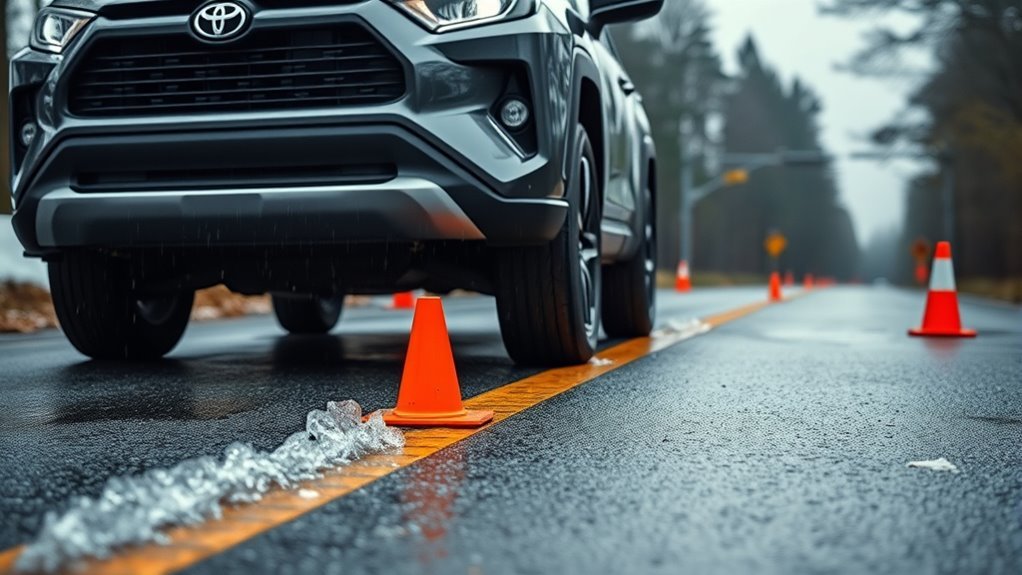
Your RAV4’s stopping distance depends heavily on tire condition, pressure and type: a 2008 RAV4 Limited V6 FWD can stop from 60 mph in about 125 ft on good tires, but worn tread, underinflation or all‑season tires in cold/wet conditions can nearly double that distance. Speed, AWD weight and surface grip further change deceleration, and reaction time adds extra feet. Keep tires and brakes inspected and properly inflated to minimize risk — continue for practical test and maintenance steps.
Quick Answer: RAV4 Stopping Distances – Summary
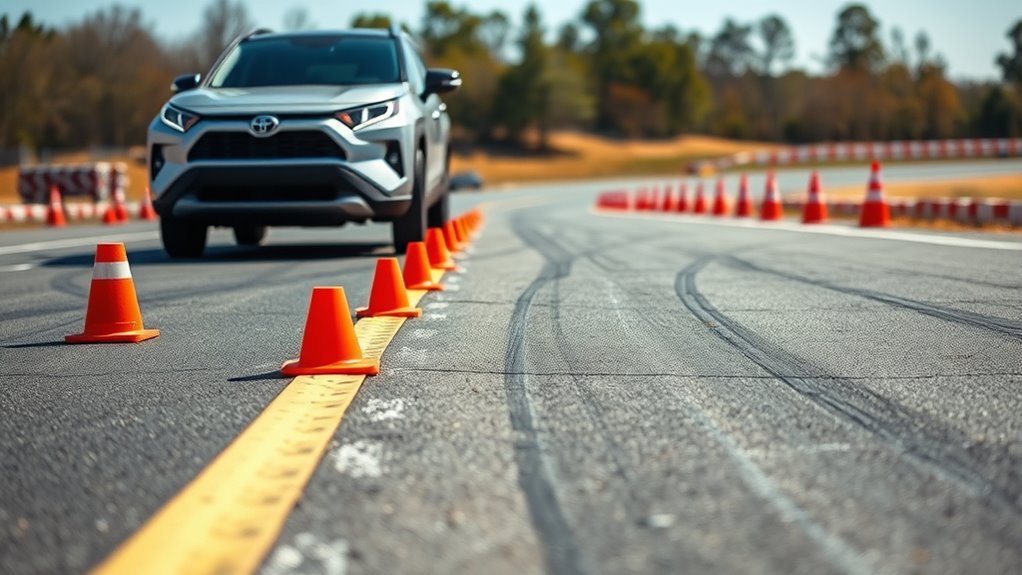
Headline figures matter: the 2008 RAV4 Limited V6 FWD stops from 60 mph in about 125 feet under standard test conditions, showing its baseline braking capability. You should treat that as a controlled benchmark: it reflects factory brake hardware—V6 trim’s larger front brakes—and ideal tire-to-pavement contact. Real-world stopping distances shift with variables you can control. Prioritize tire maintenance—tread depth, inflation, and alignment—to preserve braking efficiency; worn or underinflated tires can markedly extend stopping rolls. Weather multiplies the baseline: wet surfaces commonly increase distance by 1.5–2×, so you’ll need greater margin. Routine brake inspections and timely pad or rotor service keep system performance near published values. Use the 125-foot figure to plan safe following gaps, but adjust for current tire condition and surface state. That disciplined, evidence-based approach gives you practical freedom on the road: you’ll rely less on luck and more on predictable vehicle behavior.
Stopping Distance vs. Braking Distance : What’s the Difference?
You need to distinguish reaction distance—the 0.5–2.0 s you travel before you apply the brakes—from braking distance, which is the ground covered once braking begins. Braking distance depends on speed, vehicle mass, tire condition and road surface and can increase sharply in wet or icy conditions. The stopping distance is their sum, so at 60 mph your total can be ~240 ft with roughly 125 ft of that as braking distance under ideal conditions.
Reaction Distance Explained
Although braking distance often gets the spotlight, reaction distance—how far your vehicle travels during the 0.5–2.0 seconds it takes you to perceive a hazard and begin braking—can account for a substantial portion of total stopping distance and varies predictably with your reaction time and speed. You should quantify reaction distance using perception speed and chosen reaction time: at higher speeds a fractional increase in reaction time yields a proportional increase in distance. Driver awareness directly reduces reaction time; distraction impacts (phone use, infotainment) and fatigue effects (sleep deprivation, long drives) lengthen it. For liberation on the road, implement safety measures: eliminate distractions, schedule rest, and train perception drills. Recognize reaction distance to set safe following gaps.
Braking Distance Defined
Having covered how reaction time adds distance before you even touch the brake, we now focus on braking distance—the ground covered from brake application to full stop. You should understand braking distance as a distinct metric: it excludes reaction distance and isolates the physics of deceleration. Braking mechanics depend on tire grip, brake system performance, and road surface; distance factors include vehicle speed, tire condition, and environmental state. At 60 mph on dry pavement, expect roughly 120–140 feet of braking distance; wet or icy conditions can multiply that considerably. Higher speeds increase required distance exponentially due to kinetic energy. Knowing this lets you set liberating, evidence-based following gaps and make control-focused choices that reduce collision risk.
Total Stopping Comparison
One clear way to avoid confusion is to treat stopping distance as the sum of two measurable phases: reaction distance (how far the vehicle travels from perception to brake application) and braking distance (how far it travels after brake application until it stops). You should recognize that braking distance is dominated by speed impact and tire performance; doubling speed roughly quadruples stopping energy, so braking distance grows nonlinearly. Reaction distance, tied to driver awareness, typically spans 0.5–2 seconds and must be added to braking distance to yield total stopping distance. Under ideal conditions at 60 mph, total stopping distance can exceed 140 feet with about 125 feet from braking alone. Assess road conditions and your attentiveness to reclaim control and reduce required space.
How Speed Affects Your RAV4’s Stopping Distance
When you double your speed in a RAV4, stopping distance can roughly quadruple, so small increases in speed produce disproportionately longer braking distances; for example, at 60 mph you may need about 125 feet to stop under ideal conditions. You should treat speed influence as a primary determinant of braking performance: kinetic energy rises with the square of velocity, so braking systems and tires must dissipate much more energy at higher speeds. Empirical rules help you estimate distance: each 10 mph adds roughly 10–15 feet to braking distance on dry pavement, while reaction time (typically 1.5–2 seconds) adds distance proportional to your speed. Under wet or icy conditions, speed’s effect amplifies dramatically—stopping distance can increase 1.5 to 10 times versus dry surfaces. To exercise freedom on the road, you’ll want to manage speed proactively; reducing velocity yields the largest, most predictable gains in your RAV4’s ability to stop safely.
How Tire Tread, Pressure and Type Change Stopping Performance
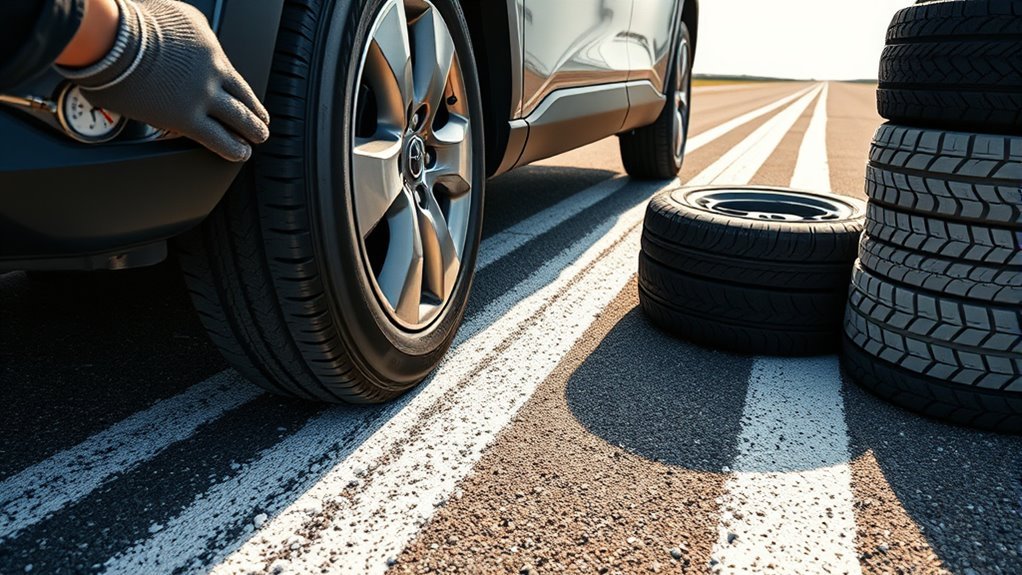
Speed is a major factor in stopping distance, but your tires determine how effectively that kinetic energy gets shed — tread depth, pressure and tire type directly change braking performance. You’ll see substantial gains: a 4/32 tread can yield up to 88.8 feet shorter stopping at 70 mph versus 2/32. Tread patterns channel contact and water evacuation, altering grip levels and traction differences; asymmetric and directional designs prioritize wet braking, while blocky patterns aid snow traction.
Inflation effects are immediate: underinflation reduces contact uniformity and increases stopping distance, overinflation shrinks contact patch and harms stability. Rubber compounds set baseline adhesion—softer compounds improve short-term traction but reduce tire longevity. Seasonal performance is engineered: winter compounds and tread patterns beat all-season rubber in cold slip conditions. Your maintenance routines—regular pressure checks, rotation, and tread-depth monitoring—preserve peak grip levels, maximize tire longevity, and guarantee predictable braking behavior when you need liberation from risk.
Weather and Road‑Surface Multipliers for Stopping Distance
Because weather and surface conditions directly change available traction, you should treat published dry stopping distances as best-case baselines rather than guarantees. You’ll account for weather impacts quantitatively: wet pavements typically multiply braking distance by 1.5–2×, while snow and ice escalate it to roughly 3–10×. Fog compounds the problem by degrading visibility and increasing reaction time, effectively lengthening total stopping distance beyond pure braking multipliers. Strong winds introduce lateral forces that can destabilize your RAV4, prompting corrective steering or sudden braking and raising effective stopping distance.
Road surface effects matter mechanically: smooth, well‑compacted asphalt delivers higher tire grip and shorter brake distances; gravel, rough, or uneven surfaces reduce available traction and lengthen stopping runs. Use conservative multipliers for planning—select the upper end of ranges when conditions are uncertain. For liberation on the road, adopt margins that let you choose speed and space deliberately rather than reactively; apply evidence-based multipliers to your following distances and speed choices.
How Weight, Brakes and AWD/2WD Change Stopping Distance
After accounting for weather and surface multipliers, you also need to factor in the vehicle itself—mass, brake hardware, and drivetrain alter how quickly your RAV4 can shed kinetic energy. Heavier AWD variants generally demand greater deceleration force; force calculation shows more mass increases stopping distance even if AWD advantages improve traction. Rotor size and brake design matter: larger rotors in higher‑spec models raise braking efficiency and reduce fade, improving emergency braking performance. Weight distribution and vehicle design influence how effectively tires convert braking torque to deceleration; balanced weight shortens distances and stabilizes vehicle handling. Studies show configuration changes can shift stopping distance by ~25 feet at 60 mph, underscoring safety implications.
- Mass increases required deceleration force, lengthening stops
- AWD advantages: better traction, higher curb weight
- 2WD performance: lower mass, often shorter emergency braking distance
- Rotor size and brake hardware affect thermal capacity and efficiency
- Weight distribution governs braking efficiency and handling during stops
Practical Maintenance to Shorten Your RAV4’s Stopping Distance
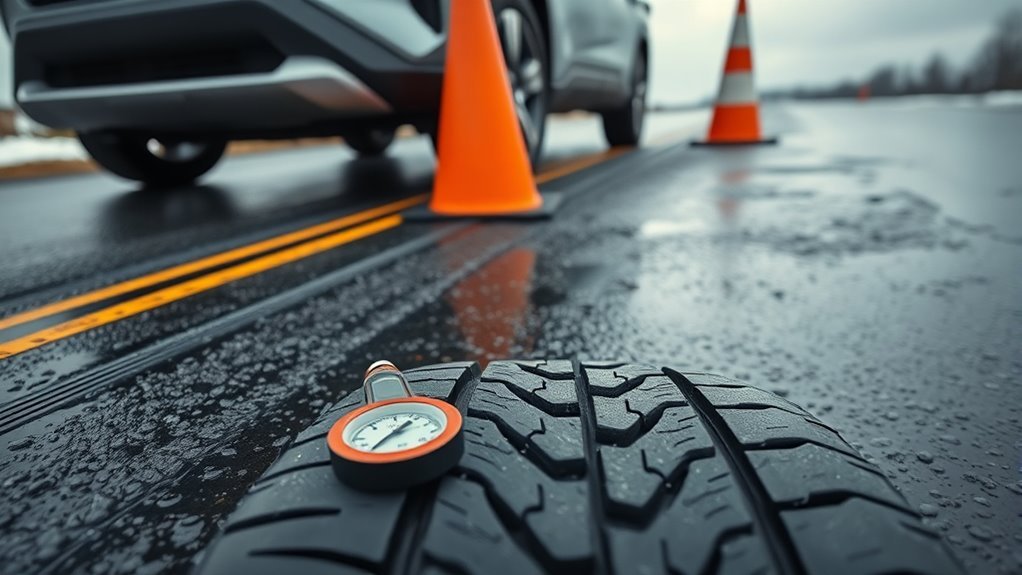
To shorten your RAV4’s stopping distance, routinely check tire tread and aim for at least 4/32 inches to preserve wet- and ice-era traction. Keep tires inflated to the manufacturer’s pressure—underinflation can raise stopping distance by up to 20%—and rotate tires every 5,000–7,500 miles for even wear. Also inspect brake pads and rotors regularly, replacing worn components to maintain designed braking efficiency.
Check Tire Tread
1 simple check you can do monthly is measuring your RAV4’s tire tread depth, because maintaining at least 4/32″ greatly reduces stopping distance on dry roads compared with severely worn tires. You’ll use depth measurement to quantify tread wear and assess safety implications. A tread depth gauge or the penny test gives objective replacement indicators; 2/32″ risks dramatically longer stopping distances (up to ~88.8 ft extra at 70 mph). Track results, rotate tires regularly, and adapt to driving conditions to preserve performance impact. You’re reclaiming control over safety and freedom on the road.
- tire tread: inspect across the tread face
- depth measurement: record monthly values
- tread wear: compare across corners
- maintenance tips: rotate, document, replace
- replacement indicators: <4/32" threshold
Maintain Correct Pressure
Maintaining your RAV4’s tire pressure at the manufacturer’s specified PSI (typically 30–35 PSI) is critical because underinflation can increase stopping distances by up to 20% through reduced tire contact and grip, while overinflation shrinks the contact patch and also degrades braking performance. You should check tire pressure monthly and before long trips or when temperatures shift; consistent monitoring preserves ideal contact patch geometry and predictable traction under braking. Use a calibrated gauge when tires are cold and adjust to the placard PSI. Proper tire pressure yields measurable safety benefits: shorter, repeatable stopping distances and improved directional control during emergency deceleration. This maintenance step is simple, evidence-based, and empowers you to reduce risk on the road.
Inspect Brake Components
Inspecting your RAV4’s brake components regularly cuts stopping distance and prevents sudden failures by ensuring pads, rotors, fluid and lines all meet performance specs. You’ll extend control and freedom by doing targeted checks: perform brake pad inspection for thickness and uneven wear, visually inspect rotors for scoring, verify fluid level and test for fluid contamination, and probe lines and fittings for leaks. Service master cylinder and proportioning valve if pressure balance drifts.
- Measure pad thickness; replace at manufacturer minimum.
- Check rotors for runout and heat spots.
- Test brake fluid for moisture and contamination; flush if degraded.
- Inspect lines for cracks, corrosion, or leaks.
- Verify master cylinder and valve operation under load.
Test and Estimate Your RAV4’s Stopping Distance on Real Roads
When you test your RAV4’s stopping distance on real roads, measure and record speeds, surface conditions, and tire tread so you can compare observed results to expected values (for example, about 125 ft at 60 mph on dry pavement). Use standardized stopping distance measurements and real world testing protocols: accelerate to a measured speed, release throttle, apply firm constant braking, and mark the stop point. Record ambient conditions, load, and tire tread depth.
Expect variation: dry 60 mph averages ~125 ft (reaction + braking); wet surfaces can double or triple that distance. Keeping tread above 4/32″ improves traction substantially and can reduce stopping distance by up to ~88.8 ft at higher speeds. Heavier loads and worn tires will lengthen stops.
Analyze your results against published values to identify deficits. If your RAV4 consistently requires longer distances, address tire condition, load management, and braking system maintenance. Real world testing empowers you to drive with informed freedom and mitigated risk.
Frequently Asked Questions
How Do Aftermarket Wheels Affect Braking Distance?
Aftermarket wheels can increase braking distance if heavier due to greater rotational inertia; lighter aftermarket materials reduce stopping force demand and improve deceleration. You’ll choose materials and wheel weight to reclaim control and minimize risk.
Do Tire Wear Indicators Relate to Braking Performance?
Worn tires can increase stopping distance by up to 25%, so yes — tire wear indicators signal reduced tire tread and lower braking force. You’ll monitor them to reclaim safety and freedom through timely replacement.
Can Towing Reduce My Rav4’s Braking Efficiency?
Yes — towing can reduce your RAV4’s braking efficiency. Exceeding towing capacity or poor weight distribution overwhelms the braking system; use properly rated trailer brakes and adjust load to maintain control and minimize stopping distance.
How Often Should ABS Sensors Be Inspected for Optimal Stopping?
Inspect ABS sensors every 12 months or 12,000 miles to preserve ABS sensor maintenance and sensor performance impact; you’ll prevent degraded stopping, rely on evidence-based checks, and reclaim control and safety on liberated drives.
Do Different RAV4 Model Years Stop Differently Under Same Conditions?
Like a knight’s sundial, yes—you’ll notice variance: newer RAV4s’ brake technology and different tire composition often shorten stops, but vehicle weight, ABS tuning, and wear still matter, so test braking under controlled, liberating conditions.
Conclusion
You now know the factors that most influence your RAV4’s stopping distance—speed, tires, weight, brakes, and road conditions—so you can manage risk proactively. Treat maintenance and tire choice like preventive medicine: small investments yield measurable safety gains. Regularly check tread, pressure, and brake condition, adapt speed to surface and weather, and test stopping distances in safe conditions. Doing so gives you quantifiable control over an otherwise variable outcome.

Related Articles
Upsizing Wheels on a Toyota RAV4: Pros, Cons, and Considerations
Boost your Toyota RAV4's performance with larger wheels, but discover the hidden trade-offs that could impact your ride before you decide.
Read More
Can I Change Tire Size on My Toyota RAV4? Rules and Recommendations
Are you considering changing the tire size on your Toyota RAV4? Discover the essential rules and recommendations before making a decision.
Read More
What to Do If the TPMS Light Comes On in Your RAV4
Understand the steps to take when the TPMS light illuminates in your RAV4, as overlooking it could lead to serious tire problems.
Read More