
The Penny Test for Tread Depth: How to Do It Right
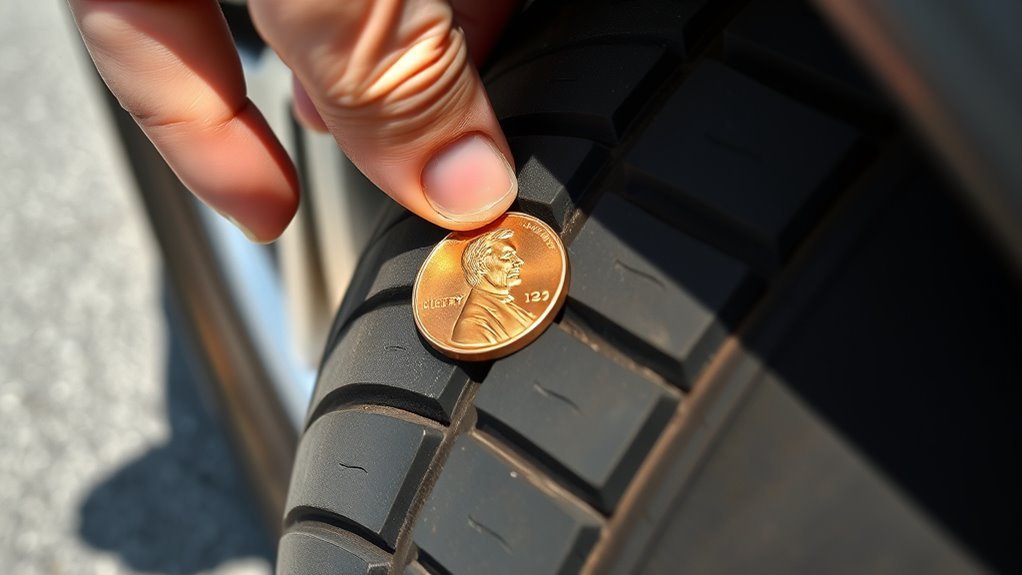
Use a penny head-first into a tire groove with Lincoln’s head facing down; if his head shows, your tread is at or below 2/32” and the tire needs replacing. Check several spots around each tire and inspect inner, center, and outer grooves to catch uneven wear from alignment or inflation issues. For better wet-weather safety aim for 4/32″ (use a quarter) or use a tread gauge for precision. Keep checking monthly and learn what each result means.
How to Perform the Penny Test Step by Step
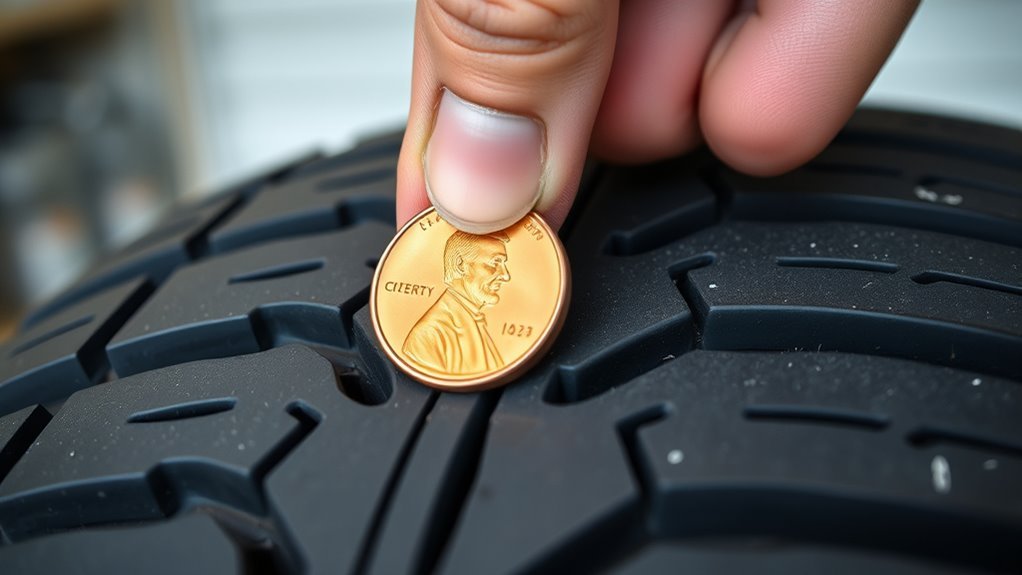
When you’re ready to check tread depth, grab a penny and press it head-first into the deepest grooves at several spots around each tire; if Lincoln’s head is covered, the tread is still adequate. You’ll insert the penny with Lincoln facing down and note whether his head is visible. Do this at multiple locations per tire, focusing on areas showing the most tread wear to get an accurate read. If Lincoln’s head is fully visible, the tread has reached 2/32″ or less and you should replace the tire immediately. Treat the penny test as a quick screening tool within your tire maintenance routine, not the only check. In wetter climates or when you want greater certainty, follow up with a quarter test or professional gauge measurement. Aim to perform the penny test at least once a year and more often in wet seasons so you retain control of your mobility and safety through routine, empowered inspection.
Quick Answer: How to Tell If Your Tires Are Unsafe
If Lincoln’s head is visible when you stick a penny into the tread, your tire’s tread is at or below 2/32″ and it’s time to replace the tire. Check several spots around each tire, since uneven or low tread in any area can signal improper inflation, alignment issues, or concentrated wear. Replace tires before they hit 4/32″ if you want markedly better wet‑weather stopping and reduced hydroplaning risk.
Visible Lincoln’s Head
A quick penny test will tell you at a glance whether a tire’s tread has reached a dangerous level: insert a penny into several tread grooves with Lincoln’s head facing down, and if you can see the top of his head the tread measures about 2/32″ or less and the tire should be replaced. When Lincoln’s head is visible, you’re facing a clear safety risk—especially on wet roads where hydroplaning and longer braking distances threaten freedom of movement. Check multiple spots on each tire to confirm the result; one visible head means replacement, but several spots give a fuller picture for tire maintenance. Use the penny test as a fast, practical gauge, pair it with other inspections, and follow basic safety precautions to stay liberated and safe on the road.
Uneven Or Low Tread
Because uneven or low tread quickly undermines grip, you should check your tires regularly and act when depth drops below safe limits. Use the penny test: if Lincoln’s head is visible, tread depth is at or under 2/32”, and replacement is mandatory. Watch for uneven tread wear across the tire—cupping, feathering, or inside-edge wear often points to misalignment or improper inflation. Those issues carry clear safety implications: higher hydroplaning risk, poor braking, and compromised handling. Aim for at least 4/32” in wet conditions. Inspect tread wear indicator bars; when they’re flush, it’s time to replace. Check tire pressure monthly, rotate tires per your owner’s manual, and fix alignment problems promptly to reclaim control and stay free on the road.
Reading Results: What Lincoln’s Head Means (2/32″ & 4/32″)
When you insert a penny, note how much of Lincoln’s head shows to classify tread depth and decide next steps. If Lincoln is mostly hidden you’ve got more than 2/32″ and the tire is still usable; if more than half or the whole head is visible you’re at or below 2/32″ and should plan replacement. Also watch for a fully exposed head at 4/32″ on wet-road tires and check multiple spots on each tire before acting. Regular monitoring of tread depth is essential for safety and compliance with regulations.
Interpreting Lincoln’s Visibility
If you press a penny into the tread with Lincoln’s head facing down, you’ll get a quick, reliable read on whether that tire is safe or needs attention: check tread visibility across several spots. If Lincoln’s head is fully covered, the tread exceeds 2/32″ and meets a basic safety threshold; that gives you freedom to keep moving but not to neglect monitoring. If his head shows, the tire is at or below 2/32″ — bald and needing replacement to restore traction. Note that visibility at about 4/32″ already signals compromised wet-weather grip, so visibility there carries urgent safety implications. Regularly testing multiple positions lets you spot uneven wear and act before risks multiply.
Action Steps By Depth
Start by interpreting what you saw with the penny and then act accordingly: If Lincoln’s head is fully covered, your tire depth exceeds 2/32″, so continue consistent tire maintenance—check tread patterns across the tire to confirm even wear and schedule routine inspections. If the head is visible, you’ve hit 2/32″ and the tire is legally bald; replace the tire immediately to reclaim safety and freedom on the road. If the head isn’t covered at 4/32″, prioritize new tires before wet-weather driving; 4/32″ is your practical threshold for traction in rain. Always test multiple spots on each tire to catch uneven tread patterns. Use a tread depth gauge or the quarter test for precise measurements and to guide replacement timing.
When to Use a Penny, Quarter, or Tread Gauge (Accuracy & Use Cases)
Wondering which method to use for a quick tread check? You’ll pick based on precision needed and driving conditions. Use the penny test for fast, on-the-spot checks: if Lincoln’s head is visible, tread depth is below 2/32” and tire safety is compromised. Reach for a quarter when you want a better wet-weather benchmark; covering part of Washington’s head suggests about 4/32”, improving wet traction. For exact readings or suspected uneven wear and alignment issues, use a tread gauge to measure in 1/32” increments.
| Method | Best use case |
|---|---|
| Penny test | Quick roadside check for legal minimum (2/32”) |
| Quarter test | Pre-trip check for wet-weather readiness (≈4/32”) |
| Tread gauge | Precise measurement; spot and multiple-location checks |
| Multiple-location checks | Detect uneven wear and alignment issues |
Check all tires at several points, at least yearly or more in wet climates, to protect your freedom to drive safely.
Penny Test Mistakes to Avoid (Prevent False Readings)
Because small mistakes can flip a quick penny check from useful to misleading, you should follow a few simple rules every time you test. Insert the penny vertically into the tread groove with Lincoln’s head facing down — correct penny placement gives a true reference for depth. Don’t roll the coin or angle it; push it straight down to avoid skewed measurements.
Check multiple spots across each tire, not just one location, so localized wear patterns won’t fool you. Confirm tire inflation before tread testing; under-inflated tires sit differently and can yield false low-depth readings. Perform the test regularly, especially before long trips and in wet conditions, to track progressive wear rather than relying on a single snapshot.
Stay disciplined: consistent technique and documented checks free you from guessing and keep you moving safely and confidently.
Why Your Tires Wear Unevenly : What It Means for Safety
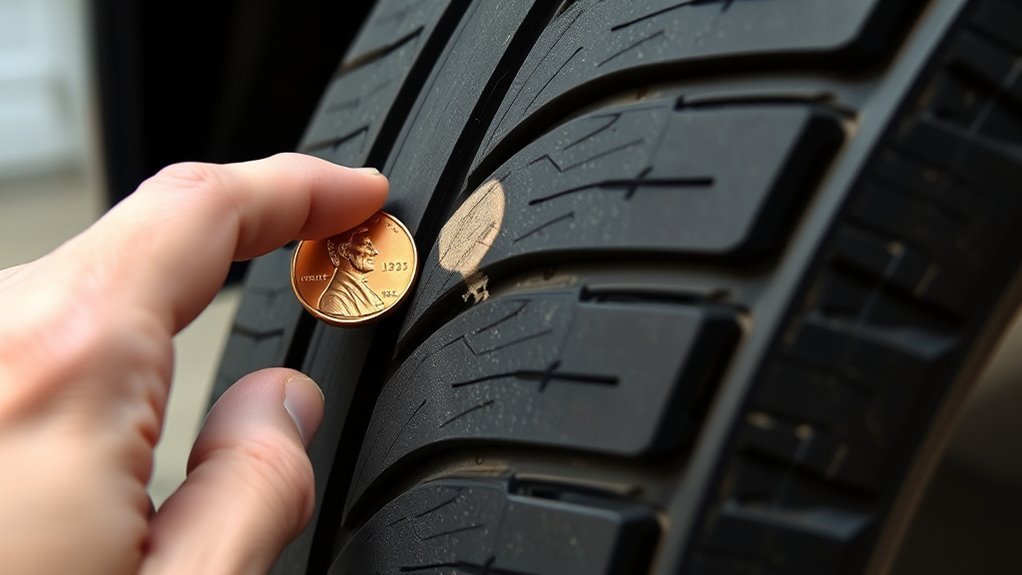
If you spot uneven tread—feathered edges, cupping, or one shoulder wearing faster than the other—it’s a clear sign something’s off with your vehicle setup or use, and that problem can seriously compromise safety. You should treat uneven tread as actionable intelligence: improper inflation reduces contact patch and performance; misalignment shifts load to limited sections of tread patterns, cutting grip and worsening handling; overloading speeds localized breakdown and raises failure risk. Check tire maintenance records and inspect all four tires regularly to detect asymmetry early. Rotate tires per the manufacturer’s schedule, measure tread depth across inner, center, and outer grooves, and correct inflation to spec. If you monitor tread patterns and respond, you’ll restore predictable braking, stability, and cornering—key freedoms when you’re behind the wheel. Don’t ignore visible wear: it’s not cosmetic. It’s a signal to fix alignment, pressure, or load before diminished traction limits your options on the road.
When to Replace Tires: Thresholds, Next Steps, and Where to Get Help
Uneven wear patterns tell you something needs fixing, but knowing when to stop repairing and start replacing is equally important for safety. You should replace tires at 2/32” — legally bald and unsafe. At 3/32” you’re nearing replacement; avoid risky wet-road driving and plan to swap them soon. At 4/32” replace if you frequently encounter rain, since stopping distances and hydroplaning resistance drop. For snow or ice, replace at 5/32” to regain necessary traction.
Keep a disciplined schedule of tread maintenance: check depth monthly with the penny test and inspect for uneven wear, cuts, or bulges. If you’re unsure, get a professional inspection; shops like Jiffy Lube provide quick measurements and recommendations. Prioritize tire safety over saving a few dollars — replacing tires restores control and reduces risk. Take ownership: act promptly when thresholds approach, follow expert guidance, and reclaim mobility with confidence. Additionally, remember that selecting appropriate tires can significantly enhance your driving experience.
Frequently Asked Questions
Is the Penny Test Accurate for Tire Tread?
Not entirely — you can use the penny test for a quick check, but for tire safety and accurate tread wear assessment you’ll want a gauge or quarter, check multiple spots, and address inflation or uneven wear first.
How Many 32NDS Is Lincoln’s Head?
2/32” — small yet essential, simple yet decisive. You’ll use Lincoln’s head as a 2/32” gauge for tread depth; you’ll keep up tire maintenance, decisive in protecting your freedom on the road.
Conclusion
You’re not just checking a nickel-sized coin — you’re safeguarding your life. Do the penny test regularly: stick Lincoln in the groove, note whether his head’s hidden, and act. If you see his scalp, get new tires now; if you see his forehead, inspect for uneven wear and consider a gauge or pro. Don’t ignore cupping, feathering, or poor inflation — small neglect becomes a very expensive, very dangerous problem fast.
Related Articles

When to Replace Tubeless Sealant: Timing & Signs
Be warned: tubeless sealant can fail in weeks or months—learn the signs, testing tips, and exact replacement timing to avoid flats.
Read More
Tire Rotation Schedule: How Often & Why It Matters
Optimizing tire life? Discover why rotating every 5,000–8,000 miles matters for safety and savings—read on to learn exact patterns and tips.
Read More
How to Dispose of Old Tires Properly in the US
Discover safe, legal ways to inspect, recycle, donate, or drop off old tires in the US—learn which options fit your situation and why it matters.
Read More
One Comment