
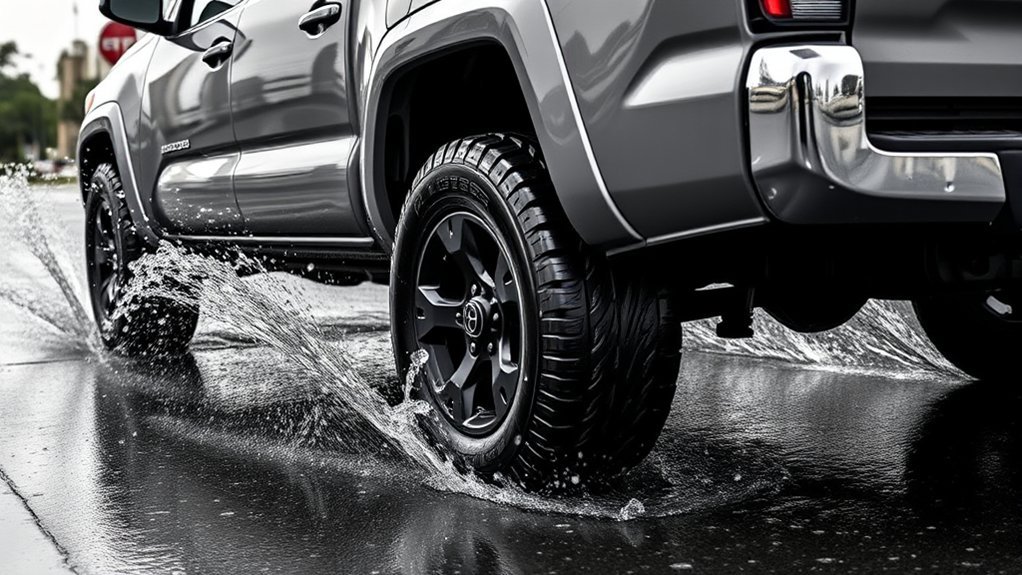
Rain changes how your Toyota Tacoma feels on the road. The same truck can feel planted with one tire and nervous with another because wet traction depends on tread depth, tread design, rubber compound, inflation pressure, load rating, speed, and how much standing water is on the pavement. The right tire will not make your Tacoma immune to hydroplaning, but it can give you a much larger safety margin.
Quick Answer
No, all Toyota Tacoma tires do not perform the same in rain. A highway all-season or wet-focused all-terrain tire with deep tread, good siping, proper pressure, and strong water channels will usually feel safer on wet pavement than a worn tire, an over-aggressive mud-terrain tire, or a tire chosen mainly for looks.
Key Takeaways
- Tread depth matters as much as tire model. For frequent rain driving, start shopping around 4/32 inch instead of waiting for the 2/32-inch wear bars.
- 3PMSF is a severe-snow symbol, not a wet-braking rating. It can be useful for winter, but it does not automatically prove superior rain performance.
- Highway all-season tires are usually best for mostly paved, rainy commuting; all-terrain tires are a better compromise if you also drive gravel, trails, or job sites.
- Mud-terrain and hybrid-terrain tires can look aggressive, but wide lugs, noise, weight, and compound choices may reduce wet-road comfort or braking compared with road-focused tires.
- No tire prevents hydroplaning at every speed. Slow down, avoid hard inputs, and keep your Tacoma’s tires correctly inflated.
At a Glance
| Time Required | 10–15 minutes to inspect tread, pressure, tire age, and visible damage before rainy-season driving. |
| Difficulty | Easy for basic checks; use a tire shop for alignment, balancing, punctures, sidewall damage, or uneven wear. |
| Tools Needed | Tread-depth gauge, quality tire-pressure gauge, flashlight, and your Tacoma’s door-jamb tire placard or owner’s manual. |
| Cost | Usually under $20 for a gauge; tire replacement cost depends on size, load rating, brand, and installation. |
How Tire Tread Design Affects Rain Performance
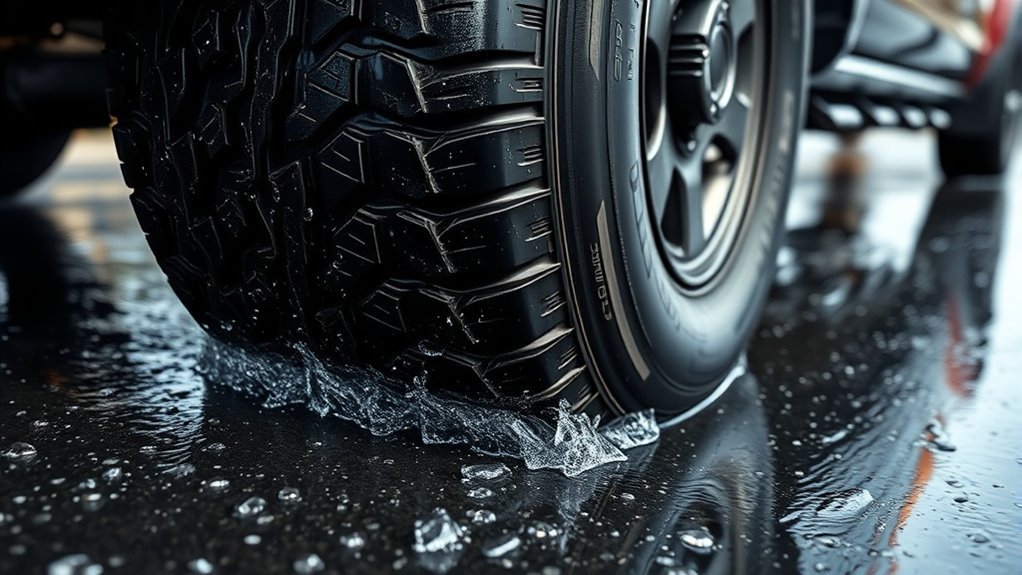
Tread design matters because rain puts water between the tire and the road. The grooves, sipes, and open channels in the tread give that water somewhere to go. When the tire cannot move water away fast enough, the contact patch shrinks and the Tacoma can begin to slide or hydroplane.
For wet pavement, look for:
- Wide circumferential grooves that move water through the tread.
- Sipes that add biting edges for wet braking and cornering.
- Stable tread blocks that do not squirm too much during emergency braking.
- Enough remaining tread depth to keep those water channels working.
All-terrain tires such as the Toyo Open Country A/T III and Yokohama GEOLANDAR A/T G015 are designed to balance pavement use with dirt, gravel, and light trail driving. They can work well in rain, but they should not be judged only by how aggressive they look. A quieter, more road-focused tread can sometimes stop better in rain than a chunky tire that looks tougher.
Note: The Three-Peak Mountain Snowflake symbol, often called 3PMSF, means the tire meets a severe-snow traction requirement. It is useful information for winter driving, but it is not the same as an independent wet-braking or hydroplaning score.
[Products Worth Considering]

AUTOWN’s 68-piece tire repair kit helps you fix punctures and plug flats quickly and effectively. It includes a T-handle and spiral probe tool for easy insertion, while the steel patch and plug materials are designed for strong adhesion and long-lasting airtight performance. The compact case makes it convenient for roadside repairs across a wide range of vehicles.

The SAFELIFE dial tire tread depth gauge measures tread depth in 1/32 inch increments with clear, easy-to-read 2-inch dial face. Color zones using a traffic light system help you quickly judge whether tread is low, marginal, or ample for safer driving. Built with a durable zinc cast body and a metal detect probe for precise, comfortable use across cars, motorcycles, trucks, and buses.

Measure tire tread depth quickly and accurately with this LUMITECO dial gauge that reads in 1/32" increments up to 14/32". The color-coded green/yellow/red zones make it easy to judge tire wear and know when replacement is needed. A rugged, compact design with a protective pouch helps keep the gauge ready for use on cars, trucks, motorcycles, and more.
All-Season vs. All-Terrain Tires: A Rain Performance Comparison
The best rain tire for a Tacoma depends on how you actually drive. A daily commuter on paved roads needs a different tire than a Tacoma that spends weekends on muddy trails or gravel access roads.
| Tire Type | Rain Strength | Rain Trade-Off | Best For |
|---|---|---|---|
| Highway all-season / touring truck tire | Often strong wet braking, quiet ride, and stable pavement handling. | Less sidewall toughness and off-road bite. | Daily driving, commuting, highway rain, towing on pavement. |
| All-terrain tire | Good compromise when the tread has full-depth grooves, siping, and wet-focused compound design. | Can be noisier and heavier than highway tires. | Mixed pavement, gravel, job sites, forest roads, camping, light trails. |
| Hybrid-terrain tire | More off-road look and grip than many all-terrains while still usable on pavement. | Wet braking and comfort vary widely by model and size. | Drivers who want off-road styling without going full mud-terrain. |
| Mud-terrain tire | Clears mud and debris well off-road. | Usually louder, heavier, and less refined on wet pavement. | Frequent mud, rocks, ruts, and trail use where road comfort is secondary. |
For mostly rainy road driving, a highway all-season or mild all-terrain is usually the smarter choice. For a Tacoma that sees rain and dirt, compare current all-terrain options with strong wet-traction claims and enough siping, such as the Toyo Open Country A/T III, Yokohama GEOLANDAR A/T G015, Michelin Defender LTX M/S for road-focused use, and newer all-terrain choices such as the BFGoodrich All-Terrain T/A KO3 if the correct Tacoma size is available.
[Products Worth Considering]

These aluminum alloy tire valve stem caps with an O-ring seal help protect valve stems from corrosion while adding a clean, stylish look to your vehicle. The universal fit works across cars, trucks, motorcycles, bicycles, and more, making them an easy upgrade for everyday driving and off-road use. Installation is quick, and the included four-pack keeps all your tires dressed and protected.

Monitor tire tread wear with a smart, color-coded depth gauge that shows clear condition ranges at a glance. The bar is range marked for fast, easy readings, helping you maintain safer traction and performance. Each gauge is portable with a pocket clip, and the set includes 20 units for daily use and sharing.

Accurately measure tire tread depth with a calibrated gauge marked from 0 to 1 inch in 1/32 inch increments. The color-coded bar helps you quickly identify tread condition ranges, supporting safe driving for trucks, motorcycles, automobiles, and passenger vehicles.
The Role of Rubber Composition in Wet Grip
Tread pattern moves water; rubber compound creates grip. Both matter. A tire with deep channels but a hard, aging compound can still feel slippery. A softer, wet-focused compound can grip better on wet pavement, but it may wear faster depending on the tire design and driving conditions.
Silica-enhanced compounds are common in many modern all-season and all-terrain tires because they can help a tire stay flexible and maintain traction in wet or cool conditions. However, compound details are not always easy to compare from a product page. That is why wet-braking tests, owner feedback from similar trucks, and the tire’s remaining tread depth all matter.
| Rain Factor | What It Does | What to Check |
|---|---|---|
| Compound | Helps the tire stick to wet pavement, especially during braking and cornering. | Wet-braking reviews, manufacturer wet-traction claims, age, cracking, and hardening. |
| Tread depth | Gives water channels enough volume to move water away. | Measure with a tread-depth gauge, not just a glance. |
| Siping | Adds small biting edges for wet and light-snow traction. | Look for full-depth or long-lasting siping on all-terrain tires. |
| Tire age | Older rubber can lose flexibility even when tread looks acceptable. | Read the DOT date code and inspect for cracks, bulges, cuts, or vibration. |
Best Toyota Tacoma Tires for Rainy Weather
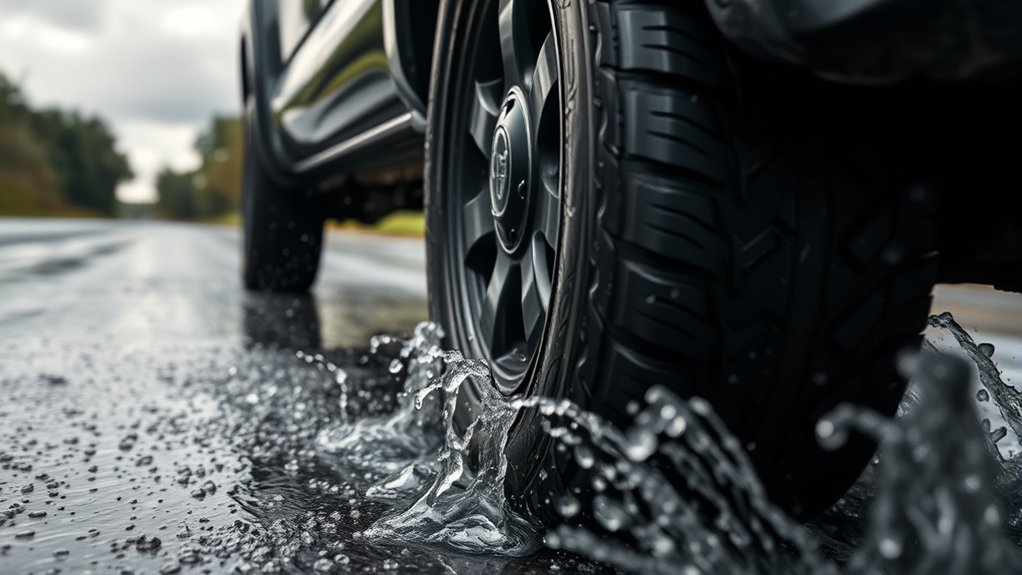
The “best” rain tire is not one universal model. It is the tire that matches your Tacoma’s size, load range, driving mix, climate, and comfort needs. Instead of trusting star ratings with no source, use this practical short list by driving style.
[Products Worth Considering]

Upgrade your ride with a 2-pack set of 26x1.95 folding mountain bike tires built for dependable traction on mud, rocks, and trail surfaces. A reinforced puncture-resistant layer helps protect against sharp debris, while included butyl inner tubes provide strong sealing and shock absorption. Ready for fast swaps with included tire levers and universal sizing for most bikes.

This spare tire tool kit is designed for the 2004 to 2018 Ford F-150 to help you loosen and tighten wheel lug nuts and manage the spare tire and provided jack functions from underneath the vehicle. It includes the lug nut wrench and extension pieces plus a convenient storage carrying case for organized transport. The jack itself is not included.

This digital tire pressure gauge with built-in inflator helps you accurately check and adjust tire pressure for safer driving and better fuel efficiency. It supports multiple units (PSI, KPA, BAR, KG/CM²) and reads within 1% for reliable results. The 3-in-1 design inflates, deflates, and measures, with a quick-connect air chuck and compatible hose setup for cars, trucks, SUVs, RVs, and motorcycles.
For Mostly Paved Rainy Driving
Choose a highway all-season or touring light-truck/SUV tire with strong wet-braking reviews, quiet ride quality, and long tread life. The Michelin Defender LTX M/S is a common road-focused option for pickups and SUVs, and Michelin emphasizes long tread life for that tire family. For wet commuting, road manners and braking confidence usually matter more than aggressive sidewall styling.
For Rain Plus Gravel, Job Sites, and Trails
Choose a balanced all-terrain tire. The Toyo Open Country A/T III is marketed with a strong focus on wet performance, durability, and treadwear life. Yokohama’s GEOLANDAR A/T G015 highlights 3PMSF severe-snow service, wet/winter traction, and circumferential grooves that expel water. These are the kinds of features Tacoma owners should compare when they need one tire for wet pavement and unpaved roads.
For Aggressive Style With Some Wet-Road Compromise
Hybrid-terrain tires such as the Nitto Ridge Grappler split the difference between mud-terrain appearance and all-terrain road manners. Nitto lists the Ridge Grappler’s wet performance as 4 out of 5, but that is a manufacturer performance rating, not a substitute for your own size-specific research, tread-depth checks, and cautious wet driving.
Pro Tip: When comparing Tacoma tires for rain, search for reviews in your exact size and load range. A P-metric version and an LT E-load version of the same tire can feel different because weight, stiffness, tread depth, and inflation needs can change.
Tire Grip in Rain
Wet grip is not just about brand. Your Tacoma’s rain traction depends on the complete setup:
- Correct size and load rating: Match the tire placard and owner’s manual.
- Correct cold inflation pressure: Do not use the sidewall maximum as your normal pressure target.
- Even wear: Cupping, feathering, and inside-edge wear reduce grip and can point to alignment or suspension issues.
- Enough tread depth: Worn tires have less room to move water away from the contact patch.
- Driving speed: Even a great tire can hydroplane in enough standing water at enough speed.
Hydroplaning Resistance Factors
Hydroplaning happens when the tire rides on water instead of pavement. Wider tires, shallow tread, low pressure, deep standing water, worn shocks, and higher speeds can all make the problem worse. Tire Rack explains that tread design affects hydroplaning resistance at higher speeds and in deeper water, while tread compound affects wet traction at lower speeds or in shallower water.
Warning: Do not assume four-wheel drive will save your Tacoma from hydroplaning. Four-wheel drive can help you move, but it does not shorten wet stopping distance or guarantee steering control when the tires lose contact with the road.
What You Should Know About Hydroplaning and Safety
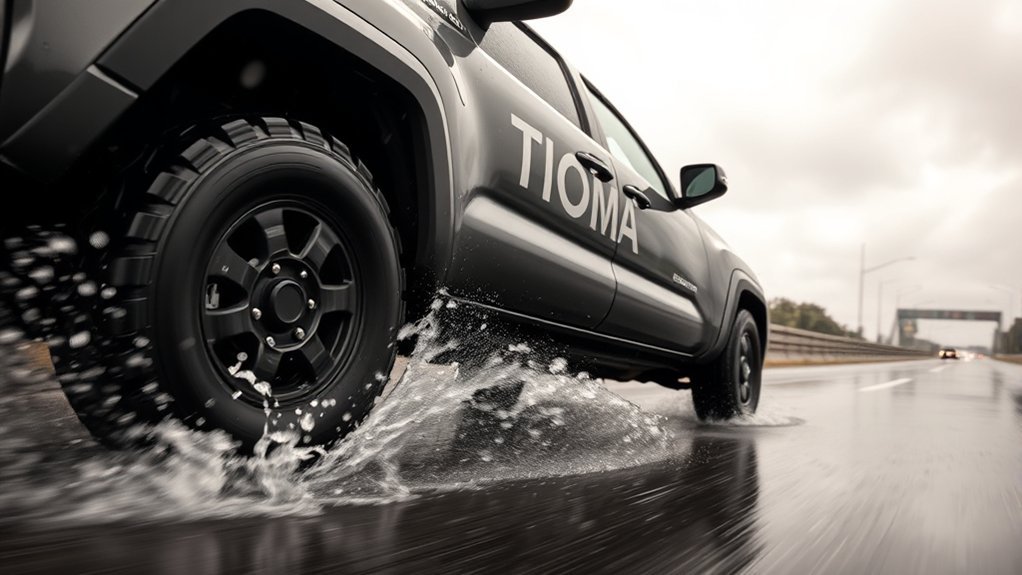
Hydroplaning risk rises when your tires cannot clear water fast enough. AAA notes that with as little as 1/12 inch of water on the road, tires have to move a large amount of water to keep rubber on pavement, and even new tires can lose some contact with the road at speeds as low as 35 mph.
AAA testing found that tires worn to 4/32 inch increased wet stopping distance by 42% for a Toyota Camry and 44% for a Ford F-150 compared with new tires.
That does not mean every Tacoma will produce the same numbers, but it proves the direction of the risk: as tread wears down, wet braking and handling get worse. Tire Rack’s wet-braking testing also shows a major jump in stopping distance as tread drops from new to 4/32 inch and then to 2/32 inch.
If your Tacoma begins to hydroplane:
- Ease off the accelerator. Do not stab the brakes.
- Look where you want the truck to go. Your hands tend to follow your eyes.
- Steer smoothly. Avoid sharp corrections.
- Wait for traction to return. Then slow down and increase following distance.
- Do not use cruise control in heavy rain. You need immediate control of throttle inputs.
What Tacoma Owners Should Look for in Rain Reviews
Owner reviews can be useful, but only if you read them carefully. A review from a Tacoma owner in the Pacific Northwest with constant rain is more useful for wet-road confidence than a review from a dry climate where the tire mostly sees dirt. Look for repeated comments about wet braking, hydroplaning resistance, cornering stability, road noise, treadwear, and how the tire performs after 15,000–30,000 miles.
Be careful with vague praise such as “great in all weather.” Instead, look for specifics:
- Did the tire feel stable in heavy rain at highway speed?
- Did the owner mention panic stops or downhill wet braking?
- Was the review from a Tacoma or a similar midsize truck?
- Was the tire new, or did it still perform well after wear?
- Was the tire P-metric, XL, C-load, E-load, or another LT version?
The same tire model can feel different across sizes and load ranges, especially on a pickup like the Tacoma. That is why a tire that is excellent on a crossover may not feel identical on a lifted or loaded Tacoma.
How to Maintain Tires for Better Rain Performance
Good rain performance is not just bought; it is maintained. Toyota’s Tacoma maintenance guidance recommends scheduled maintenance every 5,000 miles or six months, whichever comes first, and the maintenance chart includes tire rotation at 5,000-mile intervals. Always follow the guide for your exact model year, drivetrain, tire size, and driving conditions.
Use this rain-readiness checklist:
- Measure tread depth. Use a gauge in several grooves across each tire. Replace immediately at 2/32 inch; for frequent rain driving, start shopping around 4/32 inch.
- Check cold tire pressure. Use the Tacoma’s door-jamb placard or owner’s manual. The pressure molded on the sidewall is usually a maximum, not your normal setting.
- Inspect for damage. Look for sidewall bulges, cuts, exposed cords, cracks, punctures, and uneven wear.
- Rotate on schedule. Rotation helps keep tread depth even, which improves wet handling and braking balance.
- Keep alignment in check. If the truck pulls, the steering wheel is off-center, or the tires feather, have the alignment inspected.
- Replace aging tires. Michelin advises replacement when tires have been in service for 10 years from the manufacture date regardless of tread, and sooner if damage, cracking, vibration, or reduced wet grip appears.
When to Replace Tires for Optimal Rain Handling
The legal minimum is not the same as the safest rain-driving choice. Waiting until the wear bars are flush at 2/32 inch may keep you barely legal in many places, but wet-weather performance has already declined. If your Tacoma regularly sees rain, replacing tires near 4/32 inch gives you more safety margin.
Tread Depth Importance
Tread depth is one of the easiest rain-safety checks. New light-truck and SUV tires often start with much deeper tread than passenger-car tires, especially all-terrains. But as the grooves wear down, they hold and move less water. That increases stopping distance and hydroplaning risk.
Use these simple thresholds:
- 6/32 inch or more: Usually healthy for rain if the tire is evenly worn and not aged or damaged.
- 4/32 inch: Start planning replacement if you drive in rain often.
- 2/32 inch: The tire is worn out at the wear bars and should be replaced.
Weather Conditions Awareness
Rain is not always the same. A light drizzle after weeks of dry weather can lift oil and dirt from the road surface. Heavy rain can create standing water in ruts, intersections, and highway lanes. In both cases, your best defense is slower speed, more following distance, smooth steering, and tires with enough tread to clear water.
Tire Age Consideration
Age matters even if the tread looks good. Heat, sunlight, ozone, road chemicals, and storage conditions can degrade rubber. Check the DOT date code on the sidewall. The last four digits show the week and year of manufacture; for example, 2522 means the tire was made in the 25th week of 2022.
Replace tires sooner if you see cracking, bulges, exposed cords, vibration, or wet-weather grip that suddenly feels worse. Do not forget the spare, especially if it is mounted under the truck and exposed to road grime and weather.
Making an Informed Choice for Rainy Drives in Your Tacoma
For a rain-focused Tacoma tire, begin with your driving mix. If you mostly commute and tow on pavement, a highway all-season or touring truck tire is usually the cleanest fit. If your Tacoma splits time between pavement, gravel, camping roads, and job sites, choose an all-terrain tire with proven wet-road manners. If you need mud-terrain traction, accept that wet pavement comfort and braking may not be its strongest area.
Before buying, confirm these details:
- The tire is available in the correct size for your Tacoma.
- The load rating matches your truck, cargo, towing, and off-road needs.
- Wet braking and hydroplaning feedback is strong for the same tire category and size.
- The tread design has meaningful water channels and siping.
- The tire is not old stock with an outdated DOT date.
- Your alignment, shocks, brakes, and pressure are in good shape before judging the tire.
The right tire choice should make your Tacoma feel predictable in the rain, not invincible. Pair good tires with slower speeds, extra following distance, and routine maintenance, and rainy drives become much less stressful.
Frequently Asked Questions
Do all tires perform the same in the rain?
No. Tires vary widely in wet braking, hydroplaning resistance, tread depth, compound, siping, and water-channel design. A worn premium tire can also perform worse in rain than a newer mid-range tire with deeper tread.
Why does my Tacoma hydroplane?
Your Tacoma hydroplanes when water builds between the tire and the road faster than the tread can move it away. Speed, standing water, worn tread, low tire pressure, wide tires, and abrupt steering or braking can all make hydroplaning more likely.
Are all-terrain tires good in rain on a Tacoma?
Some all-terrain tires are good in rain, especially models with strong siping, full-depth grooves, and wet-focused compounds. Others prioritize off-road durability or mud traction. Compare wet-braking feedback and do not assume every aggressive tread is better on wet pavement.
What tread depth is safest for rainy driving?
For frequent rain driving, start shopping for replacement tires around 4/32 inch. At 2/32 inch, the tire is at the wear-bar limit and should be replaced. Wet braking and hydroplaning resistance decline before the tire reaches the legal minimum.
Does four-wheel drive help a Tacoma stop better in rain?
No. Four-wheel drive can help with acceleration on loose or slippery surfaces, but it does not shorten braking distance. Stopping and steering in rain still depend heavily on tire grip, tread depth, pressure, brakes, road conditions, and speed.
Conclusion
Your Toyota Tacoma’s rain performance depends heavily on its tires. Tread depth, water-channel design, rubber compound, pressure, load rating, and age all affect how well the truck brakes, steers, and resists hydroplaning. For wet roads, choose a tire that matches your real driving—not just the most aggressive tread you can fit—and replace it before rain performance drops too far. With the right tires and steady driving habits, your Tacoma can handle rainy roads with far more control and confidence.
Sources
- NHTSA TireWise — tire safety, maintenance, and tire-rating guidance.
- AAA All-Season Tire Testing — wet braking and handling declines at 4/32-inch tread depth.
- AAA Wet Weather Driving Tips — hydroplaning prevention and wet-driving behavior.
- Toyota Tacoma Warranty & Maintenance Guide — scheduled maintenance and tire-rotation guidance.
- Toyo Open Country A/T III Product Information — manufacturer details on wet performance focus and all-terrain design.
- Yokohama GEOLANDAR A/T G015 Product Information — manufacturer details on wet/winter traction features and water evacuation grooves.
