
How To Choose Tires for a Dual Use Toyota Tacoma
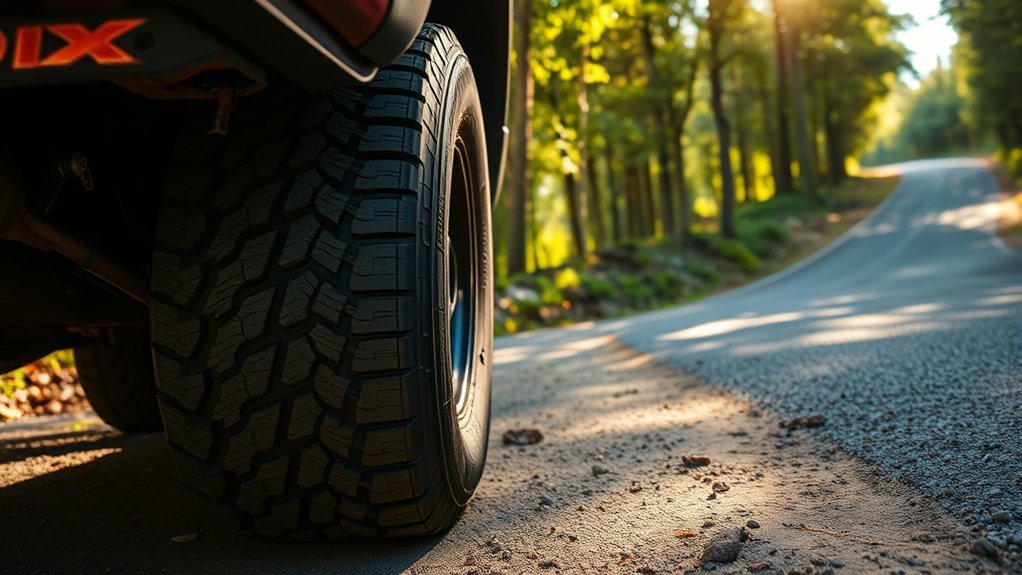
Choosing tires for a dual-use Toyota Tacoma means balancing highway comfort, wet braking, load capacity, and trail durability. The best choice depends on your exact model year, trim, wheel size, payload, towing habits, climate, and how often you leave pavement. Start with Toyota’s tire placard, then choose the least aggressive tire that still covers your real off-road needs.
Quick Answer
Choose Tacoma tires by matching your model-year door placard first, then select a tread type for how you actually drive. Highway tires suit mostly pavement, all-terrain tires balance road and trail use, and mud-terrain tires favor severe off-road grip. Match or exceed the original load and speed ratings, and verify clearance before upsizing.
Key Takeaways
- Use the driver-door tire placard and your model-year owner’s manual as the starting point for size, load rating, and cold inflation pressure.
- All-terrain tires are usually the best compromise for a Tacoma that spends most of its time on pavement but regularly sees gravel, dirt, snow, or mild trails.
- A larger tire can affect clearance, gearing, braking, steering feel, fuel economy, speedometer accuracy, and spare-tire fitment.
- Do not use a universal “30 psi” rule or assume every Tacoma needs a load index of 109. Requirements vary by year, trim, tire size, and loading.
- For towing or heavy payloads, verify the tire’s load capacity at the intended pressure and stay within the truck’s payload, axle, and gross vehicle weight limits.
Understanding Tire Types for Your Toyota Tacoma
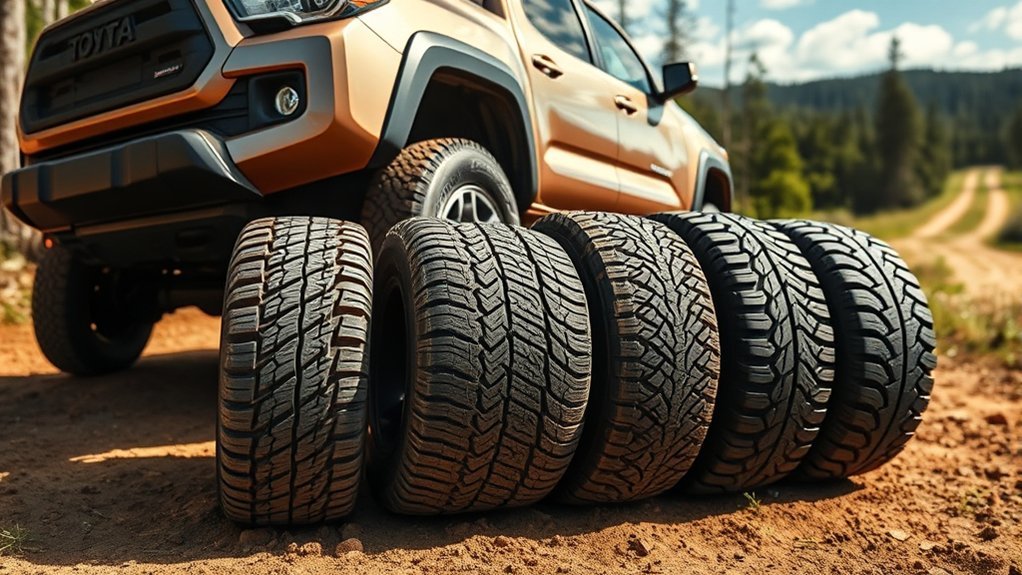
The right category matters more than an aggressive sidewall design. A tire built for your normal driving conditions will usually brake, ride, and wear better than one chosen mainly for appearance.
| Tire Type | Best For | Main Trade-Off |
|---|---|---|
| Highway or all-season | Commuting, long trips, wet roads, light towing, and occasional graded dirt roads | Less traction and sidewall protection on loose, rocky, or muddy trails |
| All-terrain | Mixed pavement, gravel, snow, forest roads, camping, and moderate off-road use | Usually heavier, noisier, and less efficient than a highway tire |
| Hybrid or rugged-terrain | Drivers who want stronger off-road bite than a typical all-terrain tire without moving fully to mud-terrain | More noise, weight, and rolling resistance than milder all-terrain designs |
| Mud-terrain | Deep mud, loose rock, severe trails, and dedicated off-road use | More road noise, reduced wet-road refinement, faster or uneven wear, and higher weight |
| Dedicated winter | Frequent freezing temperatures, packed snow, and icy winter roads | Seasonal changeover and storage are required |
If your Tacoma spends about 80% or more of its time on pavement, a highway tire or mild all-terrain tire often gives the best daily experience. If you regularly drive gravel, snow, or rutted access roads, an all-terrain tire with strong wet performance and a Three-Peak Mountain Snowflake rating can be a better fit. For deep mud, look for larger voids and self-cleaning tread designs, but accept the added road noise and weight.
Note: The M+S marking is a basic tread-design designation. A Three-Peak Mountain Snowflake marking shows that the tire met an industry snow-traction test, but it does not make every all-terrain tire equal to a dedicated winter tire on ice.
[Products Worth Considering]

Universal magnetic jack pad with aluminum grooved design to protect vehicle pinch welds during lifting. Durable nylon pad inserts are upgraded and secured with screws to...
Essential Considerations for Selecting Tacoma Tire Sizes
Tacoma tire sizes vary by generation, trim, wheel package, and market. Do not assume that 265/70R17 fits every SR5 or TRD Off-Road. Check the driver-door Tire and Loading Information label, the original tire sidewall, and the owner’s manual for your exact model year.
For example, Toyota’s 2024 Tacoma manual lists several factory combinations, including 245/70R17, 265/70R17, and 265/65R18, with different load indexes and recommended cold pressures. That range shows why a single “stock Tacoma size” or pressure cannot safely cover every truck. Review the Toyota Tacoma tire and wheel specifications for a model-year example, then use Toyota’s current manuals portal for your own truck.
How to Read the Tire Size Code
A size such as 265/70R17 115T breaks down like this:
- 265: approximate section width in millimeters.
- 70: sidewall height as a percentage of the section width.
- R: radial construction.
- 17: wheel diameter in inches.
- 115: load index.
- T: speed rating.
The replacement tire should fit the wheel’s approved width range and meet or exceed the original load and speed requirements unless a qualified tire professional approves a different application.
Stock Size Versus Larger Tires
Staying with the placard size is the lowest-risk choice for clearance, braking, steering, speedometer accuracy, spare-tire storage, and driver-assistance calibration. Larger sizes such as 275/70R17 or 285/70R17 may fit some Tacoma setups, but compatibility depends on generation, suspension height, wheel width, offset, alignment, tire construction, actual measured dimensions, and how the truck is loaded.
Warning: Do not buy an oversized tire from the size code alone. Check full-lock steering clearance, suspension compression, upper-control-arm clearance, mud-flap and body-mount clearance, brake clearance, spare-tire fitment, and the tire maker’s approved rim-width range before driving.
Upsizing also changes effective gearing. A taller, heavier tire can make acceleration feel slower, increase braking effort, reduce fuel economy, and change the indicated speed. After changing tire size or rotating wheels, some Tacoma models require tire-pressure monitoring system initialization or registration. Toyota’s manual explains when the system must be initialized, and this related guide covers TPMS sensor service basics.
Load Capacity and Performance
Load capacity is critical when your Tacoma carries tools, camping gear, a bed rack, a rooftop tent, passengers, or trailer tongue weight. The tire is only one part of the limit. You must also stay within the truck’s payload rating, gross vehicle weight rating, gross axle weight ratings, and towing limits.
Load Rating Importance
The original article’s “load index of 109 or higher” rule is too broad. Use the original-equipment requirement for your exact truck as the minimum. Toyota factory combinations can use different load indexes, so the safe rule is to match or exceed the placard and manual specification while using an approved tire size.
A tire’s maximum sidewall load is tied to a specified pressure. It does not mean the truck should be driven at the sidewall’s maximum pressure. For a clear explanation of the markings, see this guide to tire load ratings and safety.
P-Metric Versus LT Tires
Passenger-metric and LT tires can both work on a Tacoma when the size and load capacity are correct, but they behave differently:
- P-metric or standard-load tires are often lighter, quieter, and more comfortable for daily driving.
- XL tires provide added load capacity in some metric sizes without the weight of many LT options.
- LT tires are designed for light-truck service and are available in different load ranges. They can improve durability and load capability, but they may add weight, stiffness, road noise, and rolling resistance.
Do not choose an LT tire simply because it has an “E” load range. Select the construction needed for your actual loads and terrain. An unnecessarily heavy tire can reduce ride quality and performance without adding useful capability.
Tire Size Considerations
Wider tires can increase the contact patch under some conditions, but they do not guarantee better braking or traction. Tread compound, casing design, pressure, temperature, road surface, and vehicle setup matter just as much. A wider tire may also hydroplane sooner in standing water, follow road grooves, rub at full steering lock, or place more stress on steering and suspension components.
Keep all four tires the same size, type, and similar tread depth unless Toyota specifies otherwise. Mixed diameters can affect four-wheel-drive operation and stability systems.
Off-Road Capability Requirements
For off-road use, prioritize tread suited to your terrain, durable shoulders, appropriate sidewall construction, and enough load capacity for the truck when fully equipped. A mild all-terrain tire suits gravel and forest roads. A more open tread helps in mud, while a strong casing and controlled pressure matter on rocks.
Lowering pressure off-road can improve the tire’s ability to conform to loose or uneven terrain, but no single pressure works for every Tacoma. Tire construction, wheel size, vehicle weight, speed, terrain, and bead retention all matter. Reinflating to the placard pressure before highway driving is essential.
Pro Tip: Before a trip, weigh the loaded truck by axle at a certified scale. Compare the axle weights with the truck’s ratings and the tire maker’s load-and-inflation data instead of guessing from the empty vehicle.
Why All-Terrain Tires Are Ideal for Tacoma Owners
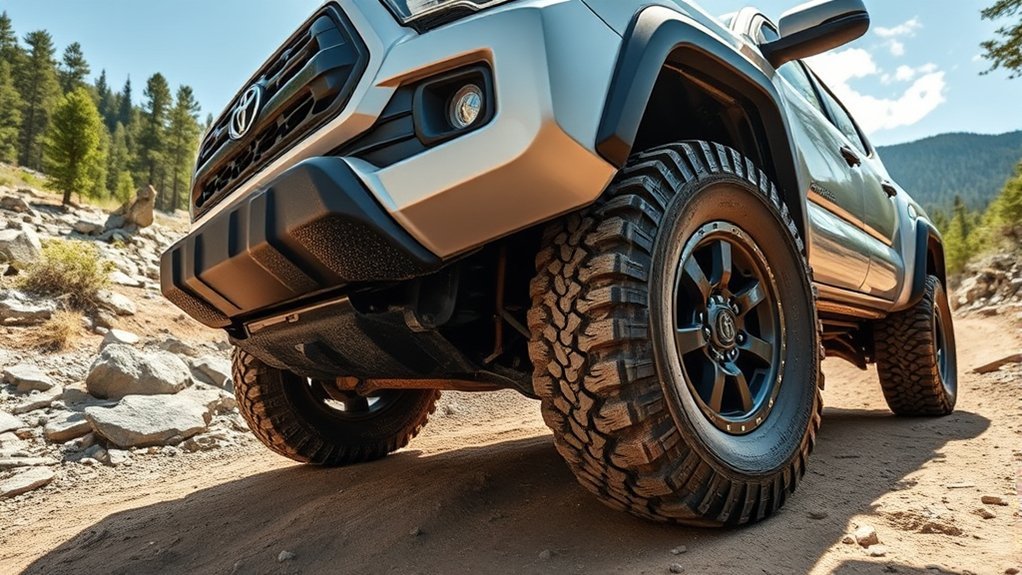
All-terrain tires are popular on dual-use Tacomas because they bridge the gap between highway tires and mud-terrain tires. A well-chosen all-terrain model can handle commuting, wet roads, gravel, snow, camping access roads, and moderate trails without the noise and weight of a dedicated mud tire.
The trade-off is that “all-terrain” covers a wide range. A mild design may ride quietly but struggle in deep mud. A rugged design may deliver stronger trail traction but add weight and road noise. Compare wet braking, snow rating, tread depth, tire weight, sidewall construction, warranty terms, and available Tacoma sizes instead of judging only by appearance. This guide on when all-terrain tires make sense explains the same road-versus-trail trade-off.
The best dual-use Tacoma tire is usually the least aggressive design that still handles your hardest regular terrain.
Best Tire Brands for Your Toyota Tacoma
No brand is best for every Tacoma. Fitment, construction, and use case matter more than the logo. Confirm that the exact size and load specification you need is available before comparing features or warranties.
Top Performance Brands
- BFGoodrich All-Terrain T/A KO3: A current severe-snow-rated all-terrain option with a 50,000-mile limited treadwear warranty. BFGoodrich introduced it as the successor to the KO2 and continued expanding replacement sizes through 2026. Review the official KO3 specifications.
- Falken Wildpeak A/T4W: The successor to the A/T3W, with a severe-snow rating and warranty terms that vary by construction. Falken lists up to 65,000 miles for non-LT sizes and 60,000 miles for LT sizes. See the official A/T4W details.
- Michelin Defender LTX M/S 2: A strong option for owners who prioritize highway comfort, wet performance, towing stability, and tread life over aggressive trail traction. Warranty mileage varies by size. Check the official Defender LTX M/S 2 page.
- Nitto Ridge Grappler: A hybrid-terrain design for drivers who want more aggressive off-road traction and styling than a conventional all-terrain tire. Expect more weight and a firmer ride in many sizes.
- Toyo Open Country M/T: A mud-terrain choice for severe off-road use. Its open tread and durable construction favor mud and rocks, but it is usually more tire than a mostly pavement-driven Tacoma needs.
Budget-Friendly Options
“Budget-friendly” changes with tire size, promotions, installation, and expected tread life. Compare the total fitted cost rather than the tire price alone. Goodyear Wrangler, Cooper Discoverer, and General Grabber lines can be worth comparing, but choose the current model that matches your road, trail, weather, and load needs.
- Check the exact warranty: Mileage coverage can differ between standard-load, XL, and LT sizes.
- Compare tire weight: A cheaper heavy tire may cost more in fuel and ride quality.
- Prioritize wet braking: Wet-road confidence matters more often than extreme off-road traction for most drivers.
- Confirm local support: A common size and brand may be easier to replace during a trip.
- Avoid false economy: Do not choose a lower load or speed rating to save money.
For more examples of how wet traction, size, and construction affect a buying decision, see this related tire comparison guide.
Essential Maintenance Tips for Tire Longevity
Good maintenance protects handling, tread life, and fuel economy. Use these habits for highway and off-road driving:
- Check pressure monthly when cold: Use the driver-door placard pressure, not the maximum pressure molded on the tire sidewall. NHTSA recommends checking all tires, including the spare, at least monthly.
- Adjust for approved load conditions: Follow Toyota and tire-maker guidance when carrying heavy loads or towing. Do not invent a pressure based only on tire appearance.
- Rotate on schedule: Follow the maintenance guide for your model year and the tire maker’s warranty requirements. Shorten the interval if the tires show uneven wear.
- Inspect after trails: Look for cuts, punctures, bulges, missing tread chunks, stones, and sidewall abrasion. Clean packed mud from the wheels because it can cause vibration.
- Watch tread depth: Replace tires at or before 2/32 inch, and consider earlier replacement when wet or snow traction has noticeably declined.
- Correct alignment problems: Feathering, one-sided wear, steering pull, or an off-center steering wheel can signal alignment or suspension issues.
- Check tire age: Read the last four digits of the DOT Tire Identification Number for the production week and year. NHTSA notes that some manufacturers recommend replacement at six to 10 years regardless of remaining tread.
- Service the TPMS: Relearn or initialize the system when required after rotation, pressure changes, sensor replacement, or tire-size changes.
Temperature changes also affect inflation pressure, so recheck it during major seasonal shifts. This related guide explains why cold tire pressure changes with temperature.
Frequently Asked Questions
What tire size fits my Toyota Tacoma?
Use the driver-door tire placard and the owner’s manual for your exact model year and trim. Tacoma sizes vary by generation, wheel package, and market, so a size that fits one SR5 or TRD Off-Road may not be correct for another.
Will 285/70R17 tires fit a Tacoma without a lift?
Sometimes, but not universally. Fitment depends on generation, trim, wheel width and offset, suspension condition, alignment, tire construction, and actual measured dimensions. Some setups rub at full lock or compression and may require trimming or other changes.
Should I choose P-metric or LT tires for my Tacoma?
Choose based on load and terrain. P-metric or XL tires often ride better and weigh less for daily use. LT tires can add durability and load capability for rough trails, towing, or heavy payloads, but they may be heavier and stiffer.
What is the best tire type for daily driving and weekend trails?
A mild or moderate all-terrain tire is usually the best compromise. Look for strong wet-road performance, manageable weight and noise, suitable load capacity, and a Three-Peak Mountain Snowflake rating if you regularly drive in snow.
What tire pressure should I use in a Toyota Tacoma?
Use the recommended cold pressure on the driver-door placard for your exact truck and tire setup. Do not use a universal 30 psi setting or the tire sidewall’s maximum pressure as the normal target.
Is the TRD Sport better than the SR5 for tire choice?
Neither trim is universally better. The TRD Sport is tuned more toward on-road handling, while SR5 configurations vary widely. Choose tires from the exact wheel, placard, load, climate, and terrain requirements rather than the trim badge alone.
Conclusion
The right Tacoma tire starts with correct fitment, not the most aggressive tread. Match the door placard, load and speed requirements, wheel width, and real driving conditions first. For most dual-use owners, a well-rated all-terrain tire offers the best balance of road comfort and trail capability. Verify clearance before upsizing, use the placard pressure on the highway, and maintain the tires consistently.
Sources
- Toyota 2026 Tacoma Manuals and Warranties — current model-year owner’s manual access.
- Toyota 2024 Tacoma Maintenance Data — example factory tire sizes, load indexes, wheel sizes, and cold inflation pressures.
- NHTSA TireWise — pressure, placard, tread, tire-age, and maintenance guidance.
- BFGoodrich All-Terrain T/A KO3 — current product features, severe-snow rating, sizes, and warranty.
- Falken Wildpeak A/T4W — current product features, severe-snow rating, construction, and warranty.
- Michelin Defender LTX M/S 2 — highway-focused light-truck tire specifications and warranty information.

Related Articles
How Tire Weight Affects Toyota Tacoma Performance
How does tire weight influence your Toyota Tacoma's performance and efficiency? Discover the surprising effects that could change your driving experience.
Read More
Tire Noise Levels by Tire Type on a Toyota Tacoma
A comprehensive look at how tire types affect noise levels in your Toyota Tacoma reveals surprising insights that could enhance your driving experience.
Read More
Toyota Tacoma Stock vs Aftermarket Wheel Comparison
Optimize your Toyota Tacoma's performance and style by exploring the differences between stock and aftermarket wheels—discover which option suits your needs best.
Read More