
Toyota Hilux Double Cab Tire Specs Across All Trims
Your Toyota Hilux can use very different tires depending on its model year, market, trim, wheel package, drivetrain, and powertrain. A size that fits one Double Cab may be wrong for another. Before buying, you need to match the tire size, wheel diameter, load index, speed rating, construction, and recommended cold pressure to your specific vehicle.
Quick Answer
Toyota Hilux Double Cab tire sizes vary by generation, market, trim, and wheel package. Common eighth-generation examples include 265/65R17 and 265/60R18, while some 2026 ninth-generation models use 17- or 18-inch wheels. Use your tire placard or owner documentation for the exact size, cold pressure, load index, and speed rating.
Key Takeaways
- Do not choose Hilux tires by size alone. Match the approved load index, speed rating, construction, and wheel specification.
- The pressure printed on a tire sidewall is not your normal driving pressure. Use the vehicle’s cold-pressure label.
- 265/65R17 and 265/60R18 are common Hilux sizes, but they are not correct for every Double Cab, generation, or market.
- A 33-inch tire is not automatically a direct fit. Wheel offset, suspension travel, body clearance, gearing, and local rules must be checked.
At a Glance
| Time Required | 5–10 minutes to confirm the label, inspect the sidewalls, and check cold pressure |
| Difficulty | Easy for inspection; professional assessment recommended for nonstandard sizes |
| Tools Needed | Accurate pressure gauge, flashlight, and optional tread-depth gauge |
| Cost | Free if you already own a gauge; professional fitment costs vary by wheel and tire setup |
Toyota Hilux Tire Size Specifications Explained
Toyota sells the Hilux in many configurations around the world. The approved tire can change with the cab style, gross vehicle weight, driven axle, wheel package, trim, and production year. Treat the sizes below as common examples rather than a universal fitment list.
[Products Worth Considering]

The 22800 wheel stud installer makes replacing wheel studs quick and secure, saving time and effort during tire service. It uses a ratchet or impact wrench to pull new studs firmly into place, helping when existing studs are too long. Compatible with most automotive wheels and light-duty truck wheel studs, it’s designed for easy, tool-assisted installation.

Milton S-921 pencil tire pressure gauge helps you maintain optimal tire pressure for passenger cars with accurate readings in PSI and kPa. It features a built-in deflator valve for convenient pressure adjustments, plus a single chuck head and nylon indicator bar for easy use on the go. Built from durable plated brass and designed for reliable performance, it’s a practical road trip and cold-weather maintenance tool.

Upgrade your Toyota tire setup with these corrosion-resistant, leak-proof valve stem caps designed to help protect the valve core from water, snow, and road grime. The caps feature a snug rubber seal and durable copper alloy construction to resist rust and oxidation while maintaining stable tire pressure. Ideal for replacing worn original caps and keeping your wheels looking clean and stylish.
Common Hilux Tire Size Examples
| Tire Size | Example Hilux Application | Important Detail |
| 215/65R16C | Used on some eighth-generation 4×2 WorkMate configurations | The C suffix identifies a commercial-vehicle construction. Do not replace it with a lower-rated passenger tire. |
| 225/70R17C | Used on some Hi-Rider and 4×4 single-cab configurations | Its approved pressure and load specification may differ from wider Double Cab tires. |
| 265/65R17 | Common on several eighth-generation 4×4 Extra Cab and Double Cab trims; also listed for specified 2026 models | This size can be sold as highway, all-terrain, mud-terrain, passenger, or LT construction. The size alone does not define the tire type. |
| 265/60R18 | Used on some eighth-generation upper-trim and SR5 configurations | The lower-profile sidewall may give a different ride and damage resistance than the 17-inch setup. |
Toyota’s eighth-generation Australian specifications document these examples across WorkMate, SR, and SR5 configurations. For the ninth-generation Hilux, Toyota’s June 2026 technical sheet lists 17-inch steel, 17-inch alloy, and 18-inch alloy wheel packages for the Diesel 48V range, with 265/65R17 confirmed for specified versions.
Note: Online fitment charts can combine specifications from different countries and generations. Confirm your vehicle’s market, production year, trim, axle configuration, and tire label before ordering.
How to Read a Hilux Tire Size
A marking such as 265/65R17 112H contains several separate specifications:
- 265: The nominal tire width in millimetres.
- 65: The sidewall height as a percentage of the tire width.
- R: Radial tire construction.
- 17: The wheel diameter in inches.
- 112: The load index. This code represents the maximum load one properly inflated tire can carry under its rated conditions.
- H: The speed symbol. It identifies the tire’s tested speed capability under specified load and operating conditions.
The load index and speed symbol form the tire’s service description. According to Continental’s tire-size guidance, replacement tires should match the vehicle’s approved dimensions, load capacity, and speed specification.
You may also see C, LT, XL, a load range, or a dual load-index marking. These identify construction and load characteristics. Do not assume that a passenger tire with the same width and wheel diameter can replace a commercial or LT tire.
How to Identify the Right Tire for Your Hilux Model
Use this process before comparing brands or tread patterns:
- Record the exact vehicle details. Note the model year, production market, trim, cab style, 4×2 or 4×4 drivetrain, engine or powertrain, and current wheel diameter.
- Read the vehicle tire placard. Look on the driver-side door opening, pillar, door edge, glove box area, or another location specified in your manual.
- Check the owner documentation. Confirm approved sizes, front and rear cold pressures, load conditions, spare-tire details, and rotation guidance.
- Inspect the current tire sidewall. Record the complete marking, including the size, load index, speed symbol, C/LT/XL marking, and manufacturing date code.
- Confirm the wheels. Make sure the rim diameter, width, offset, load capacity, and mounting specification suit the tire and vehicle.
- Match the service description. Do not install a tire with a lower load index or inadequate speed rating.
- Check all five tires. Include the spare when confirming size, pressure, age, and condition.
Warning: The size molded into your current tire is not proof that it is approved. A previous owner may have changed the wheels or installed an unsuitable size. When the tire and vehicle label disagree, have a Toyota dealer or qualified tire technician verify the setup.
Match the Load Rating and Construction
A Hilux may carry passengers, cargo, a canopy, tools, recovery equipment, or trailer tongue weight. Your replacement tire must support the vehicle’s approved axle and operating loads. Never reduce the load index simply to obtain a softer ride.
LT and commercial tires can use different pressure and load relationships from passenger tires. Ask the installer to confirm the tire’s load table, wheel capacity, axle limits, and intended operating pressure, especially if your Hilux regularly carries heavy loads.
What’s the Best Tire Pressure for Your Hilux?
The best pressure is the vehicle manufacturer’s specified cold pressure for your exact tire and load condition. A single 29–35 psi range cannot cover every Hilux configuration.
Toyota UK publishes the following general Hilux examples in its tire pressure and size guide:
| Tire Size | Front Example | Rear Example |
| 225/70R17 | 2.4 bar / 35 psi | 2.4 bar / 35 psi |
| 265/65R17 | 2.0 bar / 29 psi | 2.0 bar / 29 psi |
| 265/60R18 | 2.0 bar / 29 psi | 2.0 bar / 29 psi |
These are published examples, not a replacement for the label on your truck. Your placard may specify another pressure for a different load, tire construction, generation, or market.
How to Check Hilux Tire Pressure
- Park the Hilux for at least three hours, or check the tires before significant driving.
- Find the approved cold pressure on the vehicle label or in the owner documentation.
- Remove the valve cap and press an accurate gauge firmly onto the valve.
- Add or release air until the reading matches the specified cold pressure.
- Check every road tire and the spare.
- Refit each valve cap and inspect the valves for leakage or damage.
The pressure molded on the tire sidewall is normally a maximum or rating-related value, not the recommended road pressure for your Hilux. NHTSA’s tire-safety guidance recommends checking all tires at least monthly while cold and before long trips.
Pro Tip: Photograph your tire placard and save it on your phone. You will have the correct size and cold-pressure information available when visiting a tire shop or adjusting pressure during a trip.
Do not release air from a warm tire simply because its pressure has risen after driving. Heat naturally increases pressure. Recheck it when cold unless the tire is clearly and dangerously overinflated.
All-Terrain vs. Mud Tires: Which Is Best for Your Hilux?
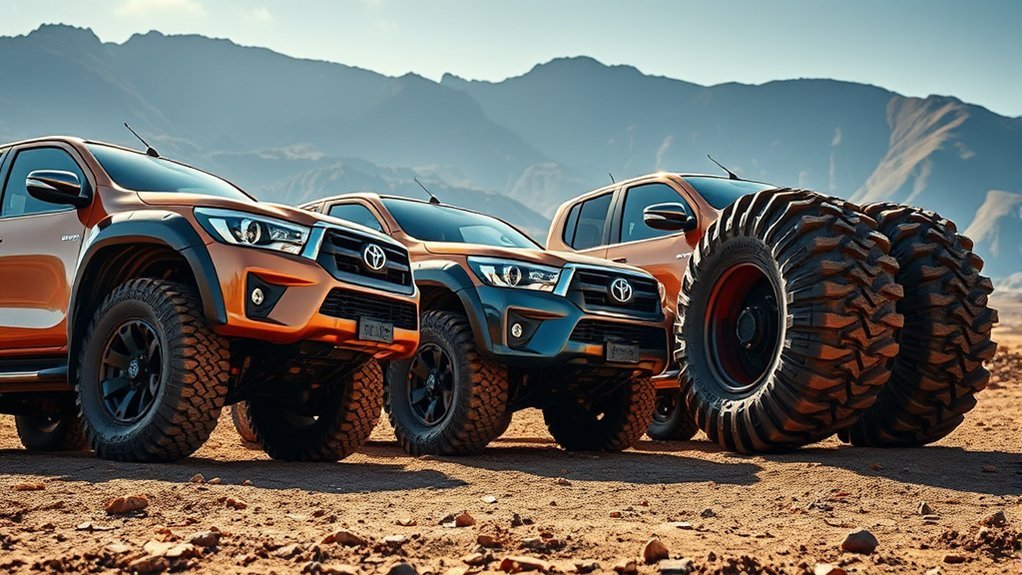
Your best tire type depends on where you drive, how much weight you carry, the weather, and how much road comfort you are willing to trade for off-road traction.
| Tire Type | Best For | Main Trade-offs |
| Highway-Terrain | Commuting, towing on paved roads, long-distance driving, and light gravel use | Usually quieter and smoother, but less capable in deep mud or loose terrain |
| All-Terrain | Mixed road, gravel, trails, work sites, and moderate off-road driving | A useful compromise, with more noise and rolling resistance than many highway tires |
| Mud-Terrain | Frequent deep mud, soft soil, ruts, and demanding off-road use | More road noise, heavier steering feel, and potentially faster or less even paved-road wear |
| Winter or Snow-Rated | Sustained cold weather, snow, and ice | Seasonal use may be needed, and local winter-equipment rules can apply |
Choose all-terrain tires if your Hilux spends most of its time on pavement but regularly visits gravel roads, campsites, farms, or moderate trails. Choose mud-terrain tires when deep mud and loose surfaces are a normal part of your driving rather than an occasional event.
Do not assume an aggressive tread automatically improves every type of traction. Wet-road braking, noise, steering response, fuel use, ride comfort, and tread life can all change. Compare tested performance and select a service rating that matches your Hilux.
Upsizing and Fitting 33-Inch Tires on a Hilux
You may be able to fit a tire with an approximate 33-inch overall diameter, but it is not a universal bolt-on upgrade. “33-inch” describes approximate diameter rather than one exact metric size, and the result changes with rim diameter, tread design, actual measured dimensions, wheel offset, and suspension setup.
A complete fitment check should cover:
- Full steering lock: Check clearance in both directions.
- Suspension compression and articulation: A tire that clears while parked may rub when the suspension moves.
- Wheel width and offset: Moving the wheel inward or outward can create new contact points and change bearing or steering loads.
- Body and liner clearance: Mud flaps, inner liners, body mounts, bumpers, and guards may interfere.
- Load and speed ratings: Larger size does not guarantee adequate capacity.
- Spare-tire storage: Confirm that a matching spare fits and can be safely carried.
- Speedometer and odometer accuracy: A larger rolling circumference changes the distance travelled per wheel revolution.
- ABS and driver-assistance operation: Major diameter changes can affect systems that use wheel-speed information.
- Braking and gearing: Heavier tires increase rotating mass and can change acceleration, braking feel, and effective gearing.
- Legal and insurance requirements: Modification limits, inspection rules, guard coverage, and notification requirements vary by location.
Toyota’s official Hilux AT35 information shows why large-tire conversions require more than a lift. That engineered package uses dedicated wheels together with changes to the suspension, body, frame, and bodywork.
Warning: Do not order 33-inch tires based only on a social-media photo or another owner’s setup. Have the exact wheel, tire, suspension, alignment, and vehicle combination measured by a qualified installer.
[Products Worth Considering]

TP-M13W combination repair unit kit includes wrapped stems with matching patches for fast, reliable tire repairs. It’s suitable for both radial and bias ply tires and is designed for chemical or heat vulcanization. Gray vulcanizing gum with blue backing helps create a strong bond, with the stem portion wrapped for added effectiveness.

The Topeak SmartGauge D2 delivers precise digital tire pressure readings for bikes, motorcycles, and sports equipment up to 250 psi (17 bar). Its rotating SmartHead works with both Presta and Schrader valves, so you can check pressure quickly without adapters. The LCD display makes it easy to read results in psi, bar, or kg/cm² with an included CR2032 battery for immediate use.
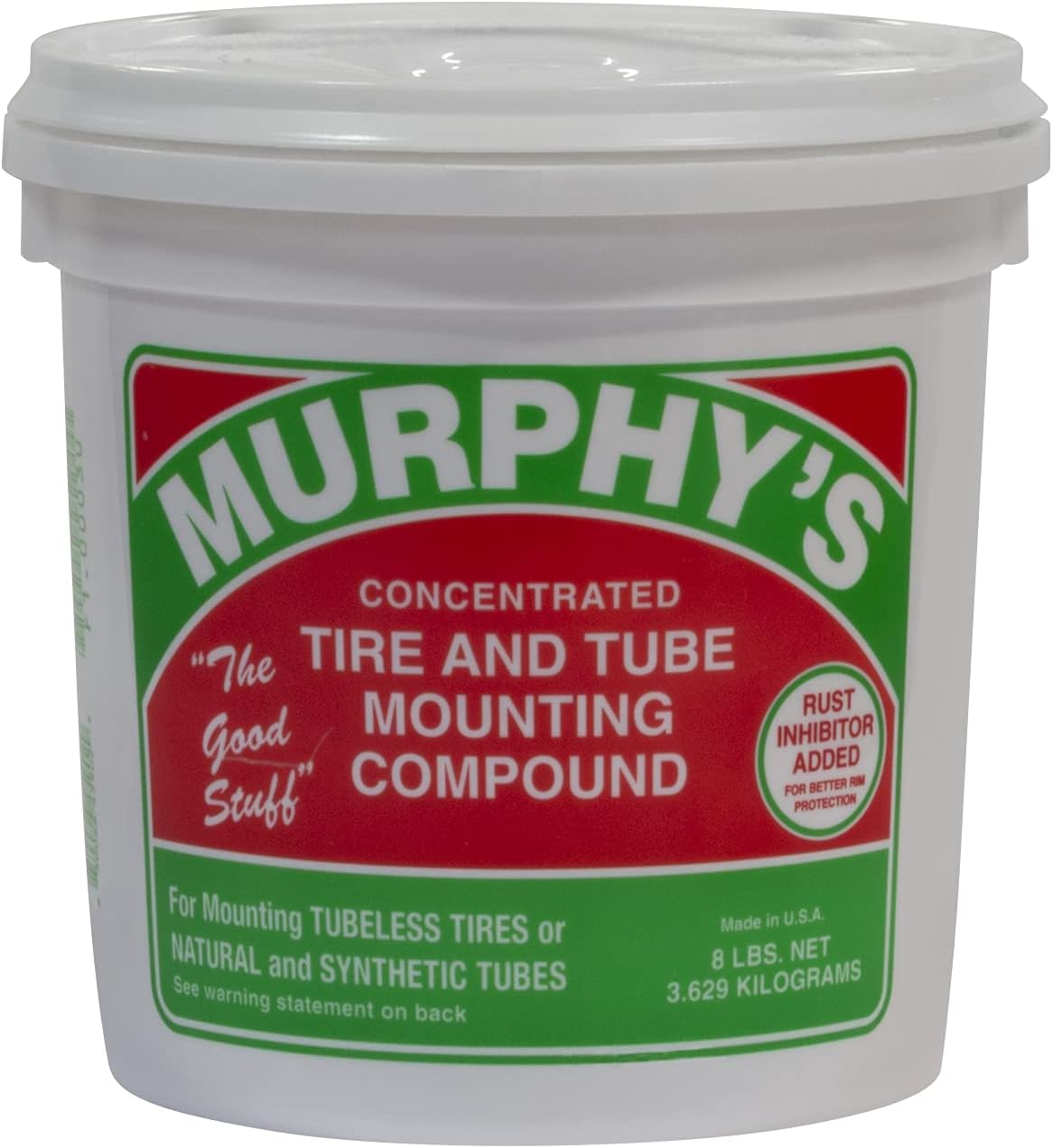
A concentrated tire and tube mounting compound designed to help simplify mounting rubber tires and tubes on passenger, semi truck, construction, and OTR applications. Its ultra-thick formula packs beads effectively and includes rust inhibitors to help protect against corrosion during use.
When to Replace Your Tires
Replace a Hilux tire when tread wear, structural damage, age, pressure loss, or declining performance makes continued use unsafe. Do not wait for a tire to become visibly bald or fail.
Tire Replacement Warning Signs
- Tread at the wear indicators: Replace the tire when the main tread is level with its molded wear bars.
- Insufficient tread depth: NHTSA advises replacement at 2/32 inch, approximately 1.6 mm. UK cars and light vans must retain at least 1.6 mm across the central three-quarters of the tread and around the circumference. Check the law where your Hilux is registered.
- Cuts, bulges, exposed cords, or deep cracking: Stop using the tire and have it inspected.
- Repeated pressure loss: A leaking valve, wheel, bead, puncture, or structural problem needs professional diagnosis.
- Irregular wear: One-sided, cupped, scalloped, or centre wear can indicate pressure, alignment, balance, suspension, or load problems.
- New vibration or noise: A change in behaviour may indicate internal damage, imbalance, or uneven wear.
- Age: Check the tire identification code for its manufacturing week and year. Follow the tire and vehicle manufacturer’s inspection and replacement guidance even when tread remains.
- Poor wet, snow, or off-road grip: A tire can become unsuitable for your conditions before it reaches the legal minimum.
The NHTSA TireWise guide recommends monthly checks of pressure, tread, damage, and the spare. It also notes that some vehicle and tire manufacturers recommend age-based replacement within a six-to-ten-year period, depending on their policies and the tire’s use.
If you replace only two tires, fit matched tires on the same axle and follow the vehicle and tire manufacturer’s placement guidance. On a 4WD Hilux, ask a qualified technician whether the remaining tread-depth and rolling-circumference difference is acceptable for the drivetrain.
Frequently Asked Questions
Can You Fit 33-Inch Tires on a Hilux?
A 33-inch tire may fit some Hilux setups, but a lift does not guarantee compatibility. You must check the metric tire size, wheel width and offset, full-lock clearance, suspension compression, body mounts, liners, spare location, load rating, speedometer accuracy, local modification rules, and insurance requirements.
What Size Are Stock Hilux Tires?
Stock Hilux tire sizes vary widely. Common eighth-generation examples include 215/65R16C, 225/70R17C, 265/65R17, and 265/60R18. Some 2026 ninth-generation configurations use 17- or 18-inch wheels. Check the label and documentation for your exact market, year, and trim.
What Is a Common Weakness of the Toyota Hilux?
A common trade-off is a firm or bouncy unladen ride because many Hilux versions use a rear suspension designed to carry substantial loads. The effect varies by generation and trim. Incorrect pressure, heavy LT construction, aggressive mud tires, worn dampers, or poor wheel balance can make the ride feel harsher.
Which Is Better, the 2.4 or 2.8 Hilux?
Neither engine is automatically better for every driver. In markets where both are offered, the 2.8-litre version generally suits heavier towing and performance needs, while a 2.4-litre version may suit lighter work and lower operating requirements. Compare the official payload, towing, fuel, transmission, and tire specifications for your market and model year.
Should I Use the Pressure Printed on the Tire Sidewall?
No. The tire-sidewall figure is not normally the recommended road pressure for your Hilux. Use the cold pressure shown on the vehicle tire label or in the owner documentation. Check the tires before driving or after they have cooled for at least three hours.
Do I Need to Replace All Four Tires on a 4WD Hilux?
Not in every case, but all tires should have compatible size, construction, load rating, and rolling circumference. A large tread-depth difference can create a circumference difference. Ask Toyota or a qualified tire technician whether a two-tire replacement is acceptable for your drivetrain and remaining tread condition.
Conclusion
Choosing the right Toyota Hilux tire involves more than selecting 265/65R17 or 265/60R18. You must confirm the approved wheel size, load index, speed rating, construction, cold pressure, and intended use for your exact vehicle. Use the tire placard and owner documentation first, then have any nonstandard wheel or 33-inch setup professionally measured before installation.
Check pressure and condition every month and before long trips. Correct inflation, adequate tread, matched tires, and prompt attention to damage will improve handling, tire life, fuel efficiency, and safety without relying on unsupported pressure ranges or fitment assumptions.
Sources
- Toyota Hilux 2026 Technical Specifications — current ninth-generation wheel, tire, weight, and powertrain information.
- Toyota Australia Eighth-Generation Hilux Specifications — official examples of 16-, 17-, and 18-inch Hilux tire fitments.
- Toyota UK Tire Pressure and Size Guide — published Hilux pressure examples and label guidance.
- Continental Tire Size Guide — explanation of tire dimensions, load index, and speed rating.
- NHTSA TireWise — pressure, tread, tire-age, damage, rotation, and replacement guidance.
- UK Highway Code: Tire Maintenance — UK inflation and minimum tread-depth requirements.
[Products Worth Considering]

Steelman white tire marking crayons provide high-contrast, semi-permanent marks for repairing and inspecting tires and equipment. They write on wet or dry, smooth or coarse surfaces including rubber, metal, glass, and wood, making them ideal for puncture location and damage outlining. The lead- and zinc-free crayons resist weather and fading yet wipe away when you no longer need the marks.

These aluminum alloy tire valve stem caps with an O-ring seal help protect valve stems from corrosion while adding a clean, stylish look to your vehicle. The universal fit works across cars, trucks, motorcycles, bicycles, and more, making them an easy upgrade for everyday driving and off-road use. Installation is quick, and the included four-pack keeps all your tires dressed and protected.

The SAFELIFE dial tire tread depth gauge measures tread depth in 1/32 inch increments with clear, easy-to-read 2-inch dial face. Color zones using a traffic light system help you quickly judge whether tread is low, marginal, or ample for safer driving. Built with a durable zinc cast body and a metal detect probe for precise, comfortable use across cars, motorcycles, trucks, and buses.

Related Articles
Toyota Hilux Run-Flat Tires: What You Need to Know
Take control of your safety with Toyota Hilux run-flat tires; discover their benefits and hidden costs that could change your driving experience forever.
Read More
Effects of Underinflated Tires on the Toyota Hilux
Inadequate tire pressure in your Toyota Hilux can lead to serious safety issues and costly repairs; discover how to avoid these pitfalls.
Read More
The Risks of Overinflating Toyota Hilux Tires
Overinflating your Toyota Hilux tires can lead to dangerous blowouts and uneven wear, but understanding the risks is crucial for your safety.
Read More