
Toyota Hilux Tire Rotation Schedule and How It Helps

Regular tire rotation helps your Toyota Hilux wear its tires more evenly, steer more predictably, and stay ready for towing, hauling, rough roads, and daily driving. The right schedule depends on your model year, market, tire type, load, and driving conditions, so your owner’s manual should always come first.
As a general rule, many Hilux owners should plan on rotating tires about every 5,000 to 8,000 miles, or sooner if the truck sees heavy loads, gravel, off-road use, towing, or visible uneven wear. The key is not just the interval. You also need the right rotation pattern and safe lifting steps.
Quick Answer
For most Toyota Hilux models, check your owner’s manual first, then use a common rotation interval of about 5,000 to 8,000 miles. Rotate sooner if you tow, haul, drive off-road, or see uneven tread wear. Use the pattern that matches your drivetrain, tire type, and spare setup.
Key Takeaways
- Rotate Hilux tires on a manual-approved schedule, commonly around every 5,000 to 8,000 miles.
- Use a rearward cross or X-pattern for many non-directional 4×2 and 4×4 setups, but keep directional tires on the same side.
- Check tire pressure, tread depth, sidewall damage, and wheel balance during every rotation.
- If you rotate tires yourself, use wheel chocks, jack stands, and a torque wrench, not just the factory jack.
- Uneven wear after rotation may point to low pressure, alignment problems, suspension wear, or overloading.
At a Glance
| Time Required | 30 to 60 minutes at home; usually less at a tire shop |
| Difficulty | Moderate DIY job if you have safe lifting equipment |
| Tools Needed | Owner’s manual, wheel chocks, floor jack, jack stands, lug wrench, torque wrench, tire-pressure gauge, tread-depth gauge |
| Cost | DIY: $0 if you already own tools; shop service often costs a small labor fee unless included with tire purchase or maintenance |
Why Tire Rotation Matters for Your Hilux

Your Hilux puts different loads on each tire. Front tires handle most steering and a large share of braking force. Rear tires may carry more stress when the bed is loaded, the truck is towing, or a 4×2 model is sending drive force through the rear axle. On 4×4 and AWD versions, keeping tread depth similar across all tires also helps maintain balanced traction.
Rotating the tires spreads wear across the set instead of letting one position wear out early. That can help preserve tread life, reduce road noise, limit vibration, and keep braking and cornering more predictable. It also gives you a regular chance to inspect each tire for cuts, bulges, nails, uneven tread, and pressure loss.
NHTSA tire-safety guidance notes that poor tire maintenance, including underinflation and missed rotations, can contribute to flats, blowouts, and tread separation. That is especially important on a Hilux used for work, towing, gravel roads, or off-road trails.
Note: Tire rotation cannot fix a damaged tire, a worn-out tire, a bent wheel, or a suspension problem. If one tire has a bulge, exposed cord, deep cut, or very low tread, replace or repair it before rotating.
[Products Worth Considering]

Secure your parked vehicle quickly with AFA Tooling 4T rubber wheel chocks in a 4-pack for two dual-wheel sets. The ribbed design and textured base grip fast without pounding, so you can chock tires on trailers, RVs, ATVs, and work vehicles with confidence. EZ rustproof handles with rope ties keep the pair together for easy placement and removal, while nylon-reinforced rubber stands up to dirt, ice, salt, and harsh weather.

Universal magnetic jack pad with aluminum grooved design to protect vehicle pinch welds during lifting. Durable nylon pad inserts are upgraded and secured with screws to resist damage and keep in place. Designed to fit most single vehicle pinpoint welds for safer, stable jacking when changing tires, repairs, or performing oil changes.

EVOULTES heavy duty tire inflator with an integrated gauge delivers accurate pressure readings from 10–120 PSI, helping you inflate, deflate, and check tires in one tool. The 16.5-inch extended dual-head air chuck with swivel base reaches hard-to-access dual wheel valves on trucks and RVs. A brass trigger core and side-mounted air release valve make operation smooth, with standard 1/4" NPT threading and quick-connect compatibility for easy setup.
How Often Should You Rotate Your Hilux Tires?
Start with the service schedule in your Hilux owner’s manual or maintenance booklet. Toyota sells the Hilux in different markets and configurations, so the exact service interval can vary by model year, drivetrain, tire size, and local maintenance schedule.
For general tire care, a common rotation range is about every 5,000 to 8,000 miles. Some tire makers recommend around 5,000 to 7,000 miles, while NHTSA advises checking the owner’s manual and rotating every 5,000 to 8,000 miles if the vehicle manufacturer recommends it.
Rotate Sooner Under Severe Use
You may need shorter intervals if your Hilux often handles:
- Towing a trailer or caravan
- Heavy payloads in the bed
- Rough gravel roads
- Off-road tracks, sand, mud, or rocks
- Frequent stop-and-go driving
- Hard cornering, braking, or uneven terrain
- Uneven tire pressure or visible tread differences
If you see uneven wear before your next scheduled service, do not wait for the mileage number. Rotate the tires, check pressures, and inspect alignment and suspension.
Choose the Right Hilux Tire Rotation Pattern
The correct pattern depends on whether your Hilux has non-directional tires, directional tires, a full-size spare, matching tire sizes, and 4×2, 4×4, or AWD/BEV running gear. When the owner’s manual or tire sidewall disagrees with a general pattern, follow the manual and tire sidewall.
Common Patterns for Non-Directional Matching Tires
- 4×2 Hilux with same-size, non-directional tires: A rearward cross pattern is often used. Rear tires move straight to the front. Front tires move to the opposite rear positions.
- 4×4 Hilux with same-size, non-directional tires: An X-pattern or manufacturer-approved cross pattern is often used to help even out tread depth across all four tires.
- Battery-electric AWD Hilux, where sold: Follow the owner’s manual closely because drivetrain and tire-wear behavior can differ from diesel or petrol models.
Directional, Staggered, and Spare Tire Cases
- Directional tires: Keep each tire on the same side of the truck and rotate front to rear only, unless the tire is dismounted and remounted correctly.
- Different front and rear tire sizes: Do not use a normal cross pattern. Some staggered setups cannot be rotated front to rear.
- Temporary spare: Do not include a temporary spare in the regular rotation.
- Full-size matching spare: Some setups allow a five-tire rotation. Follow the Hilux manual and confirm TPMS requirements if the spare has a sensor.
Pro Tip: Mark each tire’s current position with chalk before removing it. Write LF, RF, LR, and RR on the tread area so you can confirm the pattern before reinstalling.
How to Rotate Toyota Hilux Tires Yourself
You can rotate Hilux tires yourself if you have the right tools, a safe flat surface, and the correct torque specification from your owner’s manual. If you are unsure how to lift the truck safely, use a qualified tire shop instead.
Warning: Never rely on a jack alone while working around or under a vehicle. Park on level ground, chock the wheels, use rated jack stands at approved lift points, and tighten lug nuts to the torque specification in your Hilux owner’s manual.
Tools You Need
- Hilux owner’s manual or service booklet
- Wheel chocks
- Floor jack rated for the truck
- Jack stands rated for the truck
- Lug wrench or breaker bar
- Torque wrench
- Tire-pressure gauge
- Tread-depth gauge
- Chalk or masking tape for tire positions
Step-by-Step DIY Rotation
- Park safely. Use a flat, solid surface. Shift to Park or gear, set the parking brake, and chock the wheels that stay on the ground.
- Confirm the pattern. Check your manual, tire sidewall, drivetrain, and spare-tire setup before loosening anything.
- Loosen the lug nuts slightly. Break them loose while the tires are still touching the ground. Do not remove them yet.
- Lift the truck at approved points. Use a proper jack and support the truck with jack stands before removing wheels.
- Remove and inspect each tire. Look for nails, cuts, bulges, cracks, uneven wear, and sidewall damage.
- Move each tire to its new position. Follow the correct rotation pattern for your tire type and drivetrain.
- Hand-start the lug nuts. Tighten them by hand first to avoid cross-threading.
- Lower the truck carefully. Once the tires touch the ground, tighten the lug nuts in a star pattern with a torque wrench.
- Set cold tire pressure. Use the tire placard or owner’s manual, not the maximum pressure printed on the tire sidewall.
- Test drive gently. Listen for new vibration, pulling, clicking, or steering-wheel shake.
Signs Your Hilux Needs a Tire Rotation
Do not rely only on mileage. Your tires can tell you when something is wrong. A Hilux that carries tools, loads, passengers, or off-road gear may show wear faster than a lightly used truck.
Uneven Tread Wear
Uneven tread wear is one of the clearest signs that rotation is overdue. Look for one front tire wearing faster than the other, more shoulder wear on one tire, cupping, feathering, or a visible tread-depth difference between axles.
Use a tread-depth gauge during each rotation. If the tread is near the legal or safety limit in your area, rotation is not enough. Replace the tire. In U.S. safety guidance, tires are considered unsafe when worn down to 2/32 inch.
Steering Wheel Vibrations
Steering-wheel vibration can come from uneven wear, wheel imbalance, tire damage, mud stuck in a wheel, or alignment problems. If the vibration changes after rotation, have the tires balanced and inspected.
Pulling to One Side
If your Hilux pulls left or right on a straight, level road, do not assume rotation alone will solve it. Check tire pressure first. If the pull remains, the truck may need an alignment check or suspension inspection.
New Road Noise
A growling, humming, or uneven sound may point to cupped tread or irregular wear. Rotation may reduce future wear, but existing cupping often needs balancing, alignment diagnosis, or tire replacement.
How Regular Tire Rotations Improve Performance and Safety
Regular rotation helps keep tread depth more even across all four tires. That supports steadier grip when braking, steering, cornering, and driving on wet or loose surfaces.
On a working Hilux, the benefit is practical. The rear tires may work harder during towing, hauling, and rear-wheel-drive use. The front tires may work harder during steering and braking. Rotation helps share those loads over time.
Even wear can also help maintain fuel efficiency and ride comfort. It does not create magic fuel savings, but it can reduce irregular wear that adds rolling resistance, vibration, and noise.
[Products Worth Considering]

This 4-in-1 tire valve core removal tool helps you deflate, unblock, and remove or install valve cores quickly for easier tire repair. The multifunction design also supports re-taping damaged threads and reaming inside the valve stem for smoother service. Included as a 2-pack, it’s compact for convenient carry and works for cars, bicycles, and motorcycles.

The JACO FlowPro Tire Inflator measures, inflates, and airs down tires up to 100 PSI with battery-free operation and ±2% accuracy after calibration. It features a glowing pressure dial for night visibility, a heavy-duty steel build with a hybrid hose, and a precision push-to-inflate thumb trigger. The patented Lightning Air Chuck locks on for a secure seal, and the kit includes quick-connect hardware for easy inline use with your air compressor.
What Happens If You Don’t Rotate Your Tires?
If you skip rotations, one pair of tires may wear faster than the other. Over time, that can cause poor traction, extra road noise, vibration, pulling, and shorter tire life.
Neglecting rotation can also make tire problems harder to catch. A regular rotation is a built-in inspection point where you can find nails, cuts, low pressure, sidewall damage, cracked valve stems, and abnormal wear before the problem becomes expensive or unsafe.
Some tire mileage warranties also require proof of regular rotations. Keep receipts or a maintenance log that shows the date, mileage, tire positions, pressure check, and any balancing or alignment work.
What to Expect During a Professional Tire Rotation Service
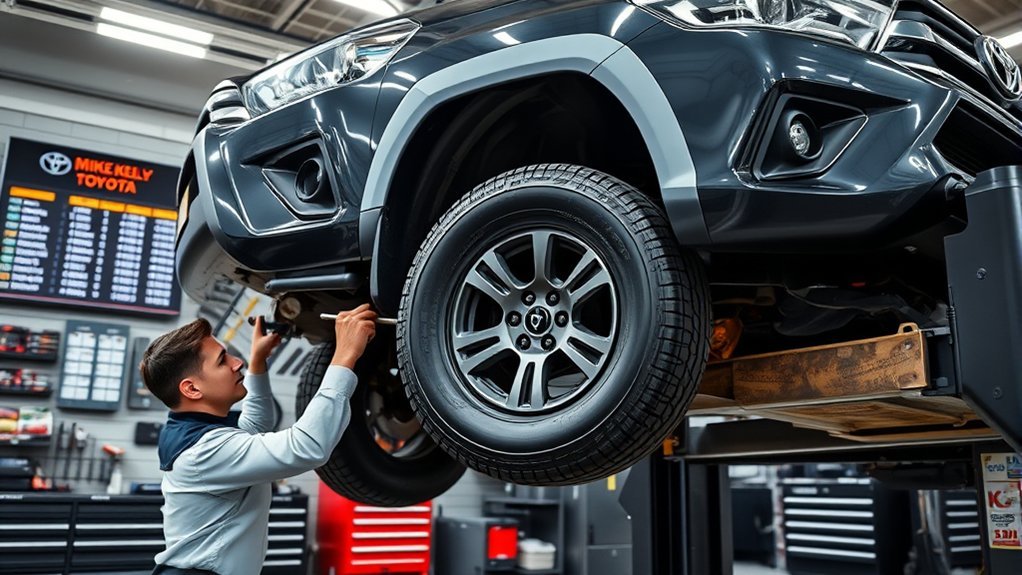
A professional tire rotation should be more than moving wheels around. A good shop or Toyota dealer should confirm the correct pattern, inspect the tires, set pressure, and check for issues that could cause new uneven wear.
During a proper service, expect the technician to:
- Confirm tire type and size. Directional tires, mismatched sizes, and spare-tire setups affect the pattern.
- Inspect tread and sidewalls. This includes cuts, punctures, bulges, cracks, uneven wear, and tread depth.
- Check air pressure cold when possible. Tire pressure should match the placard or manual, not the tire sidewall maximum.
- Rotate using the correct pattern. The pattern should match your Hilux drivetrain and tire setup.
- Torque the lug nuts correctly. The final tightening should use a torque wrench and a star pattern.
- Check balance or alignment if needed. Vibration, cupping, or pulling may need more than rotation.
If the shop finds severe uneven wear, ask for the cause before buying tires. Alignment, worn suspension parts, low pressure, overloading, or damaged wheels can ruin a new set if the root issue remains.
After-Rotation Checklist
After rotating your Hilux tires, take a short drive at low and moderate speeds. Then check for these items:
- No steering-wheel shake
- No pulling left or right
- No clicking, rubbing, or knocking sounds
- No TPMS warning light
- Correct cold tire pressure the next morning
- Lug nuts rechecked after the first short drive if your manual or shop recommends it
If the truck feels worse after rotation, do not ignore it. A tire may be out of balance, damaged, mounted in the wrong direction, or revealing an alignment issue that was hidden by the previous wear pattern.
Frequently Asked Questions
Can I rotate my Toyota Hilux tires myself?
Yes, you can rotate Hilux tires yourself if you have a flat work area, wheel chocks, a suitable jack, rated jack stands, and a torque wrench. Do not use only the emergency jack for a full rotation job. If you are unsure about lift points or torque specs, use a professional service.
What tools do I need for tire rotation?
You need the owner’s manual, wheel chocks, a floor jack, jack stands, a lug wrench or breaker bar, a torque wrench, a tire-pressure gauge, and a tread-depth gauge. Chalk or tape also helps you label tire positions before moving them.
What is the best tire rotation pattern for a Toyota Hilux?
For many same-size, non-directional 4×2 Hilux setups, a rearward cross pattern is common. For many 4×4 setups, an X-pattern or manual-approved cross pattern may be used. Directional tires must stay on the same side and move front to rear only. Always confirm the pattern in your owner’s manual.
Is tire rotation necessary for all vehicles?
Most vehicles benefit from tire rotation, but not every tire setup can be rotated the same way. Directional tires, staggered tire sizes, dual rear wheels, temporary spares, and some specialty fitments need special handling. Check the manual before using a standard pattern.
How does tire rotation affect my warranty?
Some tire mileage warranties require regular rotation records. Keep receipts or a simple log with the mileage, date, tire positions, and service performed. Vehicle warranty rules and tire warranty rules are separate, so check the tire warranty booklet for the exact terms.
Can uneven tire wear be fixed after rotation?
Rotation can slow future uneven wear, but it cannot fully restore tread that is already badly cupped, bald, feathered, or damaged. If uneven wear returns quickly, check tire pressure, alignment, wheel balance, suspension parts, and load habits.
Should I balance the tires every time I rotate them?
Balancing is not always required at every rotation, but it is smart if you feel vibration, see cupping, install new tires, or notice uneven wear. Many shops will check balance during rotation if you report shaking or noise.
Conclusion
Regular tire rotation is a simple way to protect your Toyota Hilux tires, handling, and ride comfort. Use your owner’s manual as the final authority, rotate around the common 5,000 to 8,000 mile range when appropriate, and shorten the interval for towing, hauling, gravel, or off-road use.
The best rotation is not just about moving tires. It includes checking pressure, tread depth, sidewall condition, wheel balance, alignment symptoms, and lug-nut torque. Done correctly, it helps your Hilux stay safer, smoother, and more predictable on the road or trail.
Sources
- NHTSA TireWise Tire Safety — tire pressure, tread depth, rotation, tire maintenance, and blowout safety guidance.
- Michelin Tire Rotation Guide — rotation intervals, drivetrain patterns, directional tire guidance, and uneven wear prevention.
- Bridgestone Tire Rotation Guide — general rotation intervals, severe-use guidance, and rotation patterns.
- Toyota Australia HiLux — current HiLux drivetrain and model-range context.
- Toyota Australia Manuals Portal — owner’s manual source for model-specific service and tire guidance.

Related Articles

Toyota Hilux Run-Flat Tires: What You Need to Know
Take control of your safety with Toyota Hilux run-flat tires; discover their benefits and hidden costs that could change your driving experience forever.
Read More
Effects of Underinflated Tires on the Toyota Hilux
Inadequate tire pressure in your Toyota Hilux can lead to serious safety issues and costly repairs; discover how to avoid these pitfalls.
Read More
The Risks of Overinflating Toyota Hilux Tires
Overinflating your Toyota Hilux tires can lead to dangerous blowouts and uneven wear, but understanding the risks is crucial for your safety.
Read More