
Steering Wheel Shake at High Speed on a Tundra: Tire-Related Causes

A Toyota Tundra steering wheel that shakes at highway speed needs a structured diagnosis, not a parts-replacement guess. Tire and wheel problems are common, but the timing and location of the vibration matter. A shake while cruising points in a different direction than vibration during braking, acceleration, turning, or travel over bumps.
Quick Answer
If your Toyota Tundra’s steering wheel shakes at highway speed, start with the tires and wheels: check cold pressure, damage, debris, wheel condition, and balance. If the shake appears only while braking, inspect the brakes. If it changes with acceleration, turns, or bumps, inspect the driveline, hubs, steering, and suspension.
Key Takeaways
- A repeatable shake at steady highway speed often begins with a tire or wheel problem, but no single speed confirms the cause.
- Vibration only during braking points more strongly toward the brake discs, pads, calipers, hubs, or wheel installation.
- Alignment can correct pulling and abnormal tire wear, but it does not replace proper wheel balancing.
- Use the tire-pressure, wheel-fastener, rotation, and inspection specifications for your exact Tundra year and configuration.
- Do not continue highway driving with a tire bulge, loose wheel, severe wobble, grinding noise, brake pull, or loose steering.
At a Glance
| Time Required | 20–60 minutes for initial checks; professional diagnosis may take longer |
| Difficulty | Basic for visual checks; intermediate or professional for lifted-wheel, brake, hub, suspension, and driveline testing |
| Tools Needed | Accurate tire-pressure gauge, flashlight, tread-depth gauge, and the correct Toyota manual; a torque wrench and lifting equipment may be needed for qualified inspection |
| Cost | Basic visual and pressure checks may cost nothing; balancing, alignment, diagnosis, and repairs vary by location and the failed component |
Warning: Reduce speed and stop in a safe place if the shake becomes severe or you find a tire bulge, exposed cord, loose wheel, grinding noise, strong brake pull, burning smell, clunking steering, or visible steering-part movement. Have the Tundra towed when continued driving could cause loss of control.
Identifying Symptoms of Steering Wheel Shake in Your Tundra

Start by noting exactly when the vibration appears. Record the speed range, whether you are accelerating or coasting, whether the brake pedal is pressed, and whether the steering wheel, seat, or floor shakes most. These details can narrow the diagnosis before any parts are removed.
A steering-wheel vibration usually suggests that the disturbance is reaching the front steering system. A vibration felt mainly through the seat or floor may originate from a rear wheel, rear tire, driveshaft, or another part of the driveline. This is a useful clue, not a final diagnosis.
| When the Shake Happens | More Likely Areas to Check | Helpful Clues |
|---|---|---|
| At a repeatable highway-speed range | Tire balance, tire uniformity, bent wheel, debris, wheel centering | May become stronger, weaker, or disappear as speed changes |
| Only while braking | Brake discs, pads, calipers, hub surfaces, wheel-fastener torque | Brake pedal may pulsate; truck may pull or produce a burning smell |
| During acceleration or under load | Driveshaft, U-joints, CV joints, engine or transmission mounts | May lessen when you release the accelerator |
| During turns | Wheel bearing, hub, tie rod, ball joint, CV joint | Noise or vibration may change when vehicle weight shifts |
| After hitting a pothole or curb | Bent wheel, damaged tire, lost wheel weight, alignment, suspension | Inspect before returning to highway speed |
| Immediately after service | Wheel centering, balance, tire seating, hub cleanliness, fastener torque | Return promptly to the shop that performed the work |
[Products Worth Considering]

EVOULTES heavy duty tire inflator with an integrated gauge delivers accurate pressure readings from 10–120 PSI, helping you inflate, deflate, and check tires in one tool. The 16.5-inch extended dual-head air chuck with swivel base reaches hard-to-access dual wheel valves on trucks and RVs. A brass trigger core and side-mounted air release valve make operation smooth, with standard 1/4" NPT threading and quick-connect compatibility for easy setup.

The JACO FlowPro Tire Inflator measures, inflates, and airs down tires up to 100 PSI with battery-free operation and ±2% accuracy after calibration. It features a glowing pressure dial for night visibility, a heavy-duty steel build with a hybrid hose, and a precision push-to-inflate thumb trigger. The patented Lightning Air Chuck locks on for a secure seal, and the kit includes quick-connect hardware for easy inline use with your air compressor.
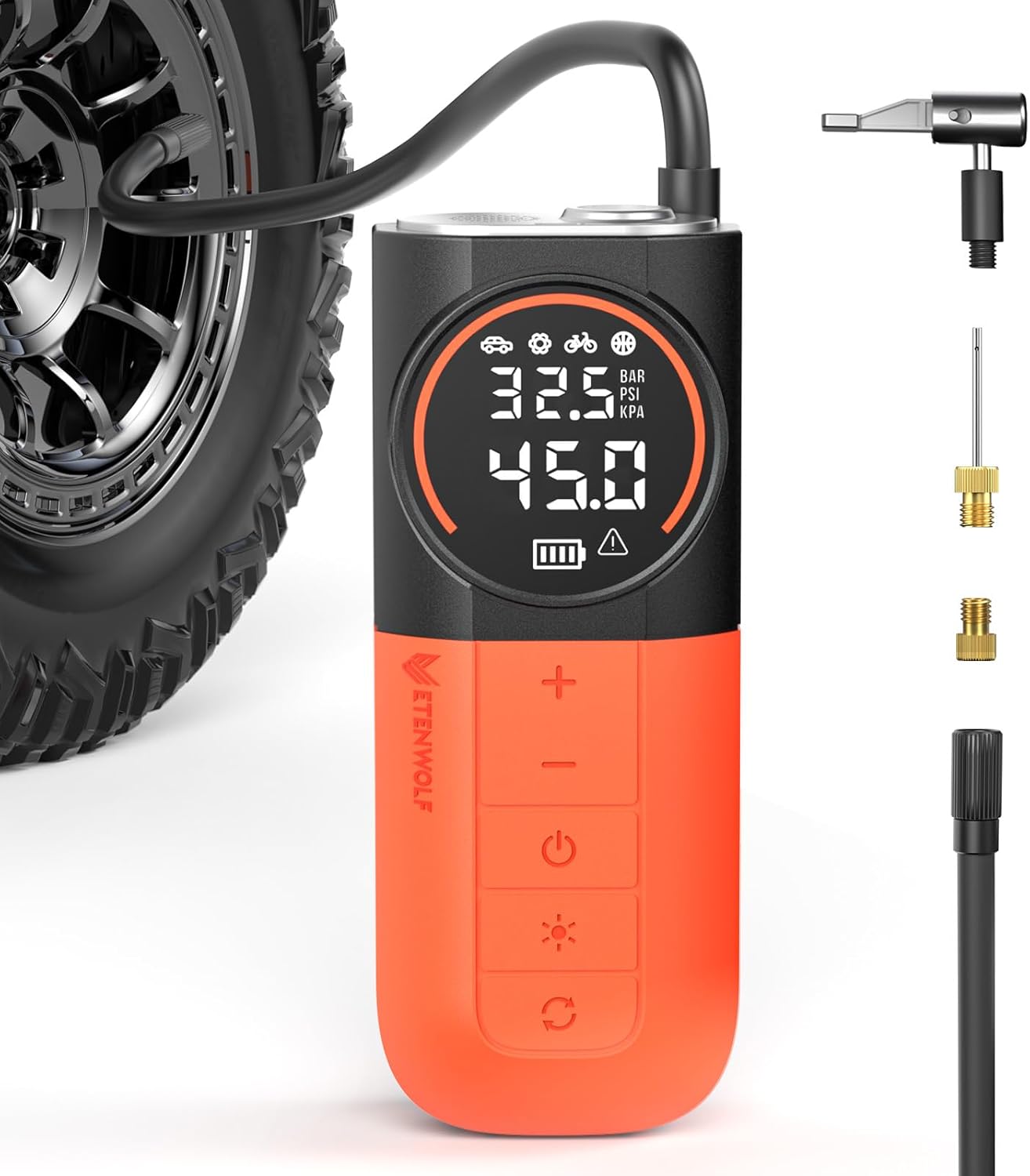
The ETENWOLF S1 cordless tire inflator delivers ultra-fast inflation with up to 160 PSI and a 20 L/min airflow for quicker tire top-offs. Its 5200mAh battery and cooling system support inflating many tires and sports balls on a single charge, while the digital pressure gauge and multi-unit display help you reach the right pressure accurately. With preset modes, pressure memory, an auto-stop feature, and an LED flashlight, it’s built for easy roadside and everyday use.
Common Tire Problems Leading to Steering Wheel Shake
Tires and wheels are the best place to begin when the shake follows vehicle speed and remains present while you hold a steady throttle. The most common possibilities include:
- Incorrect cold tire pressure: Use the pressure on the Tire and Loading Information label or in the manual for your exact Tundra. Do not use the maximum pressure printed on the tire sidewall as the normal target.
- Lost wheel weights or incorrect balance: A small weight change can create a noticeable vibration as wheel speed rises.
- Road-force variation: A wheel and tire can be balanced by weight yet still produce excessive force variation when loaded against the road.
- Irregular tread wear: Cupping, scalloping, feathering, or flat spots can make the tire roll unevenly.
- Internal tire damage: Belt separation, a sidewall bulge, or an internal defect requires immediate professional evaluation.
- Bent or cracked wheels: Potholes and curb impacts can damage steel or alloy wheels without creating an obvious flat tire.
- Debris attached to a wheel: Packed mud, ice, stones, or other material can temporarily unbalance the assembly.
- Incorrect tire or wheel fitment: Oversized tires, aftermarket wheels, wheel spacers, and incorrect hub-centric hardware can introduce vibration.
The National Highway Traffic Safety Administration recommends checking tire pressure when the tires are cold and inspecting for irregular wear, physical damage, noise, and vibration. Replace or professionally inspect a tire with a bulge, exposed material, severe cracking, or suspected separation.
Pro Tip: Write down the speed at which the shake begins, becomes strongest, and fades. A repeatable speed band gives a tire shop more useful information than saying the truck “shakes on the highway.”
How Tire Balance Impacts Steering Stability
Tire balance controls how mass is distributed around the rotating wheel-and-tire assembly. When the distribution is uneven, the assembly can move up and down or side to side as speed increases. That movement may reach the steering wheel as a shake or produce a vibration through the seat and floor.
Balancing and alignment are not the same service. Balancing addresses the rotating assembly. Alignment adjusts wheel angles and is more closely associated with pulling, an off-center steering wheel, and certain tire-wear patterns. A Tundra may need both services, but an alignment alone will not normally correct a genuine wheel imbalance.
Tire Balancing Techniques
A technician may use several checks depending on the symptom:
- Dynamic balancing: Measures imbalance across the inner and outer planes of the wheel.
- Runout inspection: Checks whether the wheel or tire rotates with excessive vertical or lateral movement.
- Road-force measurement: Applies a load roller to the tire to identify tire-uniformity, centering, and force-variation problems that may not appear during ordinary balancing.
- Match mounting: Repositions the tire on the wheel to reduce the combined high points of the tire and wheel.
- Centering verification: Confirms that the wheel is mounted accurately on the balancing machine and the vehicle hub.
If conventional balancing has been repeated without success, ask whether the shop can perform a road-force test. It can help identify a tire-and-wheel assembly that is balanced by weight but still produces vibration under load.
Effects of Imbalance
| Issue | Typical Symptoms | Appropriate Check |
|---|---|---|
| Wheel imbalance | Speed-sensitive steering, seat, or floor vibration | Dynamic balance and centering verification |
| Road-force variation | Persistent vibration despite repeated balancing | Road-force measurement and match mounting |
| Bent wheel or excessive runout | Wobble, vibration, pressure loss, or irregular wear | Wheel and tire runout measurement |
| Poor alignment | Pulling, off-center steering wheel, feathered wear | Steering and suspension inspection followed by alignment |
| Irregular tire wear | Noise, roughness, cupping, or vibration | Inspect balance, alignment, tire condition, shocks, and suspension |
Identifying Worn Suspension Parts That Cause Vibration
If tire and wheel testing does not correct the shake, inspect the parts that hold and guide each wheel. Looseness can allow a wheel to change position, amplify an existing tire vibration, or produce a shimmy after bumps and steering inputs.
Common Suspension Issues
- Ball joints: Worn joints can affect wheel control, steering response, alignment, and tire wear.
- Inner and outer tie rods: Looseness can create steering play, wandering, clunks, or unstable toe alignment.
- Control arms and bushings: Torn or separated bushings can permit unwanted movement during braking, acceleration, and cornering.
- Shocks and mounting hardware: Worn damping components can allow excessive wheel movement and contribute to cupped tire wear.
- Wheel bearings and hubs: Wear may cause humming, grinding, looseness, or vibration that changes during turns.
- Steering rack, linkage, or stabilizer: Wear or damaged mounts can allow steering vibration to become more noticeable.
Do not judge ball-joint or wheel-bearing condition from a universal movement number. Inspection position, suspension loading, joint design, and specifications differ by Tundra year and generation. Use the correct Toyota repair procedure or have a qualified technician perform the test.
Importance of Regular Inspections
| Component | Inspection Focus | Possible Clues |
|---|---|---|
| Ball joints | Movement, binding, damaged boots, loss of lubricant | Clunking, wandering, abnormal tire wear |
| Tie rods | Joint looseness, damaged boots, mounting security | Steering play, toe change, unstable tracking |
| Control-arm bushings | Cracks, separation, fluid leakage where applicable | Movement during braking or acceleration |
| Shocks and mounts | Leaks, damaged bushings, loose mounts, poor damping | Bouncing, cupping, reduced control over bumps |
| Hubs and bearings | Noise, roughness, runout, looseness | Hum or vibration that changes during turns |
| Rims and wheels | Bends, cracks, debris, damaged seats, missing weights | Speed-sensitive vibration or pressure loss |
Signs of Worn Components
Arrange a steering and suspension inspection when the shake is accompanied by any of these symptoms:
- Loose, vague, or delayed steering response
- A clunk when braking, accelerating, turning, or crossing a bump
- Rapidly changing alignment or an off-center steering wheel
- Feathered, cupped, or uneven tire wear
- A humming or grinding sound that changes during turns
- Visible damage to a joint boot, bushing, mount, control arm, or steering component
- Movement at a wheel that exceeds the applicable Toyota service specification
Worn suspension and steering parts can also create tire-wear patterns that remain after the loose component is replaced. A damaged or badly cupped tire may therefore need replacement even after the original suspension problem is repaired.
Common Brake Issues Leading to Steering Wheel Shake

If the Tundra drives smoothly until you press the brake pedal, focus on the brake and hub assemblies rather than assuming the tires are unbalanced. Brake-related steering shake can result from disc irregularity, excessive runout, heat damage, uneven pad deposits, a sticking caliper, hub contamination, or incorrect wheel installation.
| Brake Issue | Possible Symptoms | Inspection Needed |
|---|---|---|
| Disc or hub runout | Steering shake or pedal pulsation while braking | Clean hub surfaces and measure runout with proper equipment |
| Uneven pad transfer or disc thickness | Rhythmic vibration that follows wheel speed | Inspect pads and discs and measure against service limits |
| Sticking caliper | Pulling, excess heat, burning smell, reduced fuel economy | Check caliper movement, hoses, pads, and temperature difference |
| Incorrect wheel-fastener torque | Vibration after wheel or brake service | Verify hub seating and the exact Toyota torque procedure |
| Brake overheating | Vibration, fading, smell, discoloration, or noise | Inspect discs, pads, calipers, and brake-fluid condition |
Brembo’s wheel-tightening guidance explains that incorrect or uneven fastener torque can affect wheel, hub, and brake-disc operation. Always use the Toyota specification for your exact year and wheel configuration instead of copying a torque value from another Tundra generation.
Note: Moisture absorbed by brake fluid can reduce its boiling resistance, but “moisture buildup” should not be used as a general explanation for a warped brake disc. Brake vibration requires inspection of the full disc, pad, caliper, hub, and wheel-installation system.
Other Causes of Tundra Vibration
[Products Worth Considering]

This portable cordless tire inflator delivers up to 160 PSI with fast 17 L/min airflow to help you quickly top up tires and get back on the road. It features dual power mode, running on a 21V rechargeable battery or a 12V DC adapter for convenient roadside use. An automatic shut-off with digital pressure gauge helps prevent overinflation, and a built-in LED light improves visibility in low-light conditions.

This portable cordless tire inflator delivers fast, efficient inflation for cars, motorcycles, bikes, and sports balls with a digital pressure gauge. Use the one-click PSI preset with auto shut-off for accurate, hands-free topping to your target pressure up to 150 PSI. It’s compact and rechargeable with a built-in emergency LED light plus valve adapters and accessories for quick, ready-to-go use.
Wheel Bearings and Hubs
A worn bearing or damaged hub can cause roughness, looseness, or a humming sound that changes as you steer. A hub with excessive runout can also affect the brake disc and wheel. Bearing diagnosis normally requires the truck to be lifted safely and may require runout measurement.
Driveshaft and Driveline Problems
Investigate the driveline when vibration becomes stronger under acceleration, towing load, or a particular throttle position. Possible areas include the driveshaft, U-joints, slip joints, CV joints where equipped, mounts, and driveline angles.
Lift kits, altered ride height, worn carrier components, impact damage, or incorrect driveshaft installation can change driveline geometry. A driveline vibration may be felt more strongly through the floor or seat than through the steering wheel.
Aftermarket Wheels, Tires, Lifts, and Spacers
Large or heavy tires place greater demands on balancing accuracy and steering components. Check that aftermarket wheels use the correct offset, center bore, lug-seat style, load rating, and centering hardware. Inspect wheel spacers for correct fit, damage, fastener security, and manufacturer-approved installation.
If the shake began after a lift, leveling kit, wheel spacer, or tire-size change, tell the technician exactly what changed. Alignment, caster, driveline angle, tire uniformity, and component clearance may all need review.
Steps to Fix Steering Wheel Shake in Your Tundra
- Record the symptom pattern. Note the speed, road surface, throttle position, braking input, steering input, and where you feel the vibration.
- Check cold tire pressure. Inflate each tire to the value on the Tundra’s door label or in its year-specific manual. Inspect the spare when applicable.
- Inspect every tire. Look for bulges, exposed cords, cuts, cracks, flat spots, embedded objects, cupping, separation, and uneven tread depth.
- Inspect the wheels. Remove packed debris and look for bends, cracks, damaged lug seats, missing weights, and poor hub centering.
- Review recent work. If the problem began after tire, wheel, brake, or suspension service, have the installation, balance, hub surfaces, and wheel-fastener torque rechecked.
- Balance and measure the assemblies. Start with accurate dynamic balancing. Use road-force measurement and runout testing if the vibration persists.
- Check alignment and tire wear. Inspect steering and suspension before aligning the truck. Do not use alignment as a substitute for balancing.
- Inspect the brakes when the shake occurs during braking. Check the discs, pads, calipers, hubs, and wheel installation with the proper measuring equipment.
- Inspect hubs, bearings, steering, and suspension. Use the correct Toyota service procedure for the truck’s year and configuration.
- Investigate the driveline when vibration follows acceleration or load. Inspect driveshafts, joints, mounts, and driveline angles, especially on modified trucks.
Rotate tires only when the tire design, wheel sizes, and Toyota rotation pattern allow it. Directional tires, different front and rear fitments, or modified wheel packages may require a different procedure. A shop can temporarily change wheel positions as a diagnostic test when it is safe and compatible.
Warning: Never work beneath a Tundra supported only by a jack. Steering, suspension, brake, hub, and driveline inspections require correctly rated lifting equipment, secure support points, and the applicable service procedure.
Check Toyota Information and Recalls
Tire pressure, rotation patterns, wheel-fastener procedures, suspension inspection methods, and service limits can differ across Tundra generations, trims, tire packages, and modifications. Consult the Toyota Tundra manual portal and select the correct model year.
You can also enter the truck’s VIN in the NHTSA recall lookup. A recall search does not replace diagnosis, but it can identify an open safety campaign that should be completed by a Toyota dealer.
Frequently Asked Questions
What can cause a shaky steering wheel at high speeds?
Common causes include incorrect tire pressure, wheel imbalance, road-force variation, irregular tire wear, a bent wheel, poor wheel centering, hub or bearing wear, and loose steering or suspension parts. If the shake appears only during braking or acceleration, inspect the brake system or driveline as well.
Why does my Tundra shake after getting new tires?
Possible causes include inaccurate balancing, poor centering on the balancer or hub, excessive road-force variation, a defective tire, incorrect pressure, a bent wheel, debris between mounting surfaces, or incorrect wheel-fastener torque. Return to the installer and describe the exact speed and conditions.
Will a wheel alignment fix steering wheel vibration?
Alignment may help when the truck pulls, the steering wheel is off-center, or the tires have alignment-related wear. It does not normally correct an unbalanced wheel, a damaged tire, excessive road-force variation, a bent rim, or a brake-related shake.
Why does the steering wheel shake only when I brake?
Brake-only vibration can come from disc or hub runout, uneven friction material, heat damage, a sticking caliper, worn pads, hub contamination, or incorrect wheel installation. The discs, pads, calipers, hubs, bearings, and fastener procedure should be inspected together.
Can oversized tires or a lift kit cause Tundra vibration?
Yes. Heavy or oversized tires can require more precise balancing, while lifts may change alignment and driveline angles. Incorrect wheel offset, center bore, spacers, lug-seat design, or tire clearance can also contribute. The complete modified setup should be inspected rather than balancing the tires repeatedly.
Is it safe to drive a Tundra with steering wheel shake?
A mild vibration still deserves prompt inspection because tire, wheel, brake, hub, or steering faults can worsen. Stop driving and arrange towing if the shake is severe or accompanied by a tire bulge, loose wheel, grinding, brake pull, burning smell, clunking, or visibly loose steering or suspension parts.
Conclusion
Start a Tundra highway-vibration diagnosis with the simplest safety checks: cold tire pressure, tire damage, wheel condition, debris, and recent service. Next, verify balance, road force, runout, wheel centering, and the correct wheel-fastener procedure. Use the symptom pattern to decide whether the brakes, hubs, steering, suspension, or driveline need further testing.
A precise diagnosis prevents repeated balancing, unnecessary alignments, and random parts replacement. When the vibration is severe, appears during braking, follows acceleration, or comes with looseness or noise, have a qualified technician inspect the truck before returning to highway speed.
Sources
- Toyota Tundra Manuals and Warranties — year-specific owner information and access to Toyota manuals.
- NHTSA TireWise — tire pressure, damage, tread, rotation, balancing, and alignment guidance.
- Hunter Road Force Wheel Balancing — diagnostic load testing, centering, balancing, and tire-uniformity information.
- Brembo Wheel Tightening Guidance — wheel-fastener torque, hub contact, and vibration considerations.
- Brembo Brake Disc Overheating Guidance — brake heat, caliper drag, vibration, and disc damage.
- Monroe Uneven Tire Wear Guidance — cupping, wheel damage, imbalance, road-force variation, and worn suspension components.

Related Articles
Toyota Tundra Tire and Wheel Package: What to Consider Before Buying
Unlock the secrets to choosing the perfect tire and wheel package for your Toyota Tundra—essential tips await to enhance your ride.
Read More
Do Bigger Tires Void a Toyota Tundra Warranty? Magnuson-Moss Act Explained
Bigger tires might not void your Toyota Tundra warranty, but understanding the Magnuson-Moss Act is crucial—discover how to protect your investment effectively.
Read More
Toyota Tundra Tire Rack Setup: Garage Storage Ideas for Seasonal Sets
Better tire storage for your Toyota Tundra awaits—discover essential tips to maximize space and protect your seasonal sets in the garage!
Read More