
How to Rotate Tires on a Toyota Tundra: Patterns, Intervals, and DIY Steps
Last updated: July 7, 2026
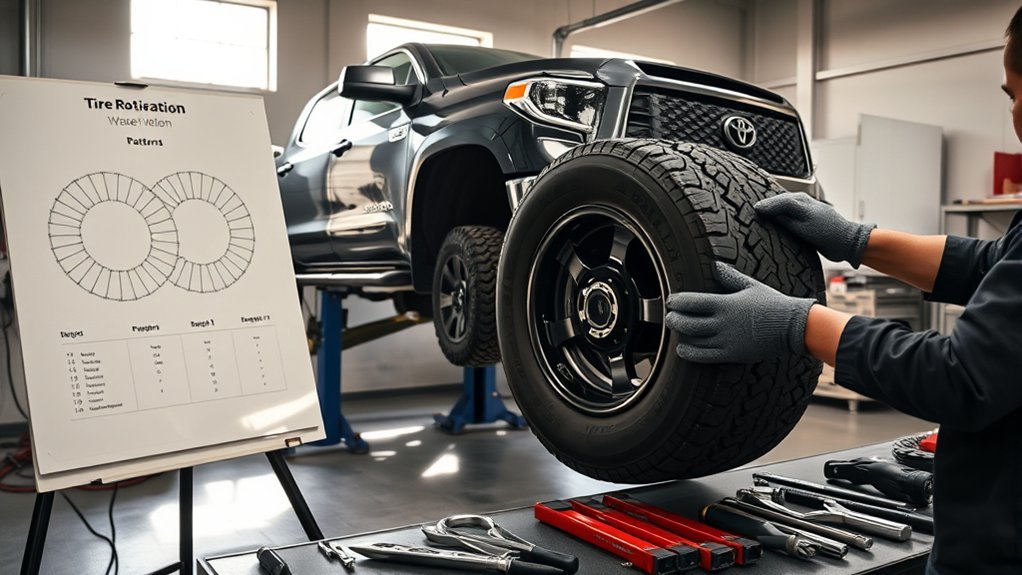
To rotate Toyota Tundra tires, first confirm the tire type and wheel setup. Many same-size, non-directional Tundras use a rearward-cross pattern: rear tires move straight forward, and front tires cross to the opposite rear positions. Directional tires stay on the same side, and mismatched front/rear sizes need tire-maker guidance. Rotate at Toyota’s 5,000-mile or six-month maintenance interval, use rated jack stands, and torque the wheel nuts only to your exact owner’s manual or wheel-maker specification.
Quick Answer
For many Toyota Tundras with same-size, non-directional tires, use rearward cross: move the rear tires straight to the front, then cross the front tires to the opposite rear positions. Use the tire maker’s pattern if it differs, rotate every 5,000 miles or six months, and never work under a truck supported only by a jack.
Key Takeaways
- A common pattern for many same-size, non-directional Tundra tires is rearward cross: rear tires go straight forward, front tires cross to the rear.
- Toyota’s current maintenance guidance calls for scheduled maintenance every 5,000 miles or six months, whichever comes first.
- Do not use the old “about 85 ft-lbs” rule. Lug-nut torque varies by model year, wheel material, lug nut type, and aftermarket wheel instructions.
- Use wheel chocks, rated jack stands, the correct lift points, and a star pattern when tightening lug nuts.
- Check tread depth, tire pressure, sidewall damage, and uneven wear while the wheels are off.
What’s in This Guide
At a Glance
| Time Required | 30–60 minutes for a careful DIY rotation |
| Difficulty | Moderate because the Tundra is heavy and must be lifted safely |
| Tools Needed | Owner’s manual, wheel chocks, correct lug socket, breaker bar or lug wrench, rated floor jack, rated jack stands, torque wrench, tire-pressure gauge, tread-depth gauge |
| Cost | $0 if you already own the tools; usually low-cost at a tire shop if you prefer not to lift the truck |
DIY reality check: A Tundra wheel-and-tire assembly is heavy, and oversized tires, steel wheels, wheel spacers, or a loaded truck can raise the risk. If your jack, jack stands, socket, or torque wrench is not rated for the job, use a tire shop or Toyota dealer instead.
Why Tire Rotation Matters for Your Tundra

Tire rotation helps spread wear across all four tires instead of letting one axle do most of the work. On a truck like the Toyota Tundra, towing, payload, off-road driving, braking, and steering loads can all change how quickly each tire wears. Regular rotation can help reduce irregular wear, support steady traction, and help tires last longer.
The National Highway Traffic Safety Administration notes that poor tire maintenance, including failing to rotate tires, can contribute to flats, blowouts, or tread separation. It also recommends checking tire tread and pressure regularly, not only when the truck feels different on the road.
NHTSA reported 511 motor vehicle traffic fatalities in tire-related crashes in 2024, which is a strong reminder that tire maintenance is a safety task, not just a tire-life task.
Which Toyota Tundra Tire Rotation Pattern Should You Use?
Start with Toyota’s current Tundra Warranty & Maintenance Guide, which recommends scheduled maintenance every 5,000 miles or six months, whichever comes first, and lists tire rotation throughout the 5,000-mile maintenance chart. If you drive off-road, tow often, carry heavy loads, or see uneven wear, inspect the tires sooner.
Note: Rotation pattern depends on tire size, tread direction, wheel type, and drivetrain. Before moving a tire, check for directional arrows on the sidewall and confirm whether all four tires are the same size.
| Tundra tire setup | Recommended pattern |
| Same-size, non-directional tires | Rearward cross: rear tires move straight to the front; front tires cross to the opposite rear positions. For 4WD/AWD guidance that calls for double-X, follow your tire maker or Toyota manual. |
| Directional tires | Front-to-rear on the same side only, unless the tire is dismounted and remounted correctly. |
| Different front and rear tire sizes | Do not use a front-to-rear pattern. Use the tire maker’s guidance, often side-to-side only if the tires are non-directional. |
| Matching full-size spare | Include it only if it matches the road tires and wheels and your owner’s manual or tire maker allows a five-tire rotation. |
The Tire Industry Association describes rear-wheel-drive rotation as the opposite of the front-wheel-drive pattern: rear tires go straight forward while front tires cross to the rear. It also lists a double-X pattern for 4WD/AWD vehicles, so treat the tire maker’s pattern and Toyota’s model-year guidance as the tiebreaker.
Essential Tools for DIY Tire Rotation
Gather the tools before you lift the truck. A Tundra is too heavy for shortcuts, so every tool must match the truck’s weight, wheel type, and lug nut setup.
- Owner’s manual or Toyota manual lookup: Use Toyota’s Manuals and Warranties page to confirm your exact year, wheel type, lift points, and torque spec.
- Lug nut wrench, breaker bar, or tire iron: Use the correct socket size for your lug nuts. Many newer Tundras use a 22 mm socket, but verify yours before starting.
- Rated floor jack and jack stands: A 3-ton jack is common for truck work, but the jack and stands must be rated for the load and used only at approved lift/support points.
- Wheel chocks: Chock the wheels that remain on the ground before lifting.
- Torque wrench: Final-tighten the lug nuts only with a calibrated torque wrench.
- Tire-pressure gauge and tread-depth gauge: Check all tires after rotation and before driving.
Warning: Never crawl under a Toyota Tundra supported only by a jack. Use rated jack stands on stable, level ground, and follow the lift points in your owner’s manual.
Air tools can speed up lug nut removal, but do not use an impact wrench as your final tightening method. Hand-start every lug nut first, snug them in stages, and finish with a torque wrench.
[Products Worth Considering]

Secure your parked vehicle quickly with AFA Tooling 4T rubber wheel chocks in a 4-pack for two dual-wheel sets. The ribbed design and textured base grip fast without pounding, so you can chock tires on trailers, RVs, ATVs, and work vehicles with confidence. EZ rustproof handles with rope ties keep the pair together for easy placement and removal, while nylon-reinforced rubber stands up to dirt, ice, salt, and harsh weather.

Universal magnetic jack pad with aluminum grooved design to protect vehicle pinch welds during lifting. Durable nylon pad inserts are upgraded and secured with screws to resist damage and keep in place. Designed to fit most single vehicle pinpoint welds for safer, stable jacking when changing tires, repairs, or performing oil changes.

Camco Trailer Aid Plus tandem tire ramp lifts your trailer for quick, safe tire changes with ample clearance from its 5 1/2-inch lift. It helps you change a flat tire without unloading cargo, making roadside and routine maintenance more efficient. The heavy-duty, waterproof and rustproof polymer design supports up to 15,000 lb and is built for easy portability and storage.
Before You Start: Safety and Compatibility Checks
Before lifting the truck, park on a flat, solid surface, shift into Park, set the parking brake, and place wheel chocks at the tires that will stay on the ground. Then check these items:
- Tire direction: Look for arrows or “rotation” markings. Directional tires must keep rolling in the same direction.
- Tire size: Confirm all four tires are the same size if you plan to rotate front-to-rear.
- Wheel type: Aluminum and steel wheels can have different torque values on newer Tundras.
- Spare tire: Only include the spare if it is a matching full-size spare and the manual/tire maker allows it.
- Tread condition: If one tire is badly worn, cupped, bulged, cracked, or punctured, fix that problem before rotating.
- Aftermarket wheels or spacers: Use the wheel maker’s lug nut type and torque guidance before moving the truck.
Pro Tip: Mark the current tire positions with chalk or masking tape before removal: LF, RF, LR, and RR. That makes the rotation pattern easier to follow.
[Products Worth Considering]

This VEVOR tire bead breaker uses a slide-hammer impact and wedge tip to separate tire beads from rims quickly and efficiently without damaging hub surfaces. The long handle and sturdy steel construction help reduce user strain while providing reliable, portable tire changing for cars, trucks, and more. Ideal for home mechanics and repair shops handling multiple vehicle tire sizes.

EVOULTES heavy duty tire inflator with an integrated gauge delivers accurate pressure readings from 10–120 PSI, helping you inflate, deflate, and check tires in one tool. The 16.5-inch extended dual-head air chuck with swivel base reaches hard-to-access dual wheel valves on trucks and RVs. A brass trigger core and side-mounted air release valve make operation smooth, with standard 1/4" NPT threading and quick-connect compatibility for easy setup.
How to Rotate Your Tundra’s Tires Step-by-Step
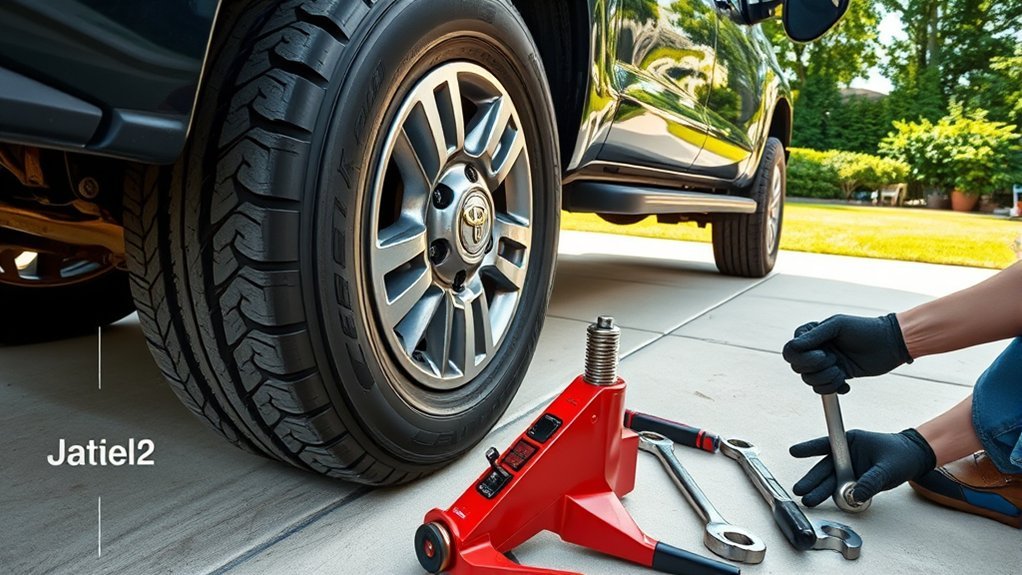
- Confirm the pattern. For many same-size, non-directional Toyota Tundra setups, use rearward cross: left rear to left front, right rear to right front, left front to right rear, and right front to left rear. If your tire maker or Toyota guide calls for a different pattern, use that pattern instead.
- Loosen the lug nuts slightly. While the tires are still on the ground, break each lug nut loose about a quarter turn. Do not remove them yet.
- Lift the truck safely. Use the correct lift point from your owner’s manual. Raise only as much as needed, then place rated jack stands at approved support points.
- Remove the wheels. Finish removing the lug nuts and place them where dirt cannot get into the threads.
- Inspect each tire and wheel. Look for nails, cracks, bulges, exposed cords, sidewall damage, bent wheels, abnormal tread wear, or uneven wear from poor alignment.
- Move the tires to their new positions. Follow the pattern you confirmed before starting. Keep directional tires on the same side of the truck.
- Hand-start the lug nuts. Thread every lug nut by hand to avoid cross-threading. If a lug nut will not spin on smoothly by hand, stop and inspect the threads.
- Snug in a star pattern. With the wheel still slightly off the ground or just touching, snug the lug nuts in a crisscross pattern so the wheel seats evenly.
- Lower the Tundra. Lower the truck until the tire is firmly on the ground, then remove the jack and stands carefully.
- Torque to the correct spec. Use your exact Toyota owner’s manual or wheel-maker specification. Do not rely on a generic online torque chart, because older trucks, newer trucks, aluminum wheels, steel spare applications, and aftermarket wheels can differ.
- Check pressure and TPMS. Set cold tire pressure to the driver-door tire placard, not the number molded on the tire sidewall. Drive a short distance and confirm the TPMS light stays off.
Note: Toyota’s owner guidance can list different wheel-nut torque values by wheel material or spare-tire setup. Always match the spec to your exact model year, wheel material, and lug nut type before tightening.
What to Inspect During a Tire Rotation
A tire rotation is the perfect time to catch small problems before they become expensive. Check each tire and wheel for:
- Tread depth: Replace tires when tread is down to 2/32 inch. For wet, snowy, towing, or off-road use, plan replacement earlier if traction is getting weak.
- Uneven wear: Feathering, cupping, one-shoulder wear, or center wear can point to alignment, balance, inflation, or suspension issues.
- Sidewall damage: Replace a tire with bulges, deep cuts, exposed cords, or severe cracking.
- Embedded objects: Nails or screws should be inspected by a tire professional before they cause a slow leak.
- Wheel and hub condition: Clean heavy dirt or corrosion from the mounting face so the wheel seats flat.
- Brake and suspension clues: Look for fluid leaks, damaged boots, loose components, or abnormal brake wear.
Safety Tips for Tire Rotation and Maintenance
Tire rotation is safe only when the truck is stable before any wheel comes off. Follow these safety rules every time:
- Use a solid, level surface. Avoid gravel, sloped driveways, soft asphalt, and roadside shoulders unless it is an emergency.
- Chock the wheels before lifting the truck.
- Use the correct Toyota lift points and support points. Do not guess under suspension, skid plates, or body panels.
- Never rely only on a hydraulic jack. Use rated jack stands before removing wheels.
- Do not put oil, grease, or anti-seize on wheel studs unless Toyota or the wheel maker specifically instructs it. Lubricated threads can change clamping force and lead to over-tightening.
- Retorque after a short break-in drive if your manual, wheel maker, or tire shop recommends it, especially after wheel removal or spare installation.
Before starting tire maintenance, check for any fluid leaks or damage around the tires, brakes, and suspension components. Keeping your work area clear of obstacles helps you stay focused and reduces the chance of a mistake.
When to Get Alignment or Balancing Instead
Tire rotation does not fix alignment or balance problems. It only changes tire positions to help even out normal wear. Schedule a professional inspection if you notice:
- The Tundra pulls left or right on a straight, level road.
- The steering wheel is off-center.
- The truck shakes at highway speed after rotation.
- One edge of a tire wears faster than the rest.
- Tread looks cupped, scalloped, or feathered.
- The same tire wear pattern returns quickly after rotation.
Troubleshooting After Rotation
If something feels wrong after rotating your Tundra’s tires, do not ignore it. Use these quick checks:
- Vibration: Recheck lug nut torque, inspect wheel seating, and have the tires balanced if vibration continues.
- Pulling: Check tire pressure first. If pressure is correct, schedule an alignment or tire inspection.
- TPMS light: Confirm all tires, including the spare if equipped with a sensor, are set to the placard pressure. Some systems need a short drive to update.
- Clicking or scraping: Stop driving and inspect for loose lug nuts, a bent dust shield, or debris near the brakes.
- Uneven wear keeps returning: Rotation will not solve worn shocks, bad alignment, loose steering parts, or incorrect inflation.
Frequently Asked Questions
Can I rotate tires if they show uneven wear?
Yes, but inspect the cause first. Mild uneven wear may improve with rotation, correct pressure, and regular maintenance. Severe shoulder wear, cupping, feathering, or one tire wearing much faster than the others usually means you need an alignment, balance, suspension inspection, or tire replacement.
How do I know when to replace my tires?
Replace tires when tread reaches 2/32 inch, when the treadwear bars are flush with the tread, or when you see unsafe damage such as bulges, exposed cords, deep cracks, or sidewall cuts. For towing, rain, snow, or off-road driving, do not wait until the legal minimum if traction is already poor.
What happens if I skip tire rotation?
Skipping tire rotation can cause faster uneven wear, shorter tire life, more road noise, reduced wet traction, and a higher chance of vibration. On 4WD trucks, keeping tire wear even is especially important because mismatched tire diameters can add stress to drivetrain components.
Do I need an alignment after rotating tires?
Not every time. You need an alignment check if the truck pulls, the steering wheel is off-center, tread wear is uneven, or the tires feather or cup. Tire rotation moves tires to new positions; alignment adjusts wheel angles and is a separate service.
Can I rotate tires without a jack?
No. You must lift the vehicle to remove and move the wheels. For a Tundra, use a properly rated jack, rated jack stands, wheel chocks, and the correct Toyota lift points. If you do not have the right equipment, have a tire shop or Toyota dealer perform the rotation.
Should I include the spare tire in my Tundra rotation?
Only include the spare if it is a matching full-size tire and wheel, has compatible tread depth, is not directional in the wrong direction, and your owner’s manual or tire maker allows it. Do not include a temporary, mismatched, badly aged, or different wheel-type spare in a normal four-tire rotation.
What torque should I use on Toyota Tundra lug nuts?
Use the wheel-nut torque listed for your exact model year, wheel material, lug nut type, and wheel setup. Do not assume an older 85 ft-lbs rule is correct, and do not use a generic torque chart for aftermarket wheels.
Should a 4WD Tundra use rearward cross or double-X?
Use Toyota’s model-year guidance and the tire maker’s rotation pattern first. Rearward cross is common for rear-wheel-drive trucks with same-size, non-directional tires, while some tire-industry guidance lists double-X for 4WD/AWD vehicles. Do not cross directional tires unless they are dismounted and remounted correctly.
Do I need to balance tires every time I rotate them?
No, not every time. Balance the tires if you feel vibration after rotation, see cupping or patchy wear, lose a wheel weight, or install new tires. Rotation changes tire positions; balancing corrects uneven weight around the wheel-and-tire assembly.
Do I need to reset TPMS after rotating Tundra tires?
Usually, set all cold tire pressures to the driver-door placard first, then drive a short distance and watch the TPMS light. If the light stays on, follow the reset or sensor registration steps in your exact owner’s manual because TPMS procedures vary by model year.
Conclusion
Rotating your Toyota Tundra’s tires can be a good DIY job when you have the right equipment and follow the correct pattern. Confirm the tire setup first, rotate at Toyota’s 5,000-mile or six-month maintenance interval, inspect every tire while it is off, and torque the lug nuts to the manual-specified value. If you see severe uneven wear, vibration, pulling, damage, or any lift-point uncertainty, stop and have the truck inspected before the next long drive.
Sources
- Toyota 2026 Tundra Warranty & Maintenance Guide — scheduled maintenance interval and tire-rotation maintenance chart.
- Toyota Manuals and Warranties — owner manual lookup for exact model-year torque, lift-point, TPMS, and spare-tire guidance.
- NHTSA TireWise — tire tread, rotation, pressure, balance, alignment, and tire-safety guidance.
- Tire Industry Association Tire Rotation — rotation pattern guidance by drivetrain and tire type.

Related Articles
Toyota Tundra Tire and Wheel Package: What to Consider Before Buying
Unlock the secrets to choosing the perfect tire and wheel package for your Toyota Tundra—essential tips await to enhance your ride.
Read More
Do Bigger Tires Void a Toyota Tundra Warranty? Magnuson-Moss Act Explained
Bigger tires might not void your Toyota Tundra warranty, but understanding the Magnuson-Moss Act is crucial—discover how to protect your investment effectively.
Read More
Toyota Tundra Tire Rack Setup: Garage Storage Ideas for Seasonal Sets
Better tire storage for your Toyota Tundra awaits—discover essential tips to maximize space and protect your seasonal sets in the garage!
Read More