
Recommended Tire Pressure for Every 4Runner Model Year
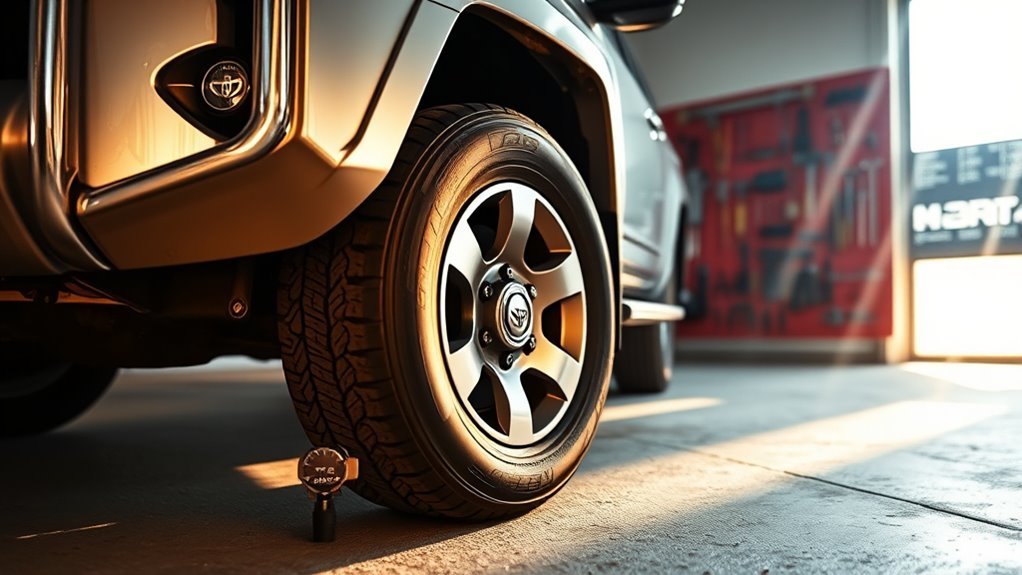
The right Toyota 4Runner tire pressure is the cold PSI printed on your Tire and Loading Information label, usually on the driver-side door jamb. Do not use the maximum PSI molded into the tire sidewall as your everyday setting. For many stock U.S. 2010–2024 4Runners, the common placard baseline is 32 PSI front and rear. For many stock 2025–2026 4Runners, the common baseline is 33 PSI front and rear. Older models, replacement tires, LT tires, and upsized off-road tires can require different pressures, so always verify your own label first.
Quick Answer
Set your Toyota 4Runner tires to the cold PSI on the driver-door placard. As a practical baseline, many stock 2010–2024 4Runners use 32 PSI front/rear, while many stock 2025–2026 4Runners use 33 PSI front/rear. Check pressure cold, at least monthly, and before trips, towing, or trail driving.
Key Takeaways
- Your 4Runner’s door-jamb placard beats any online chart, forum post, or sidewall number.
- Check PSI cold: before driving, after three hours parked, or after driving less than about 1 mile.
- Do not overinflate for fuel economy; proper inflation is safer and more effective long term.
- Airing down helps off-road traction, but you must reinflate before highway driving.
- TPMS is a warning system, not a replacement for a quality tire-pressure gauge.
At a Glance
| Time Required | 5–10 minutes for a basic pressure check |
| Difficulty | Easy |
| Tools Needed | Tire-pressure gauge, air compressor or air pump, valve caps |
| Cost | Usually free to a few dollars for air; $10–$30 for a basic gauge |
Use Your 4Runner Door Placard as the Final PSI Source
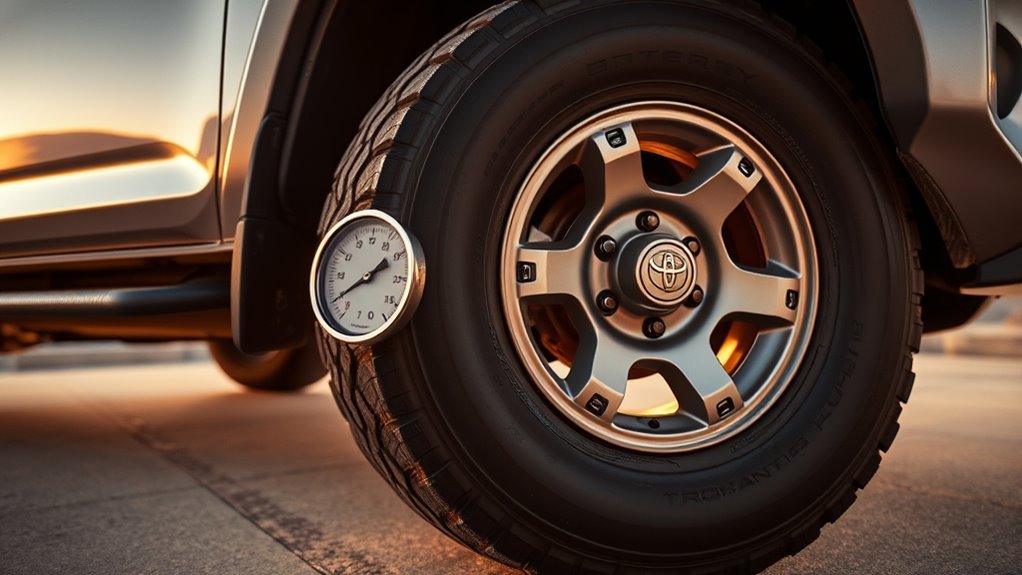
Your 4Runner’s recommended pressure is engineered around the vehicle’s weight, original tire size, load rating, suspension, and handling targets. That is why Toyota tells owners to use the driver-door sticker or owner’s manual, not the number printed on the tire sidewall.
The sidewall number is the tire’s maximum cold inflation pressure for that tire casing. It is not the normal daily-driving PSI for your 4Runner. Running near the sidewall maximum can reduce ride comfort, shrink the contact patch, increase center tread wear, and hurt braking grip.
| 4Runner model years | Common stock cold PSI baseline | What to verify |
|---|---|---|
| 2025–2026, 6th gen | Often 33 PSI front / 33 PSI rear | Door label, trim, tire size, and whether the vehicle is gas or i-FORCE MAX |
| 2010–2024, 5th gen | Often 32 PSI front / 32 PSI rear | Door label, P265/70R17 or P245/60R20 tire size, trim, and load |
| 1990–2009 | Varies by year, tire size, and load label | Original manual, door placard, glove-box label, or Toyota technical information |
| Aftermarket LT, E-load, or upsized tires | Not always the stock placard PSI | Tire load-inflation table, tire shop guidance, actual axle load, and chalk test results |
Warning: Do not assume 33 PSI is correct for every 4Runner. A 2024 4Runner, a 2026 4Runner, and a 2002 4Runner can have different placard pressures. The door label is the final on-road reference for stock tires.
[Products Worth Considering]

EVOULTES heavy duty tire inflator with an integrated gauge delivers accurate pressure readings from 10–120 PSI, helping you inflate, deflate, and check tires in one tool. The 16.5-inch extended dual-head air chuck with swivel base reaches hard-to-access dual wheel valves on trucks and RVs. A brass trigger core and side-mounted air release valve make operation smooth, with standard 1/4" NPT threading and quick-connect compatibility for easy setup.

The AstroAI 2 pack air chucks provide a heavy-duty, closed-flow locking design that helps keep air flowing during inflation while securely attaching to the valve stem. Built with 250 PSI rated brass components and compatible with Schrader valves, they feature 1/4" female NPT threads for a wide fit with common inflators. The straight tip and locking clip make filling tires and monitoring pressure more convenient.

This portable cordless tire inflator delivers up to 160 PSI with fast 17 L/min airflow to help you quickly top up tires and get back on the road. It features dual power mode, running on a 21V rechargeable battery or a 12V DC adapter for convenient roadside use. An automatic shut-off with digital pressure gauge helps prevent overinflation, and a built-in LED light improves visibility in low-light conditions.
Cold vs. Hot: The Right Way to Check Your Tire Pressure
Check your 4Runner tire pressure when the tires are cold. Cold means the vehicle has been parked for at least three hours or has been driven only a short distance. This matters because driving heats the tire, and warm air inside the tire reads higher on the gauge.
- Park on level ground and let the tires cool.
- Find the correct cold PSI on the driver-door placard.
- Remove the valve cap and press a quality gauge squarely onto the valve stem.
- Add or release air until the gauge matches the placard PSI.
- Check all four tires and the spare.
- Reinstall valve caps to keep dirt and moisture out of the valve.
NHTSA recommends checking all tires, including the spare, and using the manufacturer’s cold inflation pressure from the vehicle placard or manual. If a tire repeatedly needs air, inspect it for a nail, bead leak, valve-stem leak, cracked wheel, or TPMS sensor issue.
Pro Tip: Keep a digital or dial gauge in the glove box. Gas-station gauges get dropped, left outside, and abused, so they are not always accurate.
When Your 4Runner Might Need a Different Pressure
The placard pressure is the normal on-road setting for stock tires and normal loads. You may need a different pressure only when the setup or use case changes.
- Heavy cargo or towing: Do not jump straight to 40–45 PSI. First check the owner’s manual, payload rating, trailer tongue weight, and tire load rating. Never exceed the tire or vehicle limits.
- LT or E-load tires: These often need a different PSI than the factory P-metric tire to carry the same load. Use tire load-inflation tables or ask a qualified tire shop.
- Upsized off-road tires: Larger tires may ride better at a lower PSI than the door label, but the pressure still must safely support the vehicle on pavement.
- Uneven tread wear: Center wear usually points to too much pressure; shoulder wear can mean too little pressure, poor alignment, hard cornering, or worn suspension parts.
- Off-road driving: Airing down can improve traction and ride comfort, but it is a low-speed trail setting, not a highway setting.
Note: If you changed tire size, load range, or wheel size, the original door placard may no longer be enough by itself. Match pressure to the new tire’s load capacity, not just to the old PSI number.
Does Higher Tire Pressure Improve 4Runner MPG?

Proper pressure helps fuel economy because an underinflated tire flexes more, builds heat, and increases rolling resistance. But that does not mean you should overinflate your 4Runner above the placard just to chase MPG.
FuelEconomy.gov says proper tire inflation can improve gas mileage by 0.6% on average and up to 3% in some cases. It also notes that underinflated tires can lower gas mileage by about 0.2% for every 1 PSI drop in the average pressure of all tires.
The best MPG move is boring but effective: keep all tires at the correct cold placard pressure and check them before they drift low.
Running significantly above the recommended pressure can make the ride harsher, reduce grip, increase center tread wear, and make the tire more vulnerable to impact damage. For most owners, the safe target is simple: maintain the correct pressure, do not exceed it without a legitimate load-based reason, and recheck monthly.
How to Use the Chalk Test to Verify Your Pressure
The chalk test is a simple contact-patch check. It is useful when you have aftermarket tires, LT tires, or unusual wear. It should not override the tire’s load capacity or the vehicle’s safety limits.
Chalk Test Basics
- Start with cold tire pressure near your door placard or calculated load-table pressure.
- Park on flat pavement.
- Draw a thick chalk line across the full tread width of each tire.
- Drive straight for 50–100 feet without hard braking or turning.
- Inspect the chalk pattern.
Reading Wear Patterns
- Even chalk removal: The contact patch is close to balanced.
- Center disappears first: The tire may be overinflated for that load.
- Edges disappear first: The tire may be underinflated, overloaded, or rolling onto the shoulders.
- One side wears more: Check alignment, camber, suspension, or driving surface.
Run the test separately for front and rear tires because the 4Runner’s axle loads are not identical. If you carry a rear drawer system, rooftop tent, bumper, winch, or recovery gear, your ideal pressure may change.
How to Reset Your 4Runner’s TPMS After Pressure Changes
TPMS reset steps vary by model year and equipment. Some 4Runners use a reset button, some use a vehicle settings menu, and some need a relearn tool when sensors or wheels are replaced. Always start by setting all tires to the correct cold PSI first.
- Set all tires, including the spare if monitored, to the correct cold pressure.
- Turn the ignition or power mode to ON without driving.
- Use the TPMS reset button or tire-pressure menu if your model has one.
- Follow the prompt or hold the reset control until the system confirms initialization.
- Drive normally so the system can read the sensors.
If the TPMS light stays on, flashes, or returns after driving, do not keep resetting it blindly. Recheck pressure with a gauge, inspect for leaks, and have the sensors checked if needed. Federal TPMS language also makes clear that TPMS is not a substitute for proper tire maintenance.
Warning: A TPMS warning means at least one tire may be significantly underinflated or the system may have a fault. Stop, check pressures with a gauge, and do not rely only on the dashboard light.
[Products Worth Considering]

The AstroAI L7 Air Tire Inflator refills car tires quickly with up to 150PSI max pressure and a fast 1-minute inflation claim. It includes 5 preset modes for car, motorcycle, bicycle, balls, and manual use, along with an auto shutoff to help prevent overinflation. Designed for convenience, it features a digital gauge with unit switching, a top LED light with multiple modes, and USB-C/USB ports for backup power.

The JACO FlowPro Tire Inflator measures, inflates, and airs down tires up to 100 PSI with battery-free operation and ±2% accuracy after calibration. It features a glowing pressure dial for night visibility, a heavy-duty steel build with a hybrid hose, and a precision push-to-inflate thumb trigger. The patented Lightning Air Chuck locks on for a secure seal, and the kit includes quick-connect hardware for easy inline use with your air compressor.
Off-Road Tire Pressure: Airing Down for Rocks, Sand, and Trails
Airing down helps your 4Runner’s tires flex over rocks, washboard, sand, and loose dirt. The larger contact patch can improve traction and comfort, but low pressure also increases sidewall flex and heat. Use lower PSI only at low speeds off-road.
| Terrain | Conservative starting range | Notes |
|---|---|---|
| Gravel roads / washboard | 26–30 PSI | Improves comfort without getting extremely soft. |
| Rocky trails | 18–25 PSI | Go lower only with experience, proper tires, and careful speed control. |
| Soft sand or snow | 15–22 PSI | More flotation, but higher risk of debeading if you turn hard or drive fast. |
| Highway driving | Return to placard PSI | Reinflate before sustained pavement speed. |
Carry a compressor if you air down. The trail pressure that feels great at 10 mph can overheat a tire at highway speed. Reinflate before leaving the trailhead, then recheck cold pressure the next morning.
Summer Heat and Winter Cold: Seasonal Pressure Adjustments
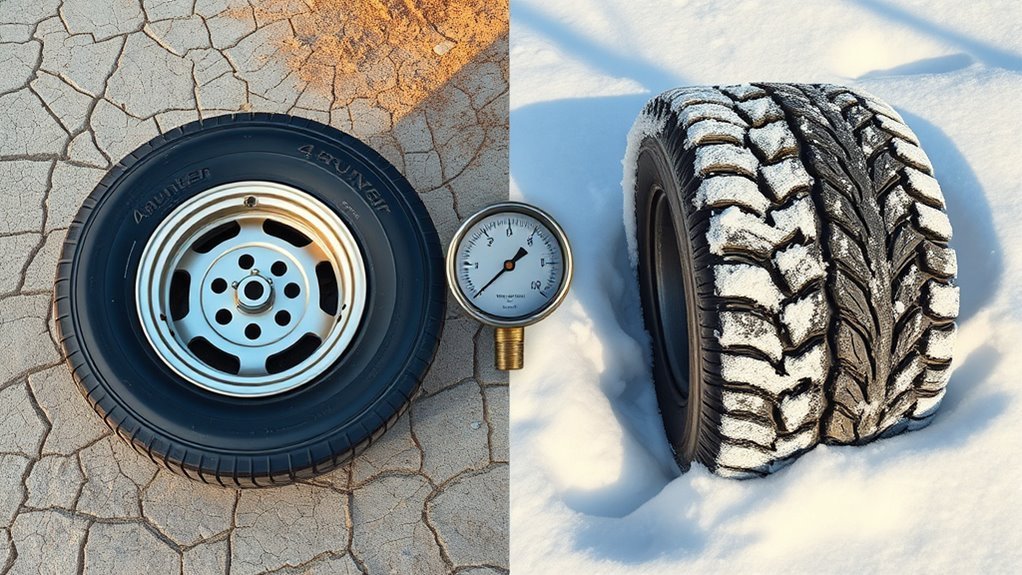
Air pressure changes with temperature. The U.S. Tire Manufacturers Association notes that tire pressure can rise or fall by about 1–2 PSI for every 10°F temperature change.
That means a tire set correctly on a warm afternoon may look low on a cold morning. It also means a tire set in winter may read high during summer heat. The answer is not to guess. Check cold pressure and adjust back to the door placard.
- Winter: Expect pressure to drop. Add air when cold pressure falls below the placard.
- Summer: Do not bleed hot tires just because the reading is higher after driving. Recheck when cold.
- Big temperature swings: Check more often after a 20°F–30°F weather change.
- Long trips: Check before leaving, especially with passengers, cargo, or a trailer.
Why Some New 4Runners Arrive Overinflated
Some vehicles arrive at the dealer or the owner with tires inflated above the driving recommendation. Higher pressure may be used during shipping or storage, but it should be corrected during delivery inspection. Do not assume the dealer already fixed it.
Before your first long drive in a new or recently serviced 4Runner, check all tire pressures cold. If they are above the door placard, bleed them down to the correct cold PSI. A few minutes with a gauge can improve ride quality, braking feel, and tread wear.
Pro Tip: Also check pressure after tire rotation or service. Shops sometimes set all SUVs to a generic number instead of your specific door label.
Frequently Asked Questions
Is 32 PSI or 33 PSI correct for a Toyota 4Runner?
Use the PSI on your driver-door placard. Many stock 2010–2024 4Runners commonly use 32 PSI front and rear, while many stock 2025–2026 4Runners commonly use 33 PSI front and rear. Older models and aftermarket tires can differ.
What tire brand works best with the recommended PSI?
The correct pressure is based more on tire size, load rating, and vehicle weight than brand. Choose a tire that matches your 4Runner’s required size, load index, speed rating, and driving use. Then set pressure from the door label or a load-inflation calculation for non-OE tires.
Can I rotate 4Runner tires without adjusting pressure?
You can rotate them, but you should still check and reset pressure afterward. Many 4Runners use the same front and rear PSI, but a gauge check catches shop errors, slow leaks, and pressure changes from temperature.
Does the spare tire need the same PSI?
Check the spare, too. A full-size spare may use the same PSI as the road tires, but you should verify the tire label, owner’s manual, and spare tire type. Temporary spares, if equipped, can require a much higher pressure.
How often should I replace valve stems?
Replace rubber valve stems when you install new tires or when they are cracked, leaking, or weathered. If your wheels use TPMS sensors, ask the tire shop whether the sensor seal, nut, core, or service kit should be replaced during tire service.
Will nitrogen inflation improve my 4Runner’s handling?
Nitrogen can slow normal pressure loss slightly, but it will not transform handling. Regular air is already mostly nitrogen and works well when you check pressure consistently. Correct PSI matters far more than the gas type.
Should I use the maximum PSI printed on the tire?
No. The sidewall number is the tire’s maximum cold pressure, not your 4Runner’s normal driving pressure. Use the Tire and Loading Information label on the vehicle unless a tire professional has calculated a different pressure for a changed tire setup.
Conclusion
Your 4Runner’s tire pressure should start with one source: the Tire and Loading Information label on your vehicle. For stock setups, many 2010–2024 4Runners commonly sit around 32 PSI cold, and many 2025–2026 4Runners commonly sit around 33 PSI cold, but your door label is the number that matters. Check pressure cold, check it monthly, verify the spare, and reinflate after off-road airing down. That simple habit protects tread life, ride quality, fuel economy, braking, and safety.
Sources
- Toyota — How to Check Tire Pressure — backs cold-pressure checks, placard/manual location, underinflation and overinflation effects.
- Toyota Owners — 4Runner Manuals and Warranties — backs use of official Toyota manuals for model-specific specifications.
- NHTSA TireWise — Tire Safety — backs placard-first PSI, cold checks, spare checks, TPMS limits, and tire safety warnings.
- FuelEconomy.gov — Gas Mileage Tips — backs fuel-economy benefits of proper inflation and the warning not to use sidewall max as the normal pressure.
- U.S. Tire Manufacturers Association — Tire Care Essentials — backs monthly checks, cold-pressure checks, spare checks, and temperature-related PSI changes.
- 49 CFR § 571.138 — Tire Pressure Monitoring Systems — backs TPMS warning language and the need for regular tire maintenance.

Related Articles

When to Switch From All-Season to Winter Tires on a 4Runner
Ineffective all-season tires in cold weather can jeopardize your safety—discover when to make the crucial switch for better traction and handling.
Read More
4Runner Tire Mileage: How Many Miles Should They Last
Curious about how long your 4Runner tires should last? Discover essential tips and factors that influence tire longevity.
Read More
How Long Do Toyota 4Runner Tires Typically Last
How long do Toyota 4Runner tires typically last? Discover the factors that influence tire longevity and essential tips for maintenance.
Read More