
Toyota Camry Tire Size Impact on Speedometer Accuracy: What Changes?

Changing the overall diameter of your Toyota Camry’s tires can change what the speedometer and odometer report. Taller tires travel farther with each revolution, while shorter or heavily worn tires travel less. The effect is predictable with basic math, but safe fitment requires more than matching diameter. You also need to verify the approved size, wheel compatibility, load capacity, clearance, tire pressure, and electronic-system requirements for your Camry’s exact model year and trim.
Quick Answer
Changing a Toyota Camry’s overall tire diameter changes how far the car travels per wheel revolution. A taller tire usually makes the speedometer and odometer read low; a shorter or worn tire usually makes them read high. Use the door placard as your baseline, calculate the diameter change, verify it with GPS, and consult a qualified shop before changing sizes.
Key Takeaways
- A larger overall tire diameter normally makes your actual speed higher than the speed shown on the dashboard.
- A smaller overall diameter normally makes the dashboard show a higher speed than the car is actually traveling.
- A 3% increase in diameter makes an indicated 60 mph equal about 61.8 mph—not 63.3 mph.
- Never select a Camry tire by diameter alone. Confirm the approved size, load index, speed rating, wheel fitment, clearance, TPMS requirements, and model-specific guidance.
At a Glance
| Time Required | 15–25 minutes for calculation and a basic road check |
| Difficulty | Easy to calculate; professional verification recommended before changing sizes |
| Tools Needed | Door-jamb placard, model-specific owner’s manual, tire-pressure gauge, calculator, and GPS or passenger-operated stopwatch |
| Cost | Usually $0 for testing; professional inspection or model-specific correction costs vary |
Warning: Do not install a tire simply because its calculated diameter is close to the original. The tire must also be approved for the vehicle or professionally verified for wheel width, offset, load index, speed rating, brake clearance, suspension clearance, steering clearance, TPMS compatibility, and safe operation of ABS, traction control, stability control, and driver-assistance systems.
Toyota Camry Tire Size and Rolling Diameter
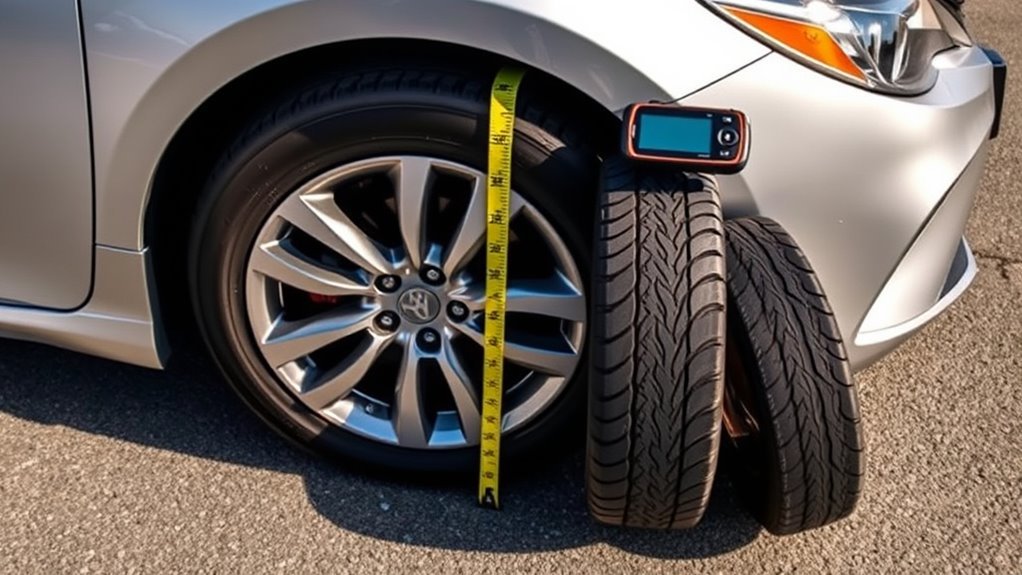
Your Camry’s correct starting point is the tire and loading information placard on the driver’s door or door jamb. The placard identifies the original tire size and recommended cold inflation pressure. You should also check the owner’s manual for the exact model year and trim through the official Toyota manuals portal.
Camry tire sizes are not universal. They vary by generation, trim, drivetrain, market, and wheel package. Some Camrys use 16-, 17-, or 18-inch wheels, while current configurations can also use 19-inch wheels. Toyota’s current Camry specifications show why you should verify the vehicle rather than rely on a generic list.
The wheel diameter is only one part of the measurement. A larger wheel can be paired with a shorter tire sidewall so that the total tire diameter stays close to the factory specification. This is commonly called plus sizing. When it is properly engineered, the wheel becomes larger while the tire’s overall rolling diameter changes very little.
[Products Worth Considering]

This portable cordless tire inflator delivers up to 160 PSI with fast 17 L/min airflow to help you quickly top up tires and get back on the road. It features dual power mode, running on a 21V rechargeable battery or a 12V DC adapter for convenient roadside use. An automatic shut-off with digital pressure gauge helps prevent overinflation, and a built-in LED light improves visibility in low-light conditions.

The JACO FlowPro Tire Inflator measures, inflates, and airs down tires up to 100 PSI with battery-free operation and ±2% accuracy after calibration. It features a glowing pressure dial for night visibility, a heavy-duty steel build with a hybrid hose, and a precision push-to-inflate thumb trigger. The patented Lightning Air Chuck locks on for a secure seal, and the kit includes quick-connect hardware for easy inline use with your air compressor.

EVOULTES heavy duty tire inflator with an integrated gauge delivers accurate pressure readings from 10–120 PSI, helping you inflate, deflate, and check tires in one tool. The 16.5-inch extended dual-head air chuck with swivel base reaches hard-to-access dual wheel valves on trucks and RVs. A brass trigger core and side-mounted air release valve make operation smooth, with standard 1/4" NPT threading and quick-connect compatibility for easy setup.
How to Read a Tire Size
In a size such as 205/55R16:
- 205 is the nominal tire width in millimeters.
- 55 means the sidewall height is 55% of the tire width.
- R identifies radial construction.
- 16 is the wheel’s bead-seat diameter in inches.
Michelin’s tire-marking guide also explains why the load index and speed rating following the size are important. A dimensionally similar tire is not an acceptable replacement if its load capacity or other required rating is too low.
How to Calculate Nominal Tire Diameter
Use these formulas:
Sidewall height in inches = tire width × aspect ratio ÷ 100 ÷ 25.4
Nominal tire diameter = wheel diameter + (2 × sidewall height)
For a 205/55R16:
- Sidewall height: 205 × 0.55 ÷ 25.4 = approximately 4.44 inches
- Overall diameter: 16 + (2 × 4.44) = approximately 24.88 inches
Note: Sidewall math gives a nominal diameter. The tire manufacturer’s published measured diameter and revolutions-per-mile figure are better for final comparison because tread design, rim width, load, pressure, and tire construction can change the real measurement slightly.
How Camry Tire Size Changes Speedometer Readings
The speedometer is designed around an expected relationship between wheel rotation and road speed. When the new tire travels a different distance per revolution, that relationship changes.
Use this formula for a basic estimate:
Actual speed = indicated speed × new tire diameter ÷ original tire diameter
For example, if the replacement tire is exactly 3% taller than the original:
60 mph × 1.03 = 61.8 mph actual speed
A 3% change in rolling diameter produces approximately a 3% difference between indicated and actual travel—not a fixed number of miles per hour at every speed.
The odometer is affected in the same direction. A taller tire makes fewer revolutions per mile, so the odometer generally records less distance than the vehicle actually travels. A shorter tire makes more revolutions per mile and generally records more distance.
Bigger Tires and Slower Speed Readings
A tire with a larger overall diameter covers more road with every revolution. If the Camry’s control system still assumes the original diameter, the dashboard usually shows a lower speed than the vehicle’s actual speed.
The original article compared 205/55R16 with 245/65R17. Nominal calculations show:
| Tire size | Nominal diameter | Change | Actual speed at indicated 60 mph |
|---|---|---|---|
| 205/55R16 | 24.88 in. | Baseline | 60.0 mph |
| 245/65R17 | 29.54 in. | Approximately +18.7% | Approximately 71.2 mph |
This is a mathematical comparison only. It is not a recommendation to install 245/65R17 tires on a Camry. The size change is extreme and may create serious clearance, handling, braking, gearing, and electronic-system problems.
Even a much smaller increase can affect steering response, acceleration, braking feel, wheel-well clearance, and the behavior of systems that compare wheel-speed signals. Added tire and wheel weight can also reduce responsiveness independently of diameter.
Smaller Tires and Faster Speed Readings
A tire with a smaller overall diameter makes more revolutions over the same road distance. The speedometer therefore tends to show a higher speed than the vehicle is actually traveling.
Compared with a nominal 205/55R16, a 195/60R15 is approximately 2.7% smaller in diameter:
| Tire size | Nominal diameter | Dashboard effect |
|---|---|---|
| 205/55R16 | 24.88 in. | Baseline for this example |
| 195/60R15 | 24.21 in. | At indicated 60 mph, actual speed is approximately 58.4 mph |
These sizes are examples, not a statement that either size is approved for your Camry. A smaller tire may also reduce ground clearance, alter load capacity, change handling, and create an incompatible wheel or brake fitment.
How Tire Wear Changes Camry Speedometer Accuracy
Tread wear gradually reduces tire diameter. If tread depth falls from 10/32 inch to 2/32 inch, each side of the tire loses 8/32 inch. The total diameter therefore falls by approximately 16/32 inch, or one-half inch.
On a tire roughly 26.5 inches in diameter, that represents a theoretical reduction of about 1.9%. At an indicated 60 mph, the vehicle could be traveling near 58.9 mph if the speedometer were perfectly calibrated to the new tire’s full nominal diameter.
Real-world results vary because a tire’s loaded rolling radius is also affected by construction, pressure, temperature, load, and tread design. Wear normally makes the speedometer read slightly high, so it does not create the same speeding risk as a substantially oversized tire. It can still affect trip-distance, odometer, maintenance, and fuel-economy comparisons.
Check tread depth and condition regularly. NHTSA’s TireWise guidance also recommends using the vehicle manufacturer’s size and cold inflation-pressure specifications.
How Camry Tire Size Affects MPG and Gearing
A taller tire makes the overall gearing taller, similar to using a numerically lower final-drive ratio. Engine or motor speed may be lower at a given road speed, but acceleration can feel weaker because the drivetrain must overcome greater leverage at the tire.
A shorter tire does the opposite. It shortens the effective gearing, raises drivetrain speed at a given road speed, and can make initial response feel quicker.
Diameter alone does not predict the exact fuel-economy change. MPG can rise or fall depending on:
- Tire width and aerodynamic drag
- Tire and wheel weight
- Rolling-resistance characteristics
- Tread compound and design
- Cold inflation pressure
- Vehicle load and alignment
- City versus highway driving
- Changes in indicated odometer distance
A heavier or wider setup may reduce efficiency even when its diameter is close to the original. An inaccurate odometer can also distort hand-calculated MPG because the displayed distance may no longer match the true distance traveled.
[Products Worth Considering]
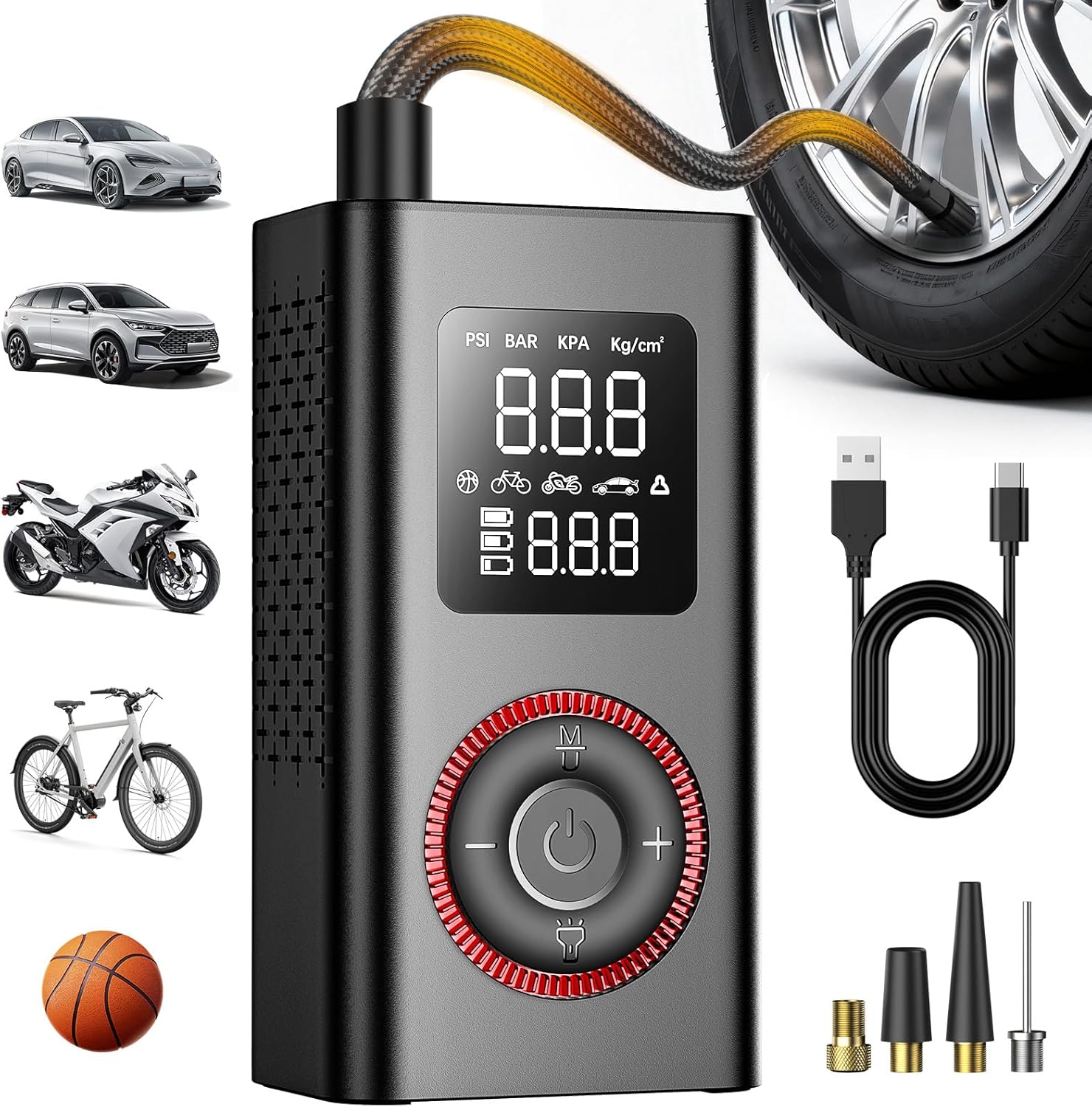
This portable tire inflator delivers fast, efficient inflation with a maximum 150 PSI rating and accurate pressure control for cars, motorcycles, bikes, and more. It features preset modes with automatic shutoff to help prevent overinflation, plus a real-time digital gauge and bright LED light for roadside use. Powered by a rechargeable 6000mAh battery with Type-C charging and a USB output, it’s also useful as an emergency power source for devices.

The AstroAI L7 Air Tire Inflator refills car tires quickly with up to 150PSI max pressure and a fast 1-minute inflation claim. It includes 5 preset modes for car, motorcycle, bicycle, balls, and manual use, along with an auto shutoff to help prevent overinflation. Designed for convenience, it features a digital gauge with unit switching, a top LED light with multiple modes, and USB-C/USB ports for backup power.
Other Camry Systems Tire Size Can Affect
Changing tire size can affect more than the speedometer. Depending on the model year and equipment, the vehicle may use wheel-speed information for:
- Anti-lock braking
- Traction control
- Vehicle stability control
- Electronic all-wheel drive operation
- Adaptive cruise and other driver-assistance calculations
- Tire-pressure monitoring
On an AWD model, do not mix tires with meaningfully different rolling circumferences between axles. Use matching approved tires and follow Toyota’s rotation and replacement instructions. Different tread depths, models, or sizes can create different wheel speeds even when all four sidewalls show similar markings.
New wheels may also require compatible TPMS valves and transmitters. Depending on the Camry’s year and equipment, sensor IDs or wheel positions may need to be registered or initialized through a model-specific procedure.
How to Check Camry Speedometer Accuracy

Before testing, confirm that all tires are the same approved size, inspect them for uneven wear, and adjust cold pressure to the specification on the door placard. Underinflation can change the loaded rolling radius and introduce another variable.
GPS Speed Comparison
Choose a level, open road where you can maintain a steady legal speed without distracting other traffic. Mount the GPS device where it can be viewed safely, or have a passenger record the readings. Do not hold or operate a phone while driving.
- Maintain a steady indicated speed, such as 30, 45, or 60 mph.
- Allow the GPS reading to stabilize.
- Record both the dashboard and GPS speeds.
- Repeat at several speeds and in both directions when practical.
- Compare the average difference rather than relying on one brief reading.
If the dashboard reads lower than GPS after a tire change, the fitted tire may have a larger rolling circumference than the calibration expects. If the dashboard reads higher than GPS, the fitted tire may have a smaller rolling circumference.
Pro Tip: Compare the GPS result with the calculated diameter ratio. If the two disagree substantially, recheck tire pressure, confirm the exact tire model’s published dimensions, inspect for mixed sizes or wear, and repeat the test before assuming the vehicle needs electronic correction.
Mile-Marker Timing
Mile markers provide a second check, but several miles are more reliable than a single mile because stopwatch reaction time and marker placement can create noticeable error.
- Use a limited-access road with clear mile markers and safe conditions.
- Have a passenger operate the stopwatch.
- Hold a steady indicated 60 mph where legal and appropriate.
- Time at least five consecutive miles.
- At a true 60 mph, five miles should take five minutes.
If an indicated 60 mph takes noticeably more than five minutes for five miles, the actual speed is below 60 mph. If it takes noticeably less, the actual speed is above 60 mph.
A three-second difference over only one mile represents roughly a 5% variation around 60 mph, but it does not by itself prove the speedometer needs recalibration. Road grade, traffic, cruise-control variation, timing reaction, pressure, tire wear, and marker accuracy should be considered.
How to Correct Camry Speedometer Error
Start by finding the cause rather than immediately changing electronic settings. The safest correction is often to restore the manufacturer-approved tire and wheel configuration.
Check the Tire Size Difference
- Read the original size from the door placard.
- Confirm the fitted size on all four tire sidewalls.
- Check the exact tire model’s published overall diameter or revolutions per mile.
- Calculate the percentage difference.
- Verify wheel width, load index, speed rating, pressure, and clearance.
Do not rely on a universal “3% rule” as proof that a tire is safe. Keeping diameter close may reduce speedometer error, but it does not establish correct load capacity, wheel fitment, brake clearance, suspension clearance, or manufacturer approval.
Use GPS Verification
After checking the dimensions and setting cold pressure correctly, compare dashboard speed with GPS at several steady speeds. A consistent percentage difference that agrees with the calculated diameter change strongly suggests the tire size is the cause.
GPS is a useful comparison tool, but it is not a substitute for certified diagnostic equipment. Reception, road slope, acceleration, device filtering, and signal obstruction can affect short readings.
Choose a Safe Correction Method
Use the following order:
- Restore an approved tire size. This is usually the most direct way to return speed, odometer, clearance, and system behavior toward the intended design.
- Ask a qualified tire professional to verify the complete fitment. Diameter is only one requirement.
- Consult a Toyota dealer or model-specific specialist. Ask whether your exact model year and control modules support an approved calibration procedure.
- Confirm the result. Recheck the speedometer with GPS and inspect for warning lights, rubbing, vibration, or unusual system behavior.
Why Generic OBD-II Recalibration Is Not Universal
A Bluetooth OBD-II adapter may be able to read diagnostic data, but that does not mean it can safely rewrite tire circumference or speedometer calibration. Available functions depend on the adapter, app, vehicle year, ECU, permissions, and supported service procedures.
Do not enter an unverified tire value or write control-module settings with a generic app. Unsupported coding can create incorrect data, warning lights, communication faults, or changes that are difficult to reverse. Use documented, model-specific equipment and procedures only.
Frequently Asked Questions
How do larger tires affect Camry speedometer and odometer accuracy?
A larger overall diameter covers more distance per wheel revolution. The speedometer normally reads lower than the vehicle’s actual speed, and the odometer normally records fewer miles than the vehicle actually travels. The approximate difference follows the percentage change in rolling diameter.
How much tire-diameter change is acceptable on a Toyota Camry?
There is no universal percentage that proves a tire is approved for every Camry. A close diameter helps limit speedometer error, but you must still verify the exact model year, trim, wheel dimensions, load index, speed rating, pressure, clearance, TPMS compatibility, and Toyota or professional fitment guidance.
Does low tire pressure change speedometer accuracy?
Low pressure can reduce the tire’s loaded rolling radius and slightly change the reading, but it will not safely compensate for a major size difference. Set cold pressure to the vehicle placard specification before calculating or testing speedometer error.
Can a Toyota dealer recalibrate the speedometer for larger tires?
Possibly, but availability depends on the Camry’s model year, control modules, supported service functions, and the proposed fitment. Ask the dealer to check the vehicle by VIN. Do not assume that a generic OBD-II app can perform the same procedure.
Will new Camry wheels require TPMS programming?
New wheels generally need compatible tire-pressure sensors. Depending on the model year and system, sensor IDs, wheel positions, or inflation settings may need to be registered or initialized. Follow the model-specific Toyota manual or have a qualified shop complete the setup.
Can factory wheels from another Camry trim be installed safely?
Not automatically. A factory wheel from another trim may have a different width, offset, tire requirement, load rating, brake clearance, TPMS configuration, or calibration relationship. Verify compatibility by model year, trim, drivetrain, VIN, and complete wheel-and-tire specifications.
Conclusion
Your Camry’s speedometer is calibrated around an expected rolling circumference. A taller tire normally makes the dashboard understate speed and distance, while a shorter or worn tire normally makes it overstate them. Calculate the nominal difference, verify it with repeated GPS or mile-marker checks, and use the door placard and model-specific Toyota manual as your baseline.
Most importantly, do not treat speedometer accuracy as the only fitment requirement. An acceptable replacement must also meet the vehicle’s wheel, clearance, load, pressure, TPMS, braking, handling, and electronic-system requirements. When those details are uncertain, restoring the approved size or consulting a qualified Toyota or tire professional is safer than relying on a generic calculator or unsupported OBD-II setting.
Sources
- Toyota Manuals and Warranties — model-year-specific owner documentation and maintenance guidance
- Toyota Camry Specifications — current trim and wheel-configuration information
- NHTSA TireWise — tire size, pressure, inspection, replacement, and safety guidance
- Michelin: Choosing the Right Tire Size — tire placard, sidewall markings, fitment, and system effects
- Michelin: Changing Tire Size or Specifications — manufacturer-approved replacement-size guidance

Related Articles

Toyota Camry All-Season Tires Explained: What They Can and Can’t Do
In exploring Toyota Camry all-season tires, discover their benefits and limitations—are they really the right choice for your driving needs?
Read More
Toyota Camry Tire Traction in Ice and Snow: A Practical Winter Driving Guide
Learn essential tips for maximizing tire traction on ice and snow in your Toyota Camry, ensuring your winter driving is safe and confident. Discover more now!
Read More
Do Toyota Camry Tires Need Snow Chains? When They Help and When They Don’t
How do snow chains enhance your Toyota Camry's winter driving safety, and when should you avoid using them? Discover the essential details inside!
Read More