
Why Is the Toyota Camry Tire Pressure Light On? Causes and Fixes
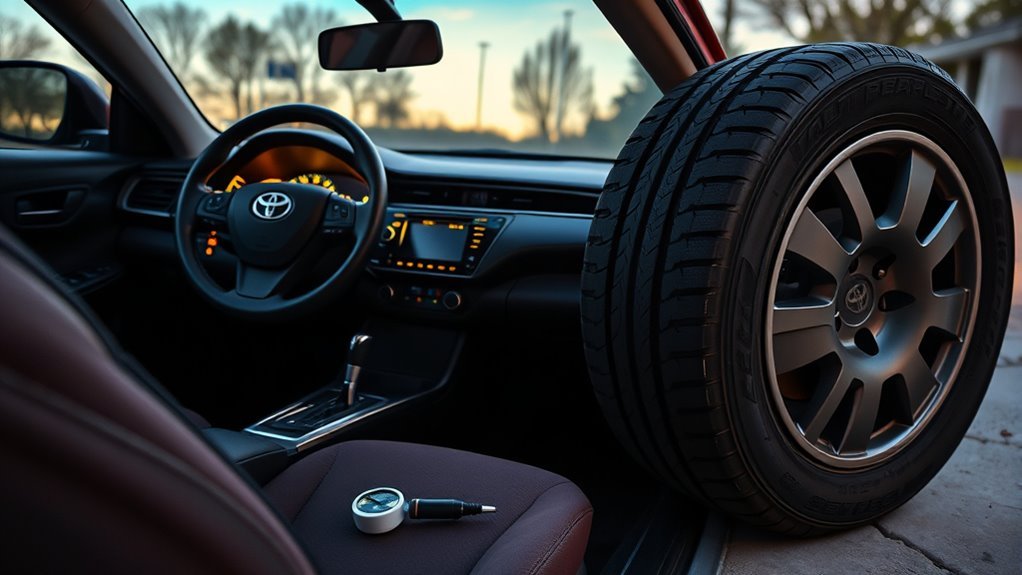
Your Toyota Camry tire pressure light comes on when the car detects a tire-pressure problem or a fault in the tire pressure monitoring system. Start with a real tire-pressure gauge, not the dashboard light alone. Check every tire cold, inflate to the pressure on the driver-side door-jamb label, inspect for leaks, and only reset the system after the tire pressures are correct.
Quick Answer
A solid Toyota Camry tire pressure light usually means one or more tires are low. A light that blinks for about a minute and then stays on points to a TPMS malfunction. Check all tires cold, inflate them to the door-jamb label pressure, then reset or service the system if the warning remains.
Key Takeaways
- Use the tire pressure listed on your Camry’s driver-side door-jamb label, not a generic PSI number.
- A solid warning light usually points to low tire pressure; a blinking light usually means the TPMS needs diagnosis.
- Do not reset the TPMS until all tires are correctly inflated and inspected for leaks or damage.
- TPMS sensor batteries often last about 5 to 10 years, so older Camrys may need sensor replacement.
- If the light stays on after correct inflation and reset, a tire shop or Toyota dealer can scan the sensors and register replacements if needed.
At a Glance
| Time Required | 10 to 30 minutes for basic checks; longer if a leak or bad sensor needs repair |
| Difficulty | Easy for pressure checks; moderate to professional for TPMS sensor diagnosis |
| Tools Needed | Tire-pressure gauge, air compressor, soapy water, flashlight, and TPMS scan tool if the light blinks or will not clear |
| Cost | Often free for inflation; leak repair or TPMS sensor replacement can range from modest tire-shop service fees to several hundred dollars depending on parts, labor, and programming |
Why Is the Toyota Camry Tire Pressure Light On?
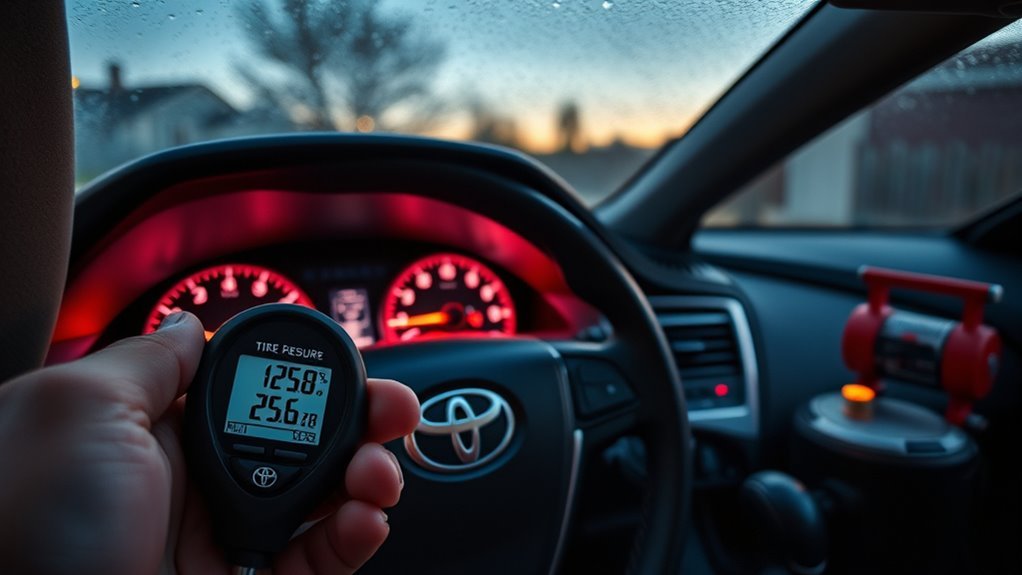
Your Toyota Camry tire pressure light usually turns on because at least one tire is significantly underinflated. Common causes include normal air loss over time, colder weather, a puncture, a leaking valve stem, a damaged tire bead, or a tire that was recently serviced without the TPMS being reset correctly.
The most important number is not a generic 32 psi figure. It is the cold tire pressure printed on your Camry’s driver-side door-jamb tire label. Federal tire-safety guidance says tires should be checked monthly when cold and inflated to the vehicle manufacturer’s recommended pressure on the vehicle placard or tire inflation pressure label. You can read the official TPMS safety language in the NHTSA TPMS final rule.
Warning: If a tire looks flat, the car pulls hard, you hear flapping, or you see sidewall damage, do not keep driving. Pull over safely, use the spare or roadside assistance, and avoid driving on a severely underinflated tire.
[Products Worth Considering]

The JACO FlowPro Tire Inflator measures, inflates, and airs down tires up to 100 PSI with battery-free operation and ±2% accuracy after calibration. It features a glowing pressure dial for night visibility, a heavy-duty steel build with a hybrid hose, and a precision push-to-inflate thumb trigger. The patented Lightning Air Chuck locks on for a secure seal, and the kit includes quick-connect hardware for easy inline use with your air compressor.

This portable cordless tire inflator delivers up to 160 PSI with fast 17 L/min airflow to help you quickly top up tires and get back on the road. It features dual power mode, running on a 21V rechargeable battery or a 12V DC adapter for convenient roadside use. An automatic shut-off with digital pressure gauge helps prevent overinflation, and a built-in LED light improves visibility in low-light conditions.

EVOULTES heavy duty tire inflator with an integrated gauge delivers accurate pressure readings from 10–120 PSI, helping you inflate, deflate, and check tires in one tool. The 16.5-inch extended dual-head air chuck with swivel base reaches hard-to-access dual wheel valves on trucks and RVs. A brass trigger core and side-mounted air release valve make operation smooth, with standard 1/4" NPT threading and quick-connect compatibility for easy setup.
Solid vs. Blinking Camry TPMS Light
The light pattern tells you where to start. A solid light usually means a tire-pressure problem. A blinking light, especially one that flashes for about a minute and then stays on, usually means the TPMS itself has a malfunction. Toyota’s 2025 Camry manual explains that when the tire pressure warning light comes on after blinking for about one minute, the tire pressure warning system may have a malfunction and should be checked by a Toyota dealer. See Toyota’s warning-light guidance in the Toyota Camry owner’s manual.
| Light Pattern | Most Likely Meaning | What to Do First |
|---|---|---|
| Solid tire pressure light | One or more tires may be underinflated | Check all tires cold and inflate to the door-jamb label pressure |
| Blinks, then stays solid | TPMS malfunction, weak/dead sensor battery, unregistered sensor, or receiver issue | Check pressure for safety, then have the TPMS scanned |
| Comes back after reset | Slow leak, incorrect reset, wrong baseline pressure, or sensor fault | Recheck cold pressures and inspect for leaks before resetting again |
Check Tire Pressure and Look for Leaks
Start with the simplest check: measure the pressure in each tire while the tires are cold. “Cold” means the car has been parked for at least a few hours or driven only a short distance at low speed. Heat from driving raises tire pressure, which can hide a low tire.
- Find the correct PSI: Open the driver door and read the tire and loading information label on the door jamb.
- Check all four tires: Use a reliable tire-pressure gauge. Do not rely only on the dashboard warning.
- Inflate to spec: Add air until each tire matches the label pressure for the tire size installed on your Camry.
- Inspect the tires: Look for nails, screws, cuts, sidewall bulges, cracked valve stems, or bead leaks around the rim.
- Use soapy water: Spray the tread, valve stem, and rim edge. Bubbles that keep forming usually mean a leak.
Pro Tip: Check tire pressure in the morning before driving. A pressure reading taken after a highway trip can be several psi higher than the true cold reading.
If the light turns off after inflation, keep checking that tire over the next few days. A tire that loses pressure again likely has a slow leak and should be inspected by a tire shop.
How to Reset the Camry TPMS Light
Only reset the Camry TPMS light after the tires are correctly inflated. Resetting the system with low or uneven pressures can teach the car the wrong baseline and cause more confusion later.
Check Tire Pressure Before Resetting
Confirm all four tires are inflated to the label pressure. If your Camry displays individual tire pressures, compare the dashboard readings with a manual gauge. If one dashboard reading is clearly wrong while the gauge reading is correct, the sensor for that wheel may be failing.
Use the TPMS Reset Button or Vehicle Menu
Reset methods vary by Camry model year and trim. Some Camrys use a physical TPMS reset button, often low on the instrument panel or near the driver-side lower dash area. Other models may use the multi-information display settings. Toyota’s customer support explains that some Toyota vehicles reset by first confirming correct pressures, turning the engine on, and holding the reset button until the TPMS indicator blinks slowly three times. You can review Toyota’s general TPMS reset guidance at Toyota Customer Support.
- Park safely and set all tires to the correct cold pressure.
- Turn the ignition or power switch on as directed by your owner’s manual.
- Use the TPMS reset button or tire-pressure setting menu if your Camry has one.
- Wait for the confirmation blink or message described in your manual.
- Drive normally and recheck whether the light clears.
Drive to Relearn
After inflation or reset, many Toyota systems need a short drive to update tire-pressure data. If the light stays on after a normal drive, do not keep resetting it repeatedly. Recheck tire pressures cold, inspect for leaks, and move to sensor diagnosis if everything is correct.
Note: Reset instructions are not identical for every Camry. Always use the owner’s manual for your exact model year, especially after tire rotation, wheel replacement, tire-size changes, or TPMS sensor replacement.
How to Tell If the TPMS Sensor Failed

A failed TPMS sensor can make the tire pressure light stay on even when the tires are correctly inflated. This is common as vehicles age because direct TPMS sensors use sealed internal batteries. Once the battery dies, the sensor usually has to be replaced as a unit. NGK notes that TPMS sensor batteries commonly last about 5 to 10 years or around 100,000 miles, depending on use and conditions. See NGK’s TPMS replacement guidance.
| Symptom | Likely Issue | Best Next Step |
|---|---|---|
| Light blinks for about a minute, then stays on | TPMS malfunction | Have a shop scan the TPMS sensors and receiver |
| One wheel shows no pressure reading | Dead sensor battery or sensor communication failure | Replace and register that sensor if confirmed bad |
| Light comes back after correct inflation | Slow leak, wrong reset baseline, or bad sensor | Leak test first, then scan sensors |
| Light appears after new tires or wheels | Sensor ID not registered or incompatible sensor | Ask the installer to complete TPMS relearn or registration |
A professional TPMS scan tool can read each sensor’s ID, battery status, pressure signal, and temperature data without guessing. That makes diagnosis faster than replacing sensors one at a time.
[Products Worth Considering]

The Fanttik X10 Pro is a cordless portable tire inflator that reaches up to 150 PSI and can inflate an R15 tire in about 35 seconds for quick roadside or home top-ups. With AccuInFlate auto-stop and smart start/stop controls, it helps maintain accurate pressure and frees your hands once the target is reached. A high-visibility digital display and preset modes make it easy to set and monitor inflation for cars, motorcycles, bikes, and balls.

The AstroAI L7 Air Tire Inflator refills car tires quickly with up to 150PSI max pressure and a fast 1-minute inflation claim. It includes 5 preset modes for car, motorcycle, bicycle, balls, and manual use, along with an auto shutoff to help prevent overinflation. Designed for convenience, it features a digital gauge with unit switching, a top LED light with multiple modes, and USB-C/USB ports for backup power.
What TPMS Repairs Cost on a Camry
TPMS repair cost depends on the problem. Adding air is free or inexpensive. Repairing a small tread puncture is usually less expensive than replacing a sensor. Sensor replacement costs more because the tire may need to be dismounted, the sensor installed, the tire resealed and balanced, and the new sensor registered to the vehicle.
Current repair-estimator data from RepairPal lists average TPMS sensor replacement around the mid-$200 to low-$300 range, before taxes, fees, and location differences. Prices can be higher at a dealer or when multiple sensors are replaced at the same time.
- Pressure check and inflation: often free or low cost.
- Leak inspection: may include a small diagnostic or tire-service fee.
- Patch or plug-patch repair: depends on tire condition and puncture location.
- TPMS sensor replacement: includes sensor, valve hardware, labor, balancing, and programming or relearn.
- Multiple sensor replacement: can make sense if all sensors are the same age and one has failed from battery age.
Note: A tire shop may be cheaper than a dealer for sensor replacement, but the shop must have the correct sensor and TPMS programming tool for your Camry.
How to Prevent TPMS Warning Lights
You cannot prevent every puncture or sensor failure, but you can reduce false warnings and catch tire problems earlier with a simple routine.
Check Tire Pressure Regularly
Check all tires at least once a month when cold and before long trips. This matches the safety language required in vehicle owner’s manuals under the federal TPMS rule. TPMS helps, but it is not a substitute for basic tire maintenance.
- Use the driver-side door-jamb label for the correct cold tire pressure.
- Check all four tires with a manual gauge.
- Do not forget the spare if your Camry has one; the TPMS may not monitor it.
- Inspect tread and sidewalls for nails, cuts, bulges, and uneven wear.
- Replace missing valve caps to keep dirt and moisture out of the valve stem.
TPMS is a warning system, not a replacement for monthly cold tire-pressure checks.
Replace Aging TPMS Sensors
If your Camry is more than 5 to 10 years old and the tire pressure light blinks or returns even when the tires are correct, aging TPMS sensors become more likely. Many owners replace sensors when buying new tires because the tire is already off the wheel, which can reduce repeat labor later.
Use quality sensors that match your Camry’s model year, wheel type, and TPMS frequency. After replacement, the sensor IDs may need to be registered or relearned with a scan tool before the warning light clears.
Frequently Asked Questions
Why is my tire pressure light on when my tires look fine on my Toyota Camry?
A tire can look fine and still be several psi low. Check every tire with a gauge when cold and inflate to the driver-side door-jamb label. If the pressure is correct and the light stays on, you may have a slow leak, a reset issue, or a TPMS sensor fault.
What does a blinking tire pressure light mean on a Toyota Camry?
A blinking light that flashes for about a minute and then stays on usually means the tire pressure monitoring system has a malfunction. Check tire pressure first for safety, then have the TPMS scanned if the blinking pattern returns.
What is the correct tire pressure for a Toyota Camry?
The correct pressure is printed on the tire and loading information label on the driver-side door jamb. Many Camry models use pressures in the low-to-mid 30 psi range, but your exact model year, trim, tire size, and load label should always decide the correct cold pressure.
Can I drive with the tire pressure light on?
If the light is solid and the car drives normally, drive carefully to a safe place where you can check and inflate the tires. Do not keep driving if a tire is visibly flat, damaged, very low, or causing vibration, pulling, or noise. If the light is blinking, the TPMS may not be monitoring properly, so use a gauge and schedule service.
What is the life expectancy of a Toyota Camry TPMS sensor?
Direct TPMS sensors often last about 5 to 10 years because their internal batteries are sealed inside the sensor. Heat, driving habits, mileage, and sensor quality can change the lifespan. When the battery fails, the whole sensor usually needs replacement.
Why did the tire pressure light come on after new tires?
The tires may not be inflated to the Camry’s label pressure, a sensor may have been damaged during service, or the TPMS sensor IDs may need to be registered or relearned. Return to the installer and ask them to verify pressure, sensor signal, and TPMS registration.
Conclusion
If your Camry’s tire pressure light came on after a cold morning, tire service, or rough commute, start with the basics: check every tire cold, inflate to the door-jamb label pressure, and inspect for leaks or damage. A solid light usually means low pressure. A blinking light usually means the TPMS needs diagnosis. Fixing the cause quickly protects tire life, braking, handling, and fuel economy.
Sources
- Toyota 2025 Camry Owner’s Manual: Warning Lights — supports blinking TPMS malfunction guidance.
- Toyota Customer Support: Tire Pressure Monitoring System — supports Toyota reset-button guidance.
- NHTSA FMVSS No. 138 TPMS Final Rule — supports monthly cold pressure checks, placard pressure, TPMS purpose, and malfunction behavior.
- RepairPal TPMS Sensor Replacement Cost Estimate — supports current repair-cost range context.
- NGK: When Should TPMS Sensors Be Replaced? — supports TPMS sensor battery lifespan guidance.

Related Articles

Toyota Camry All-Season Tires Explained: What They Can and Can’t Do
In exploring Toyota Camry all-season tires, discover their benefits and limitations—are they really the right choice for your driving needs?
Read More
Toyota Camry Tire Traction in Ice and Snow: A Practical Winter Driving Guide
Learn essential tips for maximizing tire traction on ice and snow in your Toyota Camry, ensuring your winter driving is safe and confident. Discover more now!
Read More
Do Toyota Camry Tires Need Snow Chains? When They Help and When They Don’t
How do snow chains enhance your Toyota Camry's winter driving safety, and when should you avoid using them? Discover the essential details inside!
Read More