
How to Read a Tire Gauge at a Gas Station: Quick Guide
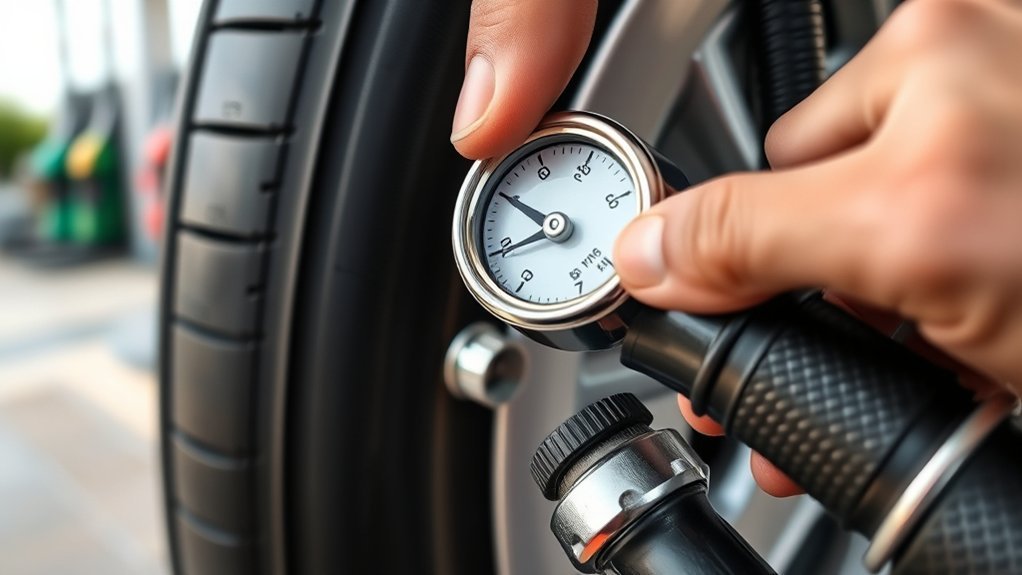
Reading a gas station tire gauge is simple once you know what number you are looking for. Start with the recommended PSI on your vehicle’s driver-side door jamb or owner’s manual, then use the gauge at the valve stem to compare the tire’s current pressure with that target. Add air in short bursts, recheck, and adjust each tire one at a time.
Quick Answer
To read a gas station tire gauge, press the gauge or air-hose chuck firmly onto the valve stem until the hissing stops, then read the PSI shown on the screen, dial, or sliding stick. Compare it with the cold PSI listed on your door-jamb sticker, not the tire sidewall.
Key Takeaways
- Use the recommended cold PSI on the driver-side door jamb, fuel door, glove box, or owner’s manual.
- Do not use the maximum PSI printed on the tire sidewall as your normal target.
- Press the gauge straight onto the valve stem until the air hiss stops, then read the number right away.
- Check tire pressure when the tires are cold whenever possible.
- Add or release air in small steps, then recheck all tires, including the spare if your vehicle has one.
At a Glance
| Time Required | 5 to 10 minutes for all four tires |
| Difficulty | Easy beginner maintenance |
| Tools Needed | Tire pressure gauge, gas station air pump or portable compressor, and your vehicle’s recommended PSI |
| Cost | Usually free to a few dollars at a station; a personal gauge is a low-cost tool |
Warning: Do not inflate to the maximum PSI printed on the tire sidewall unless your vehicle manufacturer specifically tells you to. The normal target is the vehicle’s recommended cold tire pressure. If a tire is visibly damaged, nearly flat, or loses air again soon after filling, do not keep driving on it. Have it inspected.
Find Your Recommended PSI
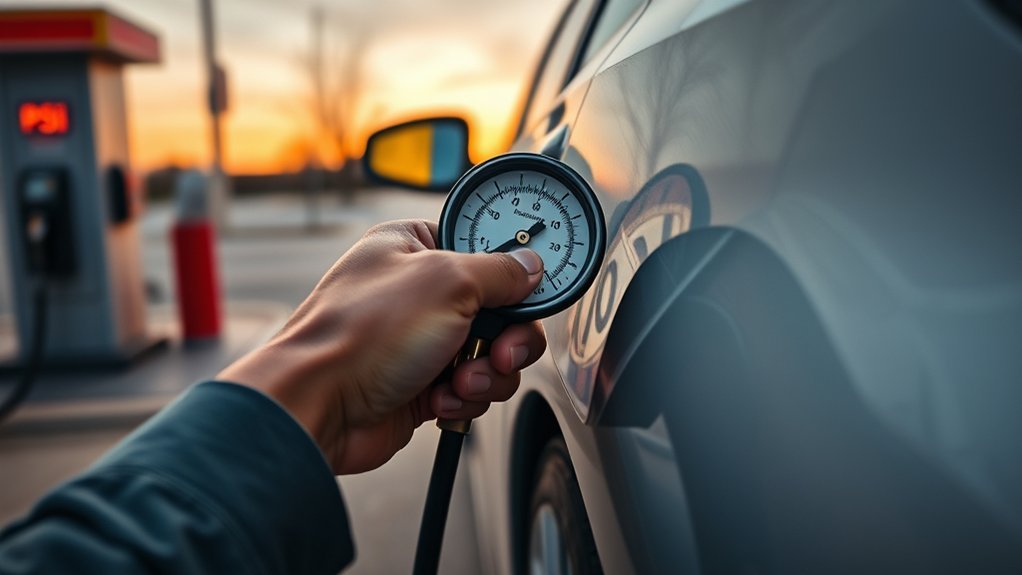
Before you touch the air pump, find your vehicle’s recommended cold tire pressure. It is usually printed on the Tire and Loading Information Label on the driver-side door edge or door jamb. Some vehicles also list it in the glove box, fuel door, or owner’s manual.
This number is the target PSI for safe everyday driving. It is different from the maximum pressure molded into the tire sidewall. The sidewall number is a tire limit, not the pressure your vehicle was designed to use.
Many passenger vehicles fall somewhere around 30 to 35 PSI, but that range is only a rough example. SUVs, trucks, loaded vehicles, and vehicles with different front and rear tire pressures may need something else. Always follow the label for your exact vehicle, tire size, and load.
Note: If your front and rear tires have different PSI targets, write both numbers down before you start. This prevents you from filling every tire to the same number by mistake.
[Products Worth Considering]

EVOULTES heavy duty tire inflator with an integrated gauge delivers accurate pressure readings from 10–120 PSI, helping you inflate, deflate, and check tires in one tool. The 16.5-inch extended dual-head air chuck with swivel base reaches hard-to-access dual wheel valves on trucks and RVs. A brass trigger core and side-mounted air release valve make operation smooth, with standard 1/4" NPT threading and quick-connect compatibility for easy setup.

The AstroAI 2 pack air chucks provide a heavy-duty, closed-flow locking design that helps keep air flowing during inflation while securely attaching to the valve stem. Built with 250 PSI rated brass components and compatible with Schrader valves, they feature 1/4" female NPT threads for a wide fit with common inflators. The straight tip and locking clip make filling tires and monitoring pressure more convenient.

This portable cordless tire inflator delivers up to 160 PSI with fast 17 L/min airflow to help you quickly top up tires and get back on the road. It features dual power mode, running on a 21V rechargeable battery or a 12V DC adapter for convenient roadside use. An automatic shut-off with digital pressure gauge helps prevent overinflation, and a built-in LED light improves visibility in low-light conditions.
Know the Type of Gauge You Are Reading
Gas stations use different air machines, so the gauge may not look the same every time. The reading is still the same idea: you are looking for PSI, which means pounds per square inch.
| Gauge Type | How to Read It | Best Use |
|---|---|---|
| Digital gauge | Read the number on the screen. | Fast, clear readings. |
| Dial gauge | Read where the needle points on the PSI scale. | Reusable personal tool. |
| Stick gauge | Read the number where the sliding bar stops. | Simple backup gauge. |
| Built-in station gauge | Read the screen, dial, or gauge on the pump. | Useful at the pump, but verify with your own gauge when possible. |
Read the Tire Gauge Correctly
Remove the valve cap from the tire and place it somewhere safe, such as your pocket or the center console. Press the tire gauge straight onto the valve stem. You may hear a short hiss at first. Keep pressing until the hiss stops. That means the gauge has sealed against the valve.
Read the number immediately. On a digital tire pressure gauge, use the number shown on the screen. On a dial gauge, read the needle position. On a stick gauge, read the number on the sliding bar. If the reading jumps around or seems too low, remove the gauge and press it on again with a straighter seal.
Compare the reading with the recommended pressure from the vehicle label. If the tire is below the target, add air. If it is above the target, release a little air and recheck.
Pro Tip: Keep your own tire gauge in the vehicle. Air-hose gauges at service stations can be weathered or inaccurate, so a personal gauge gives you a more consistent reference.
Check Tire Pressure on Cold Tires
For the most accurate reading, check your tire pressure when the tires are cold. A tire is generally considered cold after the vehicle has been parked for at least three hours or driven less than about one mile at moderate speed.
Cold tires give you a better baseline because driving heats the tire and raises the pressure. If you check pressure after highway driving, the number may look higher than it really is when the tire cools down.
Find the recommended PSI first, then remove the valve cap, press the gauge straight onto the valve stem, and write down the reading for that tire. It is also smart to choose tires that offer consistent traction year-round, but pressure still has to be checked regularly no matter which tire you use.
| Step | Action | Purpose |
|---|---|---|
| 1 | Check when tires are cold | Improve accuracy |
| 2 | Seal the gauge on the valve stem | Avoid a false low reading |
| 3 | Compare with the recommended PSI | Know whether to add or release air |
Proper tire pressure helps safety, tire life, and fuel economy. FuelEconomy.gov says proper inflation can improve gas mileage by 0.6% on average and up to 3% in some cases.
Add Air to Reach the Target PSI
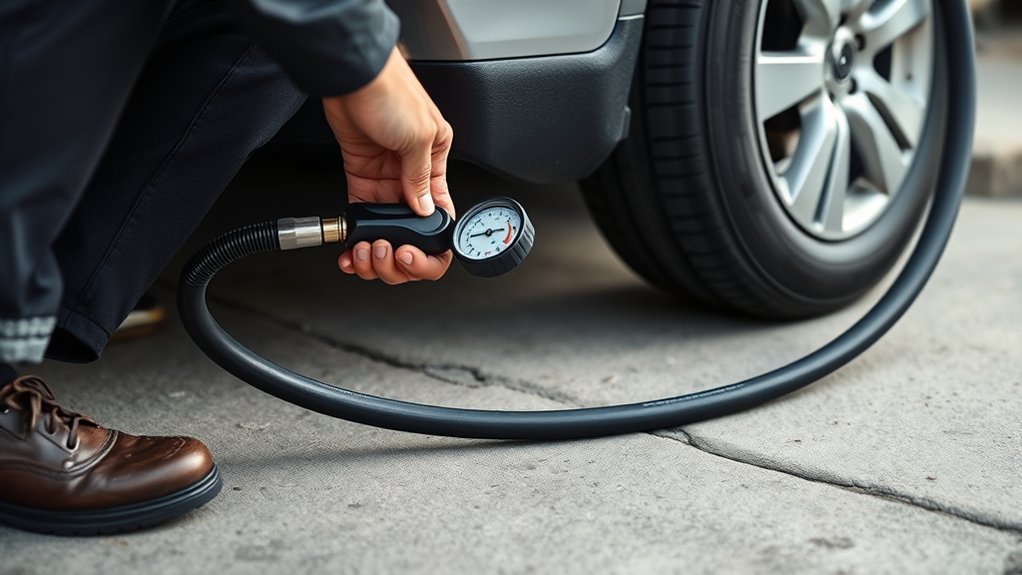
Once you know the current reading, use the gas station air pump or a portable compressor to bring the tire up to the target PSI. Add air slowly. A few seconds can change the reading more than you expect, especially on smaller tires.
Confirm the Recommended PSI
Check the recommended PSI on the vehicle label again before you start filling. This is especially important if your front and rear tires use different pressures. Remove the valve cap and keep it clean so you can reinstall it later.
Compare the current tire pressure to the target. If the label says 35 PSI and your gauge says 31 PSI, you need to add about 4 PSI. Regular pressure checks support proper tread life and performance, but the exact target should always come from your own vehicle.
Attach the Air Hose
Slide the air hose chuck straight onto the valve stem and press firmly. If air leaks loudly from the connection, the hose is not seated correctly. Remove it and try again at a straighter angle.
Start the air compressor with the button, payment system, or station control. Some pumps let you set the target PSI first, while others require you to fill manually and check often.
| Step | Action | Result |
|---|---|---|
| 1 | Seal hose on valve stem | Air flows into the tire instead of leaking out |
| 2 | Add air in short bursts | Reduces the chance of overfilling |
| 3 | Recheck with your gauge | Confirms the final PSI |
Recheck Tire Pressure
After adding air, remove the hose and check the pressure again with your gauge. If the reading is still low, add another short burst and recheck. If the reading is too high, release a small amount of air and check again.
If you had to drive to the gas station, the tires may be warm. In that case, any adjustment is temporary. Some tire guidance suggests setting warm tires about 4 PSI above the cold target when you must fill at a station, then rechecking when the tires are cold. The safest habit is to confirm the final pressure later after the vehicle has been parked for at least three hours.
- Attach the hose securely.
- Add air in short bursts.
- Watch the pump gauge if it has one.
- Verify with your own gauge when possible.
- Replace the valve cap when you finish.
Let Air Out of an Overinflated Tire
If the tire pressure is too high, release air slowly. Many tire gauges have a small deflation button or nub. You can also press the small center pin inside the valve stem with the tip of the gauge, a pen tip, or your fingernail.
Let air out in brief taps, then check the pressure again. Do not hold the valve open for too long because pressure can drop quickly. Repeat until the reading matches the recommended PSI from the vehicle label.
When you are done, replace the valve cap firmly. The cap helps keep dirt and moisture out of the valve. Proper pressure also supports wet-road control, along with choosing tires suited for wet-road traction.
What If the Gas Station Gauge Seems Wrong?
Gas station air pumps are useful, but they are not always perfect. Hoses, chucks, and built-in gauges can get dropped, weathered, or worn. If the station gauge and your personal gauge disagree, use your personal gauge as the more consistent reference, especially if you know it has been accurate in the past.
Here are common problems and quick fixes:
- The gauge reads 0 or very low: The chuck probably is not sealed. Press it on straighter and harder until the hiss stops.
- Air leaks loudly while filling: Remove the hose and reseat it on the valve stem.
- The machine times out: Recheck the tire, restart the pump if needed, and continue in small steps.
- The tire will not hold pressure: Stop topping it off repeatedly. It may have a puncture, leaking valve, bead leak, or wheel damage.
- The TPMS light stays on: Recheck all tires cold. If pressures are correct and the light stays on or flashes, the TPMS may need service.
[Products Worth Considering]

The JACO FlowPro Tire Inflator measures, inflates, and airs down tires up to 100 PSI with battery-free operation and ±2% accuracy after calibration. It features a glowing pressure dial for night visibility, a heavy-duty steel build with a hybrid hose, and a precision push-to-inflate thumb trigger. The patented Lightning Air Chuck locks on for a secure seal, and the kit includes quick-connect hardware for easy inline use with your air compressor.

The Fanttik X10 Pro is a cordless portable tire inflator that reaches up to 150 PSI and can inflate an R15 tire in about 35 seconds for quick roadside or home top-ups. With AccuInFlate auto-stop and smart start/stop controls, it helps maintain accurate pressure and frees your hands once the target is reached. A high-visibility digital display and preset modes make it easy to set and monitor inflation for cars, motorcycles, bikes, and balls.
Why a Digital Tire Gauge Helps
A digital tire gauge helps because it gives a clear PSI number without making you interpret a needle or sliding stick. This is especially helpful at night, in cold weather, or when you are working quickly at a busy gas station.
Digital gauges are not required, but they can make tire checks easier. Some models also store readings, light up the valve area, or shut off automatically to save battery.
- Clear numbers reduce reading mistakes.
- Fast readings make pump stops easier.
- Memory features can help you track slow pressure loss.
- Backlit screens are easier to use in low light.
- A personal gauge helps you avoid relying only on a station gauge.
Whichever gauge you choose, keep it clean and store it where you can find it. Understanding tire size specifications can also help with tire shopping, but pressure checks still depend on your vehicle’s PSI label.
Check All Four Tires Again
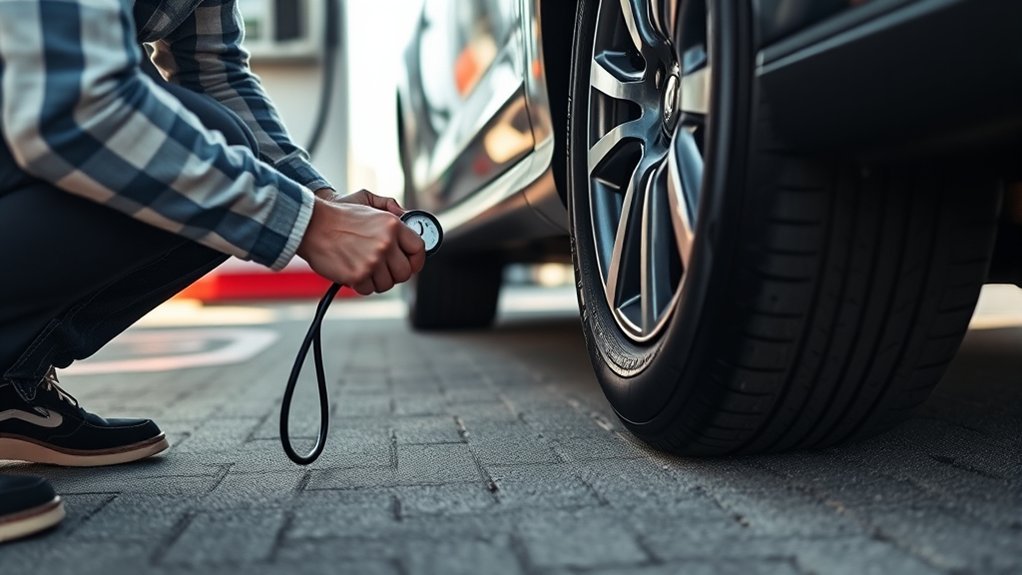
After you check one tire, repeat the same process on all four. Each tire can have a different pressure because of load, temperature, small leaks, and driving conditions.
Work in a simple pattern so you do not miss one: front left, front right, rear right, rear left. If your vehicle has a spare tire, check that too when accessible. Some spare tires need much higher pressure than the road tires, so check the spare’s label or owner’s manual.
Remove each valve cap, press the gauge straight onto the valve stem, and read the pressure right away. Record the readings if you are trying to spot a slow leak. After you adjust a tire, replace the valve cap before moving to the next one.
Good pressure habits support vehicle safety and performance, but tire selection also matters for ride quality, traction, and wear.
Note: Do not rely on the TPMS light alone. Federal rules allow a TPMS warning threshold that may not trigger until a tire is significantly below the recommended cold pressure. A monthly manual check is still the better habit.
When to Recheck Tire Pressure
Recheck tire pressure at least once a month and before long trips. Tires naturally lose pressure over time, and temperature changes can shift PSI even when nothing is wrong with the tire.
After Temperature Swings
Cold weather can lower tire pressure, and warm weather can raise it. A common rule of thumb is that pressure may change by about 1 PSI for every 10°F temperature shift, but the exact change can vary. The practical step is simple: after a major weather change, check your tires cold and adjust them to the placard PSI.
- Cold tires give the most accurate reading.
- Cold snaps can reveal low pressure.
- Heat can make a tire read temporarily higher.
- Season changes are a good reminder to check.
- Correct pressure supports safety, tire life, and fuel economy.
Monthly Pressure Checks
Check tire pressure at least once a month, even if the tires look fine. Underinflated tires can be hard to spot by eye. Use a gauge when the tires are cold, remove the valve cap, press the gauge straight on, and read the PSI.
If the reading is low, add air and recheck. If the reading is high, release air in small taps and recheck. Monthly tire pressure checks help reduce uneven wear, wasted fuel, and the risk of driving on a dangerously low tire.
Before Road Trips, Heavy Loads, or Towing
Check tire pressure before a long drive, carrying heavy cargo, or towing. Some vehicles list separate PSI guidance for heavy loads. If your vehicle does, follow that label or owner’s manual instruction before the trip, then return to the normal setting when the load changes if the manual tells you to.
Frequently Asked Questions
How do you read a gas station tire gauge?
Press the air-hose gauge or your personal gauge straight onto the valve stem until the air hiss stops. Read the PSI on the digital screen, dial, or sliding stick. Compare that number with the recommended cold PSI on your vehicle’s door-jamb sticker or owner’s manual.
Should I trust the tire gauge at a gas station?
You can use it, but it is smart to verify with your own tire gauge when possible. Station gauges and air hoses can be worn, dropped, or exposed to weather. If your personal gauge and the station gauge disagree, rely on the gauge you know is consistent.
What should my tire pressure be for a Subaru Outback?
A Subaru Outback often uses tire pressure in the low-to-mid 30 PSI range, but the exact number depends on model year, tire size, trim, and load. Check the driver-side door-jamb sticker or owner’s manual and use that cold PSI as your target.
How do I check tire pressure on a Mercedes GLS 450?
Open the driver’s door and find the tire pressure label. Check the tires cold, remove the valve cap, press a gauge firmly onto the valve stem, and compare the reading with the listed PSI. Some GLS 450 models may also show tire pressures in the vehicle menu, but a manual gauge check is still useful.
What tire pressure does a Kia Forte need?
Many Kia Forte models use a pressure around the low 30s PSI, but you should not guess. Check the door-jamb sticker or owner’s manual for your exact model year and tire size. Use that number when the tires are cold.
What PSI should RAV4 tires be?
Most Toyota RAV4 tires are commonly set somewhere around the low-to-mid 30 PSI range, but the correct number is on your driver-side door-jamb sticker or in the owner’s manual. Check pressures cold and follow the manufacturer’s spec, not the sidewall maximum.
Why did my TPMS light come on after cold weather?
Cold weather can lower tire pressure enough to trigger the TPMS light. Check all tires with a gauge when they are cold and inflate them to the vehicle’s recommended PSI. If the light flashes or stays on after pressures are correct, the TPMS may need service.
Conclusion
Now you can read a gas station tire gauge with confidence. Find the recommended cold PSI first, press the gauge firmly onto the valve stem, read the number, and adjust the tire in small steps. Recheck after every fill or release, replace the valve caps, and repeat the process on all four tires.
Make tire pressure a monthly habit and check again before long trips or big temperature changes. Correct pressure helps protect handling, tire wear, fuel economy, and safety.
Sources
- NHTSA TireWise: Tire Safety Ratings and Awareness — supports cold tire pressure checks, monthly tire checks, tire placard guidance, TPMS limitations, and tire safety context.
- FuelEconomy.gov: Keeping Your Vehicle in Shape — supports fuel economy impact and the instruction to use the door-jamb sticker or owner’s manual instead of the sidewall maximum.
- eCFR 49 CFR 571.138: Tire Pressure Monitoring Systems — supports TPMS warning-threshold context.
- Bridgestone: How to Check Tire Pressure with a Tire Pressure Gauge — supports gauge use, cold tire definition, gas station compressor guidance, hot-tire adjustment caution, and personal gauge advice.

Related Articles

How to Book a Tire Appointment at Walmart
Mysterious steps make booking a Walmart tire appointment simpler than you think, but one crucial detail could save you time and money.
Read More
How to Book a Tire Appointment at Discount Tire
Online or by phone, booking a Discount Tire appointment is easy—just gather a few details first and discover the fastest way to get in.
Read More
How to Book a Tire Appointment at Sam’s Club
Know the quick steps to book a Sam’s Club tire appointment and avoid common booking mistakes before you head in.
Read More