
53Pcs Tire Patch Kit Review: Heavy-Duty Tire Repair Tools with Buffing Wheel and Patches
Disclosure: As an Amazon Associate, we earn from qualifying purchases. If you click a link on this page and make a purchase, we may receive a small commission at no extra cost to you.
A flat tire can turn into an expensive delay, but the right repair supplies depend on the type of tire and where the damage occurred. The BDYAQGC 53-piece Tire Patch Kit gives you a large patch assortment, a 42 mm tungsten steel buffing wheel, a roller, a liner scraper, and valve tools in one compact set. Its main strength is the amount of reusable hardware and patch material you receive. Its main limitation is important: it does not include vulcanizing cement or the plug or stem needed for an industry-standard passenger-car tread repair.
Quick Verdict
Rating: 8.2/10, recommended with caveats
Best For: Home garages, bicycle or equipment inner-tube work, and buyers who already own compatible cement and repair materials
Bottom Line: You get 45 patches in three sizes plus useful preparation and valve tools. For tubeless passenger and light-truck tires, this is a supporting tool kit rather than a complete repair system because a patch alone does not meet industry repair guidance.
Key Specifications
| Specification | Detail |
|---|---|
| Brand | BDYAQGC |
| Product type | Inside-tire patch preparation and application kit |
| Total pieces | 53 |
| Patch count | 45 patches, 15 per size |
| Patch sizes | 32 mm, 42 mm, and 58 mm |
| Buffing tool | 42 mm tungsten steel buffing wheel |
| Included hand tools | Patch roller, inner-liner scraper, single-head valve-core tool, double-head valve-core tool, and 4-way valve tool |
| Included adapters | Low-speed hexagonal connecting rod and high-speed circular connecting rod |
| Supplies not listed | Vulcanizing cement, tire cleaner, plug stems, inflation equipment, and tire-removal tools |
| Best use | Garage-based repair preparation, compatible tube repairs, valve service, and use as part of a complete repair process |
[Products Worth Considering]

This tire repair patch tool kit helps you quickly seal small punctures using upgraded mushroom plugs and a built-in roller system that presses for even penetration. The tungsten buffing wheel and HSS twist drill bits prepare the damaged surface for stronger adhesion, while the crown-angle friendly plugs are designed to keep water and debris out. Ideal for puncture repairs on many vehicle types, from cars and trucks to bikes and scooters.

This VEVOR tire bead breaker uses a slide-hammer impact and wedge tip to separate tire beads from rims quickly and efficiently without damaging hub surfaces. The long handle and sturdy steel construction help reduce user strain while providing reliable, portable tire changing for cars, trucks, and more. Ideal for home mechanics and repair shops handling multiple vehicle tire sizes.

This compact capsule-style tire repair kit helps you quickly fix punctures and plug flats with minimal effort. The rugged stainless steel shell protects the contents for reliable roadside use, while the simple plug assembly makes repairs fast and tool-free. Suitable for motorcycles, cars, ATVs, UTVs, and even mountain bikes.
BDYAQGC 53Pcs Tire Patch Kit
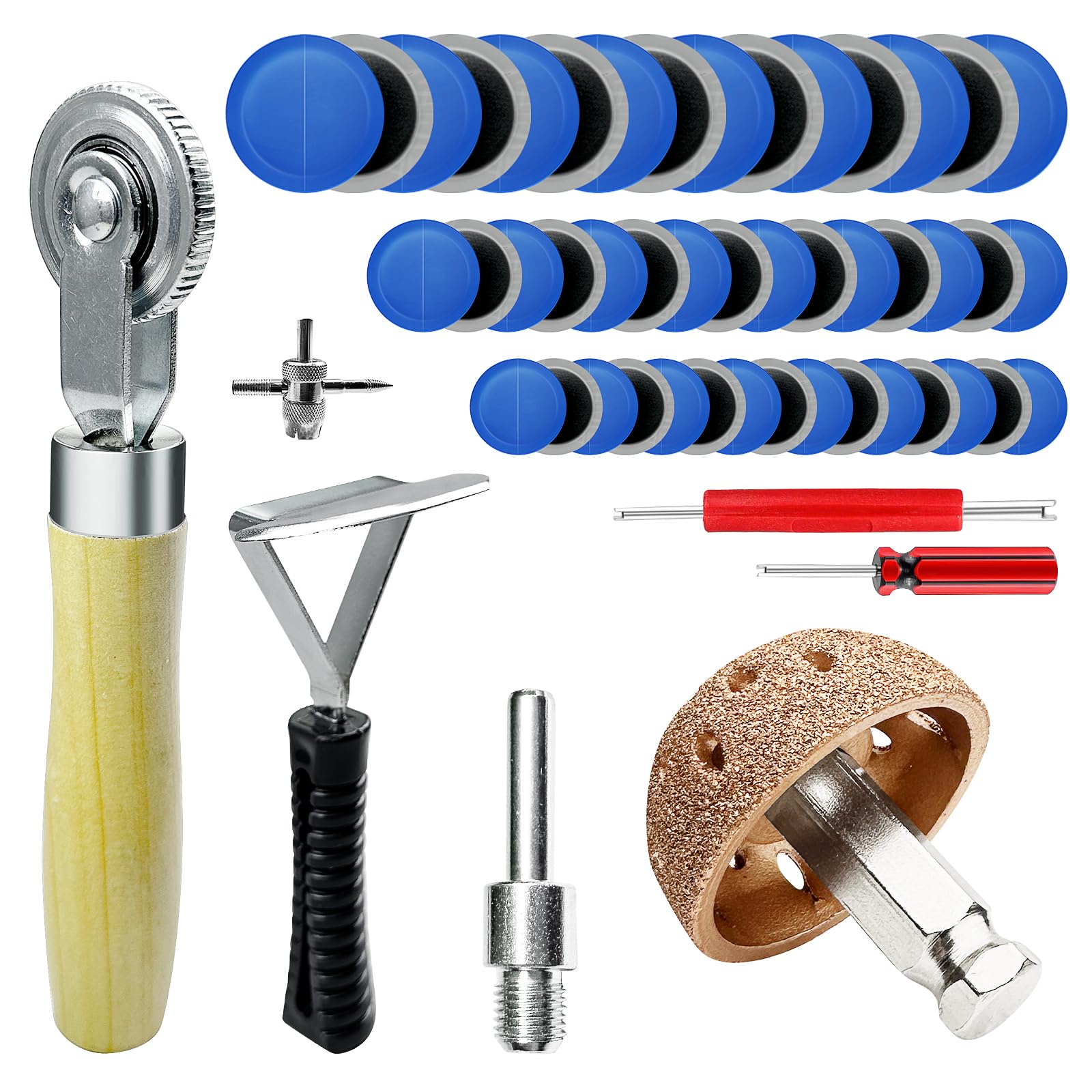
The BDYAQGC set is built around inside-the-tire surface preparation. The tungsten steel wheel roughens the repair area, the scraper removes residue from the inner liner, and the roller helps press a patch evenly after compatible cement has been applied. You also receive 45 patches, divided across 32 mm, 42 mm, and 58 mm diameters, so you can choose a patch that extends beyond a small injury area.
The extra valve-core tools add value for garages that service bicycles, motorcycles, lawn equipment, ATVs, and other pneumatic tires. However, the kit does not include every item needed for every tire type. You still need the correct vulcanizing cement, cleaning solution, inflation equipment, and any repair stem or plug required by the tire maker or industry procedure.
Who Should Buy It?
Best For
- Home mechanics who already have tire cement, cleaner, and suitable repair units
- Owners servicing repairable inner tubes or off-highway equipment according to the tire maker’s instructions
- Garages that want reusable buffing, rolling, scraping, and valve-core tools in one set
Skip If
- You need a complete roadside repair kit that works without removing the tire
- You plan to repair passenger-car tubeless tires with a patch alone
- The damage is in the sidewall or shoulder, exceeds the tire maker’s repair limit, or includes internal structural damage
Before You Buy: For passenger and light-truck tires, the U.S. Tire Manufacturers Association says a repairable tread puncture should be no larger than 1/4 inch (6 mm), the tire must be removed and inspected, and the injury channel must be filled with a stem or plug while the inner liner is sealed with a patch. This kit does not include that plug or stem, so it should not be treated as a complete highway-tire repair system. Review the USTMA tire repair guidance before deciding whether a tire is repairable.
Materials and Build Quality
The 42 mm tungsten steel buffing wheel is the most distinctive component. It gives you a powered way to prepare rubber more consistently than a small sheet of sandpaper, especially when you have several repairs to complete. The connecting rods provide mounting options for compatible rotary equipment, but you should use controlled speed and light pressure so you do not remove too much inner-liner material.
The roller, scraper, and valve tools are metal, which makes them more reusable than the patches and cement. The patches are consumables, while the tools should remain useful after the included patch supply is gone. The storage packaging is basic, so a small divided toolbox may protect the patches and keep the metal pieces organized better over time.
Patch Sizes and Compatibility
The kit includes 15 patches in each of three diameters: 32 mm, 42 mm, and 58 mm. That range is useful because the patch must cover the prepared area with enough margin for a secure bond. The smallest size suits compact tube punctures, while the larger sizes provide more coverage for approved repairs that require a wider prepared surface.
Patch diameter does not determine whether a damaged tire is safe to repair. Tire construction, injury size, angle, location, prior repairs, and internal damage all matter. Passenger and light-truck sidewall or shoulder damage should not be patched, and a tire that has been driven while severely underinflated needs a full internal inspection before reuse.
Ease of Use
The tools follow a logical sequence: mark the injury, remove and inspect the tire or tube, clean and prepare the repair area, apply the correct cement and repair unit, then roll the patch from the center outward. Patch selection and rolling are simple. Correct inspection, buffing depth, cement choice, cure time, and tire reassembly require more skill.
This is not a true grab-and-go roadside solution for a passenger vehicle. An internal patch requires access to the inside of the tire, which usually means demounting it from the wheel. You also need a way to reinflate the tire and verify that the repair holds pressure.
Pro Tip: Store the rubber patches in a sealed bag away from heat, oil, moisture, and direct sunlight. Keep your cement tightly closed and check its condition before starting, because dried or incompatible cement can ruin an otherwise careful repair.
How It Performs in Real Use
For Bicycle and Small-Equipment Inner Tubes
The patch variety and roller are useful when a tube can be safely removed, inspected, and repaired. You still need cement that is compatible with the tube material. Some modern bicycle tubes use TPU rather than conventional butyl or latex, and those may require a product-specific repair method.
For Passenger-Car and Light-Truck Tires
The buffing wheel, scraper, roller, and patches can support an inside repair, but the set is incomplete by itself. A proper repair requires the tire to be removed, the full injury to be inspected, and the puncture channel to be filled as well as the inner liner sealed. For most drivers, a trained tire technician is the safer choice.
For ATVs, Lawn Equipment, and Small Tractors
The mix of patch sizes and valve tools can be practical for off-highway equipment, especially in a workshop where you already have tire irons, cement, compressed air, and leak-testing supplies. Follow the equipment and tire manufacturer’s repair limits because low-speed or agricultural tires can use different constructions and procedures.
For Long-Term Garage Use
The reusable metal tools are the strongest long-term value. Once the original patches are used, you can restock compatible patches and cement instead of replacing the entire kit. Keep the buffing wheel clean and inspect it for damage before each use.
How to Use It Correctly
- Confirm the damage is repairable. Do not proceed with sidewall, shoulder, bead, exposed-cord, severe run-flat, or oversized damage.
- Remove and inspect the tire or tube. For passenger and light-truck tires, inspection from the inside is part of a proper repair.
- Mark and clean the repair area. Use a cleaner approved for the tire or tube material, and let the surface dry.
- Prepare the surface carefully. Use the scraper and buffing wheel only as directed. Over-buffing can damage the inner liner.
- Use the correct repair materials. Apply compatible vulcanizing cement and, where required, a stem-and-patch or combination repair unit rather than a patch alone.
- Roll and cure the repair. Press from the center toward the edges, follow the cement maker’s cure instructions, then inspect and leak-test the assembly.
- Reinflate safely. Use the vehicle or tire maker’s specified pressure and have the assembly checked professionally when there is any doubt.
[Products Worth Considering]

Wykodra tire plugs provide quick vulcanizing repairs for tubeless tires, helping you seal punctures and get back on the road. The industrial-strength rubber creates a long-lasting, leak-resistant bond and is designed for emergency fixes without removing the tire. Choose between two standard plug sizes with color-matched options for small to larger damage across many vehicles and off-road uses.
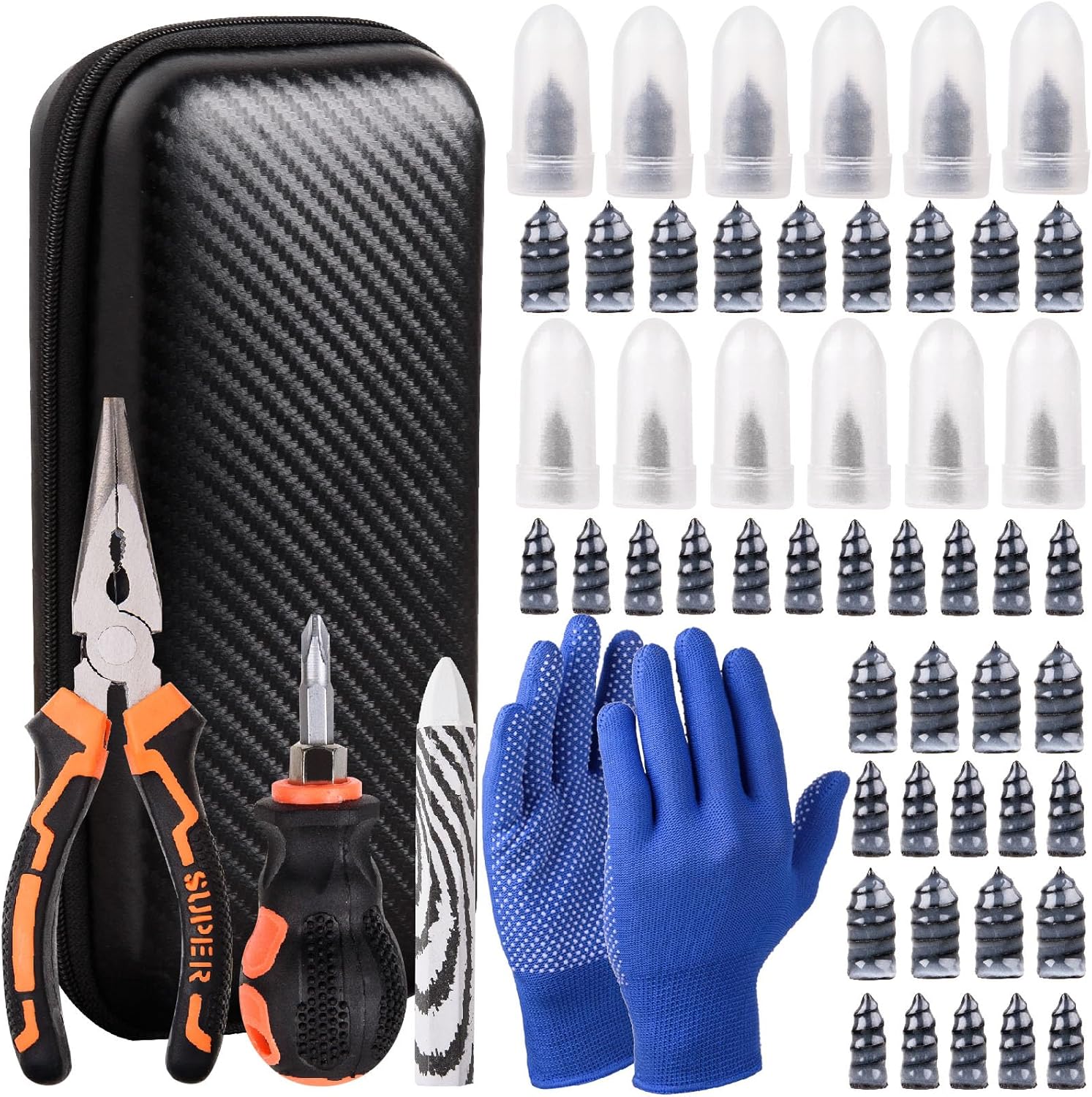
This tire sidewall puncture repair kit fixes flats fast without removing the tire, helping you get back on the road in minutes. It includes self-tapping repair nails, essential tools, gloves, and a portable storage bag for convenient roadside use. Designed for tubeless tires, it helps create a tight, leak-resistant seal for cars, motorcycles, trucks, SUVs, and ATVs.
What People Say
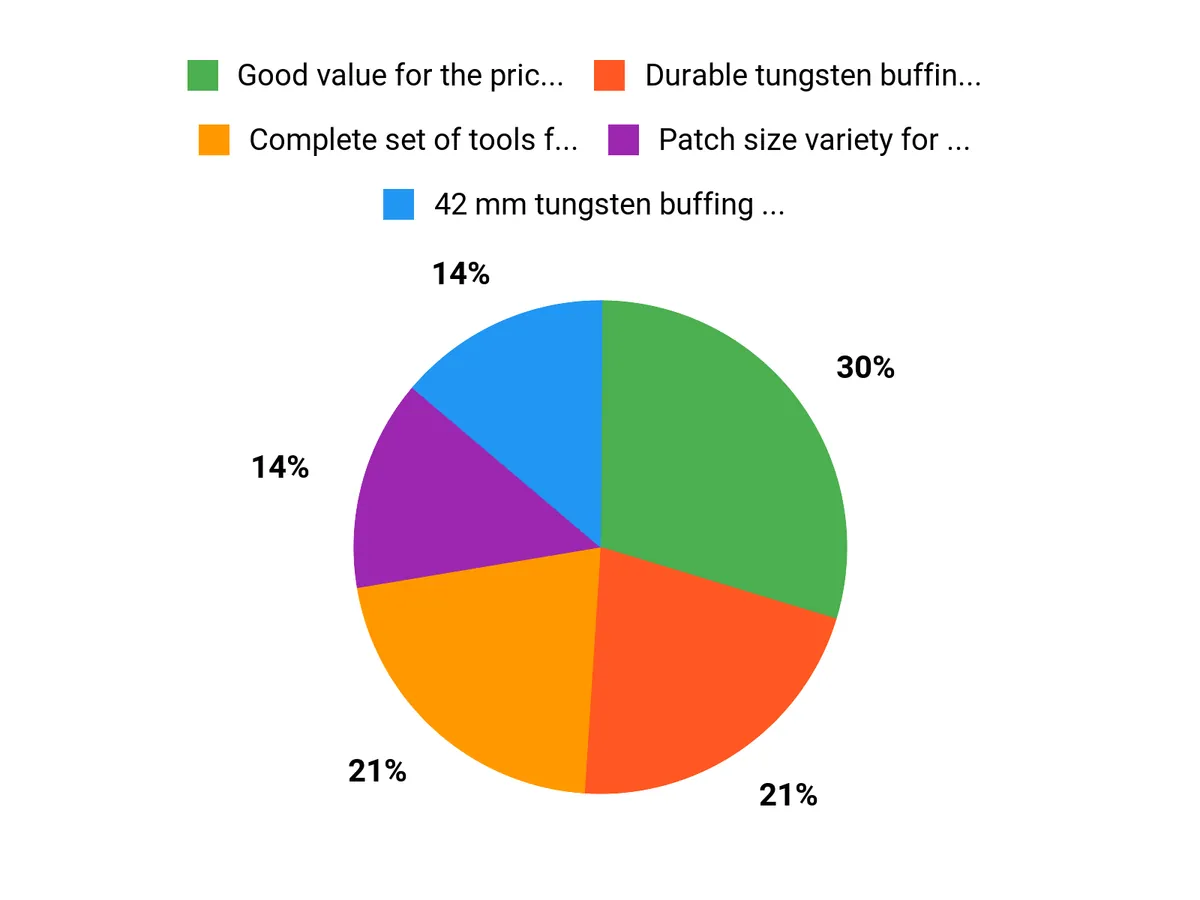
The article’s existing customer-sentiment summary is positive, with repeated praise for the patch quantity, metal tools, and buffing wheel. The most useful criticism is also consistent: cement and cleaner are not included, so the box is not ready for a complete repair as delivered. Treat the chart below as a snapshot of the article’s earlier feedback summary, not as a live Amazon rating.
Overall Sentiment: Positive, with a significant completeness caveat

Pros and Cons
Pros
- Includes 45 patches in three useful diameters
- 42 mm tungsten steel wheel speeds surface preparation
- Metal roller and liner scraper support cleaner patch installation
- Multiple valve-core tools add utility beyond patching
- Reusable hardware can be paired with future patch refills
Cons
- No vulcanizing cement or tire cleaner is included
- No plug stems or combination repair units are included for proper passenger-tire puncture repair
- Internal patching requires tire removal, inspection, inflation equipment, and repair skill
Is It Worth the Price?
This kit offers strong value when you judge it as a collection of reusable preparation tools plus a large patch refill. Buying a buffing wheel, roller, scraper, valve tools, and 45 patches separately could be less convenient. Buyers who already own compatible cement and know which repair units their tires require will get the most from it.
It is less compelling as a first or only tire-repair purchase. You must add cement and cleaner, and passenger-vehicle repairs may also require plug stems, a tire changer, inspection tools, balancing equipment, and professional training. The low kit price should not outweigh the cost of an unsafe or incomplete repair.
How It Compares to Alternatives
For bicycle inner tubes, the Park Tool VP-1 is smaller and includes vulcanizing fluid, but it has far fewer patches and no powered buffing wheel or valve-service tools. It is a better fit for a saddle bag, while the BDYAQGC set is better suited to a garage.
For buyers who want both patches and plugs in one package, the Slime Pro-Series Tire Patch & Plug Kit includes rubber cement, patches, and string plugs. However, string plugs should be treated according to the product instructions and tire-industry guidance, and they do not remove the need for internal inspection when repairing a highway tire. A professional patch-plug combination repair remains the stronger choice for a repairable passenger-car tread puncture.
Frequently Asked Questions
Does the BDYAQGC kit include vulcanizing cement?
No cement or dedicated tire cleaner is listed with the 53-piece set. Buy a cement that is compatible with your patch and tire or tube material, then follow its preparation, flash, and cure instructions.
Can this kit repair a passenger-car tire by itself?
Not according to standard passenger and light-truck puncture-repair guidance. The kit supplies patches and preparation tools, but it does not include the stem or plug needed to fill the injury channel, and the tire still must be removed and inspected.
Can you repair sidewall or shoulder damage with these patches?
No. Sidewall and shoulder damage on passenger and light-truck tires falls outside the accepted tread repair area. Replace the tire or have a qualified technician inspect it.
What patch sizes are included?
You receive 15 patches in each of three diameters: 32 mm, 42 mm, and 58 mm. Choose a size that matches the approved repair procedure and leaves adequate coverage around the prepared area.
Is the kit suitable for bicycle tubes?
It can be useful for repairable tubes when the patch and cement are compatible with the tube material. Check the tube maker’s instructions first, especially for TPU tubes, which may need a specialized patch system.
Do you need to remove the tire from the wheel?
You need access to the inner liner to use an internal patch correctly. Passenger and light-truck tire guidance also calls for removing the tire so hidden inner-liner, belt, or run-flat damage can be inspected.
What is the most common mistake when using the kit?
The biggest mistake is treating patch size as proof that the tire is repairable. Confirm the injury location and size first, inspect the inside, use compatible cement, avoid over-buffing, and do not rely on a patch-only repair for a passenger or light-truck tire.
Why Customers Choose
You may choose the BDYAQGC kit for its combination of 45 patches, three patch sizes, a powered buffing wheel, a roller, a liner scraper, and valve tools. It makes the most sense when you want a reusable garage kit and already understand that additional chemicals, repair units, and tire-service equipment may be required.
The Bottom Line
The BDYAQGC 53-piece Tire Patch Kit is a practical value for experienced DIY users who need patch preparation tools, valve tools, and a large supply of three patch sizes. Skip it as a stand-alone highway-tire repair solution because cement, cleaner, and puncture-filling stems are not included, and proper passenger-tire repair requires internal inspection and a patch-plus-stem or combination unit.
Ready to Buy?
Check the latest price, package details, and included components before you decide.

Related Articles

Best Westlake Tires 2026: Affordable Tires for Daily Driving and All-Season Use
You spend a lot of time on the road, and the tires you choose affect safety, comfort, fuel economy, and long-term costs. Westlake offers…
Read More
Best Sailun Tires 2026: Affordable Tire Picks for Everyday Driving
You rely on tires for safety, fuel economy and ride comfort, so choosing the right Sailun model matters more than just price. This guide…
Read More
Best Snow Tires for Trucks 2026: Winter Truck Tires for Safe Cold-Weather Driving
Winter tires are one of the most effective upgrades you can make to keep your truck safe when temperatures drop and roads become snow-…
Read More