
How Often Should You Balance Honda Accord Tires

You should check the balance on your Honda Accord tires about every 5,000 to 8,000 miles, often when you rotate the tires, and balance them sooner if you feel vibration at highway speed, install new tires, repair a tire, hit a pothole, or lose a wheel weight. Your exact service timing should still follow your Accord owner’s manual, tire placard, tire warranty, and the advice of a qualified technician.
Quick Answer
For most Honda Accord drivers, tire balancing is worth checking every 5,000 to 8,000 miles, usually with tire rotation. Balance new tires at installation and schedule service sooner if the steering wheel, seat, or floor vibrates at speed, or after a hard pothole or curb impact.
Key Takeaways
- A practical Honda Accord tire balancing interval is every 5,000 to 8,000 miles, especially when the tires are already off for rotation.
- Balance new tires when they are installed because even a new tire and wheel assembly can have small weight differences.
- Highway-speed vibration is the classic balance warning sign, while pulling to one side points more often to alignment, pressure, or tire problems.
- Professional dynamic balancing is more accurate than DIY methods and is the better choice for modern Accord wheels.
- Proper tire pressure, rotation, balance, and alignment work together to protect tread life, ride comfort, and safety.
At a Glance
| Best Interval | Check balance about every 5,000 to 8,000 miles, or sooner if symptoms appear. |
| Time Required | About 30 to 60 minutes at most tire shops, depending on wait time and wheel condition. |
| Difficulty | Best handled by a professional because accurate balancing requires a wheel-balancing machine. |
| Tools Needed | Dynamic wheel balancer, wheel weights, valve inspection tools, lift or jack, jack stands, and torque wrench. |
| Typical Cost | Often priced per wheel, sometimes included with tire installation or a tire-service package. Confirm the current price before booking. |
Why Regular Tire Balancing Matters for Your Honda Accord
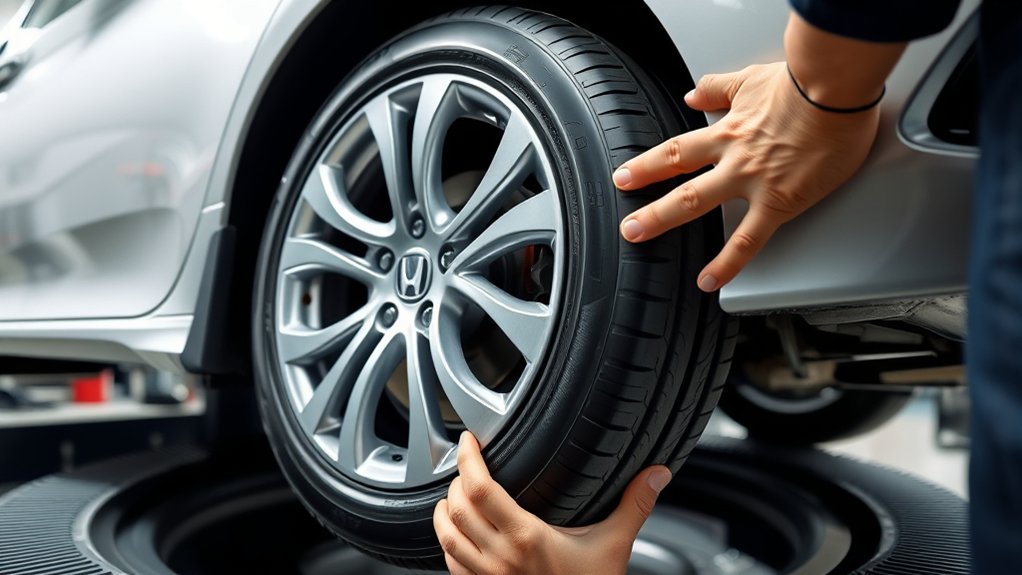
Tire balancing corrects small weight differences in the tire and wheel assembly. When the assembly is out of balance, the wheel can shake as it rotates. You may feel that shake through the steering wheel, seat, or floor, especially as speed rises.
The National Highway Traffic Safety Administration explains that tire balancing helps wheels rotate properly and helps prevent vehicle shake or vibration. That matters on a Honda Accord because the car is quiet enough that small vibration problems are easy to feel, and ignoring them can lead to uneven tire wear and extra stress on suspension parts.
Balancing is not only about comfort. It also helps the tire maintain steady contact with the road, protects tread wear, and makes it easier to notice other problems before they become expensive.
[Products Worth Considering]

This 4-in-1 tire valve core removal tool helps you deflate, unblock, and remove or install valve cores quickly for easier tire repair. The multifunction design also supports re-taping damaged threads and reaming inside the valve stem for smoother service. Included as a 2-pack, it’s compact for convenient carry and works for cars, bicycles, and motorcycles.

This VEVOR tire bead breaker uses a slide-hammer impact and wedge tip to separate tire beads from rims quickly and efficiently without damaging hub surfaces. The long handle and sturdy steel construction help reduce user strain while providing reliable, portable tire changing for cars, trucks, and more. Ideal for home mechanics and repair shops handling multiple vehicle tire sizes.

Universal magnetic jack pad with aluminum grooved design to protect vehicle pinch welds during lifting. Durable nylon pad inserts are upgraded and secured with screws to resist damage and keep in place. Designed to fit most single vehicle pinpoint welds for safer, stable jacking when changing tires, repairs, or performing oil changes.
How Often Should You Balance Honda Accord Tires?
For most Honda Accord owners, the easiest rule is to check tire balance every 5,000 to 8,000 miles, usually when the tires are rotated. NHTSA recommends checking the owner’s manual for the correct tire rotation schedule and says that, when recommended by the manufacturer, rotation is commonly done every 5,000 to 8,000 miles.
That does not mean every Accord needs a separate paid balance at every rotation. If the ride is smooth, the tires are wearing evenly, and the shop finds no issue, you may only need a balance check. If vibration appears or the tires were recently mounted, repaired, or impacted, balancing is the safer choice.
| Situation | What to Do | Why It Matters |
|---|---|---|
| Every 5,000 to 8,000 miles | Check balance during rotation. | This keeps tire service on a simple routine and helps catch vibration issues early. |
| New tire installation | Balance all new tire and wheel assemblies. | NHTSA says new tires should always be balanced when installed. |
| Steering wheel vibration at speed | Schedule a balance inspection. | High-speed shake is one of the clearest balance-warning signs. |
| After pothole, curb hit, or tire repair | Inspect the wheel, tire, and balance. | Impact can bend a wheel, shift a tire, or knock off a wheel weight. |
Note: Honda Accord service needs can vary by model year, wheel size, tire type, driving conditions, and tire warranty. Use the official Honda owner manual portal to check the guidance for your exact Accord.
Signs Your Honda Accord Tires Need Balancing
The most common sign of tire imbalance is vibration that gets worse as speed increases. On many Accords, front-wheel imbalance often shows up in the steering wheel, while rear-wheel imbalance may feel more like a shake through the seat or floor.
- Steering wheel vibration: Often noticeable around highway speeds.
- Seat or floor vibration: May point to rear tire imbalance or another rotating part.
- Cupped or patchy tread wear: Can happen when a tire bounces instead of rolling smoothly.
- New noise after tire service: A wheel weight may be loose, missing, or placed incorrectly.
- Vibration after a pothole: The wheel may be bent, the tire may be damaged, or the balance may be off.
If your Accord pulls to one side on a straight, level road, do not assume tire balance is the only cause. Pulling is more often tied to alignment, uneven tire pressure, a tire defect, brake drag, or worn steering and suspension parts.
How Do Unbalanced Tires Affect Vehicle Performance?

Unbalanced tires can make your Honda Accord feel less stable and less refined. The vibration can make the steering feel busy, create extra cabin noise, and make long highway drives more tiring.
The bigger concern is what happens over time. A tire that is not rotating smoothly can wear unevenly. Uneven tread can reduce ride comfort, shorten tire life, and make it harder for a technician to diagnose alignment or suspension issues later.
Unbalanced tires can also put extra stress on related parts. Wheel bearings, shocks, struts, tie rods, and other suspension components are designed to work with a smoothly rotating wheel. If vibration continues after balancing, have the tire, wheel, alignment, brakes, and suspension inspected rather than balancing the same wheel repeatedly.
Tire Balancing vs Rotation vs Alignment
Tire balancing, tire rotation, and wheel alignment are related, but they fix different problems. Knowing the difference helps you avoid paying for the wrong service.
| Service | What It Corrects | Common Warning Sign |
|---|---|---|
| Tire balancing | Uneven weight around the tire and wheel assembly. | Vibration or shaking at speed. |
| Tire rotation | Tire position on the car to help even out normal wear. | Front tires wearing faster than rear tires. |
| Wheel alignment | Wheel angles such as toe, camber, and caster. | Pulling, off-center steering wheel, or edge wear. |
NHTSA notes that alignment helps prevent a car from veering right or left when driving on a straight, level road. So if your Accord tracks poorly but does not shake, ask for an alignment and tire-pressure inspection before assuming balance is the main issue.
When Should You Balance Tires Sooner?
You do not need to wait for the next scheduled rotation if the car starts showing symptoms. Balance your Honda Accord tires sooner in these situations:
- You install new tires.
- You repair a puncture and remount the tire.
- You switch seasonal wheel and tire sets.
- You hit a curb, pothole, road debris, or deep railroad crossing.
- You notice a missing wheel weight.
- You feel vibration after a tire rotation.
- You see cupping, scalloping, or patchy tread wear.
- You drive often on rough roads or construction zones.
Pro Tip: If the vibration started right after tire service, return to the shop and explain exactly when it happens. “Steering wheel shakes at 60 mph” is more useful than “car feels rough.”
What Happens During Professional Tire Balancing?
During professional tire balancing, the technician removes the wheel and tire assembly, places it on a balancing machine, spins it, and lets the machine identify where weight is needed. The technician then adds small weights to the wheel to correct the heavy and light spots.
A standard dynamic balance is enough for many Accords. If the car still shakes after normal balancing, ask whether the shop offers road-force balancing. Road-force balancing checks how the tire and wheel behave under load and can help find a bent wheel, stiff tire spot, or tire-to-wheel match problem.
A good tire shop should also inspect tire pressure, tread wear, wheel damage, valve stems, and lug-nut torque. If the tire is damaged, out of round, or mounted on a bent wheel, balancing alone may not solve the vibration.
Should You DIY Tire Balancing or Seek Professional Help?
You can inspect your Honda Accord tires at home, but accurate balancing is best left to a tire shop or Honda service center. Modern wheels need precise dynamic balancing, and small errors can still cause vibration at highway speed.
At home, you can check for missing wheel weights, low tire pressure, uneven tread wear, bulges, cuts, and objects stuck in the tread. You can also note when the vibration happens and whether it changes after tire rotation. That information helps the technician diagnose the issue faster.
Warning: Never work under a vehicle supported only by a jack. Use proper jack stands on a level surface, follow the Accord owner’s manual, and have a qualified technician handle service if you are unsure.
[Products Worth Considering]

The JACO FlowPro Tire Inflator measures, inflates, and airs down tires up to 100 PSI with battery-free operation and ±2% accuracy after calibration. It features a glowing pressure dial for night visibility, a heavy-duty steel build with a hybrid hose, and a precision push-to-inflate thumb trigger. The patented Lightning Air Chuck locks on for a secure seal, and the kit includes quick-connect hardware for easy inline use with your air compressor.

EVOULTES heavy duty tire inflator with an integrated gauge delivers accurate pressure readings from 10–120 PSI, helping you inflate, deflate, and check tires in one tool. The 16.5-inch extended dual-head air chuck with swivel base reaches hard-to-access dual wheel valves on trucks and RVs. A brass trigger core and side-mounted air release valve make operation smooth, with standard 1/4" NPT threading and quick-connect compatibility for easy setup.
Why Regular Tire Balancing Makes Your Ride Safer and More Comfortable
Regular tire balancing makes your Accord feel smoother because each wheel can rotate without a heavy spot creating a repeated shake. Less vibration also makes it easier to feel real road feedback through the steering wheel.
NHTSA says poor tire maintenance, including failing to rotate tires and other maintenance needs, can contribute to flat tires, blowouts, or tread separation. It also says proper tire maintenance such as rotation, balance, and alignment can help tires last longer. Balancing is one part of that larger maintenance routine.
| Sign | Possible Cause | Best Next Step |
|---|---|---|
| Vibration at highway speed | Tire imbalance, bent wheel, tire damage, or suspension issue. | Request tire balance and wheel inspection. |
| Car pulls to one side | Alignment, tire pressure, tire defect, or brake drag. | Check pressure and alignment. |
| Cupped tread wear | Imbalance, worn shocks/struts, or alignment issue. | Inspect tires and suspension. |
| Brake pedal pulsation | Often brake rotor or brake system related. | Request a brake inspection. |
Tire Balancing Myths You Should Know

Several tire balancing myths can lead Accord owners to ignore vibration until the tires wear poorly.
Myth 1: New tires do not need balancing. New tires should be balanced when installed. Small differences in tire and wheel weight are normal, and the machine corrects them before they create vibration.
Myth 2: Balancing and alignment are the same thing. They are different services. Balance corrects weight distribution around the wheel. Alignment corrects wheel angles.
Myth 3: Vibration is normal in an older Accord. Age alone does not make vibration normal. A vibration can come from tire balance, a bent wheel, worn suspension, brake problems, tire damage, or drivetrain issues.
Myth 4: If one tire is balanced, the whole set is fine. Each tire and wheel assembly is balanced separately. One missing wheel weight can affect only one corner of the car.
Myth 5: Balancing fixes every tire problem. It does not fix a separated tire, bent wheel, worn strut, bad wheel bearing, or incorrect alignment.
How Tire Balancing Impacts Fuel Efficiency
Tire balancing can support efficient driving by helping the tires roll smoothly and reducing vibration. Still, it is better to be precise: the strongest verified tire-related fuel economy benefit comes from proper inflation, not balancing alone.
The U.S. Department of Energy and EPA fuel economy guide says proper tire inflation can improve gas mileage by 0.6% on average and up to 3% in some cases. Under-inflated tires can also lower gas mileage by about 0.2% for every 1 psi drop in the average pressure of all tires.
Fuel Consumption Savings
Do not expect tire balancing by itself to create a dramatic fuel-economy jump. Instead, think of it as part of a complete tire-maintenance plan. Balanced tires, correct tire pressure, regular rotation, and proper alignment work together to reduce unnecessary drag, uneven wear, and vibration.
Enhanced Driving Efficiency
A smooth Honda Accord is easier to drive consistently. When tires are balanced, you get less vibration through the cabin, less steering shake, and a better chance of spotting other problems early. That makes balancing valuable even when the fuel savings are indirect.
How Much Does Honda Accord Tire Balancing Cost?
Tire balancing is usually priced per wheel, but the exact cost depends on your area, wheel size, tire type, and whether you choose standard dynamic balancing or road-force balancing. Some tire retailers include balancing with new tire installation or lifetime tire service packages.
Before booking, ask three questions:
- Is balancing included with tire rotation or tire installation?
- Does the price include valve inspection and lug-nut torque?
- Do you offer road-force balancing if the vibration does not go away?
If you recently bought tires, check your tire receipt or warranty paperwork. You may already have free or discounted balancing.
Scheduling Your Tire Balancing at Honda Santa Maria
If Honda Santa Maria is your local service center, schedule tire balancing through its current service scheduler or call the service department before driving in. Dealer hours, online forms, coupons, and service pricing can change, so confirm the details when you book.
Ask whether tire balancing can be done during your oil change, tire rotation, brake inspection, or Maintenance Minder visit. Also ask the technician to inspect tread wear, tire pressure, valve stems, wheel damage, and alignment symptoms while the car is already in the service bay.
If you do not live near Santa Maria, any qualified Honda dealer, tire retailer, or independent repair shop with modern balancing equipment can perform the same basic service.
Frequently Asked Questions
How often do you really need to balance Honda Accord tires?
A good practical interval is every 5,000 to 8,000 miles, usually when you rotate the tires. Balance sooner if you feel vibration, install new tires, repair a tire, hit a pothole, or see uneven tread wear.
Should I balance my tires every time I rotate them?
Not always. If the ride is smooth and tread wear is even, a balance check may be enough. If vibration appears after rotation or the tires are already off the car, balancing is often worth doing.
How often should you get an alignment on a Honda Accord?
There is no single mileage rule for every Accord. Check alignment if the car pulls, the steering wheel sits off center, tires show edge wear, or you hit a curb or pothole hard. Some drivers also ask for an alignment check once a year or when buying new tires.
Can unbalanced tires damage my Honda Accord?
They can contribute to uneven tire wear, vibration, driver fatigue, and extra stress on steering and suspension parts. If vibration continues after balancing, have the wheel, tire, brakes, alignment, and suspension inspected.
Does TPMS tell me when tires need balancing?
No. TPMS warns about low tire pressure or a system fault. It does not measure wheel balance. You can have correct tire pressure and still need balancing if the car shakes at speed.
What is the difference between standard balancing and road-force balancing?
Standard balancing corrects weight imbalance as the wheel spins. Road-force balancing adds a loaded roller to help detect tire stiffness, wheel runout, and match-mounting issues that may cause vibration even after a normal balance.
Conclusion
Balancing your Honda Accord tires every 5,000 to 8,000 miles is a smart routine, especially when it lines up with tire rotation. You should also balance new tires at installation and schedule service sooner if vibration, uneven wear, or pothole damage appears. The main takeaway is simple: tire balance, tire pressure, rotation, and alignment all work together. Keep them in check, and your Accord will ride smoother, wear tires more evenly, and feel safer on the road.
Sources
- NHTSA TireWise — tire safety, tire pressure, balance, alignment, rotation, and new-tire balancing guidance.
- FuelEconomy.gov: Keeping Your Vehicle in Shape — tire pressure and fuel economy data from the U.S. Department of Energy and EPA.
- Honda Owner Manual Portal — official Honda source for model-year owner manuals and maintenance guidance.

Related Articles
How Tall Is a 305 70 R17 Tire? Exact Height, Width & Dimensions
Curious how tall a 305 70 R17 tire really is—and whether it fits your truck?
Read More
Can-Am Defender Tire Size Guide: Stock Specs & Upgrade Options
Just how big can you go on a Can-Am Defender before mods become necessary?
Read More
How Tall Is a 275 65 20 Tire? Exact Height, Width & Dimensions
Check the exact height, width, and hidden fitment effects of a 275/65R20 tire before you buy or upgrade.
Read More