What Does XL Mean on a Tire? Extra Load Rating Guide
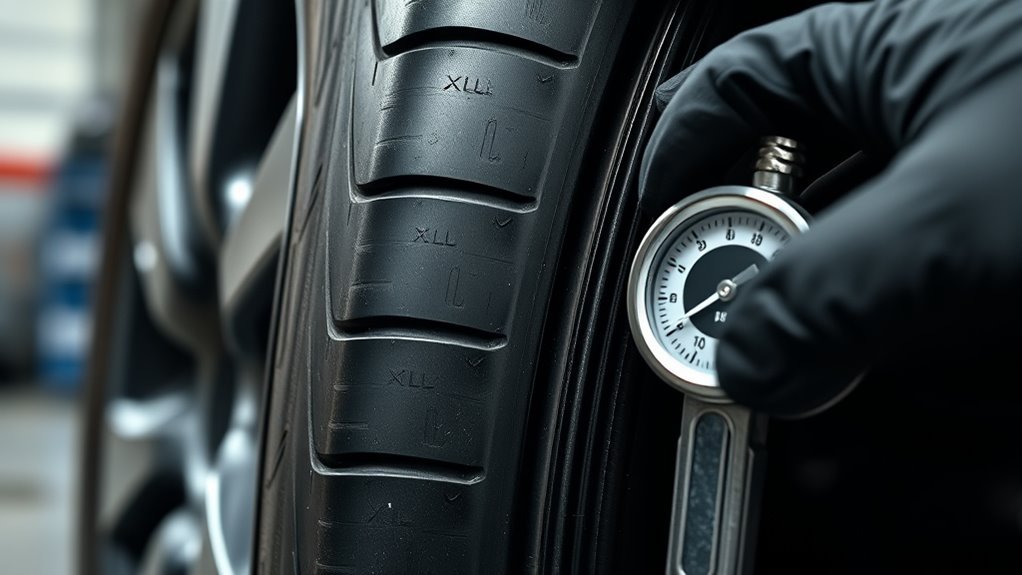
When you see XL on a tire, it means Extra Load construction: reinforced sidewalls and a higher load index so the tire can carry more weight at a higher inflation pressure. You’ll need to inflate XL tires to their specified psi (often up to 41 psi) to achieve rated capacity and ideal stability under heavy cargo or towing. They’re common on SUVs, light trucks, and trailers; keep load index and diameter compatible with your vehicle and check pressures regularly to learn more.
What “XL” Means on a Tire
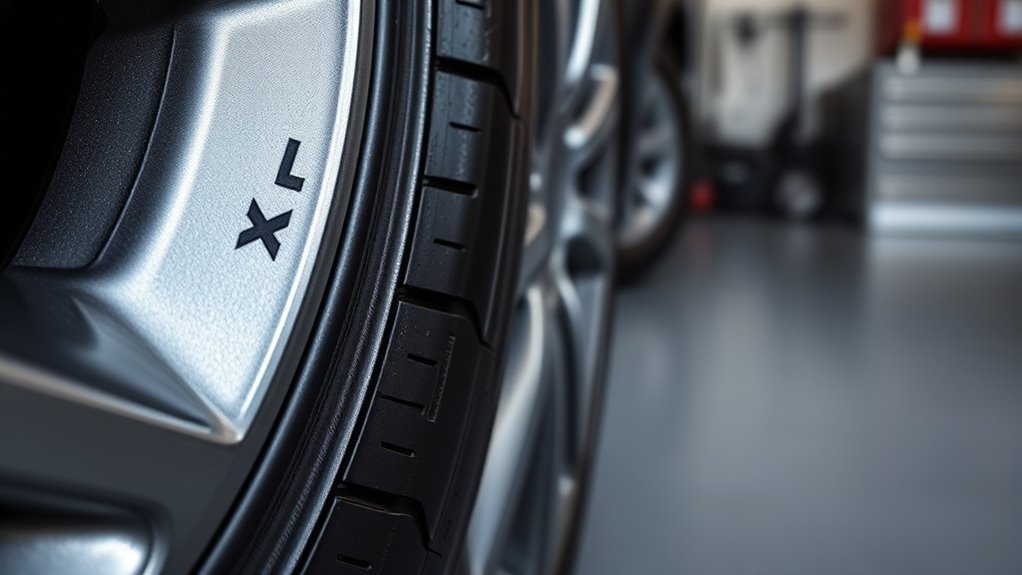
“XL” stands for Extra Load and denotes tires with reinforced sidewalls and higher load ratings than standard tires. You’ll find XL markings on the sidewall indicating construction designed to support heavier loads and higher inflation pressures—commonly up to 41 psi—to achieve rated capacity. When you fit XL tires to SUVs, trucks, or trailers, you increase resistance to sidewall damage and improve durability under repeated stress. Properly inflated XL tires maintain designed contact patch and structural integrity, directly affecting tire performance and driving safety during towing or heavy cargo transport. Specify XL when vehicle load requirements or manufacturer recommendations exceed standard capacity; otherwise you risk compromised stability, premature wear, and reduced operational safety.
XL vs. Standard Load (SL) Tires
After covering what Extra Load means, compare it directly to Standard Load (SL) tires to decide which suits your vehicle and use case. XL tires use reinforced internal structures to deliver higher load capacities and improved load stability; SL tires lack that reinforcement and target regular passenger loads. XL maximum inflation can reach 41 psi versus ~35 psi for SL, so you’ll get reduced tire deflection and better resistance to damage under heavy loads. That yields longer service life for XLs under similar operating conditions. SL tires are lighter and may yield marginally better fuel efficiency, so choose SL when load demands are low. You can fit XL in place of SL, but don’t downgrade an XL-required application to SL without exceeding safe load limits.
Reading Sidewall Markings: Find XL, Load Index & Speed
Check the sidewall format (e.g., 205/55 R17 91 V) to locate the XL marking, load index, and speed letter. The XL designation signals extra-load construction, the numeric load index maps to a specific maximum weight (91 = 1,356 lbs), and the speed letter defines the maximum safe velocity (V = 149 mph). Always match those values to your vehicle’s tire placard or owner’s manual for correct fitment.
Sidewall Marking Breakdown
Reading your tire’s sidewall lets you quickly confirm key specs: size, construction, load index and speed rating are shown as a compact code like “205/55 R17 91 V,” where 205 is width (mm), 55 the aspect ratio, R radial construction, 17 the wheel diameter (inches), 91 the load index and V the speed rating. You’ll read width and aspect ratio first; these define the contact patch geometry that affects tire performance and load distribution. Construction code (R) tells you carcass type and inflation/pressure behavior. Wheel diameter matches rim sizing. The load index number quantifies maximum supported weight when properly inflated; higher numbers mean greater capacity. Speed rating indicates safe maximum speed under load. Look for “XL” adjacent to these codes to identify reinforced, extra-load sidewalls designed for higher inflation and capacity.
Load Index & Speed
Now that you can locate the size and construction codes on the sidewall, move on to the load index and speed rating—these two markings tell you how much weight the tire will carry and how fast it can safely go under load. You’ll read a numeric load index (e.g., 91 = 1,356 lbs) followed by a speed letter (e.g., V = 149 mph). For XL tires, reinforced sidewalls and higher inflation pressures (typically 36–41 psi) raise load performance; the load index reflects that capacity. The speed rating defines maximum safe speed while carrying the rated load, so don’t exceed it. Always match sidewall markings to your vehicle placard or owner’s manual to guarantee tire safety and compliant performance.
How XL Changes Load Capacity
When you choose XL tires their higher load index directly increases the maximum safe weight per tire. You’ll also be able to run higher inflation pressures (up to about 41 psi) to boost carrying capacity. Reinforced sidewalls provide the structural strength that prevents excessive deflection and maintains stability under heavier loads.
Increased Load Index
Although they look similar to standard tires, XL (Extra Load) models use reinforced sidewalls and stronger internal construction so each tire carries a higher load index, often allowing individual capacities above 1,000 lb. You’ll notice immediate load capacity benefits: the higher load index raises per-tire rated mass, improving stability and safety when you carry heavy cargo or tow. In technical terms, XL construction increases bead, ply, and sidewall strength to shift the load index upward without changing rim size. You should factor tire weight considerations into unsprung mass and fuel consumption trade-offs, but the primary effect is predictable load-rating improvement. Choose XL when vehicle Gross Axle and Gross Vehicle Weight Ratings demand margins that standard tires can’t reliably provide.
Higher Inflation Pressure
Because XL tires are built for higher inflation, they typically run up to about 41 psi versus 35 psi for standard tires, and that extra pressure directly raises their load-carrying capacity by stiffening the sidewalls and increasing contact patch support. You should maintain the manufacturer’s recommended psi to realize inflation benefits and avoid under-inflation risks like accelerated wear or blowouts under heavy loads. Properly inflated XL tires let you carry heavier loads while preserving handling and stability; you’ll notice measurable performance impact in reduced deflection and more consistent steering response. Check pressures cold and adjust for payload changes. Consult the vehicle placard and tire data. Below is a quick reference.
| Tire Type | Max PSI | Effect |
|---|---|---|
| Standard | 35 | Lower load |
| XL | 41 | Increased load |
| XL (loaded) | 41 | Stable handling |
Reinforced Sidewall Strength
One key upgrade in XL tires is a reinforced sidewall that increases structural stiffness and lets you safely pressurize the tire up to about 41 psi, raising its load-carrying capacity above standard-load (35 psi) tires. You’ll notice improved tire performance and more predictable load distribution under heavy loads. The stiffer sidewall reduces deflection, cutting impact damage risk and extending service life. Use the following practical effects:
- Higher static load capacity per tire at recommended 41 psi versus 35 psi.
- Reduced lateral and vertical deflection, improving handling and stability.
- Improved resistance to sidewall damage from curbs and potholes.
- Enhanced durability under towing or frequent heavy-cargo use, maintaining consistent tire performance and wear patterns.
Why XL Tires Often Need Higher Inflation Pressure
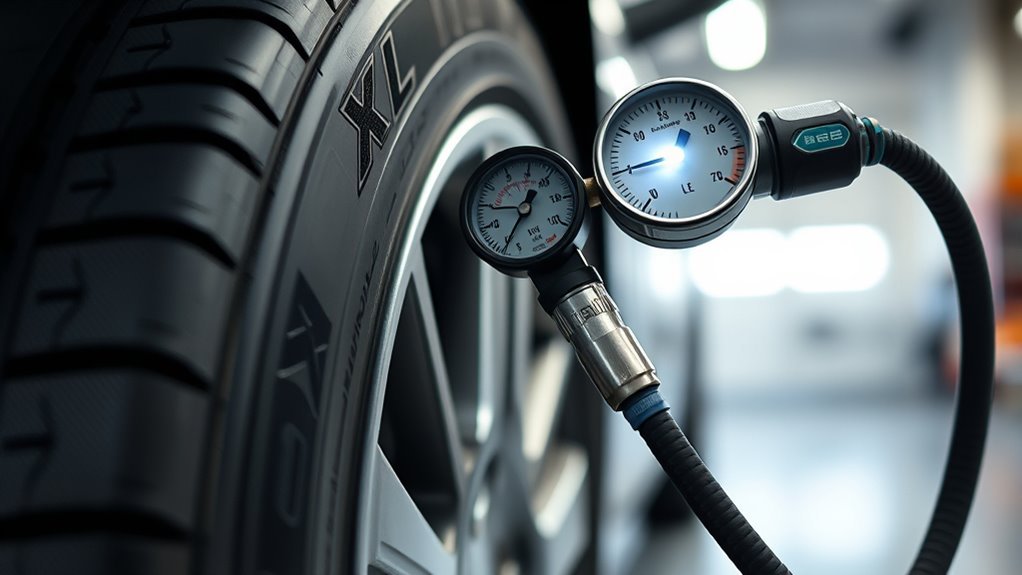
When you fit XL tires for heavier loads, they require higher inflation pressures to keep sidewalls and carcass working within their designed stress limits; you must raise pressure because XL construction supports greater load per contact patch. Higher PSI (commonly up to ~41 psi versus ~35 psi for SL) reduces tire deflection, which directly improves load stability and tire performance by limiting heat build-up and sidewall flex. Reduced deflection preserves footprint shape, enhancing handling and braking under cargo or trailer loads. You should follow manufacturer inflation tables: under-inflation increases wear, heat, and blowout risk. Check pressures cold, adjust for load and speed, and recheck after heavy use. Proper inflation guarantees the reinforced structure functions as intended without overstressing components.
Who Should Use XL Tires? Vehicles & Use Cases
If you drive an SUV or light truck that routinely carries heavy loads or tows, you’ll benefit from XL tires’ higher load rating and stiffer sidewalls. Commercial vehicles and trailers that haul substantial cargo should use XL tires to maintain stability and resist heat buildup under sustained weight. Even in mixed-use fleets, specifying XL-rated tires for load-bearing axles improves safety margins and tire longevity.
SUVs And Light Trucks
Because SUVs and light trucks often carry heavier cargo and tow loads, you should choose XL tires when your vehicle regularly operates near gross axle or vehicle weight limits. XL tires optimize tire performance and load stability through reinforced sidewalls and higher load indices. You’ll get improved durability, reduced blowout risk, and more predictable handling when loaded.
- SUVs that transport passengers or gear frequently benefit from XL for consistent handling.
- Light trucks used for hauling or towing gain braking and cornering stability with XL.
- Off-road use with heavy payloads calls for XL to resist sidewall damage and deformation.
- Manufacturers often specify XL on models designed to carry maximum-rated loads; follow the placard.
Trailers And Commercial Vehicles
1 clear rule: fit XL tires on trailers and commercial vehicles that regularly carry heavy cargo or tools, since their reinforced construction and higher load ratings maintain stability, reduce sidewall deformation, and lower blowout risk under tow or sustained loads.
You should choose XL tires for trailers to guarantee trailer stability during highway speeds and emergency maneuvers; the enhanced load index prevents overload-induced heat and failure. For delivery vans, work trucks, and light commercial units, XL delivers commercial durability—reinforced sidewalls and stronger carcass handle concentrated tool and payload weights without excessive flex. If you tow frequently or carry payloads near gross capacity, XL tires prolong service life, improve braking consistency, and reduce maintenance cycles. Use XL where load demands, sustained towing, or safety margins exceed standard tire capabilities.
Can You Fit XL Tires If Your Car Didn’t Come With Them?
Wondering whether you can fit XL tires on a car that didn’t come with them? You can, if you verify tire compatibility and accept any performance impact. Check specs, inflation, and dimensions before switching.
- Consult the owner’s manual for recommended load/speed ratings and acceptable tire sizes.
- Confirm XL tire load index meets or exceeds vehicle requirements; reinforced sidewalls increase load capacity and stability.
- Verify overall diameter and width match to avoid altering speedometer, ABS calibration, or handling characteristics.
- Set inflation to the manufacturer’s XL pressure spec; incorrect pressure negates load benefits and affects wear.
Follow these steps, and you’ll maintain safety and functionality when fitting XL tires on a non‑equipped car.
Pros and Cons of XL Tires for Daily Driving
If you regularly carry heavy loads or tow, XL (Extra Load) tires give you reinforced sidewalls and higher inflation capacity to maintain stability and reduce blowout risk; otherwise, their stiffer construction can slightly worsen ride comfort and fuel economy for everyday, light driving. You’ll benefit from higher load-carrying capacity, improved lateral stability, and reduced risk of tire failure under stress. The trade-offs are measurable: increased rolling resistance and mass can reduce fuel efficiency marginally, and the firmer sidewalls introduce comfort trade offs you’ll notice on rough surfaces. For routine light driving, standard tires typically deliver lower cost, better ride compliance, and slightly improved fuel economy. Choose XL only if your normal duty justifies the load and stability advantages.
Maintenance: Care, Inflation & Inspection for XL Tires
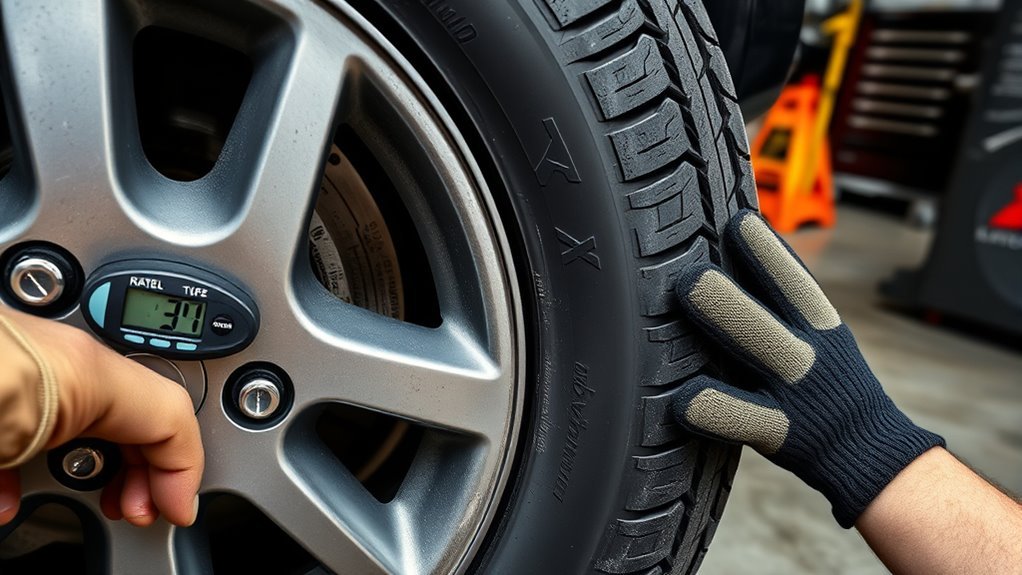
Having the right tire type is only part of the equation; routine care keeps XL tires performing to their rated capacity. You must maintain correct inflation, inspect regularly, and rotate on schedule to preserve tire longevity and safety features.
- Check pressure monthly with a reliable gauge; XL tires often require ~41 psi to support extra load and optimize fuel economy and handling.
- Rotate every 5,000–7,500 miles to guarantee even tread wear and extend lifespan.
- Inspect tread depth and sidewalls for cuts, bulges, or uneven wear; address anomalies immediately to prevent failures.
- Record maintenance and pressures; consistent documentation helps spot trends and validates safe operating limits.
Follow these steps precisely to maintain load efficiency and reduce blowout risk.
Choosing the Right XL Tire: Size, Ratings & Professional Tips
Choosing the right XL tire starts with matching size, load index, and inflation requirements to your vehicle’s specifications—check the owner’s manual or tire placard and confirm the tire’s sidewall markings for load index and speed rating. You’ll verify load capacity and prescribed inflation; XL tires require higher pressures to achieve rated load distribution and peak tire performance. Select a tire whose load index meets or exceeds vehicle requirements and whose speed rating matches expected use. Factor in terrain and towing: stiffer sidewalls improve stability but may alter ride quality. Have a trained technician confirm fitment, mount and balance, and program TPMS if needed. Regularly inspect inflation, tread, and load limits to maintain safe operation and compliance.
Frequently Asked Questions
Is It Worth Getting XL Tyres?
Yes—you’ll benefit if you carry heavy loads frequently; benefits of XL tires include higher load capacity, sturdier sidewalls, improved handling and durability. In an XL tires comparison, they justify cost for towing, hauling, and enhanced safety.
Do XL Tires Need More Psi?
Yes — though it’s counterintuitive, XL tires need more psi: you’ll raise tire pressure to increase load capacity, follow manufacturer specs precisely, and avoid overinflation to prevent harsh ride or blowout risks.
Conclusion
You’ll see “XL” when a tire’s built to carry more — typically about 10–15% higher load capacity than a Standard Load tire of the same size. That matters: one XL tire can support roughly 200–300 lb more than its SL counterpart. If you choose XL, match the load index, respect the higher inflation spec, and verify vehicle placard compatibility. With correct fitment and maintenance, XL tires boost payload capacity without changing handling when used properly.
Related Articles
How to Read Motorcycle Tire Size: Complete Breakdown
Often misunderstood, this guide decodes motorcycle tire sizes like 180/55ZR17—learn what each number and letter means to ensure safe, perfect fitment.
Read More
How to Read Bicycle Tire Size: Inches, Metric & ISO
Get the essential trick to decoding ETRTO/ISO codes so you’ll always pick rim-compatible tyres—discover what to check next.
Read More
How to Read Tire Size Numbers: Decode the Sidewall
Step-by-step guide to decode tire sidewalls—sizes, load, speed, DOT and winter symbols—so you’ll know what fits and when to replace.
Read More