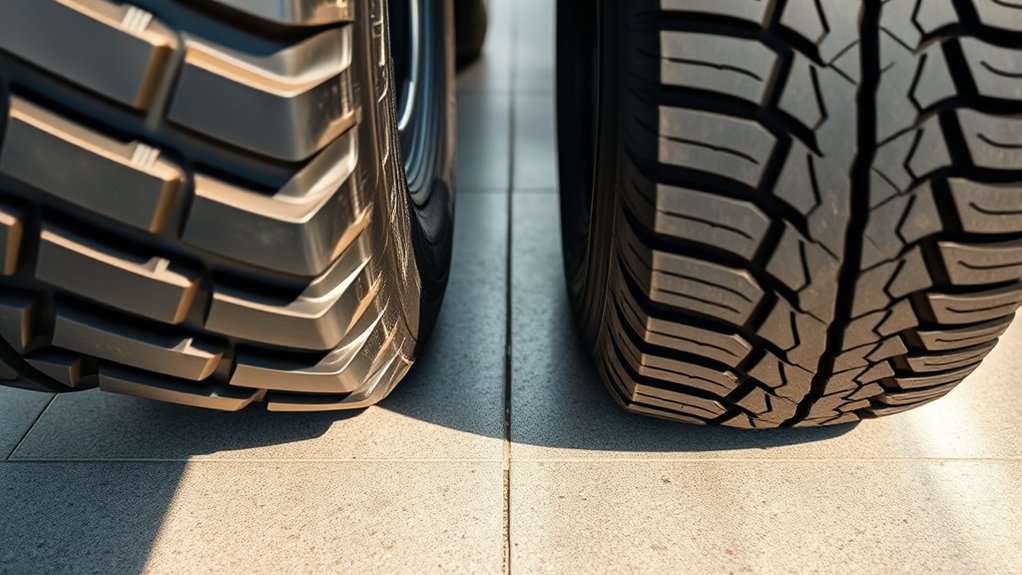
Choosing between LT and P-metric tires for your Toyota Tacoma is not just about buying the “stronger” tire. The right choice depends on how you use the truck, how much weight you carry, whether you tow, the roads you drive, and what your driver-door tire placard requires. LT tires can be the better choice for heavy loads, rock trails, and overlanding, while P-metric tires are often the better fit for stock daily driving, comfort, and fuel economy.
Quick Answer
Choose P-metric tires for a mostly stock Toyota Tacoma used for commuting, highway driving, and light weekend use. Choose LT tires if you regularly tow, haul near payload limits, drive sharp rocky trails, or run heavier overlanding gear. Always match tire size, load rating, and cold PSI to the Tacoma’s placard and load requirements.
Key Takeaways
- P-metric tires usually ride smoother, weigh less, and are better for daily driving when they match the Tacoma’s placard requirements.
- LT tires usually have tougher construction and stronger sidewalls, but they can ride firmer, cost more, weigh more, and require different inflation pressure.
- Do not compare tires by the “P” or “LT” prefix alone. Check the exact size, load index, load range, speed rating, wheel rating, and load-inflation table.
- When a P-metric tire is used on a light truck, its listed load capacity is reduced by dividing by 1.10, so load math matters.
At a Glance
| Time Required | 10–20 minutes to compare the door placard, tire sidewall, and load-inflation table before buying. |
| Difficulty | Easy for stock-size replacements; moderate if changing tire size, load range, or wheel setup. |
| Tools Needed | Driver-door tire placard, owner’s manual, tire pressure gauge, tire load-inflation table, and installer confirmation. |
| Cost | LT tires often cost more than comparable P-metric tires and may add installation, alignment, TPMS, or fitment costs. |
Understanding LT Tires: Key Features and Benefits
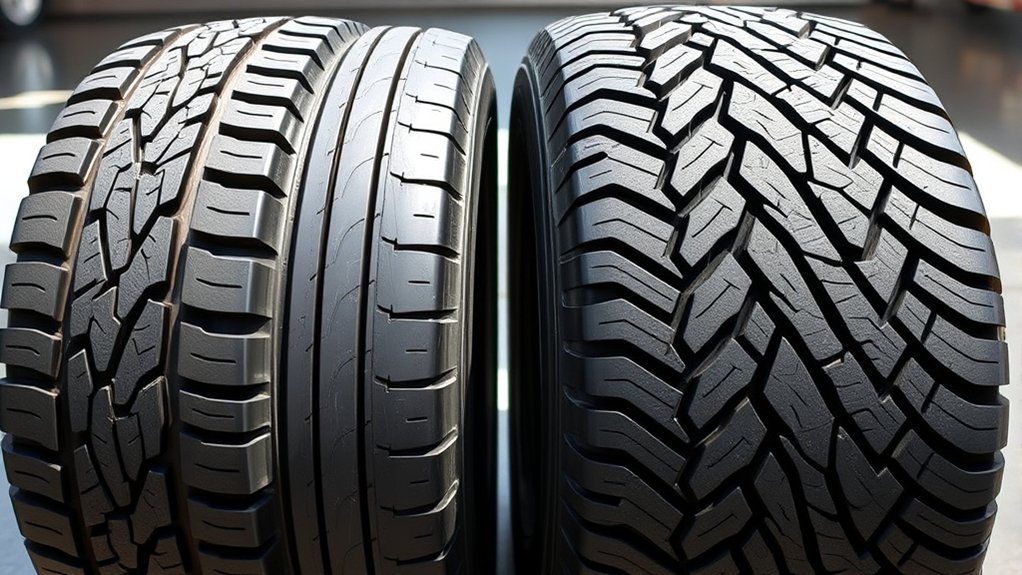
LT stands for Light Truck. LT tires are built for pickups, vans, SUVs, and commercial-style use where the tire may see heavier loads, higher inflation pressure, rougher surfaces, or more severe service than a typical passenger-car tire.
The main benefit of an LT tire on a Toyota Tacoma is durability. Many LT tires use stronger casing construction, stiffer sidewalls, and deeper tread patterns than similar passenger-type tires. That can help when the truck is loaded with camping gear, towing, airing down for rocky trails, or driving on roads where sidewall cuts are a real risk.
The trade-off is comfort. LT tires are usually heavier and stiffer, so they can make a Tacoma feel firmer over bumps. They may also increase road noise and reduce fuel economy compared with a lighter P-metric tire.
Warning: Do not choose an LT tire just because the sidewall looks stronger. The tire must still meet the Tacoma’s required size, load capacity, speed rating, wheel rating, and cold inflation pressure requirements.
Understanding P-Metric Tires for a Tacoma
P-metric tires are passenger-type tires, shown by a “P” at the beginning of the tire size, such as P265/70R17. Many pickups and SUVs have used P-metric or metric passenger-type tires as original equipment because they can provide good ride comfort, light weight, quiet highway manners, and adequate load capacity for the vehicle’s certified limits.
For Tacoma owners who mostly commute, drive highways, run errands, and take light trails, a properly rated P-metric tire can be the best everyday choice. It may brake, steer, and ride more naturally on pavement than a heavy LT tire, especially on a lightly loaded truck.
The important catch is load calculation. According to Toyo Tires’ load-inflation guidance, when a P-metric or metric passenger tire is installed on a light truck, SUV, pickup, or minivan, its load capacity is reduced by a factor of 1.10. That does not make P-metric tires unsafe; it means you must use the correct adjusted capacity when comparing options.
Key Features of P-Metric Tires vs. LT Tires
Here is the practical difference: P-metric tires are usually tuned for comfort, steering feel, lower weight, and everyday road use. LT tires are usually tuned for load carrying, casing strength, and harsher service. Neither is automatically “better” until you match it to how the Tacoma is actually used.
| Feature | P-Metric Tires | LT Tires |
|---|---|---|
| Best use | Daily driving, commuting, light loads, light trails | Heavy payload, towing, overlanding, rocky trails |
| Ride comfort | Usually smoother and quieter | Usually firmer and louder |
| Weight | Usually lighter | Usually heavier |
| Load math | Derate by 1.10 on light trucks | Use LT load table for size, load range, and PSI |
| Fuel economy | Often better | Often lower due to weight and rolling resistance |
Construction Differences
LT tires often have stronger casings and sidewalls than comparable P-metric tires. That helps them handle heat, flex, impacts, and heavy service better when they are inflated correctly for the load. P-metric tires usually have more flexible sidewalls, which can improve ride quality and reduce harshness on pavement.
That difference is easy to feel on a Tacoma. A P-metric all-terrain may feel lighter and more responsive on the highway, while an LT all-terrain may feel more planted with a trailer, a bed full of gear, or a rough forest road ahead.
Performance Capabilities
Performance depends on the exact tire, not just the prefix. An aggressive P-metric all-terrain may outperform a mild LT highway tire off-road, while an LT all-terrain may be far tougher on rocks than a smooth P-metric highway tire. Compare tread design, sidewall protection, winter rating, load index, load range, and manufacturer specifications before deciding.
The safest Tacoma tire is not the heaviest tire. It is the tire that matches the truck’s load, pressure, wheel, speed, terrain, and driving use.
How to Choose Between LT and P-Metric Tires for Your Tacoma
Start with the Tacoma, not the tire. The driver-door placard and owner’s manual tell you the original tire size, cold inflation pressure, and vehicle loading information. NHTSA’s tire safety guidance explains that the correct pressure is the vehicle manufacturer’s recommended cold inflation pressure, not the maximum pressure molded on the tire sidewall.
- Check the driver-door placard. Note the original tire size, load rating, speed rating, and recommended cold PSI.
- Check how you use the truck. Daily commuter, towing, bed load, camper shell, steel bumpers, winch, rooftop tent, or rocky trails all change the decision.
- Check payload and axle loads. Heavy gear and trailer tongue weight can push a Tacoma closer to its limits than expected.
- Compare actual tire load capacity. Use the tire’s load index or LT load table at the correct PSI.
- Account for P-metric derating. Divide the listed P-metric capacity by 1.10 when used on a light truck.
- Confirm fitment. Make sure the tire clears suspension and bodywork, works with the wheel width and load rating, and does not leave you with an unusable spare.
Pro Tip: If your Tacoma is stock and rarely carries heavy loads, start by shopping high-quality P-metric or metric tires in the original size. If your Tacoma has constant added weight or sees rough trails often, compare LT options next.
[Products Worth Considering]

These aluminum alloy tire valve stem caps with an O-ring seal help protect valve stems from corrosion while adding a clean, stylish look to your vehicle. The universal fit works across cars, trucks, motorcycles, bicycles, and more, making them an easy upgrade for everyday driving and off-road use. Installation is quick, and the included four-pack keeps all your tires dressed and protected.

Keep your tires properly inflated with this analog VONDIOR tire pressure gauge, designed for fast, easy readings without batteries. The swiveling, two-axis hose and large glow dial help you measure at any tire angle with instant visibility. Built with a protective rubber shield, it supports durable, low-maintenance use for cars and trucks.
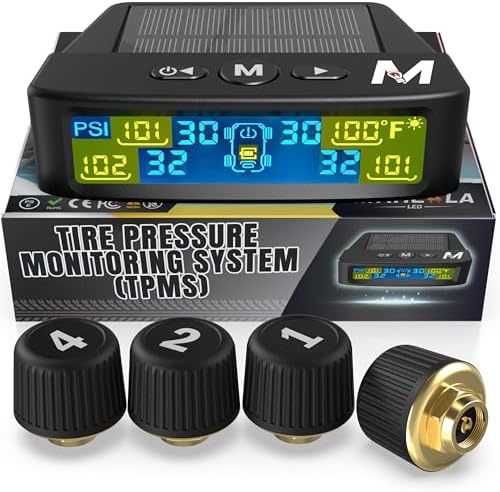
Marcala’s TPMS set of four sensors helps you monitor tire pressure and temperature in real time while driving, with updates every second. The bright color LCD uses auto-dimming for easy viewing, powered by dual solar and USB charging, and offers six alarm modes. Built for trailers, RVs, campers, trucks, and towing setups, the sensors support monitoring 1-4 wheels up to 98 PSI with IP67 waterproof protection.
Why Load Ratings Matter: LT vs. P-Metric
Load rating matters because tires carry the truck, passengers, cargo, accessories, and trailer tongue weight. A tire can have the right tread pattern and still be the wrong tire if it cannot safely carry the load at the required pressure.
Do not rely on a single number such as “Load Range C equals 2,470 pounds.” Load capacity changes by tire size, load index, load range, single or dual use, and inflation pressure. For example, the load table for one LT size may show a different Load Range C capacity than another LT size at the same PSI.
For P-metric tires, the listed load capacity is reduced on a light truck by dividing by 1.10. For example, if a P-metric tire is listed at 2,535 pounds, the light-truck-adjusted capacity is about 2,305 pounds. That adjusted number is the one to compare against the Tacoma’s load needs.
Note: The sidewall maximum PSI is not the same thing as the Tacoma’s recommended cold PSI. Use the placard, owner’s manual, and tire load-inflation data to set pressure correctly.
Comparing Performance: Off-Road vs. On-Road Capabilities
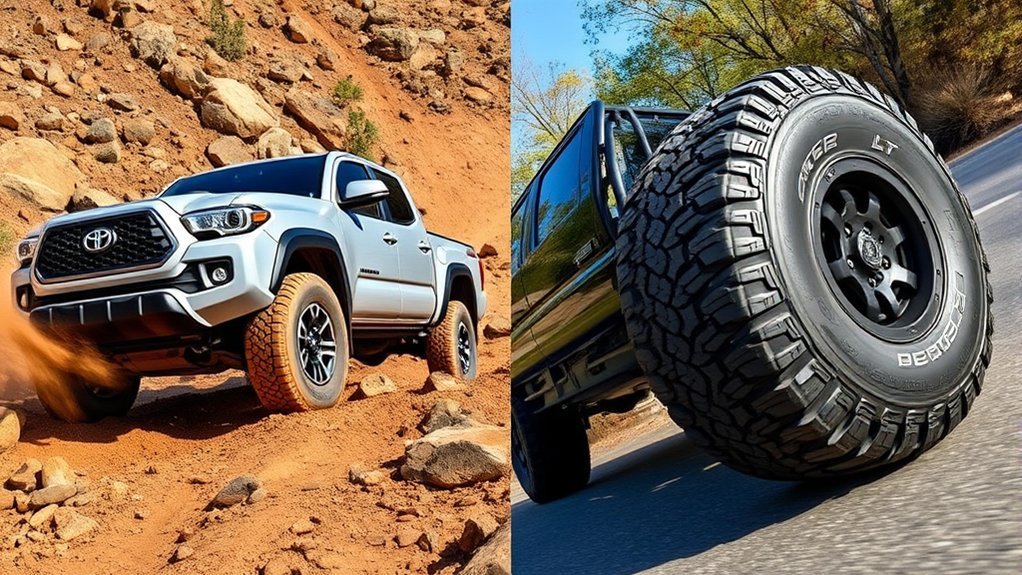
Your driving surface should guide the tire choice. A Tacoma that spends 90% of its life on pavement does not need the same tire as a Tacoma that spends weekends on sharp rocks, washboard roads, and remote trails.
Off-Road Traction Performance
LT tires often make sense for serious off-road use because their casings and sidewalls are built for harsher service. If you air down for traction, drive through jagged rock, or carry recovery gear and camping equipment, an LT all-terrain or mud-terrain can add useful durability.
However, tread design still matters. Look for open shoulder blocks, stone ejectors, sidewall lugs, and a compound suited to your terrain. For snow, look for the Three-Peak Mountain Snowflake symbol when winter traction matters.
On-Road Comfort Comparison
P-metric tires usually win for comfort. Their lighter construction and more flexible sidewalls help the Tacoma ride smoother on pavement. They can also reduce steering heaviness, cabin noise, and rolling resistance.
LT tires can still drive well on-road, especially modern all-terrain designs, but expect a firmer feel. If you drive long highway miles with an empty bed, that extra stiffness may not be worth it.
Are LT Tires Worth the Extra Cost?
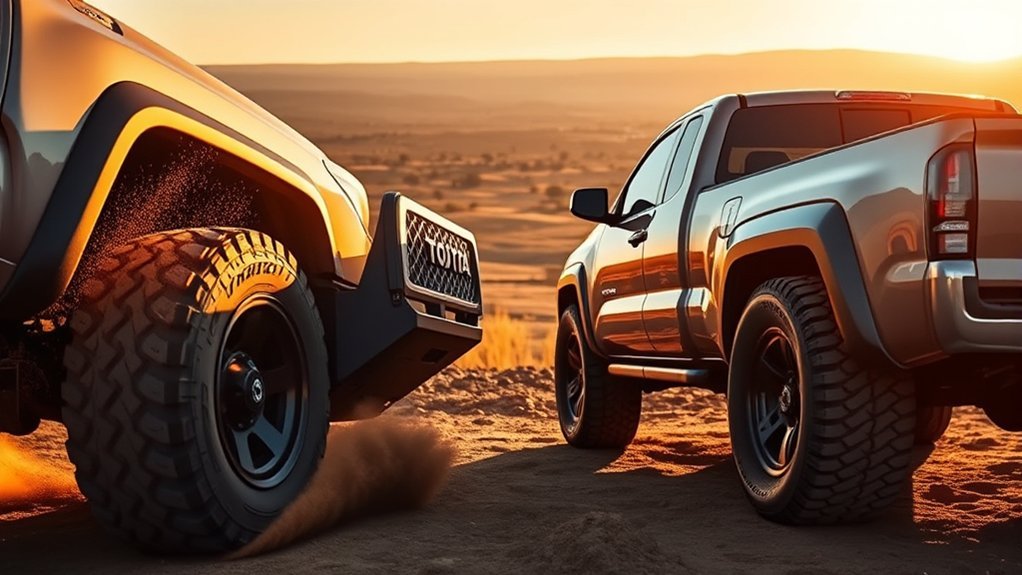
LT tires are worth the extra cost when you use the Tacoma in a way that benefits from the tougher construction. That includes frequent towing, heavy payload, overlanding gear, rough job sites, rocky trails, and repeated airing down.
They may not be worth it if your Tacoma is mostly a daily driver. In that case, a quality P-metric or metric all-terrain can give you better ride comfort, lower weight, and enough capability for light trails while still meeting the truck’s load requirements.
- Worth it: heavy gear, towing, camper shell, rooftop tent, rocky terrain, remote travel, job-site use.
- Maybe not worth it: empty-bed commuting, mostly highway driving, stock suspension, light weekend dirt roads.
[Products Worth Considering]

Measure tire tread depth quickly and accurately with this LUMITECO dial gauge that reads in 1/32" increments up to 14/32". The color-coded green/yellow/red zones make it easy to judge tire wear and know when replacement is needed. A rugged, compact design with a protective pouch helps keep the gauge ready for use on cars, trucks, motorcycles, and more.

The 22800 wheel stud installer makes replacing wheel studs quick and secure, saving time and effort during tire service. It uses a ratchet or impact wrench to pull new studs firmly into place, helping when existing studs are too long. Compatible with most automotive wheels and light-duty truck wheel studs, it’s designed for easy, tool-assisted installation.

Replace worn or missing TPMS sensors with a pre-programmed 4-pack designed for compatible GM vehicles. These 315MHz sensors provide real-time tire pressure monitoring and alert you if pressure is too high, too low, or if a rapid air leak occurs. Most installations are ready with minimal relearn effort after mounting, helping improve safety and driving confidence.
Comparing Durability: LT vs. P-Metric Tires
Durability is where LT tires usually have the advantage. Their stronger construction can resist heat, bruising, and puncture damage better in severe service. That is especially useful on trails where sidewalls scrape rocks or on long trips where the truck is loaded close to its payload limit.
P-metric tires are not weak by default. A high-quality P-metric all-terrain can be a durable and reliable choice for a Tacoma that stays within its load limits. The difference is that LT tires are built with heavier-duty use in mind, while P-metric tires are usually designed around ride quality and lighter vehicle service.
Sidewall Strength Comparison
Sidewall strength matters most off-road. A stiffer LT sidewall can reduce the chance of cuts and bruises on sharp terrain. The downside is that it may transmit more impact into the cabin on potholes, broken pavement, and washboard roads.
Tread Depth Analysis
LT versions of the same tire model often have deeper tread than P-metric versions, but this is not guaranteed. Check the manufacturer’s spec sheet for the exact size. A deeper tread can improve wear life and off-road bite, but it can also add weight and noise.
| Tire Type | Typical Strength | Best Tacoma Use |
|---|---|---|
| LT Tires | Higher casing and sidewall durability | Towing, hauling, rocky trails, overlanding |
| P-Metric Tires | Good for normal truck use when properly rated | Daily driving, highway comfort, light trails |
Fuel Efficiency: How LT and P-Metric Tires Compare
P-metric tires usually have the fuel-economy advantage because they are often lighter and less stiff. Less tire weight can help acceleration, braking, and rolling efficiency. That difference may be noticeable on a Tacoma because larger all-terrain tires already add rotating mass.
LT tires can reduce fuel economy due to added weight, deeper tread, and higher rolling resistance. The exact change depends on size, tread design, tire pressure, wheel weight, and driving speed.
If fuel economy is a priority, stay close to the factory tire size and compare tire weight before buying. A lighter P-metric all-terrain may be a smarter choice than a heavy LT tire if your truck does not need the extra strength.
Common Misconceptions About LT and P-Metric Tires
Misconception 1: LT tires are always safer. Not always. An LT tire with the wrong size, wrong pressure, or insufficient load capacity for the setup is not safer than the correct P-metric tire.
Misconception 2: P-metric tires cannot be used on trucks. They can be used when they are approved for the vehicle’s load and fitment requirements. Many light trucks and SUVs use passenger-type tires as original equipment.
Misconception 3: Load Range C, D, and E are the whole story. Load range matters, but the actual load capacity still depends on the exact tire size and inflation pressure.
Misconception 4: The sidewall max PSI is the target PSI. It is not. The sidewall shows the tire’s maximum pressure, while the vehicle placard shows the manufacturer’s recommended cold pressure for the original setup.
Fitment Checks Before Switching Tire Types
Before replacing P-metric tires with LT tires, or LT tires with P-metric tires, confirm the full setup:
- Wheel load rating: The wheel must be rated for the load, not just the tire.
- Wheel width: The tire must fit the wheel width approved by the tire manufacturer.
- Clearance: Larger or wider tires can rub the fender liner, cab mount, mud flap, or suspension.
- Spare tire: The spare should be compatible in size and load capacity.
- TPMS: Tire pressure monitoring may need adjustment or relearn after tire changes.
- Alignment: Heavier or larger tires can reveal alignment and suspension issues.
- Load and pressure: Ask the installer to verify the correct cold PSI for the tire and load.
Warning: Never exceed the Tacoma’s GVWR, GAWR, payload rating, wheel rating, or tire rating. Tires cannot increase the truck’s legal payload or towing rating.
Best Tire Models for Your Tacoma
The best tire depends on the exact Tacoma trim, tire size, load requirement, terrain, and budget. Use these as starting points, then confirm the exact size and load rating before buying.
- Daily driving and highway comfort: Michelin Defender LTX M/S is a strong choice for owners who want quiet road manners, long tread life, and all-season usability.
- Balanced all-terrain use: BFGoodrich All-Terrain T/A KO2 is a popular option for 4×4 trucks, trail use, and overlanding.
- Rugged all-terrain and work use: Goodyear Wrangler DuraTrac is aimed at rugged terrain, snow, towing, and hauling applications.
For a mostly stock Tacoma, compare P-metric and LT versions of the same model if both are available. The LT version may be tougher, but the P-metric version may ride better and weigh less.
[Products Worth Considering]

The TYAMATE TM8 solar-powered wireless TPMS delivers real-time tire pressure and temperature monitoring with six alarm modes for safer driving. A vibrant color LCD display shows readings clearly while windshield mounting keeps it hands-free and easy to read. With a wide 0–87 PSI range, strong 433.92 MHz signal transmission, and quick sensor pairing, it’s ideal for RV, sedan, SUV, MPV, and truck use.

The SAFELIFE dial tire tread depth gauge measures tread depth in 1/32 inch increments with clear, easy-to-read 2-inch dial face. Color zones using a traffic light system help you quickly judge whether tread is low, marginal, or ample for safer driving. Built with a durable zinc cast body and a metal detect probe for precise, comfortable use across cars, motorcycles, trucks, and buses.

These universal tire valve stem caps help protect valve cores from dust, debris, and moisture while helping maintain stable tire pressure. The corrosion-resistant metal construction and sealed design provide reliable protection in road grime, mud, and winter conditions. Twist-on installation makes them quick to fit on cars, SUVs, trucks, and motorcycles.
Frequently Asked Questions
Are P-metric tires better than LT tires for a Toyota Tacoma?
P-metric tires are better for many Tacoma owners who mostly drive on pavement, carry light loads, and want a smoother ride. LT tires are better for frequent towing, heavy payload, rocky trails, and constant added weight. The safer choice is the tire that matches your placard, load needs, and driving conditions.
Can I replace P tires with LT tires on my Tacoma?
Yes, but do not install LT tires without checking size, load range, wheel rating, clearance, and correct cold PSI. LT tires often require different inflation pressure than P-metric tires, and running them underinflated for the load can create excess heat.
Can I replace LT tires with P-metric tires?
Sometimes, but you must check the load requirements carefully. P-metric tires used on light trucks are derated by dividing the listed load capacity by 1.10. If the adjusted capacity does not meet the Tacoma’s load needs, choose a different tire.
Do LT tires increase Tacoma payload or towing capacity?
No. LT tires may improve tire durability and load margin when properly selected, but they do not increase the Tacoma’s GVWR, GAWR, payload rating, or towing rating. The truck’s certified limits still apply.
Will LT tires make my Tacoma ride rougher?
Usually, yes. LT tires are often heavier and stiffer than comparable P-metric tires. Some drivers like the more planted feel, but others notice more road harshness, noise, and lower fuel economy.
Should I run the pressure listed on the tire sidewall?
No. The sidewall pressure is the tire’s maximum pressure, not the automatic target pressure for your Tacoma. Start with the vehicle placard and owner’s manual, then use load-inflation data when changing tire type, size, or load range.
Conclusion
For a Toyota Tacoma, the best choice between LT and P-metric tires depends on use. Choose P-metric tires if you want comfort, lower weight, and efficient everyday driving while staying within the truck’s load limits. Choose LT tires if your Tacoma regularly tows, hauls, overlands, or drives rough terrain where stronger construction is worth the extra weight and firmer ride.
The safest approach is simple: match the tire to the truck first, then match it to your lifestyle. Check the placard, confirm load capacity, use the correct cold PSI, and have the final fitment verified before installation.
Sources
- NHTSA TireWise — tire pressure, tire size, cold inflation pressure, and tire safety guidance.
- Toyota Owners: 2024 Tacoma Tires — vehicle-specific tire and owner’s manual guidance.
- Toyo Tires: Application of Load Inflation Tables — load-inflation tables and P-metric light-truck derating guidance.
- Toyo Tires: Replacing Tires on Light Trucks — LT replacement, pressure, heat, and load-capacity guidance.
- Goodyear Wrangler DuraTrac — rugged all-terrain tire model reference.
- BFGoodrich All-Terrain T/A KO2 — all-terrain and overlanding tire model reference.