Tire Traction Rating Meaning: Grades AA, A, B & C
Tire traction grades (UTQG) — AA, A, B, C — rank wet-stopping performance: AA gives the shortest stopping distances, C the longest. You’ll use these letters to compare wet grip across tires tested under controlled skid‑trailer conditions against a reference tire. Real‑world braking also depends on load, tread depth, pressure and road state, so grades are comparative, not absolute. Choose AA or A for frequent rain or spirited driving; keep going to learn practical buying and maintenance tips.
Who This Guide Is For : Explainer + Buying Help
This guide is for drivers, fleet managers, and tire shoppers who need a clear, technical explanation of UTQG traction ratings and practical buying guidance; you’ll learn how AA–C grades reflect wet-road stopping performance, how tests are run, and how to read sidewall markings so you can match tires to your driving conditions and safety priorities. You’ll use this information to select tires with stopping distances appropriate for vehicle weight, route profiles, and local weather. Check sidewalls for UTQG markings and compare brands using standardized test results. Maintain tires to preserve rated traction: proper inflation, rotation, and tread-depth monitoring are essential. This section also debunks traction myths—ratings reflect standardized wet-stop tests, not vague marketing claims.
Tire Traction Ratings : What AA, A, B, C Mean
You’ll evaluate AA, A, B, and C primarily by their wet braking performance—higher grades mean shorter stopping distances on water‑covered pavement. These ratings come from standardized grip tests where controlled stops are performed on wet surfaces to produce reproducible stopping-distance comparisons. Knowing the grade helps you assess safety tradeoffs and match tires to expected driving conditions.
Wet Braking Performance
Because wet pavement reduces tire-road friction, traction ratings (AA to C) tell you how effectively a tire stops in rain or on slick surfaces. You should interpret ratings as a direct indicator of wet surface braking distance: AA yields the shortest stopping distances, A gives excellent performance for everyday driving, B is adequate but increases stopping distance under adverse conditions, and C meets minimum standards yet risks longer stops. When selecting tires, prioritize higher-rated compounds and tread designs if you frequently encounter rain or slush. Remember ratings reflect comparative wet braking performance, not overall handling or wear. Use AA or A for critical safety margins; consider B only for mild climates, and avoid C in regions with regular precipitation.
Grip Test Methods
Having covered how wet ratings reflect stopping distances, let’s look at how those grades are measured. You’ll see that grip testing uses a calibrated skid trailer to record stopping distances on wet asphalt with controlled water depth and surface texture. Technicians run repeated stops at set speeds, compare results to a reference tire, and derive UTQG traction grades AA–C; AA denotes shortest stops and superior wet grip, C indicates marginal traction. You must note that test consistency—road surface, water film, speed, and tread condition—directly affects tire performance outcomes, so standardized protocols are critical for valid comparisons. Finally, maintain correct pressure and tread depth to preserve the laboratory-rated traction in real-world use.
How Traction Grades Are Tested (NHTSA Wet-Stop)
Several controlled stops at 40 mph are used in the NHTSA Wet-Stop test to quantify a tire’s wet traction performance. You’ll see a skid trailer perform repeated controlled stops on wetted pavement to measure stopping distance; this test methodology isolates tire behavior under standardized load, speed, and surface conditions. Technicians compare measured stopping distances to baseline thresholds to assign traction grades from AA to C, reflecting relative wet grip and tire performance. Only tires meeting specific procedural criteria are rated, ensuring consistency across brands and models. Results focus on safety: shorter measured stops map to superior grades and imply reduced collision risk in wet conditions. You’ll rely on these grades to compare wet-stopping capability objectively.
Limits of Traction Grades in Real Driving
Remember that UTQG traction grades are derived from controlled wet-stop tests and won’t always match what you experience on varied roads. Your vehicle’s weight, load, speed and driver inputs change stopping distances even for AA-rated tires. Temperature, tread wear and inconsistent surfaces further alter grip, so treat ratings as comparative, not definitive, performance guarantees.
Controlled Test vs. Reality
Although traction grades (AA–C) come from standardized wet-stop tests, they reflect controlled conditions—specific speeds, surface textures, and temperatures—rather than the full range of variables you encounter on the road. In real world scenarios, tire performance reported by AA, A, B, or C indicates comparative wet-braking capability under test parameters, not absolute on-road grip. You should treat grades as one quantitative input, not a guarantee. Factors such as tread wear, inflation pressure, and transient maneuvers (hard turns, emergency braking) alter contact patch behavior outside test envelopes. AA-rated tires may outperform others in lab stops but can underperform on different pavements or in slush and ice. Relying solely on grades risks misestimating stopping distance and handling in everyday driving.
Vehicle And Load Variability
Lab wet-stop grades give you a baseline, but vehicle characteristics and loading change how those numbers play out on the road. You must account for load impact: standardized traction tests assume fixed mass and distribution, yet adding cargo or passengers shifts vertical loads, altering contact patch pressure and friction. Vehicle dynamics further modify effective grip; weight transfer during braking, acceleration, and cornering changes tire slip angles and peak traction demand. Heavier vehicles or those with uneven weight distribution may need higher-rated tires to maintain safety margins. Traction grades omit transient load changes, wear state, and inflation variance, so you should combine grade information with vehicle-specific assessments, payload limits, and routine maintenance to predict real-world stopping and handling performance.
Environmental And Road Factors
When you rely on traction grades, know they describe performance under controlled, idealized conditions and don’t capture the full range of environmental and road variables that determine real-world grip. You must account for rain, snow, ice, and surface type—each reduces effective friction despite an AA rating. Asphalt, concrete, wet film thickness, and texture change required stopping distances and lateral g-forces. Tire wear, inflation, alignment, and vehicle load alter contact patch behavior and often dominate over UTQG grades. Your tire maintenance and disciplined driving habits—slower speeds, greater following distances, and smooth inputs—directly mitigate these limits. In abrupt maneuvers or compromised surfaces, expect longer stops and reduced cornering margins; treat traction grades as comparative, not absolute, performance indicators.
Traction Grades and Stopping Distance in Rain
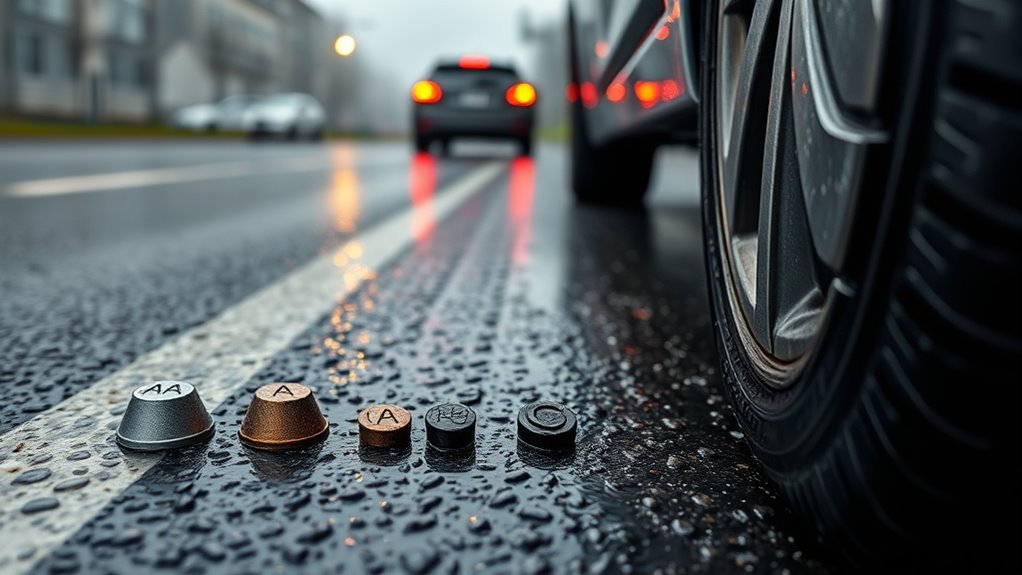
Because wet stopping performance can vary dramatically with tire choice, you should prioritize higher traction grades—AA through C—when driving in rain; rainy conditions demand attention to tire performance. AA-rated tires deliver the shortest wet stopping distances and can cut stops by up to 30% versus C-rated tires. NHTSA testing uses controlled 40 mph wet stops for consistent comparisons. Higher grades equal better grip, reduced hydroplaning risk, and more predictable control during emergency braking. Note that only ~15% of U.S. tires achieve AA.
| Traction Grade | Wet Stop Performance | Hydroplaning Resistance |
|---|---|---|
| AA | Best | Highest |
| A | Very Good | High |
| B/C | Adequate to Lower | Moderate to Lower |
Which Traction Grade to Choose (Use-Case Guide)
Choose a traction grade based on your typical driving: for daily commuting in mixed conditions, A-grade tires balance safety and wear. If you push handling and braking performance, opt for AA-grade tires to minimize stopping distances. For winter or consistently wet regions, prioritize AA or A grades over B/C to maintain control and reduce hydroplaning risk.
Daily Commuting Needs
For daily commuting in wet climates, pick the highest traction grade you can afford—AA-rated tires give the shortest stopping distances and best control on slick roads, A-rated tires deliver reliable performance for typical urban driving with occasional rain, B-rated tires may be marginal in heavy rain, and C-rated tires are generally unsuitable where wet weather is frequent. For a daily commute in areas with consistent precipitation, choose AA when budget allows; it maximizes tire safety and reduces hydroplaning risk. If you drive mostly city routes with intermittent rain, A strikes a balance of cost and performance. Reserve B only for largely dry regions and low-speed trips. Avoid C for regular wet-weather commuting. Always match grade choice to local weather statistics.
Performance Driving Demands
Performance driving demands maximum wet traction, so you should prioritize AA-rated tires whenever you’re pushing speed, cornering hard, or braking aggressively in damp conditions. AA-grade compounds and tread designs deliver superior grip and shorter stopping distances, so your performance handling remains predictable and controllable. For tire selection, weigh your track use, vehicle dynamics, and acceptable wear rates; A-grade can be acceptable for spirited street driving but compromises peak wet grip. B and C grades aren’t recommended for performance driving due to extended stopping distances and reduced lateral adhesion.
- Choose AA for highest wet traction and consistent performance handling
- Use A for mixed street/occasional spirited driving with moderate compromise
- Avoid B/C for aggressive cornering or track use
- Prioritize compound and tread over aesthetics
- Match tire selection to driving intensity and safety margins
Winter And Wet Conditions
When roads are wet or temperatures drop, you should prioritize AA-rated tires because they deliver the shortest stopping distances and highest lateral grip, greatly improving safety in rain or light snow. You’ll prefer AA for winter and heavy rain; ultra-high performance AA compounds give maximum traction and control. A-rated tires work well for everyday rainy driving and balanced tire maintenance schedules. B-rated tires are acceptable only in mild wet conditions; expect longer stopping distances. Avoid C-rated tires for winter or wet roads due to marginal grip and elevated skid risk. Consider tire maintenance and monitor tread depth, pressure, and wear to mitigate weather impact. Choose AA where safety margins are critical; choose A for general wet-weather reliability.
| Grade | Suitability |
|---|---|
| AA | Ideal |
| A | Reliable |
| B | Conditional |
| C | Not advised |
Where to Find Traction Markings on Your Tires
Most tires display their UTQG traction grade on the outer sidewall, so you can inspect the sidewall markings to verify wet-condition performance. You should read the alphanumeric traction letter (AA, A, B, C) alongside treadwear and temperature codes when doing tire maintenance; this dispels common traction myths that ratings apply to snow or ice performance. If letters are worn or absent, consult manufacturer specs or online databases for the exact model.
- Outer sidewall: UTQG traction letter (AA–C)
- Near treadwear and temperature codes: grouped markings
- Stamped model name: cross-reference for specs
- Worn sidewall: manufacturer website lookup
- Record checks during inspections: maintenance log
Use these steps to confirm wet-condition capability precisely.
Keep Traction: Pressure, Tread Depth, Rotation
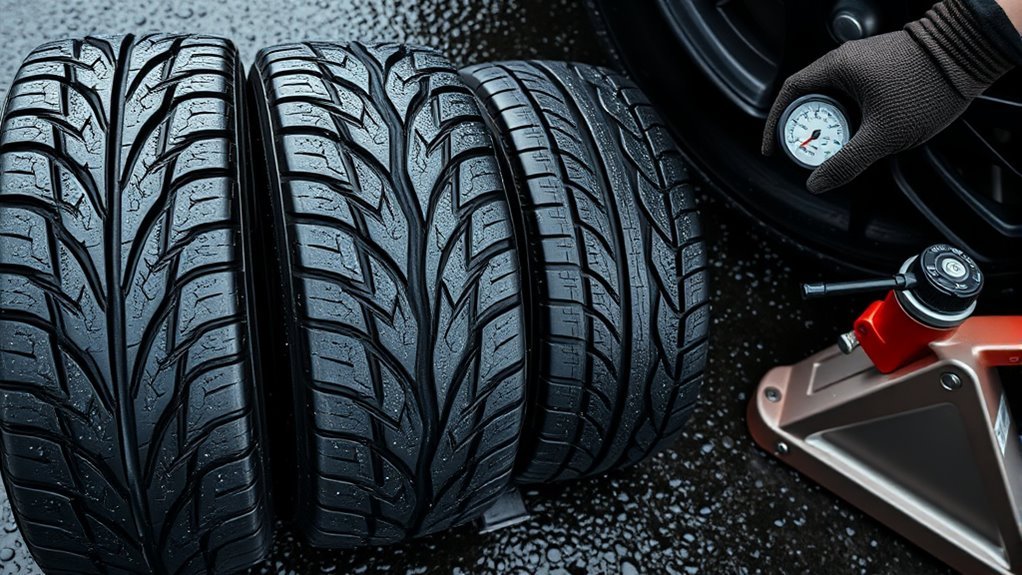
After you verify a tire’s UTQG traction grade, keep that performance by managing pressure, tread depth, and rotation. You must monitor tire pressure regularly—under-inflation can cut traction up to 20%, increasing stopping distance and wear. Measure tread depth; replace tires at or below 2/32″ to avoid compromised grip in wet conditions. Schedule tire rotation every 5,000–7,500 miles to equalize wear and preserve consistent traction across axles. Verify wheel alignment whenever you detect uneven wear or handling changes; proper alignment prevents premature degradation and sustains grip enhancement. Maintain tire cleanliness—remove debris and contaminants that create slippery surfaces. These targeted actions form a traction maintenance protocol that directly improves driving safety and predictable vehicle control.
Shopping: Balance Traction With Treadwear & Temperature
Because tires must perform across wet grip, wear life, and heat resistance, you should weigh UTQG traction grades (AA–C) against treadwear and temperature ratings before buying. You’ll match traction to driving demands: AA/A for superior wet stopping, B/C for longer life if treadwear is high. Compare treadwear numbers to estimate replacement intervals and factor temperature grade to guarantee heat dissipation at sustained speeds. Consider tire maintenance routines and prevalent weather conditions; aggressive compounds need closer inspection and rotation schedules. Integrate all three UTQG elements when specifying tires for vehicle load and typical routes.
- Prioritize AA/A if frequent wet driving and short stopping distances matter
- Balance high traction with a competitive treadwear number
- Confirm temperature A for sustained high-speed use
- Plan rotation and pressure checks per maintenance schedule
- Adjust choice to local weather conditions and driving style
Quick Checklist for Vancouver-Style Wet Conditions
1 clear checklist will help you prioritize tire choices and maintenance for Vancouver’s persistent wet roads: Choose AA-rated tires when possible for superior wet grip and shortest stopping distances; they markedly reduce hydroplaning risks compared with A–C grades. Check tread depth monthly; replace tires that approach legal minimums to maintain channeling capacity. Maintain correct inflation per vehicle placard to preserve contact patch and wear patterns. Rotate tires every 8,000–10,000 km to equalize tread life and traction. Inspect for cuts, embedded debris, or uneven wear that compromise wet performance. If you must use C-rated tires, reduce speed in heavy rain and increase following distance. Log tire service and replacements to guarantee consistent wet-weather readiness.
Frequently Asked Questions
Is Traction a or AA Better?
AA is better; you’ll get superior traction performance and improved tire safety in wet or snowy conditions. You’ll experience shorter stopping distances and reduced hydroplaning risk, so choose AA when prioritizing consistent, high-performance wet traction.
What Does AA Mean on Tires?
AA means the tire offers the highest UTQG wet traction rating; you’ll get superior tire performance and measurable traction benefits, with shorter wet stopping distances and enhanced grip, ideal for safety-focused or high-performance driving.
What Does a and B Mean on Tires?
You’ll learn quickly: A means superior wet stopping, B means acceptable but longer stops. Picture rain-slick roads—tire performance hinges on traction testing results, so you’ll choose A for performance, B for routine, cost-conscious driving.
Which Traction Grade Signifies the Best Traction a AA C AAa?
AA signifies the best traction. You’ll get superior tire performance because testing rates grip on wet surfaces; traction factors like compound, tread design, and contact patch determine stopping distance and handling, so choose AA for maximum control.
Conclusion
You’ll want tires rated AA or A if you drive often in Vancouver-style rain; I learned that when a colleague stopped two car-lengths sooner on wet pavement with A-rated tires—about 10–15 feet less braking distance at 50 km/h in NHTSA-style tests. Treat traction grades like a measured tool: use them with correct pressure, tread depth, and rotation to translate lab numbers into real-world stopping power and consistent wet-weather control.
Related Articles
How to Read Motorcycle Tire Size: Complete Breakdown
Often misunderstood, this guide decodes motorcycle tire sizes like 180/55ZR17—learn what each number and letter means to ensure safe, perfect fitment.
Read More
How to Read Bicycle Tire Size: Inches, Metric & ISO
Get the essential trick to decoding ETRTO/ISO codes so you’ll always pick rim-compatible tyres—discover what to check next.
Read More
How to Read Tire Size Numbers: Decode the Sidewall
Step-by-step guide to decode tire sidewalls—sizes, load, speed, DOT and winter symbols—so you’ll know what fits and when to replace.
Read More