Rolling Resistance & Fuel Efficiency: The Hidden Cost

You’re losing measurable fuel and raising CO₂ whenever tires deform, misalign, or sit underinflated—typically costing 1–10% in efficiency. Rolling resistance stems from hysteresis in rubber, tread design, width and pressure; low‑RR compounds and proper inflation can recover up to ~9% overall. Monthly pressure checks, regular alignment, rotation and balancing cut losses and extend tread life. For fleets, modest maintenance often pays back faster than tire replacement, and more specifics follow.
Rolling Resistance and Why It Matters for Fuel Economy

Although you might not notice it, rolling resistance—the friction tires generate as they deform and slip against the road—directly demands engine work and consequently cuts into fuel economy. You can quantify the impact: under-inflation raises consumption by about 10%, misalignment similarly inflates rolling losses up to 10%, and choosing low rolling resistance tires can reclaim as much as 9% over a tire’s life. Each 1 mph increase costing roughly 1 mpg shows how speed compounds rolling resistance effects. Focused attention to tire compounds and friction reduction yields measurable gains in energy efficiency; material choices and surface treatments reduce hysteresis and heat loss, lowering required propulsion energy. Your driving habits matter too—steady speeds and proper maintenance minimize extra drag. If you want operational freedom from fuel cost constraints, treat rolling resistance as a controllable variable: monitor pressure, correct alignment, select optimized tires, and moderate speed to maximize liberation through efficiency.
How Tire Design and Materials Affect Rolling Resistance
When you evaluate tires for efficiency, design and material choices directly determine rolling resistance through tread geometry, contact patch behavior, and compound hysteresis. You’ll see that tread design balances low resistance and necessary traction: smoother patterns lower hysteresis losses but reduce bite on loose surfaces. Rubber technology—advances like silica-enhanced formulations—lowers energy loss in the compound, letting you gain fuel efficiency without surrendering grip. Tire compounds tailored for reduced hysteresis can yield up to a 9% improvement in fuel economy over a tire’s life, converting engineering gains into real liberation from excess fuel cost. Wider tires increase contact area and traction where you need it, yet they raise rolling resistance on smooth roads, a measurable performance trade offs you must accept. Design choices and material science interact; you’ll prioritize according to mission profile. Quantify expected savings, weigh grip versus consumption, and select rubber technology and tread design that align with your operational freedom and efficiency goals.
Tire Pressure: How Inflation Affects Rolling Resistance (And How Often to Check)
Design and compound choices set a tire’s baseline losses, but inflation pressure directly controls how those losses manifest at the road. You’ll see inflation effects immediately: under-inflated tires increase rolling resistance, costing up to 3% fuel efficiency, while a 0.4–0.5 bar rise in tire pressure can cut rolling resistance by ~10%. A 10 psi deficit typically raises consumption 1–1.5%, so small pressure deviations translate to measurable energy loss. You want control and freedom from wasted fuel; correct tire pressure sharpens stability and safety while liberating miles per liter.
Proper tire pressure cuts rolling resistance, boosts fuel economy and safety—check monthly to reclaim efficiency and control.
- You regain efficiency and budget control.
- You reclaim confidence in vehicle handling.
- You break free from avoidable emissions and costs.
- You assert routine maintenance as autonomy.
Check pressures at least monthly and before long trips using a calibrated gauge when tires are cold. Adjust to manufacturer specs; prioritize consistent measurement to quantify benefits and sustain liberated, efficient mobility.
Tread Depth, Wear Patterns, and Their Effect on Safety and Fuel Use
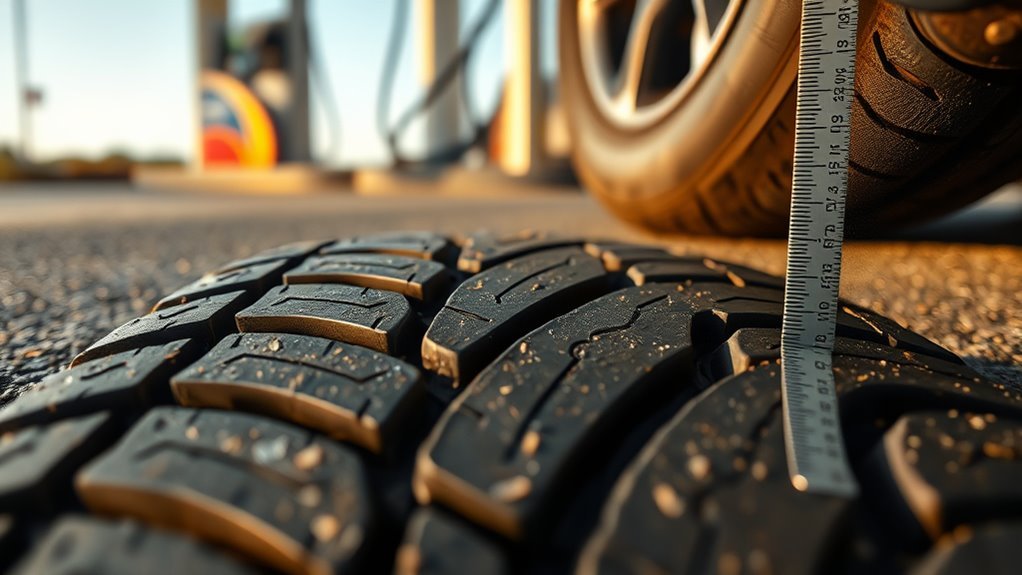
If you let tread depth fall below about 3 mm, your tire’s wet grip and hydroplaning resistance decline sharply and rolling resistance can rise enough to noticeably cut fuel economy. You need to treat tread depth as a liberation tool: maintain ≥3 mm to preserve control, reduce hydroplaning risks, and curb hidden fuel penalties. Monitor wear patterns regularly; feathering, cupping, or center wear point to alignment, suspension, or inflation faults that amplify rolling resistance and create safety concerns. Uneven wear shortens tire life, increasing replacement frequency and total cost. Legally 1.6 mm is minimum, but replacing at 3 mm protects performance and fuel efficiency. For actionable maintenance tips, check depth across the tread, rotate tires per manufacturer intervals, correct inflation to spec, and address alignment promptly. By diagnosing wear patterns early and keeping proper tread depth, you maximize traction, minimize hydroplaning risks, and reclaim efficiency—practical steps that free you from avoidable expense and safety compromise.
Measured Fuel and CO₂ Savings From Low Rolling Resistance Tires
When you compare measured outcomes, switching to low rolling resistance tires can cut fuel use by up to 9%, translating to as much as ~440 liters saved per vehicle versus low-efficiency tires over a tire life. Small adjustments matter too: raising tire pressure by 0.4–0.5 bar typically trims rolling resistance ~10%, and preventing under‑inflation/misalignment avoids roughly another 10% of excess fuel use. Aggregated across a fleet, those savings convert directly to CO₂ reductions measured in hundreds of kilograms per vehicle annually, so quantify both per‑vehicle and fleet‑level impacts when estimating benefits.
Fuel Savings Quantified
One clear measure of rolling resistance’s impact is fuel consumption: switching from low-efficiency (Class G) to high-efficiency (Class A) tires can cut fuel use by as much as 440 liters over a tire’s lifespan and improve instantaneous fuel economy by up to 9%. You gain measurable control: reduced operating cost, extended tire longevity, and a tangible environmental impact. Proper pressure and routine rotation or alignment compound savings; pressure alone can recover up to 3% efficiency. These are technical levers you can pull to free yourself from wasteful consumption.
- Imagine reclaimed funds redirected to meaningful pursuits.
- Picture the relief of fewer fill-ups and simpler logistics.
- Sense responsibility transformed into empowerment.
- Visualize lasting reduction in resource depletion.
CO₂ Reduction Estimates
Because rolling resistance directly governs the energy your vehicle must overcome, switching to low rolling resistance tires measurably cuts both fuel use and CO₂ output: studies and manufacturer tests report up to 440 L saved per tire lifecycle and instantaneous fuel-economy gains up to 9%, translating to CO₂ reductions of several hundred kilograms annually for typical passenger vehicles. You can quantify emission impact by combining measured fuel savings with vehicle-specific CO₂ factors; a 440 L reduction corresponds to roughly 1,160 kg CO₂ avoided (at 2.64 kg CO₂/L). Ancillary gains—from proper tire pressure (up to 3% fuel savings), alignment, and rotation—compound CO₂ reduction. For liberated drivers, these technical interventions yield measurable autonomy: lower operating costs, reduced emissions, and clearer control over your vehicle’s environmental footprint.
Maintenance to Lower Rolling Resistance: Alignment, Rotation, Balancing
To minimize rolling resistance you should prioritize proper wheel alignment and regular tire balancing, since alignment errors can raise fuel use by up to 10% and imbalance adds measurable energy loss. Rotate tires every 5,000–10,000 km to promote even wear that lowers resistance and extends tread life. Implement routine checks for alignment and balance to capture issues early and maintain peak fuel efficiency.
Proper Wheel Alignment
While subtle, proper wheel alignment directly lowers rolling resistance and can cut fuel consumption by up to 10% when maintained, so you should schedule regular alignment checks to prevent uneven tire wear and wasted energy. You’ll gain measurable tire alignment benefits: reduced drag, extended tire life, and clearer handling that frees you from avoidable costs. Track alignment frequency based on mileage, load, and steering feel; misalignment can raise fuel use by about 10% and accelerate replacement cycles. You’ll want rotation every 5,000–10,000 km to complement alignment and preserve even wear. Actively monitoring toe, camber, and caster keeps rolling resistance minimal and performance optimized, letting you reclaim control of operational expenditure and mobility.
- Frustration at wasted fuel transforms into decisive savings.
- Fatigue from vibration becomes calm control.
- Wear anxiety shifts to confidence.
- Costs that chained you unravel.
Regular Tire Balancing
Having kept alignment and rotation on schedule, you should next address tire balancing to further cut rolling resistance and fuel use. Regular tire balancing reduces asymmetric tire wear and can extend tire lifespan by up to 40%, lowering operating costs and liberating resources for other priorities. Unbalanced tires generate vibrations that increase energy consumption, driver fatigue, and hidden maintenance burdens; correcting balance minimizes these losses. Combine balancing with routine rotation every 5,000–10,000 km to preserve even tire wear and ideal rolling resistance. Implement a documented balancing frequency based on load cycles and mileage to realize consistent 1–3% fuel savings and measurable fleet efficiency gains. You’ll need calibrated equipment and trained technicians to sustain gains and validate returns.
Fleet Tactics to Cut Rolling Resistance Without Replacing All Tires
Although you don’t have to replace every tire to cut rolling resistance, disciplined fleet maintenance will yield measurable fuel savings quickly. You can apply tire longevity strategies and fleet management innovations to squeeze efficiency from existing rubber: keep pressures correct (every 10 psi low risks 0.5–1% extra fuel), rotate tires every 5,000–10,000 km to equalize wear, and pursue wheel alignment to avoid up to 10% higher consumption. Adaptive balancing solutions like EQUAL FLEXX cut vibrations and energy loss at the wheel end. These steps free you from unnecessary replacements while improving economy.
- Feel empowered—small actions compound into liberty from fuel waste.
- Feel decisive—data-driven checks deliver predictable savings.
- Feel resilient—extended tread life lowers capital churn.
- Feel in control—systematic maintenance replaces uncertainty with performance.
Implement these tactics with metrics, scheduled interventions, and rapid feedback loops so your fleet converts disciplined care into measurable fuel reduction without wholesale tire swaps.
Quick Checklist: Consumer and Fleet Actions You Can Do Today
Start with a few targeted checks you can do today to cut rolling resistance and fuel use: verify tire pressures (under‑inflation can raise consumption up to 10%), inspect tread depth and plan replacements at 3 mm, schedule tire rotations every 5,000–10,000 km to equalize wear, and confirm wheel alignment to avoid as much as 10% extra fuel burn. You’ll act with precision: measure pressures weekly, log rotations and alignments, and document tread depth. Embrace tire technology choices that lower resistance and demand consumer awareness when selecting replacements. For fleets, standardize inspection intervals and share data to free operators from waste. These steps sharpen operational efficiency and expand your control over fuel spend without complex retrofits. Use the table below to track simple metrics and responsibilities.
| Task | Frequency |
|---|---|
| Tire pressure check | Weekly |
| Tread depth inspection | Monthly |
| Tire rotation | 5,000–10,000 km |
| Wheel alignment check | Annually or after impacts |
Cost vs. Benefit: Calculating Payback for Tires and Maintenance
When you quantify tire and maintenance choices against fuel use and replacement cycles, you reveal clear payback timelines that guide investment decisions. You’ll use cost analysis and efficiency metrics to compare Class G versus Class A tires: switching can save about 440 liters of fuel per tire lifespan, so calculate fuel price × 440 to estimate direct savings. Factor tire lifespan changes from rotation every 5,000–10,000 km and maintenance frequency for pressure checks (up to 3% efficiency gain) and alignments (prevents a potential 10% fuel penalty). Build a simple model: upfront incremental tire cost + recurrent maintenance cost versus cumulative fuel saved and deferred replacement expenses. Solve for months or kilometers to payback; sensitivity-test fuel price and maintenance diligence. This gives you actionable thresholds for investing in low rolling resistance tires and disciplined servicing, freeing you from wasteful operating costs and accelerating both economic and environmental liberation.
- Pride in reduced fuel bills
- Relief from unexpected replacements
- Confidence in predictable operating costs
- Empowerment through measured choices
Frequently Asked Questions
How Does Rolling Resistance Affect Fuel Efficiency?
Rolling resistance increases fuel consumption by forcing your engine to work harder; you’ll lose efficiency when low tire pressure or rough road surface raise friction, so maintain pressure and choose better tires to reclaim energy.
Do Brand New Tires Make You Lose MPG Because of Rolling Resistance?
Yes—you’ll lose a bit of MPG initially; think of a sprinting jogger with new shoes. Tire types and tread patterns raise rolling resistance; you can reclaim efficiency via proper inflation, alignment, and choosing low‑resistance compounds.
Is 60 Mph More Efficient Than 70 Mph?
Yes — you’ll save fuel at 60 mph versus 70 mph. Your speed impact reduces aerodynamic factors and rolling losses, so you’ll gain roughly 10–15% better mpg, cut emissions, and free yourself from needless consumption.
Conclusion
You’ve seen how rolling resistance quietly drains fuel and boosts CO₂—so act. Prioritize correct inflation, alignment, rotation and low‑resistance tire choices to reclaim efficiency. Even modest gains compound across fleets; one percent improvement can feel like winning the lottery for your fuel budget. Track tread, wear patterns and replace or retread strategically rather than reflexively. Run simple payback calculations to justify investments, and apply the checklist to cut costs and emissions immediately.
Related Articles
Motorcycle Tire Pressure Chart: Recommended PSI by Type
Discover ideal PSI ranges for road, track, and wet motorcycle tires — practical tips and adjustments await to optimize grip and safety.
Read More
Bicycle Tire Pressure Chart by Rider Weight: PSI Guide
Want optimal ride feel and fewer flats? Discover PSI baselines by weight, tire type, and wheel size to fine-tune grip and comfort.
Read More
How Altitude Affects Tire Pressure: High Elevation Guide
Note how tire PSI drops with elevation—learn the simple adjustments to maintain safety, efficiency, and tire life as you climb.
Read More