Pneumatic vs Solid Tires: Comfort, Cost & Durability
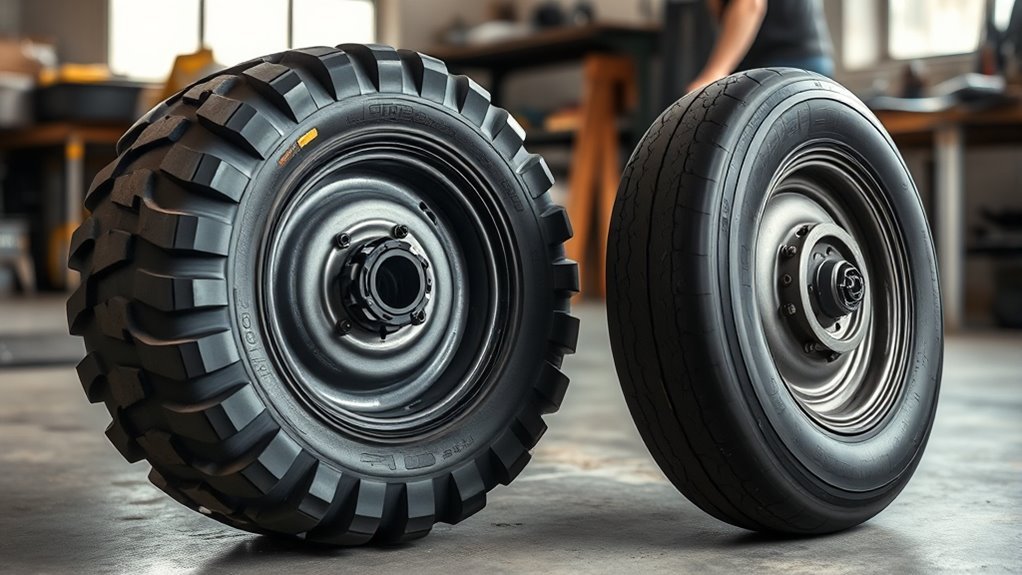
You’ll pick pneumatic tires when cushioning, traction on soft or uneven ground, and lower initial cost matter; they cost $250–$500, last ~500–1,000 hours, and need frequent air checks and puncture repairs. Choose solid tires when puncture resistance, longer life, and reduced downtime are priorities; they cost $800–$1,200, last ~3,000–4,000 hours, and cut maintenance interventions. The trade-offs affect ride quality, traction, and total cost of ownership—review the application specifics to learn more.
Match Tire Type to Job Site: Debris, Turf, and Loads
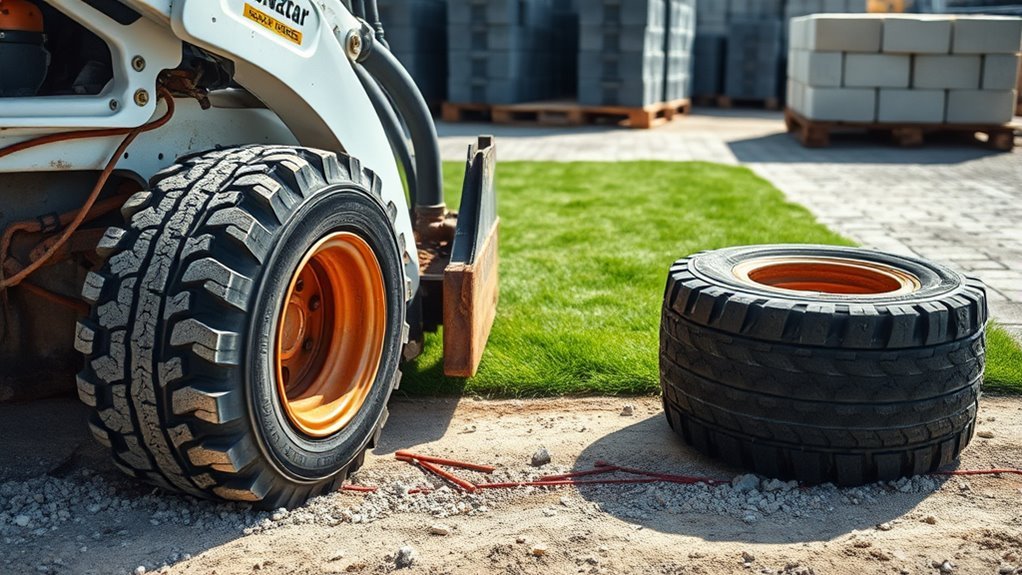
When you match tire type to the job site, prioritize surface conditions and load demands: choose solid tires for debris-laden, high-load environments because their puncture resistance and higher load ratings deliver stability and longer service life, while pneumatic tires suit turf and off‑road work by cushioning impacts, protecting grass, and adapting to uneven terrain for better traction and comfort. You’ll evaluate tire performance against application suitability: solids optimize load distribution and reduce downtime where sharp objects prevail, while pneumatics improve maneuverability on soft ground. Consider environmental impact and maintenance frequency: solids last far longer and lower waste streams, whereas pneumatics need more frequent replacement and careful pressure management. Factor in safety considerations and installation differences—solids fit heavy-duty hubs without pressure checks; pneumatics require valves and inflation protocols. Align choices with industry preferences and operational goals so you can free crews from avoidable failures, minimize cost-per-hour, and assert control over site resilience and worker autonomy.
Quick Decision Checklist: When to Pick Pneumatic vs Solid
Assess the jobsite and terrain first: if you’re dealing with rough, debris-laden or high-load conditions, favor solids for durability and puncture resistance, while pneumatics suit uneven surfaces where traction and shock absorption matter. Then weigh cost versus comfort by comparing upfront price and expected service hours—pneumatics cost less initially ($250–$500) but may incur frequent repairs, solids cost more ($800–$1,200) yet last 3,000–4,000 hours. Use those two axes to make a concise choice that matches operational priorities and total cost of ownership.
Jobsite & Terrain
Because jobsite conditions dictate performance and downtime risk, choose pneumatic tires for tasks that demand shock absorption and traction on uneven or soft surfaces, and pick solid tires where puncture hazards, heavy loads, and minimal maintenance are priorities. You’ll assess terrain challenges—landscaping, snow removal, and soft ground favor pneumatics for comfort and maneuverability; demolition, rebar-strewn zones, and continuous heavy lifting favor solids for reliability and puncture resistance. Consider weight impact: solids reduce lifting capacity but cut downtime; pneumatics improve handling but need more upkeep. Make decisions that free you from unnecessary repair cycles and maximize uptime.
| Situation | Recommendation |
|---|---|
| Soft/uneven ground | Pneumatic |
| Snow/landscaping | Pneumatic |
| Debris/rebar | Solid |
| Heavy continuous loads | Solid |
| Maintenance-limited sites | Solid |
Cost vs Comfort
Every decision should weigh upfront price against ongoing operating costs: pneumatic tires cost roughly $250–$500 each and need replacement every 500–1,000 hours, while solids run $800–$1,200 and last about 3,000–4,000 hours, so you’ll want to calculate total cost of ownership including replacement frequency, repair/patching, and downtime. You’ll assess tire performance versus lifecycle expense: pneumatics deliver superior cushioning and reduced operator fatigue but increase maintenance costs through punctures and air checks. Solids reduce service interventions and downtime, improving predictable operating budgets despite a harsher ride. Choose pneumatics when comfort boosts productivity enough to offset repair cycles; choose solids when durability and minimized maintenance costs liberate you from frequent service, stabilizing fleet availability and cash flow.
Comfort & Ride Quality: Why Pneumatics Absorb Bumps Better
While both tire types support load, pneumatic tires use an air-filled chamber that compresses and rebounds to absorb surface irregularities, so you experience markedly lower vibration transmission than with solid tires. You’ll notice tire flexibility and shock absorption working together: the air cushion flattens under weight, raises contact area, and attenuates impulse loads. That reduces transmitted forces to the frame and operator, lowering fatigue and improving control on irregular ground.
| Property | Pneumatic | Solid |
|---|---|---|
| Shock absorption | High | Low |
| Contact adaptation | Variable | Fixed |
| Vibration transmission | Low | High |
Technically, pneumatic tires act as tunable springs and dampers; you can adjust pressure to tailor ride compliance and traction. That adaptive behavior liberates operators from harsh feedback, enabling sustained productivity and safer handling in off-road conditions where solids underperform.
Durability & Downtime: When Solid Tires Save Money
When you need maximum uptime in harsh environments, solid tires deliver measurable lifecycle and maintenance advantages: they typically last 3,000–4,000 hours versus 500–1,000 hours for pneumatics, resist punctures and cuts, and eliminate air-pressure checks and flat repairs. You’ll value the clear tire longevity differential when scheduling shifts and spare parts: predictable replacement cycles simplify logistics and reduce unexpected stoppages. In industrial applications where freedom from interruption matters, puncture resistance and abrasion tolerance translate directly into downtime reduction and operational efficiency.
You’ll see maintenance savings from eliminated inflation tasks and fewer repair interventions, which streamlines workforce allocation and reduces lost production minutes. Performance consistency remains stable across load and terrain variations, supporting accurate throughput forecasting and safer workflows. Taken together, these attributes deliver straightforward cost effectiveness for teams that prioritize continuous operation and liberation from reactive maintenance. Choose solid tires when you need robust, quantifiable uptime gains and minimized interruption risk.
Real Cost Comparison: Upfront Price, CPH, and TCO Math
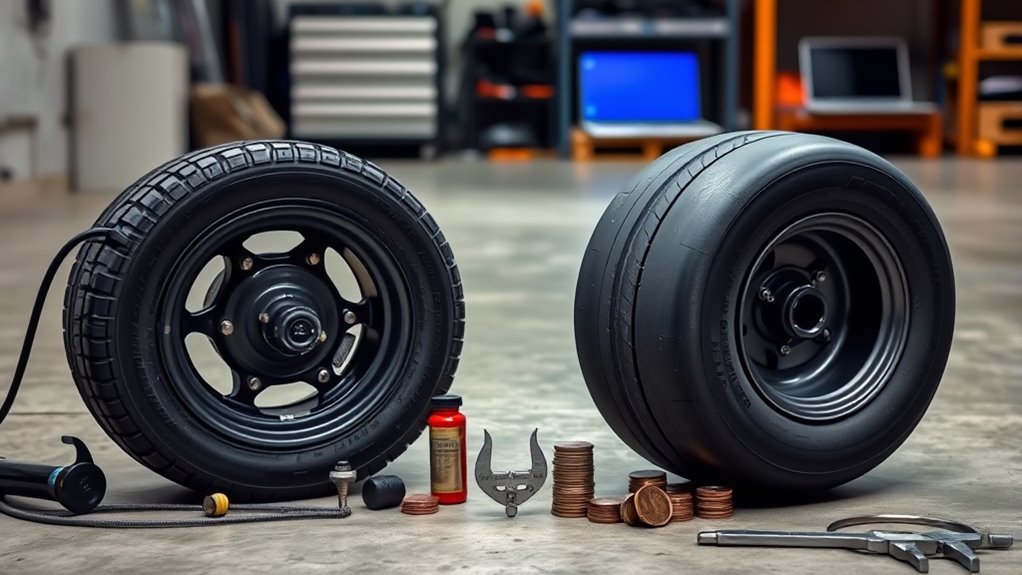
You’ll compare the upfront purchase cost—typically $250–$500 for pneumatics versus $800–$1,200 for solids—and quantify how that gap shifts across expected life hours. Use Cost-Per-Hour (CPH) calculations that include replacements, repair of flats, and downtime to reveal true operating rates. Then aggregate those CPH figures into a Total Cost of Ownership (TCO) model to show whether higher initial spend on solids yields net savings over 3,000–4,000 hours versus pneumatics at 500–1,000 hours.
Upfront Purchase Cost
Because upfront price anchors budget decisions, fleet managers must quantify both purchase cost and operational hours to compare pneumatic and solid tires on a like-for-like basis. You’ll see pneumatic advantages in lower per-unit prices ($250–$500) but higher replacement frequency; solid benefits show in $800–$1,200 unit costs with far greater service life. Balance immediate capital constraints against strategic autonomy over maintenance cycles.
| Metric | Typical Range |
|---|---|
| Pneumatic upfront | $250–$500 each |
| Solid upfront | $800–$1,200 each |
Make procurement choices that free your operations: if you prioritize lower initial spend, choose pneumatic; if you want reduced replacement events and longer term fiscal control, choose solid.
Cost-Per-Hour Analysis
Start by converting upfront price and lifespan into a consistent cost-per-hour metric so you can compare pneumatic and solid tires on equal footing. You’ll calculate CPH by dividing purchase price by usable hours, then add predictable maintenance frequency costs to reflect realistic operating expense. Use tire longevity and maintenance frequency as core variables.
- Pneumatic: $250–$500 / 500–1,000 hrs = $0.25–$1.00/hr base.
- Solid: $800–$1,200 / 3,000–4,000 hrs = $0.20–$0.40/hr base.
- Add puncture repairs and air checks to pneumatic CPH; solids need minimal routine labor.
- Factor downtime cost per hour when replacements occur more often.
- Compare ranges to choose the option that liberates your fleet from hidden recurring costs.
Total Cost Of Ownership
| Metric | Pneumatic | Solid |
|---|---|---|
| Upfront | $250–$500 | $800–$1,200 |
| Lifespan (hrs) | 500–1,000 | 3,000–4,000 |
Traction & Handling: Which Tire Works on Which Terrain
When you’re matching tire type to terrain, consider that pneumatic tires deform under load to increase contact patch and absorb irregularities, which yields superior traction and more predictable handling on loose or uneven surfaces. You’ll find pneumatic options offer better terrain adaptation and handling performance across off-road, mixed, and uneven ground because they conform, dissipate shocks, and maintain grip during lateral loads. Solid tires trade that conformity for puncture resistance and consistent response on paved or debris-laden routes, but their rigidity reduces traction on soft or irregular substrates.
- On loose soil or gravel, choose pneumatic for maximized contact and controlled slip.
- For uneven, technical trails, pneumatic improves cornering stability and braking predictability.
- On paved city streets with sharp debris, solid tires preserve uptime and reduce maintenance.
- In mixed environments, prioritize tires that balance terrain adaptation with operational resilience.
- When liberation means mobility under constraint, select the tire that maintains traction where you need to move.
Weight, Load Ratings & Safety: Impacts on Equipment Capacity
Because tire choice directly affects vehicle mass distribution and rated capacity, you should weigh the trade-offs between heavier solid tires and lighter pneumatic options when specifying equipment for a task. Heavier solid tires shift weight distribution downward and toward wheel assemblies, which can reduce published lifting capacity but increase load stability under static heavy loads. Pneumatic tires, being lighter, preserve lifting margin and can improve equipment performance where payload limits are tight, though their lower load ratings (for example ~4,700 lb) constrain use in some applications. Prioritize tire compatibility with chassis ratings and use digital selection tools to calculate safety margins precisely. Assess how added unsprung mass from solids affects dynamic balance and wear on suspension and drive components. For operators seeking liberation from downtime, choose the tire that optimizes operational efficiency without compromising load stability and safety margins; document limits, verify compatibility, and enforce strict adherence to rated capacities during routine operations.
Maintenance & Operational Simplicity: Pneumatic vs Solid Tires
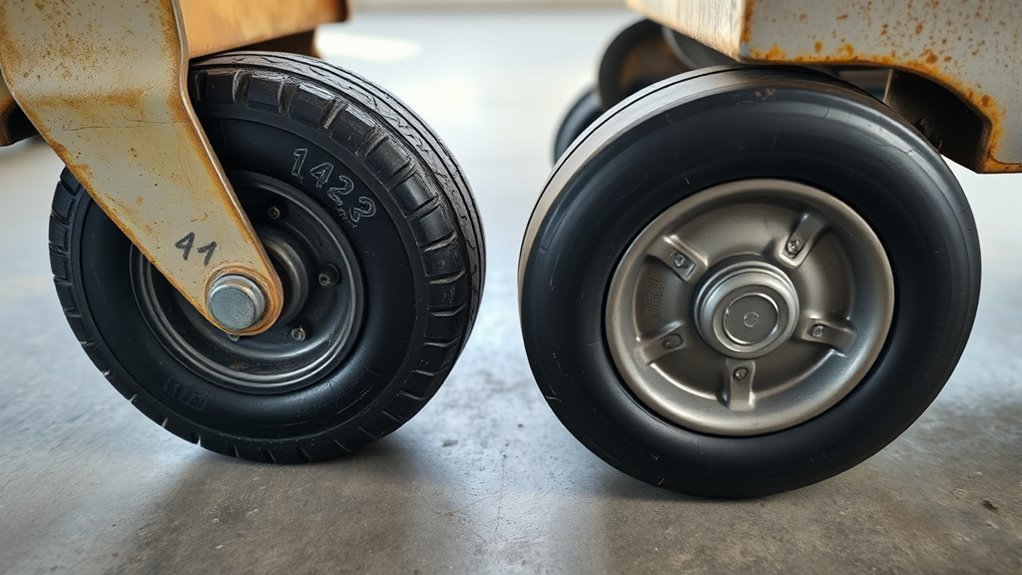
Shifting focus from how tire mass and load ratings affect capacity, consider how maintenance demands shape uptime and operational costs. You’ll find pneumatic tires need frequent tire maintenance—air pressure checks, puncture repairs, tube replacements—which increases downtime and logistical complexity. Solid tires, by contrast, remove flats and leaks, delivering predictable performance and lower intervention rates. That simplicity translates to measurable gains in operational efficiency and reduced total lifecycle expense, especially where maintenance access is constrained.
- You’ll schedule fewer service stops with solids, boosting availability.
- You’ll eliminate spare tubes and repair kits for routine operations.
- You’ll reduce unexpected downtime from flats in rugged environments.
- You’ll minimize inventory and labor tied to air-pressure management.
- You’ll extend replacement intervals, lowering per-hour tire costs.
Choose solid tires when you want liberation from constant upkeep; select pneumatics only if their ride qualities justify higher maintenance overhead and operational complexity.
Frequently Asked Questions
What Are the Disadvantages of Pneumatic Tires?
You’ll face puncture risks, frequent air pressure checks, higher rolling resistance, shorter lifespan, and increased maintenance costs; you’ll sacrifice durability and operational reliability for cushioning, so you’ll need stricter inspection and replacement schedules.
What Is the Most Durable Type of Tire?
Solid tires are the most durable; you’ll feel them shrug off nails like thunder. With clear tire longevity comparisons and material impact analysis, you’ll choose resilience, minimal upkeep, and prolonged service life to reclaim operational freedom.
Conclusion
You’ll choose tires by matching job-site demands to performance: pick pneumatics when ride comfort, traction on uneven terrain, and lighter weight matter; pick solids when downtime, puncture risk, and long-term durability dominate. You’ll weigh upfront cost against cost-per-hour and total cost of ownership, treating the tire as a system component, not just rubber. Like selecting a tool from a kit, your decision optimizes safety, capacity, and lifecycle costs with measurable criteria.
Related Articles
Latex vs TPU Tubes: Best Performance Guide
Uncover whether latex’s unbeatable rolling resistance or TPU’s lighter, tougher profile wins your rides — and what trade-offs you’ll actually feel in the saddle.
Read More
Wide vs Narrow Tires: Ultimate Grip vs MPG Guide
A concise guide comparing wide and narrow tires for grip, speed, and fuel efficiency—discover which suits your driving needs and why it matters.
Read More
Motorcycle Tire Pressure Chart: Recommended PSI by Type
Discover ideal PSI ranges for road, track, and wet motorcycle tires — practical tips and adjustments await to optimize grip and safety.
Read More