How to Prevent Flat Tires on a Bicycle: 9 Proven Tips
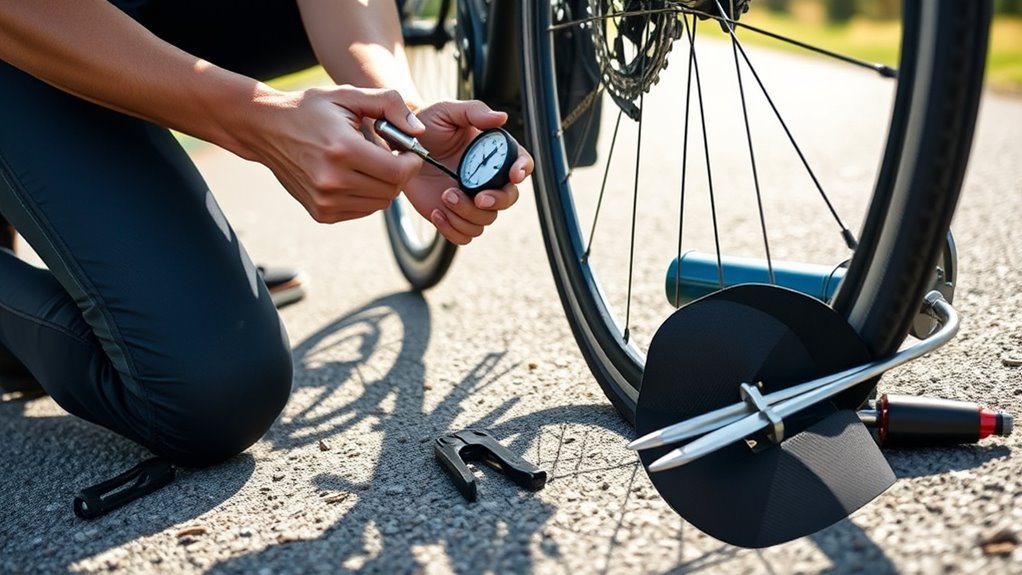
You can stop most flats by keeping tires at the manufacturer’s PSI for your weight and conditions, checking pressure before every ride, and inspecting for cuts or embedded debris. Upgrade to puncture‑resistant tires or add liners, inserts, or Tannus for tougher protection. Consider a tubeless setup with sealant to auto‑seal small holes. Store spare tubes properly and replace worn rim tape or rims. Follow these steps now, and the rest of the guide shows practical setups and inspection routines.
Quick Wins to Stop Flat Tires Now
If you want to stop flats fast, start with pressure: keep tires inflated to the manufacturer’s PSI because both over- and underinflation raise flat risk (underinflation causes pinch flats from impacts). You’ll also want puncture-resistant tires—Kevlar-belted casings trade slight weight for far fewer cuts—and consider tubeless setups where sealant handles small breaches and pinch flats vanish. Add tire liners or inserts for a sacrificial layer against sharp debris. Don’t fall for flat tire myths that claim heavier tires always slow you; durability beats frequent roadside fixes. Perform quick tire inspection tips before every ride: scan tread for embedded shards, check sidewalls for cuts or bulges, and flex the tire to reveal hidden damage. Address any issue immediately to avoid failures.
Prevent Flats: Set the Right Tire Pressure
Check the tire sidewall for the manufacturer’s PSI range and use that as your baseline. Adjust pressure toward the high or low end based on your weight and the tire width to reduce pinch flats without sacrificing grip. Check pressure before every ride and record readings so you can spot leaks or needed adjustments quickly.
Check Manufacturer PSI
Because the correct PSI is stamped on your tire sidewall, set your pump to that range and top up before every ride to reduce pinch flats and optimize performance. Check manufacturer PSI each time: it’s your baseline for tire pressure, helping prevent under-inflation and overinflation issues. Use a calibrated gauge; record inflation frequency (daily for heavy use, weekly for casual) to spot leaks. Match pressure to terrain within the printed range—softer for rough surfaces, firmer for smooth roads—without guessing. Overinflation cuts grip; underinflation increases pinch-flat risk. Log readings and inspect valves and tire condition when you inflate. A small routine prevents punctures and maintains efficient rolling resistance.
| Metric | Action | Target |
|---|---|---|
| PSI range | Set pump | Sidewall value |
| Check cadence | Record inflation frequency | Daily/Weekly |
Adjust For Rider Weight
Start by matching tire pressure to your weight: heavier riders need higher PSI to keep the contact patch from collapsing and to prevent pinch flats. Use the sidewall’s recommended PSI range as your baseline, then adjust within that range: a useful rule is +1 PSI for every 10 pounds above a reference weight. That preserves the contact patch and reduces rolling resistance on rough surfaces. Under-inflation raises pinch-flat risk and accelerates wear; over-inflation sacrifices rider comfort and traction. Aim for a balance that maintains tire durability and predictable handling. After significant weight changes or long storage, re-evaluate pressure and reset according to the guideline so your tire pressure matches current rider weight and riding conditions.
Monitor Pressure Regularly
Having matched tire pressure to your weight, make a habit of measuring pressure before every ride so you can keep it within the sidewall’s recommended PSI range. You’ll avoid pinch flats and optimize performance impact by checking both tires with reliable inflation tools and a calibrated gauge; visual inspection isn’t enough. Include pressure checks in your maintenance routine and log readings after temperature swings—weather effects lower PSI in cold conditions and raise it in heat. Adjust for riding habits and terrain: lower pressure for rough trails, higher for smooth roads. Proper gauge accuracy preserves tire lifespan; replace cheap gauges yearly. Don’t overinflate or underinflate—both harm tires. Consistent monitoring reduces flats and maintains predictable handling.
| Task | Tool | Frequency |
|---|---|---|
| Measure PSI | Digital gauge | Every ride |
| Top up air | Pump with gauge | As needed |
| Record | Logbook/app | Weekly |
| Temperature check | Thermometer | When cold |
| Gauge test | Master gauge | Monthly |
Choose Puncture‑Resistant Tires (Models & When to Upgrade)
One clear upgrade you can make to reduce flats is switching to puncture‑resistant tires—those with Kevlar or aramid belts, thicker tread compounds, or reinforced sidewalls—which resist embedded glass, thorns, and rough urban debris much better than standard casings. Choose puncture resistant models from Specialized, Continental, or Schwalbe that match your wheel size and riding style. Inspect tire age, tread cuts, and embedded debris; visible damage means it’s time for a tire upgrade. If you get frequent punctures or ride rough routes, upgrade to sturdier casings designed for higher puncture resistance. Consult your local bike shop for model selection and tire upgrade timing tailored to your use and rim. Replace rim tape when worn to maintain overall protection.
Prevent Flats: Go Tubeless or Use Sealant
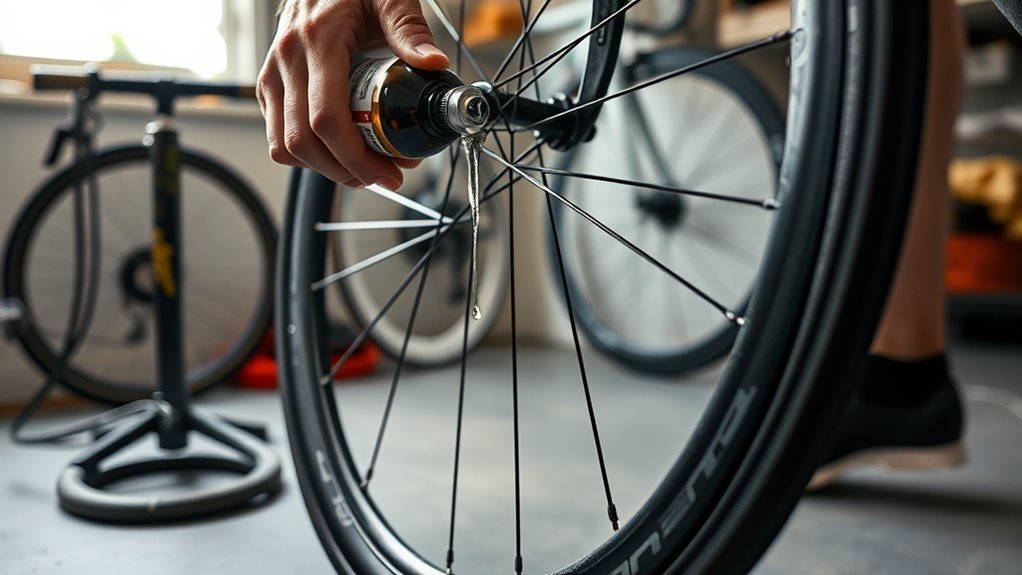
Switching to tubeless cuts pinch flats and lets you run lower pressures for better grip and comfort, though it needs compatible rims/tires and a short learning curve. Choose sealants—latex, synthetic, or particulate—based on longevity, temperature range, and puncture-sealing profile, and remember you can also add sealant to tubes if you fit removable valve cores. Keep sealant topped up on a schedule and inspect valves and beads regularly; tire inserts layer extra protection if you want redundancy.
Tubeless Conversion Benefits
Because there’s no inner tube to pinch against the rim, going tubeless removes pinch flats and lets you run lower pressures for better traction and comfort on rough terrain. You’ll notice tubeless advantages immediately: improved shock absorption, fewer roadside repairs, and better control in loose conditions. Converting is practical—kits exist for most rims and tires—so you can adapt your current wheelset without buying new ones. Once set up, sealant effectiveness handles small punctures automatically, maintaining pressure and minimizing interruptions. Maintenance is simpler than with tubes: occasional sealant top-ups and rim checks replace frequent tube swaps. For off-road riding especially, the performance gains and reduced flat risk justify conversion. Follow manufacturer torque and seating specs during installation to guarantee reliability.
Sealant Types Explained
If you’re convinced tubeless is the way to go, the next question is which sealant to use and how it behaves in service. You’ll rely on sealant effectiveness to self-seal small punctures and on sealant longevity to know service intervals. Common latex-based sealants (e.g., Stan’s) form flexible plugs for holes up to 1/4″, offering fast, reliable sealing. Thicker aqueous/particulate formulas (e.g., Slime) can be messier but add bulk protection and work in tubes if you use removable valve cores.
- Latex liquid — fast sealing, good sealant effectiveness, moderate longevity.
- Particulate/slime — higher bulk protection, lower neatness.
- Hybrid — balances plug speed and durability.
- Inserts + sealant — mechanical protection plus liquid backup.
Maintenance And Refill
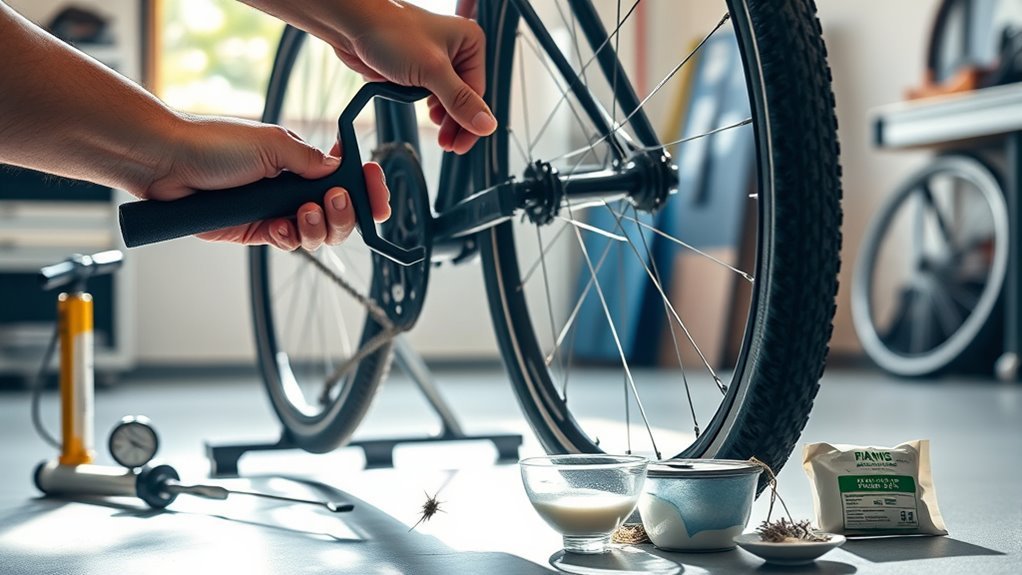
Keep sealant effective by checking and topping it up on a regular schedule — every 2–6 months depending on climate, mileage and the product — and inspect the tire for dried residue or bead leaks when you do. When you convert to tubeless, verify tire compatibility with your rims; tubeless-specific tires and rims guarantee a reliable airtight seal and proper bead seating. Drain and refresh sealant rather than just adding to old, coagulated fluid: remove the valve core, inject fresh sealant, rotate the wheel to distribute, and check for slow leaks. For added protection, install tire liners or inserts compatible with tubeless setups. Document service intervals, track sealant maintenance, and adjust frequency for hot, dry conditions or high-mileage riding.
Add Liners, Inserts, or Tannus for Extra Protection
When you’re serious about reducing flats, add a protective layer between your tire and tube—liners, inserts, or a Tannus Armour will block sharp objects and absorb impacts before they reach the tube. Understand tire liner benefits: they’re thin, low-weight, and stop thorns and glass. Consider insert installation tips: center the insert, avoid twists, and guarantee clearance for rims and brakes. Compare Tannus Armour advantages: solid, no-air protection that prevents pinch flats and works well in harsh conditions. Use puncture protection comparison to choose based on weight, ease of fitting, and ride feel.
- Choose liner for light, low-profile protection.
- Fit insert for rough terrain and impact absorption.
- Install Tannus for maintenance-free solidity.
- Combine with sealant for best results.
Dust and Store Spare Tubes Correctly
After adding liners, inserts, or a Tannus you still need to manage spare tubes properly so they perform when you need them. Dust spare tubes with talcum powder to reduce chafing and prevent sticking; this preserves bead seating and supports tire longevity. Fit valve caps to shield stems from debris and impact. Don’t use rubber bands—store tubes in a quart-sized zip-lock bag to avoid chemical degradation and contamination. Keep bags in a cool, dry place away from heat sources to prevent material breakdown. Before rides, inspect stored tubes for cracks or damage as part of emergency preparedness.
| Action | Benefit |
|---|---|
| Talcum powder | Reduces chafing |
| Valve caps | Protects stems |
| Zip-lock bag | Prevents degradation |
| Cool storage | Extends lifespan |
Inspect Tires: Step‑by‑Step Maintenance Checklist
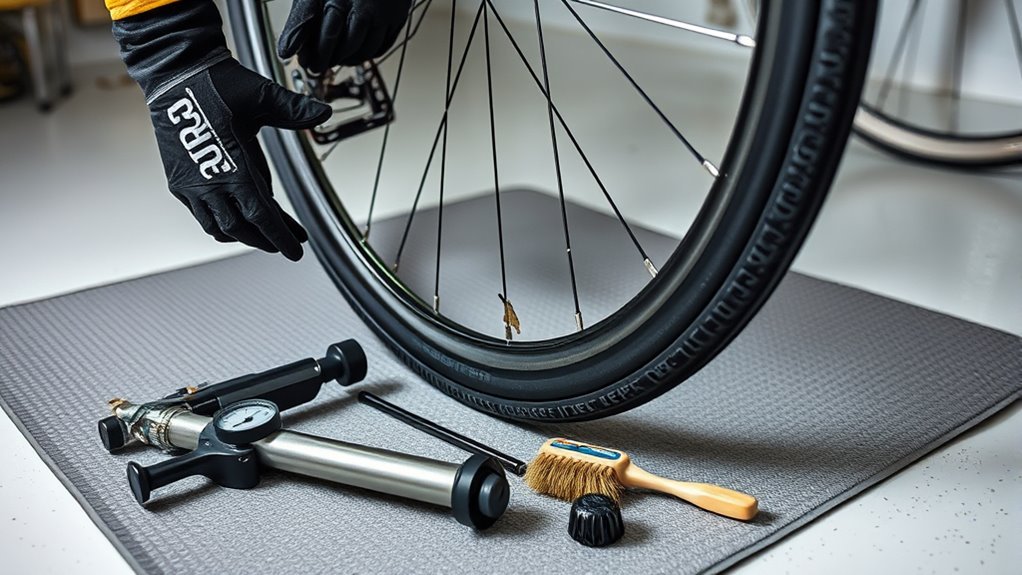
Start each ride with a quick, systematic tire check so you catch cuts, embedded debris, and pressure issues before they become flats. Use a concise, repeatable routine that covers wear, seating, pressure, and rim condition.
- Visual inspection: scan sidewalls and tread for cuts, cracking, glass, nails, and signs of tire wear; remove embedded debris with pliers.
- Pressure check: confirm PSI against the sidewall marking with a reliable gauge; correct under- or over-inflation immediately.
- Seating and tube position: deflate slightly, reseat bead evenly around the rim, guarantee the tube isn’t pinched before final inflation.
- Rim tape and spoke area: inspect tape for abrasion or gaps that can cause micro punctures; replace if damaged.
Ride Smarter: Lines, Hazards, and Seasonal Tips
Because most roadside debris collects near gutters and puddles hide potholes, pick your line to keep clear of edges and standing water so you reduce exposure to sharp objects and concealed hazards. Scan ahead, choose a predictable line that avoids debris fields and trail-side rocks, and signal changes so others expect your path. Adjust your speed: high velocity reduces reaction time and increases puncture risk when you must dodge suddenly. Use precise riding techniques—weight distribution, small steering inputs, and active scanning—to trace the cleanest arc through traffic and trail sections. Make seasonal adjustments: raise tire pressure slightly in winter to counter cold-induced PSI loss, and clean tread after wet rides to prevent embedded debris. Consistent practice of these technical habits cuts flats considerably.
Fix the Root Cause: When to Replace Tires, Rims, or Setup
One clear way to stop recurring flats is to diagnose and fix the hardware causing them: inspect tire casing and tread for cuts or thinning, check rim tape and spoke ends for abrasion points, and evaluate whether switching to puncture-resistant tires, tubeless setup, or simply fresher tubes will address the failure mode you’re seeing.
- Check tire lifespan: replace tires showing cracks, frequent punctures, or threadwear; don’t wait for a blowout.
- Assess rim condition: damaged or corroded rims and exposed spoke ends need rim tape replacement or rim repair to prevent micro-punctures.
- Setup evaluation: consider tubeless conversion to reduce pinch flats, or confirm tube storage and quality if you keep tubes.
- Upgrade timing: move to Kevlar-belted tires or new rims when flats persist despite proper pressure and inspection.
Frequently Asked Questions
What Can I Put in Bicycle Tires to Keep From Going Flat?
Put tire sealant options like latex or polymer sealants in tubes or tubeless setups; you can also fit puncture resistant tires, tire liners, Tannus Armour inserts, or convert to tubeless to minimize flats and pinch punctures.
How to Avoid a Flat Tire?
You avoid a flat tire by prioritizing tire maintenance: keep correct PSI, inspect for debris, use puncture protection like liners or tubeless sealant, ride clear of hazards, and replace worn tires promptly to reduce puncture risk.
Why Do I Always Get Flat Tires on My Bike?
You’re courting trouble: common causes like under-inflation, sharp debris, poor tire selection, aging rim tape, or pinched tubes mean you’re getting flats. Do tire maintenance routinely, inspect, inflate correctly, and fit tubes properly.
Conclusion
You’ve got practical tools to stop flats, but don’t assume one tweak fixes everything. Test the theory that higher pressure always prevents punctures: it reduces pinch flats but can make you more prone to sharp-object penetration and loss of traction. Balance pressure, tire choice, and protection (sealant, inserts, liners) for your riding conditions. Inspect and replace worn tires or damaged rims—fix the root cause, not just the symptom—to keep your rides puncture-free.
Related Articles
How to Read Motorcycle Tire Size: Complete Breakdown
Often misunderstood, this guide decodes motorcycle tire sizes like 180/55ZR17—learn what each number and letter means to ensure safe, perfect fitment.
Read More
How to Read Bicycle Tire Size: Inches, Metric & ISO
Get the essential trick to decoding ETRTO/ISO codes so you’ll always pick rim-compatible tyres—discover what to check next.
Read More
How to Read Tire Size Numbers: Decode the Sidewall
Step-by-step guide to decode tire sidewalls—sizes, load, speed, DOT and winter symbols—so you’ll know what fits and when to replace.
Read More