How to Check Tire Pressure With a Gauge (Correctly)
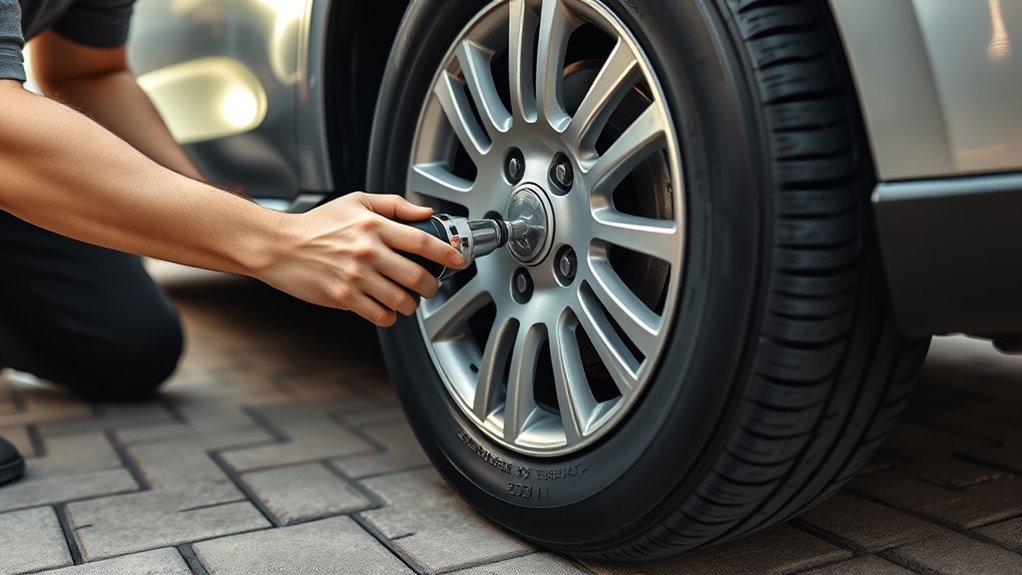
Check tire pressure only when tires are cold (3+ hours stationary or under 1 mile driven). Find the recommended PSI on the driver-side door jamb or owner’s manual, then use a calibrated gauge—digital, dial, or stick—press firmly to stop air loss and note the stabilized reading. Inflate with a compressor in short bursts, recheck, and bleed if overfilled. Record monthly, adjust ~1–2 PSI per 10°F change, and follow front/rear specs to avoid uneven wear; more procedural detail follows.
Check Tire Pressure Only When Tires Are Cold
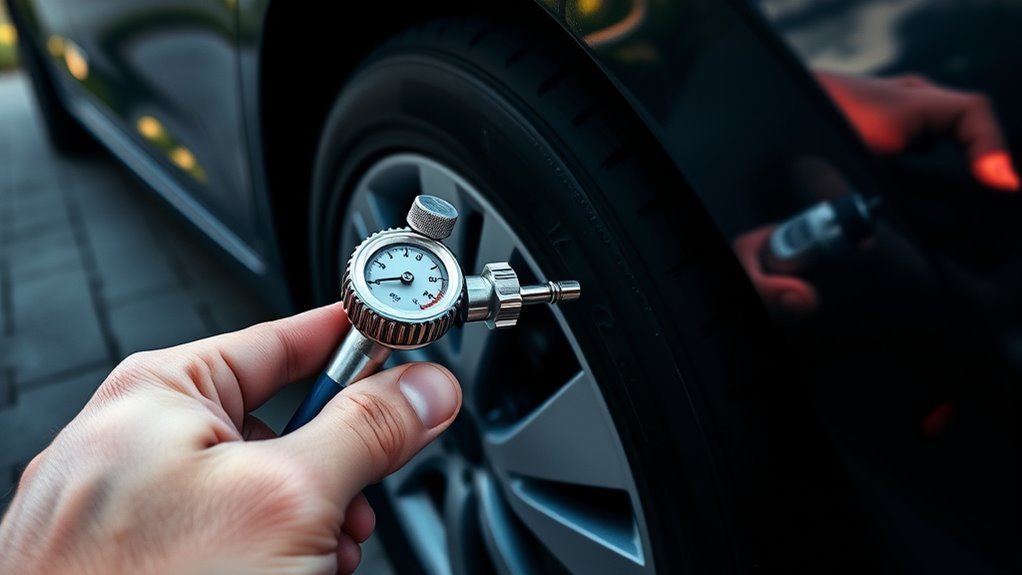
Because manufacturers set PSI for cold tires, check pressure only when the tires haven’t been driven for at least three hours or have moved less than a mile. You’ll get accurate readings that reflect the cold tire benefits: consistent baseline pressure, improved fuel economy, and predictable handling. Use a calibrated gauge, seat it firmly on the valve, and note PSI immediately. Repeat for all four tires, recording values for comparison and trend tracking. Remember that a 10°F temperature change alters pressure by roughly 1–2 PSI; schedule checks after temperature shifts. Consistent cold checks prevent underinflation, reducing risk of tire damage and failure. Accurate, repeatable measurements directly support safety performance and maintenance decision-making.
Locate Your Vehicle’s Recommended PSI (Door Jamb/Manual)
When you’re ready to set tire pressures, locate the manufacturer’s recommended PSI on the driver-side door jamb sticker or in your owner’s manual; these sources list the exact front and rear pressures your vehicle needs. Check the sticker first—it’s one of the recommended locations and is usually fixed to the door jamb or door edge. Open the manual if the sticker’s missing or unclear; the manual includes the same manufacturer-specified values. Note pressure variations: many vehicles list different PSI for front and rear tires and may include load or speed-specific recommendations. Record both front and rear numbers before you begin. If labels are damaged or absent, contact your dealer or manufacturer to confirm the correct PSI to maintain safety and fuel efficiency.
Essential Tools: Gauges, Compressors, and Extras
Choose a reliable tire pressure gauge—digital models with an LCD are accurate, affordable ($5–$15), and easiest to read, though analog and stick gauges are acceptable if calibrated. Keep a portable air compressor in your vehicle for on-the-spot inflation; look for units with preset/auto shutoff (Inflate-Right) to avoid overfilling. Store the gauge in the car and carry emergency extras like a Thru-Core sealant for quick puncture response.
Recommended Gauge Types
Pick a reliable gauge type before checking tire pressure so you get consistent, accurate readings. Choose an analog tire gauge for best gauge accuracy and durability; its dial is precise and suited for regular use. Use a digital tire gauge if you need compact portability and an LCD for low-light readability; expect to replace batteries. Keep a stick gauge as an occasional backup—it’s portable but less precise. Avoid relying on gas-station gauges because wear and poor calibration reduce reliability. For gauge maintenance, calibrate or compare your gauge periodically against a trusted reference and retire any unit that shows drift or physical damage. Store gauges dry, protect the tip, and inspect seals and batteries before each use.
Portable Air Compressors
After you’ve settled on a reliable gauge, add a portable air compressor to your kit so you can inflate tires quickly to the manufacturer’s PSI. Choose a compact, lightweight model with a built-in gauge and preset target-pressure function; set the desired PSI and the unit will auto-shutoff to prevent overinflation. Use Inflate-Right or real-time readout features to monitor pressure during inflation. Procedure: connect hose to valve, engage compressor, observe gauge, and wait for automatic cutoff or manually verify with your handheld gauge. For best results, perform inflation techniques in short bursts to avoid heat buildup and recheck cold-tire pressure. Follow compressor maintenance: drain moisture, inspect hoses and fittings, and store in a dry case to guarantee reliable operation.
Read Digital, Dial, and Stick Gauges Correctly
Attach the gauge firmly and read the digital display for an immediate PSI value. For dial gauges, hold the seal until the needle stabilizes and record the indicated pressure. With stick gauges, push until the rod extends and read the PSI markings, but treat those results as less precise and verify with a calibrated gauge.
Read Digital Displays
When you check tire pressure, press a digital gauge squarely onto the valve stem and read the PSI on the LCD; for dial gauges hold the connection until the needle stabilizes, and for stick gauges pull the rod out fully to see the marked psi.
- Position: Seat the digital head firmly to avoid leaks; confirm the LCD is clear and backlit if low light.
- Timing: Take measurements when tires are cold for consistent readings.
- Action: Note the displayed psi immediately; some units auto-lock the value, others refresh—record promptly.
- Calibration & care: Follow gauge maintenance schedules, calibrate periodically, replace batteries, and store dry to maintain digital display accuracy and safety.
Interpret Dial Gauges
A dial gauge gives you a quick, mechanical reading: press it squarely onto the valve stem, hold it level, and read the needle where it stops to determine the tire’s psi. Check that the dial gauge calibration is current before use; an uncalibrated gauge can mislead you. With the gauge seated, confirm needle alignment with the zero mark when not pressurized and with steady positioning during the measurement to avoid parallax error. Record the psi shown by the needle, then compare it to the vehicle’s recommended cold tire pressure. If readings differ, add or release air in short bursts and recheck. Store the gauge in a protective case to preserve calibration and protect the movement and needle alignment for repeatable accuracy.
Use Stick Indicators
Usually, start by identifying which gauge type you’ll use—digital, dial, or stick—since each requires a slightly different technique for an accurate reading. Use stick indicators when you need a compact, simple backup and you understand stick gauge advantages and stick gauge limitations.
- Inspect the stick for damage and calibration; discard if bent or inaccurate.
- Press the stick firmly onto the valve stem to avoid air leak—hold perpendicular until the rod stops extending.
- Read the rod extension immediately; note that stick gauges are less precise than digital or dial units.
- Record the pressure and cross-check with a digital or dial gauge if exact pressure is critical.
Calibrate regularly and replace damaged gauges to maintain measurement reliability.
Step-by-Step: Take an Accurate Pressure Reading
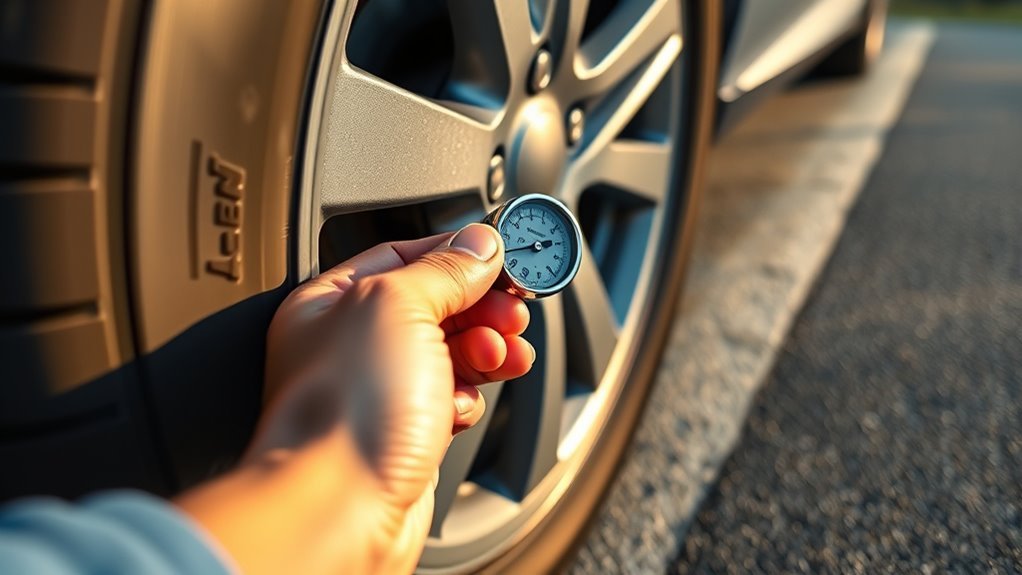
Before you start, park the car for at least three hours so the tires are cold and the PSI reading will be accurate. Begin tire maintenance tips by removing a valve cap and positioning the gauge perpendicular to the valve stem. Press firmly until the hissing stops and the gauge seals; hold steady. Wait for the gauge to stabilize, then read and record the PSI for that tire. Repeat for all four tires, using consistent pressure monitoring techniques for each wheel and noting differences. After checking, replace valve caps securely to prevent dirt and moisture intrusion. If any tire shows deviation from the manufacturer’s recommended PSI (driver’s door jamb or manual), plan to correct pressure with an air compressor and recheck per procedure.
Pump Tires to Correct Tire Pressure and Recheck
Now that you’ve recorded each tire’s cold PSI, use an air compressor to bring any low tires up to the manufacturer’s recommended pressure (found on the driver’s door jamb or in the owner’s manual). Follow these procedural tire maintenance tips and inflation techniques:
- Attach the compressor nozzle firmly, inflate in short bursts, and monitor the gauge to avoid overfilling.
- After reaching target PSI, remove the nozzle and wait 2–3 minutes for pressure to stabilize; this lets the rubber and air settle.
- Recheck pressure with your gauge; if it’s high, depress the valve core briefly to bleed small amounts until correct.
- Repeat for all tires, recording final cold PSI and noting adjustments for routine maintenance.
Regular checks improve fuel efficiency and tire longevity.
Adjust for Hot Tires and Temperature Changes
Because temperature affects air pressure, check tires when they’re cold or adjust for heat: if tires are hot, perform hot tire adjustments by inflating to 4 psi above the manufacturer’s recommended cold pressure. First, confirm the vehicle’s cold-pressure spec from the owner’s manual or driver-side door jamb. Second, use a calibrated gauge and note ambient temperature; expect readings to rise roughly 1–2 psi per 10°F (≈5.6°C) increase. Third, if you must measure after driving, add 4 psi to target pressure, then release air once cooled to the specified cold value. Fourth, record pressures and implement seasonal monitoring—check more frequently during rapid temperature shifts. Consistently adjust for temperature to prevent underinflation, tire damage, and reduced fuel efficiency.
Avoid These Common Tire-Pressure Mistakes
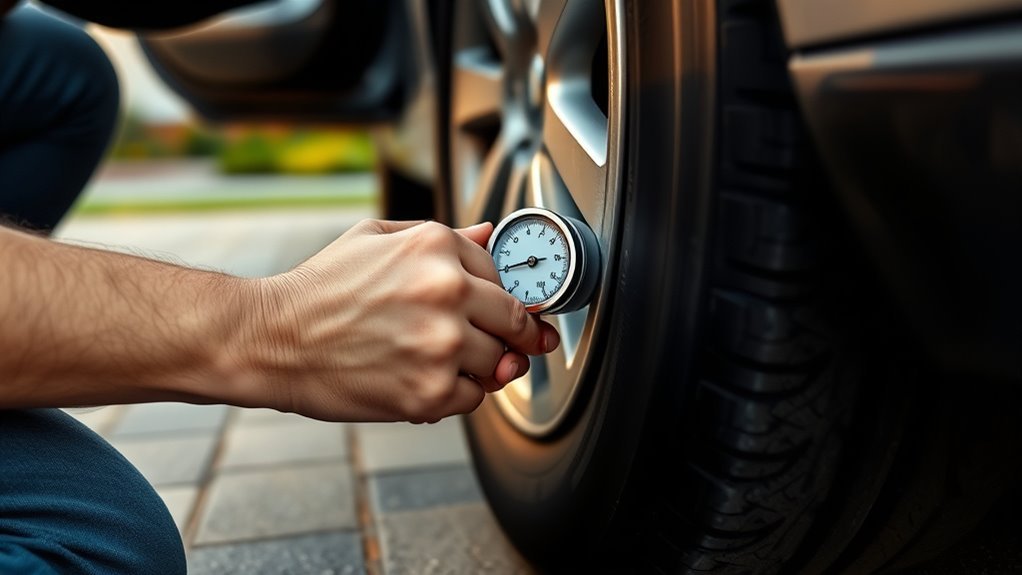
Check tire pressure only when the tires are cold to avoid readings inflated by heat. Press your gauge firmly on the valve stem and use a calibrated personal gauge rather than relying on random gas-station units to prevent leakage and inaccurate readings. Record each tire’s PSI and follow the vehicle manufacturer’s front/rear specifications to avoid overinflation errors.
Check Tires When Cold
If you want accurate readings, measure tire pressure when the tires are cold—after the vehicle’s been parked at least three hours—so temperature-induced changes don’t skew results. You’ll get consistent baseline values and avoid pressure fluctuations that mask real underinflation. Follow these steps and safety tips:
- Locate recommended PSI on the driver-door sticker or owner’s manual.
- Use a calibrated gauge; remove cap, press firmly, read, replace cap.
- Compare readings to the cold-PSI spec; add or release air in short bursts, recheck after each adjustment.
- Record values and inspect tread for uneven wear; repeat monthly or after major temperature changes.
Checking cold tires preserves performance, reduces uneven wear, and lowers risk of tire failure.
Avoid Overinflation Errors
When you top off tires, don’t rely on a hot reading or the tire sidewall’s maximum PSI—use the vehicle’s recommended cold PSI on the driver-door placard or in the owner’s manual and a calibrated gauge to avoid overinflation. Check pressures when tires are cold; driving heats air and raises readings by 1–2 psi, which is a common overinflation causes factor. Inflate in short bursts, then recheck to prevent exceeding the recommended value. Know that the sidewall maximum is not the target; use the manufacturer’s number for tire safety. Inspect and service your gauge regularly and follow calibration intervals to avoid misreads. Document pressures after adjustment and verify all four tires before driving.
Use Accurate Gauges Only
Correct tire pressures depend on accurate measurement, so use a reliable gauge rather than relying on roadside units. You’ll need consistent gauge maintenance and understand calibration importance to get repeatable readings. Follow this procedural checklist:
- Buy a quality personal gauge ($10–30 analog, $5–15 digital) and verify calibration before use.
- For analog units, store protected from shock and temperature swings; physical damage alters readings.
- For digital units, install fresh batteries and confirm zero reading; low power skews results.
- Seat the gauge firmly on the valve stem to prevent leaks during measurement.
Calibrate periodically and log results; replace or service any gauge that drifts beyond acceptable tolerance.
Tire Pressure Light On? Quick Diagnostics and Fixes
Although the tire pressure warning light usually means one or more tires are outside the manufacturer’s recommended PSI (check the driver’s door jamb or owner’s manual), you should run a quick diagnostic: inspect all four tires visually, measure cold pressures with a reliable gauge, and compare values to the spec. For tire maintenance, note ambient temperature; expect 1–2 psi change per 10°F. If a tire reads low, inflate to the cold specification, then recheck—hot tires can mask a need for up to 4 psi adjustment. If pressures are correct and the warning light stays on, suspect a faulty TPMS sensor or system; have the sensor inspected and scanned for error codes. Document any fixes and recheck the indicator after a short drive.
Monthly Checks and Simple Recordkeeping for Long Tire Life
After you’ve addressed any immediate pressure issues or TPMS alerts, set a monthly routine for checking cold tire pressures to prevent problems before they start. Use a reliable personal gauge and check after the vehicle’s been stationary for at least three hours. Record recommended PSI from the driver’s door jamb so you know target values.
- Check front, rear, and spare with the tire gauge while tires are cold.
- Compare readings to the door-jamb recommended PSI and adjust as needed.
- Log each reading and date in a simple pressure records sheet (digital or paper).
- Review logs monthly to spot slow leaks, uneven wear, or trends.
Consistent monthly maintenance preserves tread life, improves fuel efficiency, and enhances safety.
Frequently Asked Questions
Can I Use a Bicycle Pump With a Car Tire Adapter?
Yes — you can use a bicycle pump with a tire adapter, but make certain the adapter fits the valve, seal is tight, and pump can reach required pressure; connect, pump in controlled strokes, and verify pressure with a proper gauge.
How Tire Pressure Affects Fuel Efficiency by Percentage?
Like a flat sail slowing a ship, underinflation can cut fuel economy by about 2–3% for every 10 psi low; you’ll maintain ideal consumption through regular pressure maintenance, precise checks, and correcting deficits promptly.
Is TPMS the Same as a Tire Pressure Gauge?
No, TPMS isn’t the same as a tire pressure gauge. You’ll use TPMS benefits for real-time alerts, but you’ll need a gauge for precise gauge accuracy checks, performing manual measurements and calibrations as a procedure.
Can Overinflation Cause Uneven Tread Wear?
Yes — overinflation causes center wear faster; you’ll verify by inspecting tread, measuring pressures during tire maintenance, and using pressure monitoring to prevent recurrence. Follow specified inflation and rotate tires per manufacturer intervals.
How to Check Spare Tire Pressure if It’s a Donut?
Check the donut spare’s pressure by removing the valve cap, pressing a gauge firmly, and comparing PSI to manufacturer spare tire guidelines; for donut tire maintenance, inflate or service as directed, and routinely inspect tread and sidewall.
Conclusion
Check tire pressure when cold, use the PSI on your door jamb or manual, and keep a reliable gauge and compressor handy. Read digital, dial, or stick gauges as instructed, take steady, three-second readings, and adjust in small increments. Account for temperature shifts and don’t ignore the TPMS light—investigate leaks or sensor faults. Monthly checks and a simple log prolong tire life; think of your car as a precision instrument that needs regular tuning.
Related Articles
How to Read Motorcycle Tire Size: Complete Breakdown
Often misunderstood, this guide decodes motorcycle tire sizes like 180/55ZR17—learn what each number and letter means to ensure safe, perfect fitment.
Read More
How to Read Bicycle Tire Size: Inches, Metric & ISO
Get the essential trick to decoding ETRTO/ISO codes so you’ll always pick rim-compatible tyres—discover what to check next.
Read More
How to Read Tire Size Numbers: Decode the Sidewall
Step-by-step guide to decode tire sidewalls—sizes, load, speed, DOT and winter symbols—so you’ll know what fits and when to replace.
Read More