How to Change a Car Tire: Complete Step-by-Step Guide

Find a flat, safe spot away from traffic, turn on hazards, set the parking brake, and wedge opposite tires. Confirm you’ve got a jack, lug wrench, spare and flashlight. Loosen lug nuts a quarter turn, remove the hubcap, position the jack on the manufacturer’s lift point and raise until the tire clears. Remove lug nuts, swap the tire, hand-thread lug nuts, lower until wheel touches, then torque nuts in a crisscross pattern. Check spare pressure and drive slowly to a shop to learn full limits and tips.
Step 1 : Get to a Safe, Level Spot and Secure the Car

Find a flat, safe spot away from traffic—like a parking lot or wide shoulder—and pull over immediately, using exit ramps if you’re on the highway; turn on your hazard lights to increase visibility, put the car in park, shut the engine off, set the parking brake, and place wheel wedges against the tires opposite the flat to prevent rolling. You should verify the surface is level and firm before exiting. Stay visible and positioned away from moving traffic while evaluating the scene. These safety precautions reduce risk of vehicle movement and secondary collisions. If conditions feel unsafe or you lack confidence, call roadside assistance rather than attempting the change. Maintain control of the environment, keep passengers clear of the roadway, and proceed only when stability and visibility are confirmed.
Tire-Change Checklist: Tools and Spare to Keep in Your Trunk
One compact kit of the right items can turn a roadside headache into a quick repair: keep a fully inflated spare, a lug wrench that fits your lug nuts, and a jack rated for your vehicle’s weight. Check spare pressure monthly and inspect for damage as part of routine tire maintenance. Verify the lug wrench fits and that the jack’s capacity exceeds vehicle curb weight; store manufacturer instructions with the jack. Add wheel wedges to block movement and reduce rollover risk during a change. Keep a flashlight with fresh batteries and disposable or work gloves for visibility and contamination control in low light. Stow items in a dedicated trunk compartment or secured bag so tools won’t shift. Follow these safety tips before you start.
Loosen Lug Nuts and Remove the Hubcap
Start by carefully prying off the hubcap with a flat tool if present, then inspect the lug nuts for any locking mechanism that needs its key; keep that key handy. Identify hubcap types (snap-on, bolted) and remove any screws or clips methodically. With the car on level ground and the wheel contacting the surface, place the lug wrench on each nut and turn counterclockwise about 1/4–1/2 turn to break initial torque; don’t lift the vehicle yet. Keep removed lug nuts together in a container.
- Confirm hubcap type and remove per mounting method.
- Check for lug nut keys; fit and test before loosening.
- Partially loosen all lug nuts, then stow them securely.
Position the Jack and Lift the Car Safely
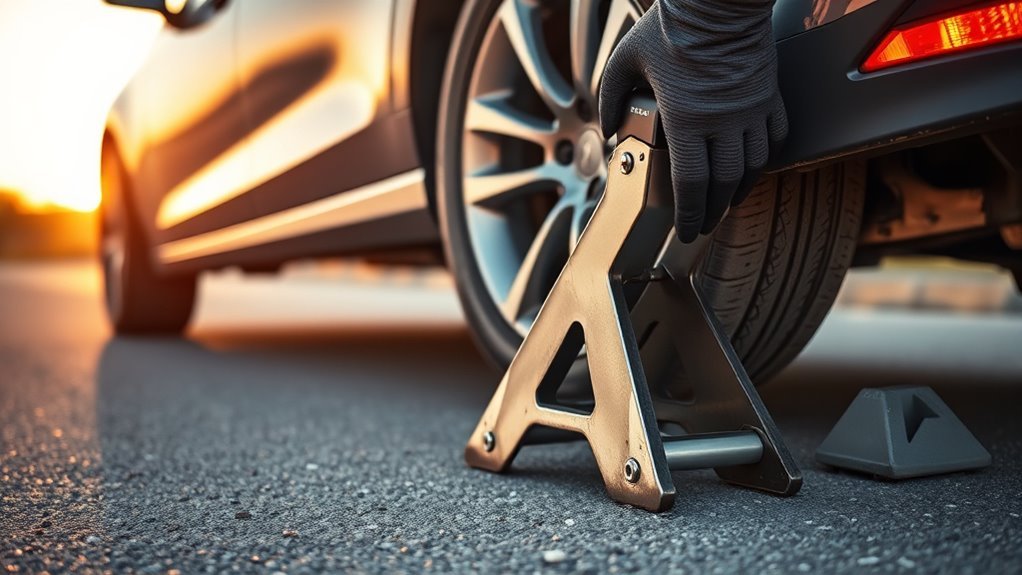
Place the jack under the vehicle’s designated metal frame point as shown in your owner’s manual to guarantee stability. Don’t use plastic body panels and, if the ground is soft, put a solid block of wood under the jack to prevent sinking. Raise the car until the tire is about 6 inches off the ground and keep all body parts clear while you work.
Jack Placement Points
Before lifting the car, consult your owner’s manual to locate the manufacturer‑specified jack points and position the jack under the vehicle’s metal frame or designated jacking pad—never on plastic trim. You’ll confirm exact locations, then select an appropriate jack type (scissor, bottle, or floor) and follow basic safety tips.
- Place the jack at the reinforced pinch weld or jacking pad near the wheel you’re changing; center the jack saddle on solid metal.
- On soft or uneven ground, set a flat wooden board beneath the jack to distribute load and prevent sinking; re‑check vehicle is level and parking brake engaged.
- Lift until the tire clears the ground by about 6 inches; stop if the jack sits crooked or shifts.
Safe Lifting Technique
Set the jack under the vehicle’s specified metal lift point—never on plastic trim—and verify the saddle is centered on solid metal per your owner’s manual. You’ll follow jack safety and precise lifting techniques: confirm a level surface, engage parking brake, place wheel wedges on the opposite side, and keep clear of moving parts. Pump the jack steadily until the wheel is about 6 inches off the ground. Stop, secure with a jack stand if available, and never work under the vehicle without support. Keep hands and body clear while raising and lowering. Double-check stability before removing lug nuts and after installing the spare.
| Checkpoint | Action |
|---|---|
| Surface | Level, solid |
| Wedges | Opposite side |
| Height | ~6 inches |
| Support | Jack stand |
| Clearance | No body under car |
Remove the Flat and Mount the Spare Tire

Loosen the lug nuts completely, then pull the flat straight off the wheel hub toward the vehicle so it clears the studs. With the car elevated, set the flat aside. Follow tire maintenance tips: inspect studs and hub for debris or damage before mounting the spare.
- Align spare tire so valve stem matches its original position and studs slide through the rim.
- Slide the spare onto the hub fully; guarantee it seats flush against the mounting surface.
- Hand-thread lug nuts onto studs and snug them evenly to prevent cross-threading.
Do spare tire care by confirming correct inflation pressure and that lug nuts start evenly. You’ll lower the car before final torqueing, but verify hand-tight security now to prevent movement during descent.
Lower the Car and Tighten Lug Nuts in a Crisscross Pattern
Lower the jack slowly until the spare just contacts the ground and stabilizes the wheel, then tighten the lug nuts in a crisscross pattern to seat the wheel evenly. Once stabilized, follow methodical tightening techniques: start by hand-threading each lug to avoid cross-threading, then snug each nut in the crisscross sequence to draw the wheel flush. After lowering the vehicle fully, use a torque wrench and apply the manufacturer’s specified torque—commonly 80–100 ft-lbs—to each lug in the same crisscross order. Perform a final pass to verify uniform torque and ascertain no lug is loose. If a hubcap fits over the lugs, replace it so it sits snugly. These steps keep the wheel aligned and reduce risk of loosening while driving.
Check Spare Tire Pressure and Stow Your Tools
With the wheel secured and lug nuts torqued, check the spare’s pressure before you stow anything. Use a reliable tire gauge and follow tire pressure management procedures: most spares require about 60 psi, but verify your owner’s manual. Conduct a spare tire inspection for cuts, dry rot, and tread condition; a degraded spare won’t be safe even if inflated.
- Measure pressure with gauge; adjust to manufacturer’s spec.
- Inspect sidewall, tread, and valve; replace if compromised.
- Stow tools and flat tire securely in designated compartment to prevent movement.
Pack the jack, lug wrench, and flat so they won’t shift. Confirm the spare sits properly in its compartment and that everything is fastened before resuming travel.
Drive to a Repair Shop: Limits and Rules for Temporary Spares
After you fit the temporary spare, drive directly to a repair shop and limit travel to about 50 miles. Keep your speed under 50 mph and avoid sharp maneuvers, since the donut is narrower and alters handling. Check the spare’s pressure before leaving and replace or repair the original tire promptly.
Temporary Spare Speed Limits
Because a temporary spare is meant only for short-term use, you should never treat it like a regular tire: keep speeds under 50 mph (80 km/h) and limit travel to about 70 miles (113 km) before fitting a full-size replacement. For temporary spare safety, remember a donut tire usage reduces handling and stability due to narrower tread and different pressure. Check the spare’s inflation before you drive and consult your owner’s manual for vehicle-specific limits.
- Inspect pressure: inflate to manufacturer-specified psi; low pressure worsens instability.
- Drive conservatively: avoid sudden maneuvers, heavy braking, and high-speed lanes.
- Replace promptly: schedule a full tire replacement or repair within the recommended distance to restore normal handling.
Distance And Usage Restrictions
One key rule: don’t treat a temporary “donut” as a long-term tire—limit travel to the manufacturer’s recommended distance (commonly about 50 miles) and keep speeds under 50 mph to preserve handling and braking performance. After fitting the spare, immediately inspect its pressure and condition; temporary spare maintenance guarantees it meets the limited-duty design parameters. Remember these constraints: narrower, lighter construction alters cornering, traction, and brake response, so avoid hard maneuvers. Consult your vehicle manual for specific distance and speed caps; variations exist between makes. Plan routing to the nearest tire repair shop and drive directly—do not use the spare for extended commutes. Prioritizing driving safety and prompt replacement reduces risk and prevents damage to drivetrain components.
Troubleshooting: Common Problems When Changing a Tire
If a problem crops up while changing a tire, stay methodical and address one issue at a time to avoid injury or further damage. You should follow tire maintenance routines and safety precautions before starting so common issues are less likely. Inspect lug nuts, jack placement, wheel studs, and spare pressure as you work.
Stay methodical when changing a tire: address one issue at a time and inspect lug nuts, jack, studs, and spare pressure.
- Stubborn lug nuts: apply penetrating oil, use a breaker bar, and pull firmly; avoid sudden jerks that strip studs.
- Jack slippage: set jack on flat, stable ground, use wheel wedges, and never get under the vehicle without proper supports.
- Stuck or misaligned tire: rock the wheel, tap with a rubber mallet to free it, then align studs; check spare pressure before driving.
Frequently Asked Questions
What Steps Make up the 5 Steps to a Tire Sale?
You assess needs, present tire types, apply sales techniques, explain pricing/promotions and installation logistics, then follow up for customer care and satisfaction, documenting choices, warranties, and any additional services like alignment.
How to Change a Tire in 8 Steps?
Like a clockwork ritual, you’ll perform eight precise steps: check safety precautions, loosen lug nuts, apply parking brake, jack vehicle, remove lug nuts, take off tire, mount spare, lower and tighten for tire maintenance.
Conclusion
You followed each step—secured the car, loosened lug nuts, jacked it up, swapped tires, and tightened in a crisscross pattern—so you’re roadworthy for now. For example, a commuter changed a rear flat on a rainy morning in 18 minutes by staying methodical and using a properly inflated spare. Keep tools stowed, check spare pressure, and head to a shop promptly: temporary spares have limits, so don’t treat them as a permanent fix.
Related Articles

How to Read Motorcycle Tire Size: Complete Breakdown
Often misunderstood, this guide decodes motorcycle tire sizes like 180/55ZR17—learn what each number and letter means to ensure safe, perfect fitment.
Read More
How to Read Bicycle Tire Size: Inches, Metric & ISO
Get the essential trick to decoding ETRTO/ISO codes so you’ll always pick rim-compatible tyres—discover what to check next.
Read More
How to Read Tire Size Numbers: Decode the Sidewall
Step-by-step guide to decode tire sidewalls—sizes, load, speed, DOT and winter symbols—so you’ll know what fits and when to replace.
Read More