
All Terrain vs Highway Tires for Toyota Tacoma Use
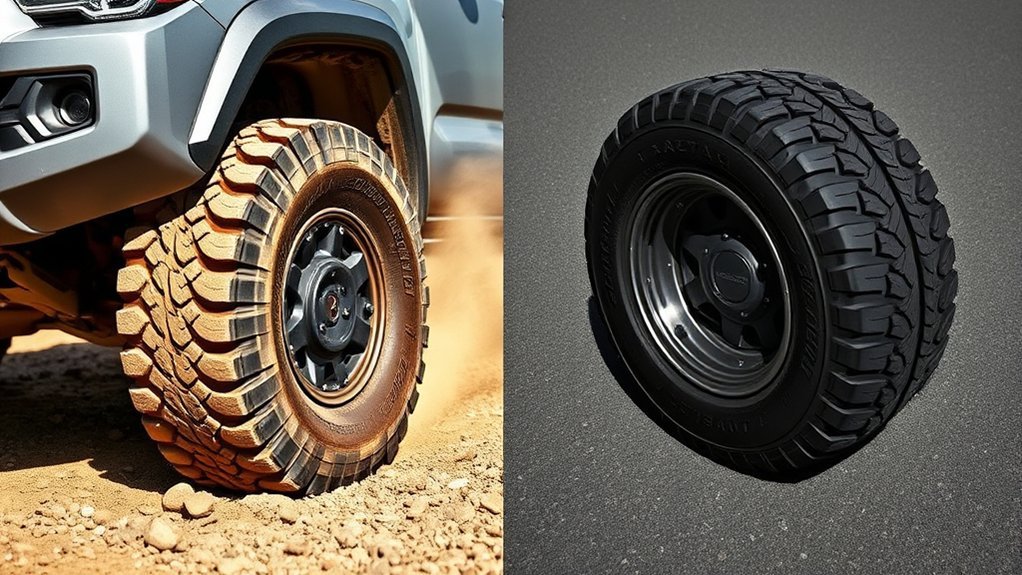
Choosing tires for your Toyota Tacoma starts with one simple question: where do you drive most? All-terrain tires make sense when your week includes gravel roads, dirt trails, campsites, worksites, boat ramps, or light off-road use. Highway tires make more sense when most of your miles happen on pavement and you want a quieter ride, steady wet-road manners, and better fuel economy potential.
The best choice is not the most aggressive tire or the smoothest tire. It is the tire that matches your real roads, payload, weather, wheel setup, and maintenance habits.
Quick Answer
Choose all-terrain tires for your Tacoma if you regularly drive on gravel, dirt, trails, worksites, campsites, or rough weather routes. Choose highway tires if you mostly commute, tow on paved roads, take long trips, or want lower road noise and better fuel economy potential. Always match size, load rating, speed rating, and pressure to your Tacoma’s placard or owner’s manual.
Key Takeaways
- All-terrain tires are best for mixed use because they balance pavement manners with better grip on dirt, gravel, grass, and uneven surfaces.
- Highway tires are usually better for daily commuting, long road trips, pavement towing, lower road noise, and fuel economy potential.
- Bigger tires can change steering feel, speedometer accuracy, braking, clearance, gearing, spare-tire fit, and fuel use.
- Do not use the maximum psi on the tire sidewall as your normal pressure. Use the Tire and Loading Information Label or owner’s manual.
- If you drive in real winter conditions, check for proper winter-tire or severe-snow ratings instead of assuming every all-terrain tire is enough.
Choosing Between All-Terrain and Highway Tires for Your Tacoma
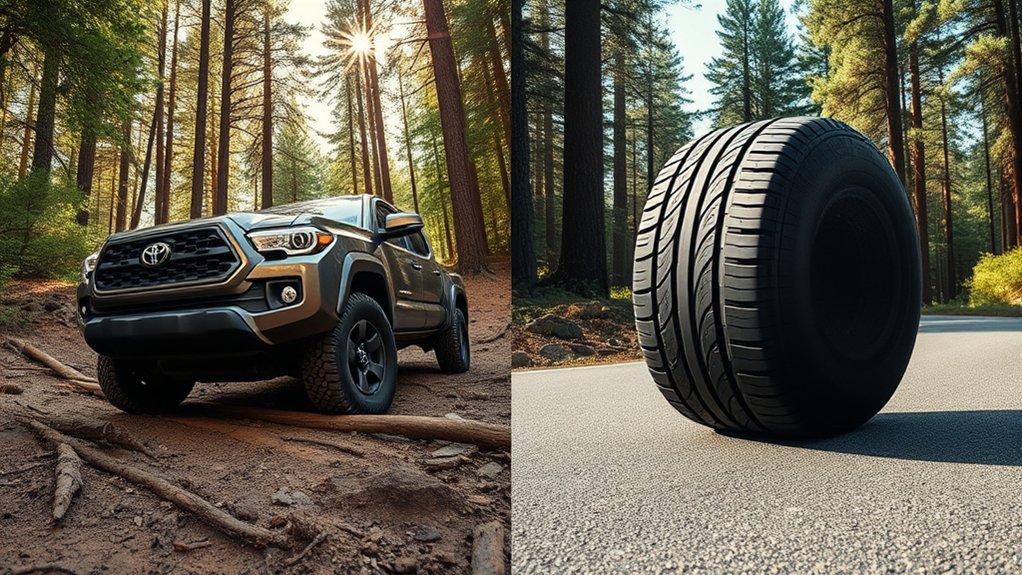
When you compare all-terrain and highway tires for a Toyota Tacoma, think about your real driving habits instead of the most aggressive tread you can find. A tire that looks great in a parking lot may feel loud, heavy, or vague on the highway if you rarely leave pavement.
If you split your time between paved roads and loose surfaces, all-terrain tires can be a smart middle ground. The National Highway Traffic Safety Administration describes all-terrain tires as a good compromise between on-road driving and off-road capability. That compromise is exactly why many Tacoma owners choose them for camping, hunting, fishing, gravel roads, and weekend trail use.
If most of your Tacoma’s miles come from commuting, highway driving, school runs, towing on pavement, or long road trips, highway tires usually fit better. Their tread blocks are typically less aggressive, so they often ride quieter, steer more smoothly, and create less rolling resistance than a heavier off-road-focused tire.
Note: Tire category alone does not guarantee performance. A premium all-terrain tire can feel better on pavement than a cheap highway tire, and a highway tire with poor wet traction may not be the safest choice. Always compare the exact tire model, size, load index, speed rating, wet traction data, treadwear warranty, and winter rating.
[Products Worth Considering]

Secure your trailer or RV tires with a scissor-style wheel chock stabilizer that applies opposing force to help prevent wheel shift. It fits tight wheel gaps from 3.5 inches up to 12 inches and works for travel trailers, campers, fifth wheels, toy haulers, and heavy-duty trucks. The surface uses new electrophoretic technology to help prevent rust for reliable travel use.

Camco Trailer Aid Plus tandem tire ramp lifts your trailer for quick, safe tire changes with ample clearance from its 5 1/2-inch lift. It helps you change a flat tire without unloading cargo, making roadside and routine maintenance more efficient. The heavy-duty, waterproof and rustproof polymer design supports up to 15,000 lb and is built for easy portability and storage.

Universal magnetic jack pad with aluminum grooved design to protect vehicle pinch welds during lifting. Durable nylon pad inserts are upgraded and secured with screws to resist damage and keep in place. Designed to fit most single vehicle pinpoint welds for safer, stable jacking when changing tires, repairs, or performing oil changes.
Best Choice by Driving Style
| Your Main Use | Better Tire Type | Why It Fits |
|---|---|---|
| Daily commute and highway trips | Highway | Quieter ride, smoother steering, and better fuel economy potential. |
| Gravel roads and light trails | All-terrain | More open tread and tougher construction help on loose or uneven surfaces. |
| Camping, hunting, fishing, or trail access | All-terrain | Better bite on dirt, grass, rocks, ruts, and uneven access roads. |
| Towing mostly on pavement | Highway or mild all-terrain | Choose enough load capacity without adding unnecessary tread noise or weight. |
| Heavy payload, bed rack, tools, or rooftop tent | Correct load-rated highway, all-terrain, or LT tire | Load index matters more than tread style when the truck carries extra weight. |
| Deep mud or frequent rock crawling | Mud-terrain or hybrid rugged-terrain | A regular all-terrain may not clear mud or protect sidewalls well enough for severe off-road use. |
| Ice, packed snow, or mountain winter roads | Winter tire or severe-snow-rated option | Aggressive tread alone does not replace tested winter traction. |
What Are All-Terrain Tires and When to Use Them?
All-terrain tires are built for drivers who need one tire to handle pavement and moderate off-road conditions. On a Tacoma, they work well when you drive on mixed surfaces but still need the truck to behave well during normal daily use.
Their tread usually has larger blocks, wider grooves, more biting edges, and stronger shoulders than a standard highway tire. Many all-terrain tires also use tougher casing or sidewall designs, which can help when you drive near rocks, roots, ruts, and rough gravel.
Benefits of All-Terrain Tires
All-terrain tires give your Tacoma more flexibility. They are not the quietest choice, and they are not always the most efficient choice, but they make sense when your route changes often.
- Better grip on loose surfaces: The more open tread helps on dirt, gravel, grass, and mild mud.
- More confident trail access: Stronger shoulders and casings can help when access roads get rough.
- Useful mixed-weather traction: Many all-terrain tires perform well in rain and light snow, but not all are severe-snow rated.
- Stronger truck look: A/T tires often match the Tacoma’s stance better than a plain highway tread.
- More versatile travel: You can commute during the week and take rougher routes on the weekend without swapping tires.
Ideal Usage Scenarios
Pick all-terrain tires if you drive your Tacoma on dirt roads, gravel roads, forest roads, boat ramps, campsites, construction sites, ranch roads, or mild trails. They are also a good fit if you live where pavement turns rough during storms or road maintenance.
All-terrain tires are less ideal if your Tacoma spends nearly all its time at highway speed. You may notice more tread hum, slightly slower steering response, shorter fuel range, and a firmer ride depending on the tire’s weight, tread design, and load rating.
Pro Tip: If you want the look of an all-terrain tire but drive mostly on pavement, choose a mild all-terrain or on-road all-terrain instead of the most aggressive tread. You will usually keep more comfort and reduce road noise.
Why Highway Tires Might Be Right for You?
If you spend most of your Tacoma’s time on paved roads, highway tires may be the better everyday choice. They are designed around road comfort, predictable handling, lower tread noise, and long treadwear rather than extra bite in loose terrain.
Highway tires can be especially useful for Tacoma owners who commute daily, tow small trailers on pavement, take long interstate trips, or care more about ride comfort than trail traction. They also help if you want your truck to feel lighter and more settled at speed.
Enhanced Fuel Efficiency
Tire choice affects fuel use because tread design, tire weight, rolling resistance, and pressure all matter. Highway tires often use less aggressive tread patterns than all-terrain tires, so they can support better efficiency on pavement when properly sized and inflated.
Do not expect a tire swap to create huge fuel savings by itself. According to FuelEconomy.gov, keeping tires inflated to the proper pressure can improve gas mileage by 0.6% on average and up to 3% in some cases. Underinflated tires can lower gas mileage by about 0.2% for every 1 psi drop in the average pressure of all tires.
Superior On-Road Handling
Highway tires usually feel more stable on pavement because their tread blocks are less open and less flexible than aggressive all-terrain blocks. That can improve steering feel, lane tracking, braking response, and cabin noise during daily driving.
| Feature | Highway Tires | All-Terrain Tires |
|---|---|---|
| Pavement comfort | Usually smoother | Can feel firmer |
| Road noise | Usually lower | Often higher |
| Fuel economy potential | Often better with proper inflation | Often lower with heavier tires |
| Wet-road performance | Can be excellent on quality models | Varies widely by tread and compound |
| Dirt and gravel grip | Limited | Better |
| Best driver | Pavement-first owner | Mixed-road owner |
Key Differences Between All-Terrain and Highway Tires
The biggest difference is the job each tire is designed to do. A highway tire prioritizes paved-road comfort and efficiency. An all-terrain tire gives up some of that refinement to gain traction and durability on rougher surfaces.
- Tread pattern: All-terrain tires use larger tread blocks, deeper grooves, and more open voids. Highway tires use tighter tread patterns for smoother pavement contact.
- Road noise: All-terrain tires often create more hum, especially as they wear. Highway tires are usually quieter at speed.
- Ride comfort: Highway tires often ride softer. Heavy-duty all-terrain tires can feel firmer, especially in LT load ranges.
- Off-road traction: All-terrain tires offer better grip on gravel, dirt, grass, and mild mud. Highway tires are not designed for repeated trail use.
- Wet-road performance: Either type can perform well in rain, but you need to compare the exact model. Tread category alone is not enough.
- Weight and efficiency: Aggressive all-terrain tires can be heavier, which may affect acceleration, braking, and fuel economy.
- Durability: Some all-terrain tires use reinforced sidewalls or LT construction, but that added strength can increase weight and ride harshness.
How to Read the Tire Label Before You Buy
Before you compare prices or tread designs, read the tire label. A size such as 265/70R16 or 265/65R17 tells you the tire width, sidewall ratio, construction type, and wheel diameter. Your Tacoma’s correct size is listed on the Tire and Loading Information Label or in the owner’s manual.
| Tire Marking | What It Means | Why Tacoma Owners Should Care |
|---|---|---|
| Size | Width, aspect ratio, construction, and wheel diameter. | Wrong size can affect clearance, braking, speedometer accuracy, and spare fit. |
| Load index | The tire’s weight-carrying rating at the correct pressure. | Important for passengers, cargo, trailer tongue weight, racks, and tools. |
| Speed rating | The tire’s speed capability under proper load and inflation. | Choose a rating that meets or exceeds the required rating for your truck. |
| P, SL, XL, or LT | Indicates passenger-style, extra-load, or light-truck construction. | LT tires can add strength but may ride stiffer and weigh more. |
| M+S or 3PMSF | Mud-and-snow marking or severe-snow symbol. | Helpful in winter, but severe winter driving may still call for dedicated winter tires. |
How Tire Size Affects Performance
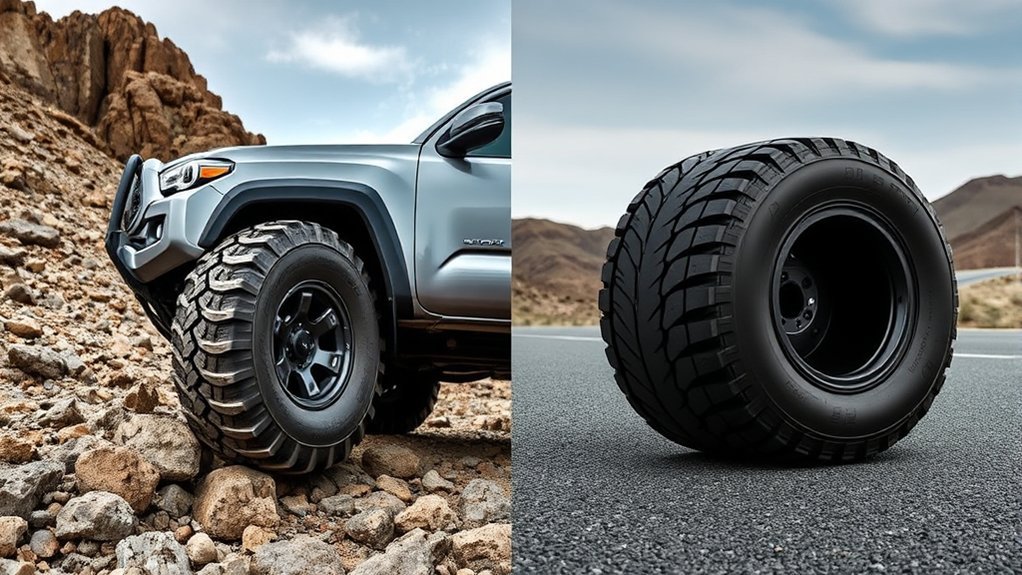
Tire size affects how your Tacoma steers, brakes, rides, and fits inside the wheel wells. A larger tire can improve ground clearance and fill the wheel opening, but it can also add weight, reduce fuel economy, slow acceleration, and create rubbing.
For example, moving from a stock-size tire to a wider or taller tire may change your contact patch, sidewall height, and overall diameter. That can affect steering response, speedometer accuracy, braking distance, suspension feel, and effective gearing. Wider tires may add grip in some conditions, but they can also follow road grooves more and require more clearance.
Warning: Do not choose a Tacoma tire size by appearance alone. Check the driver-door Tire and Loading Information Label, owner’s manual, wheel width, load index, speed rating, suspension clearance, mud-flap clearance, spare-tire fit, and TPMS compatibility before changing size.
Why Tire Load Range Matters for Tacoma Owners
Load range and load index tell you how much weight a tire can safely carry when inflated correctly. This matters on a Tacoma because many owners tow, haul tools, carry camping gear, add bed racks, install bumpers, or drive with passengers and cargo.
A passenger-style or standard-load tire can ride comfortably, but it may not be ideal for heavier payloads or repeated rough-road use. An LT tire with a higher load range can offer stronger construction, but it may ride stiffer and weigh more. Load Range E tires, for example, can feel harsh on an unloaded midsize truck if you do not need that much capacity.
- Check the placard first: Match or exceed the required size and load rating shown for your Tacoma.
- Think about real payload: Add passengers, trailer tongue weight, tools, bed racks, rooftop tents, recovery gear, and aftermarket bumpers.
- Do not overbuy stiffness: More load capacity is not always better for comfort, braking feel, or efficiency.
- Use correct pressure: A heavier tire still needs pressure based on your vehicle and load, not guesswork.
- Ask before changing categories: Moving from a passenger-style tire to an LT tire can change ride quality and pressure needs.
[Products Worth Considering]

RVMATE dual-axle RV tire covers help shield your tires from sunlight, snow, rust, and dirt to keep them in better condition in harsh weather. Made with heavy-duty waterproof, UV-resistant 420D Oxford fabric, they provide strong shading and help reduce wear. They install easily by placing the cover on the wheel and fastening the rope for a stable fit.
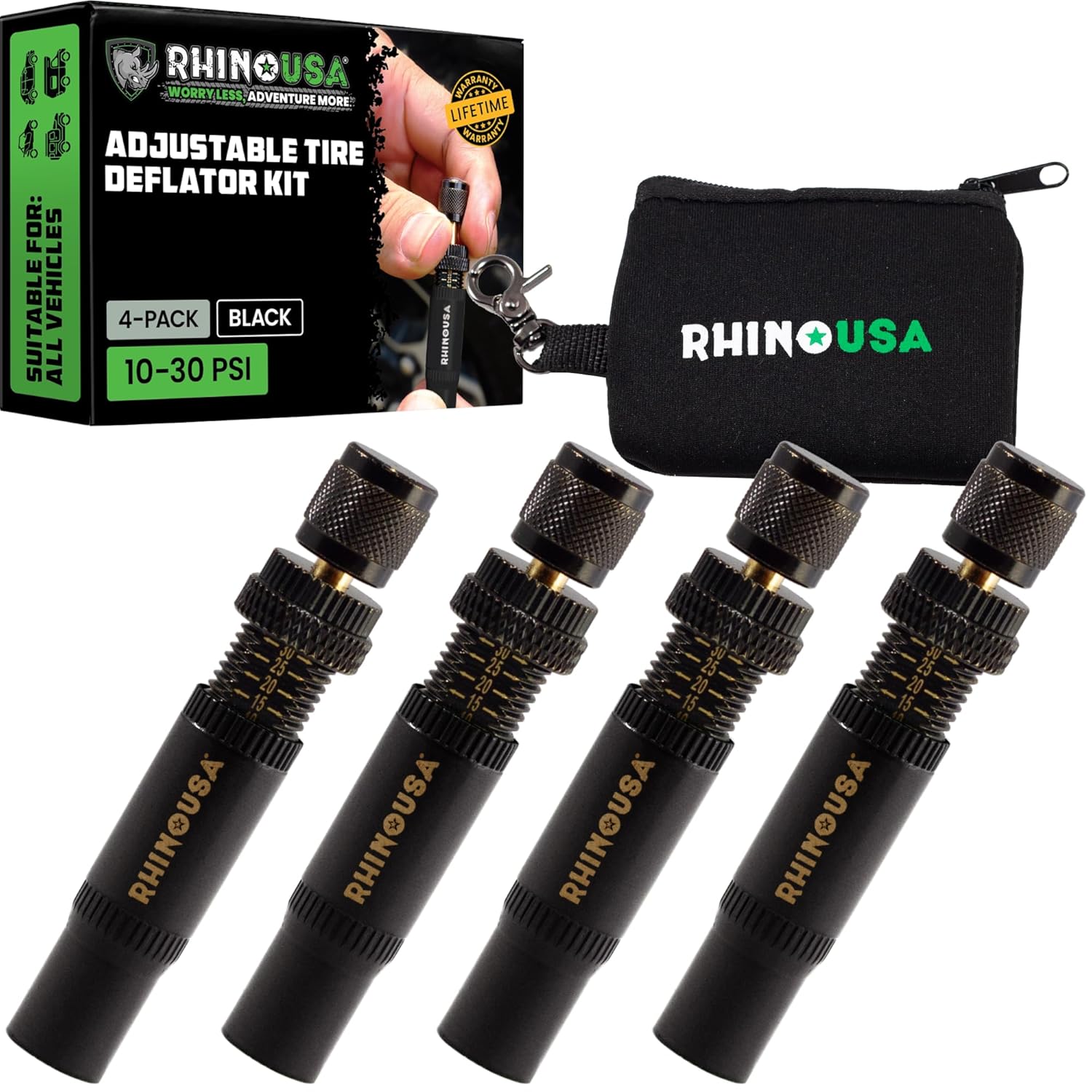
Use the Rhino USA adjustable tire deflators to air down all four tires at once by screwing one deflator onto each valve stem, letting you step away while the tires reach your preset pressure. Each deflator independently adjusts across a 10–30 PSI range with laser-etched indicators for quick setup and verification, making it ideal for beach, sand, and rocky off-road trails.
Towing, Payload, and Aftermarket Weight
If your Tacoma carries extra weight often, tire choice becomes more than a tread decision. A highway tire with the right load index may be better for pavement towing than an aggressive all-terrain that adds noise and weight. A stronger all-terrain or LT tire may be better if your truck carries recovery gear, tools, armor, or a camper setup on rough roads.
Trailer tongue weight, passengers, fuel, bed cargo, racks, and accessories all count toward the truck’s real workload. Choose a tire that supports that workload while staying within the vehicle’s ratings. The tire does not increase your Tacoma’s official payload or towing capacity.
Snow, Rain, and Seasonal Driving Considerations
Rain, snow, and temperature should influence your choice as much as dirt or pavement. Many highway tires perform well in rain because they are built for stable road contact and water evacuation. Many all-terrain tires perform well on loose snow, gravel, and slush, but that does not mean every all-terrain tire is a true winter tire.
If you drive through serious winter weather, look for a tire that fits your climate and local rules. A severe-snow-rated tire with the three-peak mountain snowflake symbol is a stronger choice for winter traction than relying on an aggressive-looking tread alone. If ice, packed snow, or steep winter roads are common, dedicated winter tires may still be the safer option.
Rain performance also depends on the exact tire model. A mild all-terrain with strong wet braking can outperform a cheap highway tire in rain, while an aggressive all-terrain with large tread voids may feel less precise on wet pavement. Compare wet traction ratings, independent testing, and owner feedback for the specific tire you plan to buy.
Common Tire Issues and How to Maintain Them
Good tire maintenance keeps your Tacoma safer and helps your tires last longer. The basics are simple: check pressure, inspect tread, rotate when recommended, keep the tires balanced, and fix alignment problems quickly.
Start with tire pressure. The NHTSA says the proper tire pressure is listed on the Tire and Loading Information Label or in the owner’s manual. Michelin also recommends checking tire pressure when tires are cold, before driving or at least three hours after driving. Do not use the maximum pressure printed on the tire sidewall as your normal setting.
Check tread depth at least monthly. Tires should be replaced when tread reaches 2/32 inch, and you should replace them sooner if you see exposed cords, sidewall bulges, deep cracking, punctures outside the repairable tread area, or uneven wear that points to suspension or alignment problems.
- Pressure checks: Check all tires, including the spare, at least once a month and before long trips.
- Rotation: Rotate every 5,000 to 8,000 miles if your owner’s manual recommends it, or sooner if uneven wear appears.
- Balancing: Balance tires when installed and whenever you feel vibration at speed.
- Alignment: Check alignment if the truck pulls, the steering wheel sits off-center, or tread wears unevenly.
- Recall checks: Use the tire DOT code and NHTSA recall tools if you suspect a tire safety issue.
Your Tacoma’s best tire is not always the toughest-looking one. It is the tire that matches your roads, load, weather, wheel setup, and maintenance habits.
Pre-Purchase Checklist for Tacoma Tires
Before you buy all-terrain or highway tires, run through a short checklist. This helps you avoid noise, rubbing, poor ride quality, or load-capacity problems after installation.
- Confirm size: Start with the Tire and Loading Information Label or your Toyota owner’s manual.
- Confirm load rating: Choose a tire that meets or exceeds the required load index for your truck and real cargo use.
- Check wheel fit: Confirm wheel width, offset, and clearance if you are changing tire size.
- Match your roads: Choose highway tires for pavement-first driving and all-terrain tires for mixed surfaces.
- Check winter needs: Look for severe-snow-rated or dedicated winter tires if your climate requires them.
- Plan pressure: Use the placard or model-specific guidance, then adjust only with qualified advice when changing tire category or load.
- Inspect after installation: Recheck torque, pressure, rubbing, TPMS function, and alignment feel after the first drives.
Frequently Asked Questions
Is there a downside to all-terrain tires?
Yes. All-terrain tires can be louder, heavier, and less fuel-efficient than highway tires. Some also ride firmer, especially in LT load ranges. They are worth it if you use the extra traction, but they may feel like overkill if your Tacoma rarely leaves pavement.
Are highway tires bad for a Toyota Tacoma?
No. Highway tires are a good choice for Tacoma owners who mostly drive on pavement. They usually offer lower road noise, smoother handling, and better fuel economy potential than aggressive all-terrain tires. The tradeoff is reduced traction on loose dirt, gravel, mud, and rocky trails.
Do bigger tires make a Tacoma better off-road?
Bigger tires can improve ground clearance and help on rough terrain, but they can also add weight, reduce fuel economy, change gearing, affect braking, and cause rubbing. Check fitment carefully before upsizing, especially if your Tacoma has stock suspension.
Should I choose Load Range E tires for my Tacoma?
Choose Load Range E only if your payload, towing, off-road use, or tire size calls for it. These tires can be stronger, but they are often heavier and stiffer than standard-load or lighter LT options. For daily driving, a lighter tire with the correct load index may ride better.
Are all-terrain tires good in rain?
Some all-terrain tires are good in rain, but wet performance depends on the exact tire model, tread compound, tread depth, and wear. Do not assume an all-terrain tire is better or worse in rain based only on tread appearance. Compare wet traction data before buying.
What tire pressure should I run on my Tacoma?
Use the cold tire pressure listed on your Tacoma’s Tire and Loading Information Label or in the owner’s manual. Check pressure when the tires are cold, including the spare. Do not use the maximum psi printed on the tire sidewall as your everyday pressure.
Conclusion
The best Toyota Tacoma tire depends on how you actually use the truck. Choose all-terrain tires if you need real mixed-surface traction for gravel, dirt, trails, campsites, worksites, or rough weather routes. Choose highway tires if your Tacoma spends most of its time on pavement and you care more about comfort, low noise, fuel economy, and long road-trip manners.
Before you buy, confirm the size, load rating, speed rating, wheel fitment, clearance, winter rating, and pressure requirements. A tire that matches your Tacoma’s real workload will feel better, last longer, and keep the truck safer on the roads you drive most.
Sources
- NHTSA TireWise — tire types, tire size, tire pressure, tread depth, rotation, recalls, balance, alignment, and tire safety guidance.
- FuelEconomy.gov: Keeping Your Vehicle in Shape — tire inflation and fuel economy impact.
- Michelin: How to Check Tire Pressure — monthly pressure checks, cold-pressure method, and door-label pressure guidance.
- Toyota Owners Manuals and Warranties — official Toyota manual lookup for model-specific tire and maintenance details.

Related Articles
How Tire Weight Affects Toyota Tacoma Performance
How does tire weight influence your Toyota Tacoma's performance and efficiency? Discover the surprising effects that could change your driving experience.
Read More
Tire Noise Levels by Tire Type on a Toyota Tacoma
A comprehensive look at how tire types affect noise levels in your Toyota Tacoma reveals surprising insights that could enhance your driving experience.
Read More
How To Choose Tires for a Dual Use Toyota Tacoma
Unlock the secrets to selecting the perfect tires for your dual-use Toyota Tacoma, ensuring optimal performance and comfort on every adventure. Discover more inside!
Read More