
How To Extend Tire Life on a Toyota Tacoma
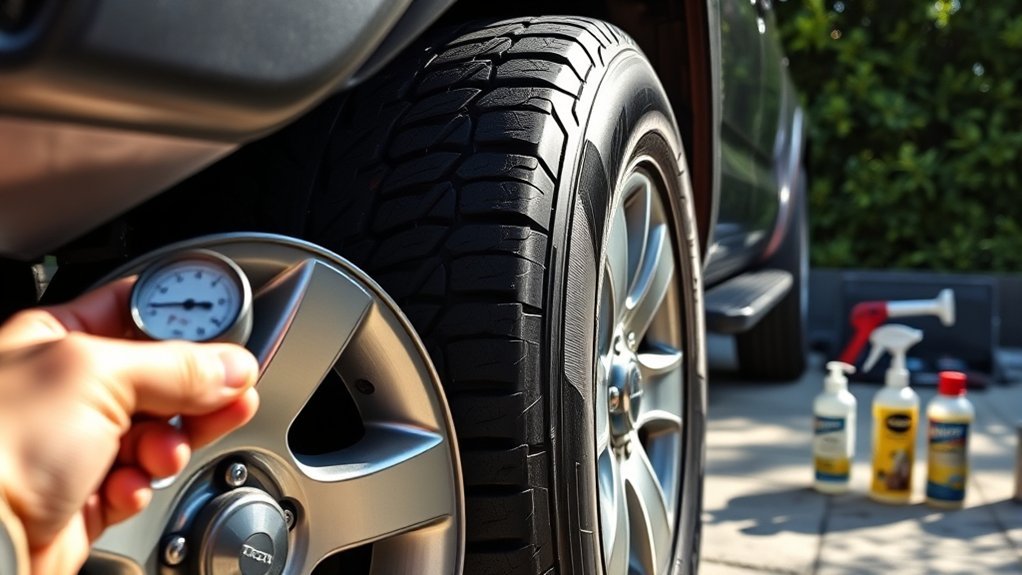
Keeping your Toyota Tacoma’s tires in good shape does more than prevent early replacement. It also helps your truck steer better, stop more predictably, carry loads safely, and use fuel more efficiently. The key is simple: check pressure, inspect tread, rotate on schedule, watch for uneven wear, and choose tires that match your Tacoma’s model year and how you drive.
Quick Answer
To extend Toyota Tacoma tire life, check cold tire pressure at least monthly, rotate tires according to your model-year maintenance guide, inspect tread and sidewalls often, fix alignment or balance issues early, and use tires that match the door-jamb placard for size, load rating, and pressure.
Key Takeaways
- Check tire pressure when the tires are cold, and use the Tacoma’s door-jamb tire placard or owner’s manual, not the maximum PSI printed on the tire sidewall.
- Follow your model-year Tacoma maintenance guide for rotation timing. Many Toyota schedules use 5,000-mile or six-month service intervals.
- Replace tires when tread reaches 2/32 inch, when wear bars are flush, or sooner if damage, age, weather needs, or poor traction make them unsafe.
- Pulling, vibration, cupping, one-sided wear, or steering shake can point to alignment, balance, suspension, or tire damage issues.
- Off-road driving, towing, heavy loads, dirt roads, and winter conditions all demand more frequent tire checks.
At a Glance
| Time Required | 5 to 10 minutes for pressure and tread checks; 45 to 90 minutes for a careful DIY rotation. |
| Difficulty | Easy for pressure and tread checks; moderate for tire rotation because the truck must be lifted safely. |
| Tools Needed | Tire pressure gauge, tread depth gauge or penny, air source, tire inflator, jack, jack stands, wheel chocks, lug wrench, torque wrench, and owner’s manual. |
| Cost | Mostly free if you already own the tools; shop rotation, balancing, and alignment costs vary by location and tire size. |
Toyota Tacoma Tire Maintenance Schedule
Your Tacoma’s exact schedule depends on model year, drivetrain, tires, and how you use the truck. Always treat your owner’s manual, maintenance guide, and driver-side door-jamb tire placard as the final source.
As a useful benchmark, Toyota’s 2025 Tacoma Hybrid Warranty & Maintenance Guide lists scheduled maintenance every 5,000 miles or six months, whichever comes first. Its maintenance chart also shows tire rotation at each 5,000-mile interval. Older and non-hybrid Tacomas may have different details, so check your exact guide before setting a schedule.
- Monthly: Check cold tire pressure, tread depth, sidewalls, valve caps, and visible damage.
- Before long trips: Check all four tires and the spare if your Tacoma has one.
- At each service interval: Rotate tires if your model-year guide calls for it, and inspect for uneven wear.
- After potholes, curbs, trail impacts, or heavy off-road use: Inspect tires, wheels, alignment symptoms, and vibration.
- When towing or carrying heavy loads: Confirm pressure and load limits before the trip, not after the truck is loaded and hot.
[Products Worth Considering]

EVOULTES heavy duty tire inflator with an integrated gauge delivers accurate pressure readings from 10–120 PSI, helping you inflate, deflate, and check tires in one tool. The 16.5-inch extended dual-head air chuck with swivel base reaches hard-to-access dual wheel valves on trucks and RVs. A brass trigger core and side-mounted air release valve make operation smooth, with standard 1/4" NPT threading and quick-connect compatibility for easy setup.

This portable cordless tire inflator delivers fast, efficient inflation for cars, motorcycles, bikes, and sports balls with a digital pressure gauge. Use the one-click PSI preset with auto shut-off for accurate, hands-free topping to your target pressure up to 150 PSI. It’s compact and rechargeable with a built-in emergency LED light plus valve adapters and accessories for quick, ready-to-go use.

This portable cordless tire inflator delivers up to 160 PSI with fast 17 L/min airflow to help you quickly top up tires and get back on the road. It features dual power mode, running on a 21V rechargeable battery or a 12V DC adapter for convenient roadside use. An automatic shut-off with digital pressure gauge helps prevent overinflation, and a built-in LED light improves visibility in low-light conditions.
Check Tire Pressure the Right Way
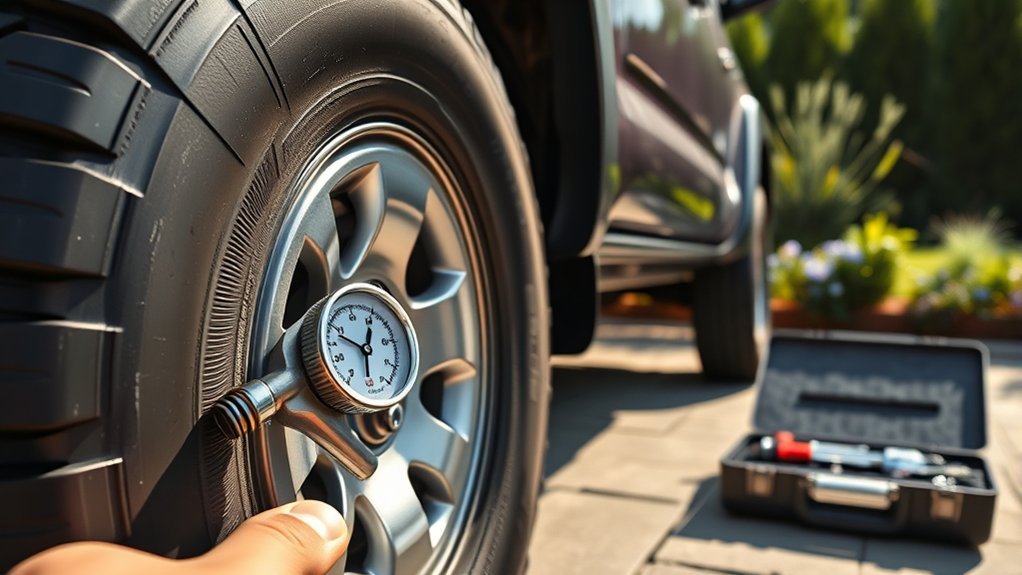
Correct tire pressure is one of the easiest ways to protect your Tacoma’s tires. It affects steering feel, braking, tire temperature, tread wear, fuel use, and load stability. The National Highway Traffic Safety Administration says the proper inflation pressure is listed on the Tire and Loading Information Label on the driver’s side door edge or in the owner’s manual.
Do not use the maximum pressure printed on the tire sidewall as your normal setting. That number is the tire’s maximum limit, not your Tacoma’s recommended cold inflation pressure.
- Check tires cold. Cold means the Tacoma has not been driven for at least three hours.
- Find the correct PSI. Use the driver-side door-jamb placard or your owner’s manual.
- Use a reliable gauge. Check all four tires and the spare if equipped.
- Add or release air slowly. Recheck with the gauge until each tire matches the recommended pressure.
- Replace missing valve caps. Caps help keep dirt, water, and road salt away from the valve core.
Note: A tire pressure monitoring system does not replace monthly checks with a gauge. The U.S. Tire Manufacturers Association says many TPMS warnings appear only after a tire is already about 25% underinflated.
FuelEconomy.gov says properly inflated tires can improve gas mileage by 0.6% on average, and up to 3% in some cases.
Temperature also changes pressure. The U.S. Tire Manufacturers Association says tire pressure can rise or fall about 1 to 2 PSI for every 10°F change. That means your Tacoma may need extra attention during cold snaps, summer heat, mountain trips, and seasonal weather swings.
Rotate Tires to Even Out Tacoma Tire Wear
Tires do not wear evenly on their own. Front tires handle steering and braking forces, while rear tires can see different loads, especially when you tow, haul cargo, or drive off-road. Regular rotation helps spread that wear across the set.
NHTSA says tire rotation can reduce irregular wear, help tires last longer, and help maintain fuel efficiency. It also says to follow the owner’s manual for the correct interval and pattern, and to rotate every 5,000 to 8,000 miles if the manufacturer recommends it.
Rotation pattern matters. A 2WD Tacoma, 4WD Tacoma, directional tire, staggered setup, or full-size spare can change the correct pattern. Use the pattern in your owner’s manual or ask a tire shop if you are unsure.
Warning: Never work under a Tacoma supported only by a jack. Use a level surface, wheel chocks, properly rated jack stands, and the correct lift points. Tighten lug nuts in a star pattern and torque them to the specification in your owner’s manual.
- Rotate on schedule: Use your model-year maintenance guide as the rule.
- Inspect during rotation: Look for nails, cuts, bulges, cracks, exposed cords, and uneven wear.
- Reset pressure after rotation: Front and rear pressures may differ on some vehicles.
- Watch for vibration: A vibration after rotation may point to a balance issue, bent wheel, tire damage, or incorrect lug torque.
Inspect Tire Tread, Wear Bars, and Sidewalls
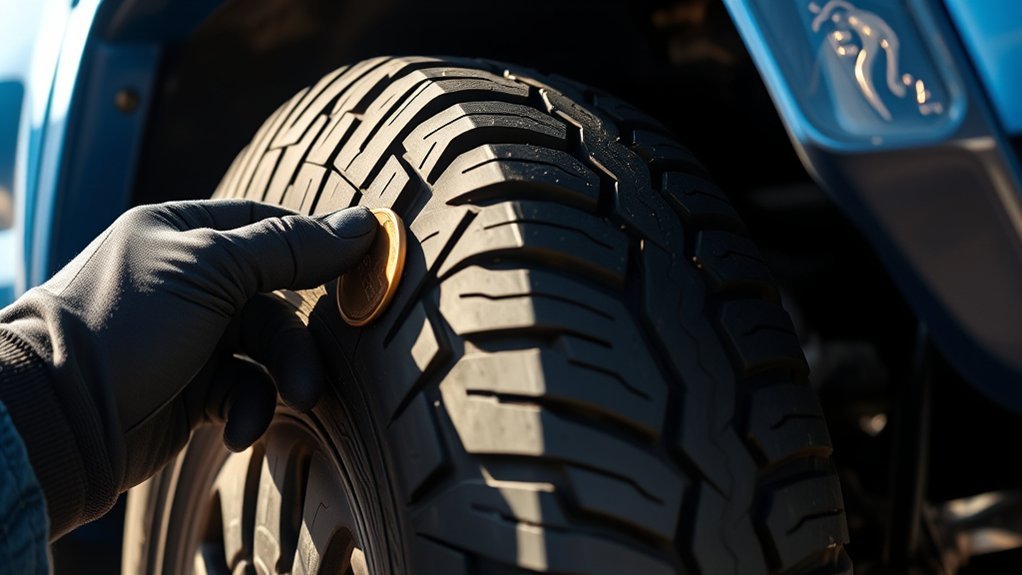
Check your Tacoma’s tread at least once a month when you check pressure. NHTSA says tires are not safe and should be replaced when tread is worn to 2/32 inch. You can measure this with a tread depth gauge or use the penny test as a quick check.
For the penny test, place a penny into a tread groove with Lincoln’s head upside down and facing you. If you can see the top of Lincoln’s head, the tread is worn enough that the tire needs replacement. Also check the tread wear bars built into the grooves. When those bars are flush with the tread, replacement is due.
Do not rely on tread depth alone. Replace or professionally inspect a tire if you see sidewall bulges, deep cuts, exposed cords, cracking, repeated air loss, a puncture near the sidewall, or damage after a hard impact.
Common Uneven Tire Wear Patterns
| Wear Pattern | Possible Cause | What to Do |
| Both outer shoulders worn | Underinflation or repeated cornering under load | Set cold pressure to the placard value and inspect for damage. |
| Center tread worn faster | Overinflation or incorrect pressure for the tire/load setup | Check cold pressure against the placard or tire-load guidance. |
| One-sided edge wear | Alignment issue, worn part, or impact damage | Schedule an alignment and suspension inspection. |
| Cupping or scalloping | Imbalance, worn shocks, loose suspension, or wheel damage | Have the tires balanced and suspension checked. |
| Feathered tread edges | Toe alignment issue | Get an alignment before the tire wears beyond repair. |
Check Tire Age Too
Tires can age out even when tread looks acceptable. NHTSA says some vehicle and tire manufacturers recommend replacing tires at six to 10 years old regardless of treadwear. Check the DOT Tire Identification Number on the sidewall. The last four digits show the week and year the tire was made.
Fix Alignment and Balancing Problems Early
Alignment and balancing are different services, but both affect tire life. Alignment controls where the tires point and how they contact the road. Balancing controls how smoothly the tire and wheel assembly spins at speed.
According to Michelin, imbalance can cause vibration, cupping, flat spots, and extra stress on steering and suspension parts. Alignment issues can lead to uneven wear, poor tracking, and unstable handling.
Have your Tacoma checked if you notice any of these signs:
- The truck pulls left or right on a straight, level road.
- The steering wheel sits off-center.
- You feel vibration through the seat, floor, or steering wheel.
- One tire edge wears faster than the other.
- The truck starts making noise after a pothole, curb hit, trail impact, or wheel change.
Pro Tip: Ask for alignment readings before and after the service. The printout helps you see whether camber, caster, and toe were actually corrected.
[Products Worth Considering]

The JACO FlowPro Tire Inflator measures, inflates, and airs down tires up to 100 PSI with battery-free operation and ±2% accuracy after calibration. It features a glowing pressure dial for night visibility, a heavy-duty steel build with a hybrid hose, and a precision push-to-inflate thumb trigger. The patented Lightning Air Chuck locks on for a secure seal, and the kit includes quick-connect hardware for easy inline use with your air compressor.
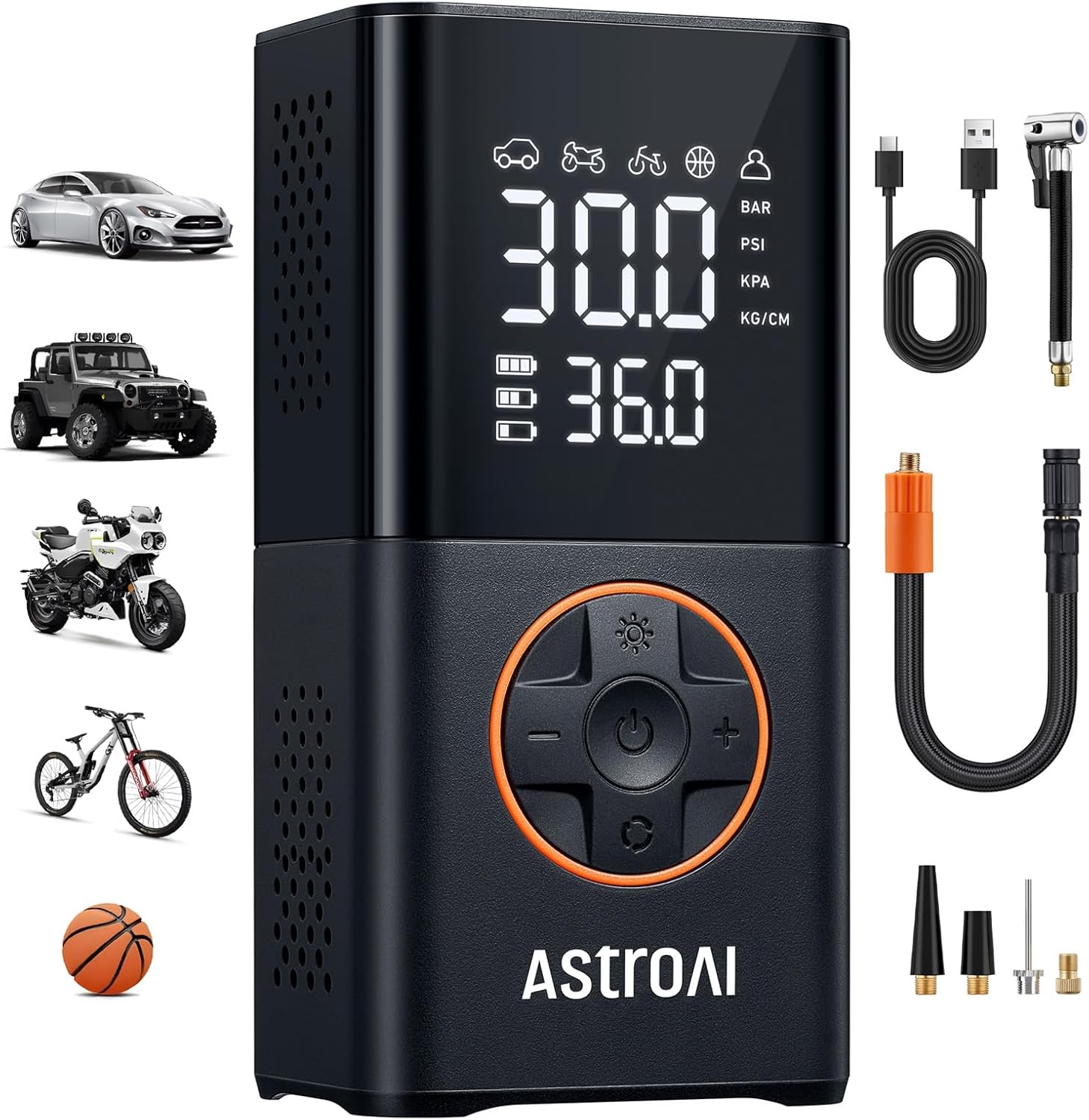
AstroAI L7 provides fast, cordless inflation for cars, motorcycles, bicycles, e-bikes, and sports balls with preset smart modes and a custom pressure option. Its compact design, dual digital display, and built-in auto-off make it easy to use for quick road-trip top-offs and emergency roadside inflation. The unit includes LED lighting and an SOS strobe flashlight for visibility, plus USB-C/USB ports for charging devices.
Extra Tire Checks for Off-Road Driving, Towing, and Loads
Tacoma owners often use their trucks harder than a daily commuter car. Trail driving, washboard roads, gravel, mud, sand, towing, rooftop tents, bed racks, and heavy cargo can all speed up tire wear or expose weak spots.
Before towing or hauling, confirm that your tires match the load requirements on your tire placard and owner’s manual. Do not exceed the tire load rating, wheel rating, payload rating, or towing limits. If you air down for off-road traction, air back up to the correct road pressure before highway driving.
- After trail use: Look for sidewall cuts, embedded rocks, bead leaks, missing valve caps, bent wheels, and punctures.
- After deep mud, sand, or water: Inspect wheels, brakes, suspension, and tires before your next highway drive.
- Before towing: Check cold pressure and confirm your tires are rated for the load.
- After carrying heavy cargo: Watch for shoulder wear, heat damage, and pressure loss.
Choose the Right Tires for Your Tacoma
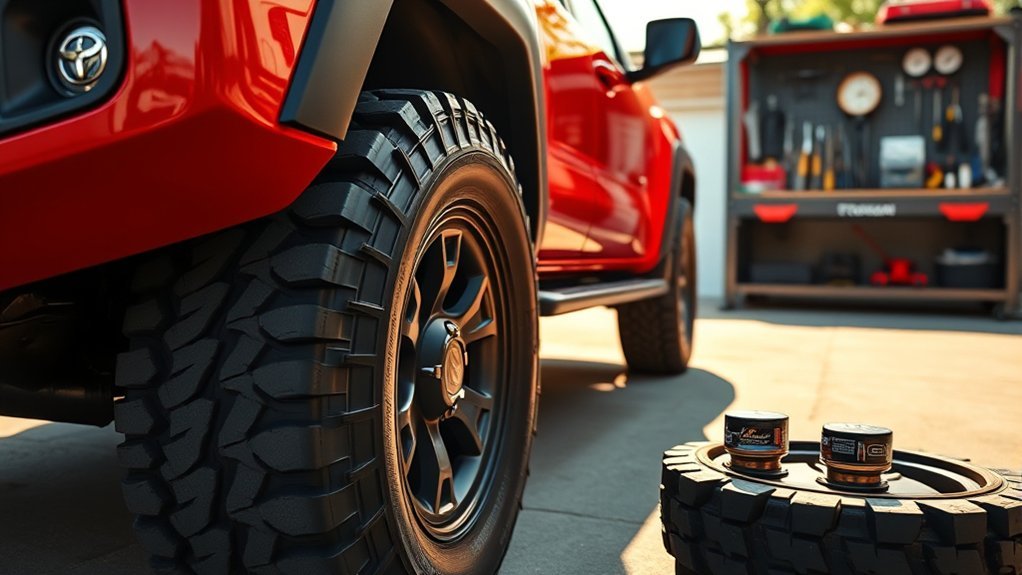
Choosing the right tires for your Tacoma starts with the label on the truck, not a guess from another driver’s setup. NHTSA says replacement tires should match the original tire size or another size recommended by the vehicle manufacturer. The correct size is listed on the driver-side Tire and Loading Information Label or in the owner’s manual.
Use this checklist before buying tires:
- Size: Match the placard size unless your owner’s manual or a qualified tire professional confirms another safe size.
- Load rating: Choose a tire that can support your Tacoma, passengers, cargo, accessories, and towing needs.
- Speed rating: Use a rating that meets or exceeds the manufacturer’s requirement.
- Load range: Light-truck tires may ride firmer but can help with heavier loads. Do not choose them only for appearance.
- Terrain: Highway tires suit commuting, all-terrain tires suit mixed road and trail use, and mud-terrain tires trade quietness and tread life for off-road bite.
- Climate: Winter tires help in snow and ice. All-weather or all-season tires may suit milder conditions, depending on your climate.
- Wheel fitment: Oversized tires can affect clearance, speedometer accuracy, fuel economy, braking, and rubbing.
If you modified your Tacoma with a lift, different wheels, heavier bumpers, armor, a camper, or a bed rack, speak with a qualified tire shop. The safest tire is the one that matches the truck’s actual load, clearance, wheel width, and driving conditions.
Frequently Asked Questions
How does temperature affect tire pressure in my Tacoma?
Tire pressure rises in warm weather and drops in cold weather. The U.S. Tire Manufacturers Association says pressure can change about 1 to 2 PSI for every 10°F shift. Check pressure cold, especially during seasonal changes, cold mornings, heat waves, and mountain trips.
What tools do I need for Tacoma tire maintenance?
For basic checks, use a tire pressure gauge, tread depth gauge or penny, air inflator, and flashlight. For a DIY rotation, you also need a proper jack, jack stands, wheel chocks, lug wrench, torque wrench, and your owner’s manual for lift points, rotation pattern, and lug-nut torque.
Can I rotate my Tacoma tires myself?
Yes, you can rotate them yourself if you have the right tools and know the correct lift points, rotation pattern, and torque specification. Use jack stands and wheel chocks every time. If your tires are directional, staggered, oversized, heavily worn, or damaged, use a professional shop.
How often should I check my Tacoma tire pressure?
Check pressure at least once a month, before long trips, before towing, before carrying heavy loads, and after big temperature swings. Check the tires cold, and include the spare if your Tacoma has one.
What are the signs of uneven tire wear?
Common signs include one-sided wear, feathered tread edges, cupping, scalloping, bald patches, shoulder wear, and center wear. These can point to low pressure, high pressure, poor alignment, imbalance, worn suspension parts, or wheel damage.
Should I replace Tacoma tires at 2/32 inch?
Yes. NHTSA says tires are not safe and should be replaced when tread reaches 2/32 inch. In rain, snow, off-road use, or towing, you may need replacement sooner because traction drops before the legal minimum.
Do Tacoma tire pressures change after driving?
Yes. Driving heats the tires and raises pressure. For the most accurate reading, check pressure before driving or after the truck has been parked for at least three hours. If you must add air when warm, recheck later when the tires are cold.
Conclusion
Good Toyota Tacoma tire maintenance comes down to a few repeatable habits. Check cold pressure every month, rotate tires on the schedule for your model year, inspect tread and sidewalls, fix alignment or balance symptoms early, and buy tires that match your truck’s size, load, and driving conditions.
Those small checks help your Tacoma ride better, handle loads more safely, and avoid preventable tire damage. They also give you a better chance of catching problems before they turn into vibration, uneven wear, poor traction, or an expensive replacement set.
Sources
- NHTSA TireWise Tire Safety — tire pressure label guidance, tread depth, penny test, rotation, alignment, balancing, and tire size guidance.
- NHTSA Tire Safety Month — monthly cold pressure checks, tread checks, rotation, balancing, and alignment reminders.
- U.S. Tire Manufacturers Association Tire Care Essentials — pressure, temperature change, TPMS limitations, tread checks, rotation, and alignment guidance.
- FuelEconomy.gov Keeping Your Vehicle in Shape — fuel economy effects of proper tire inflation.
- Toyota 2025 Tacoma Hybrid Warranty & Maintenance Guide — example Tacoma service interval and tire rotation chart.
- Michelin Wheel Alignment and Balancing — alignment, balancing, vibration, tire wear, and inspection triggers.

Related Articles
How Tire Weight Affects Toyota Tacoma Performance
How does tire weight influence your Toyota Tacoma's performance and efficiency? Discover the surprising effects that could change your driving experience.
Read More
Tire Noise Levels by Tire Type on a Toyota Tacoma
A comprehensive look at how tire types affect noise levels in your Toyota Tacoma reveals surprising insights that could enhance your driving experience.
Read More
How To Choose Tires for a Dual Use Toyota Tacoma
Unlock the secrets to selecting the perfect tires for your dual-use Toyota Tacoma, ensuring optimal performance and comfort on every adventure. Discover more inside!
Read More