
Why Bigger Tires Affect Toyota Tacoma Acceleration
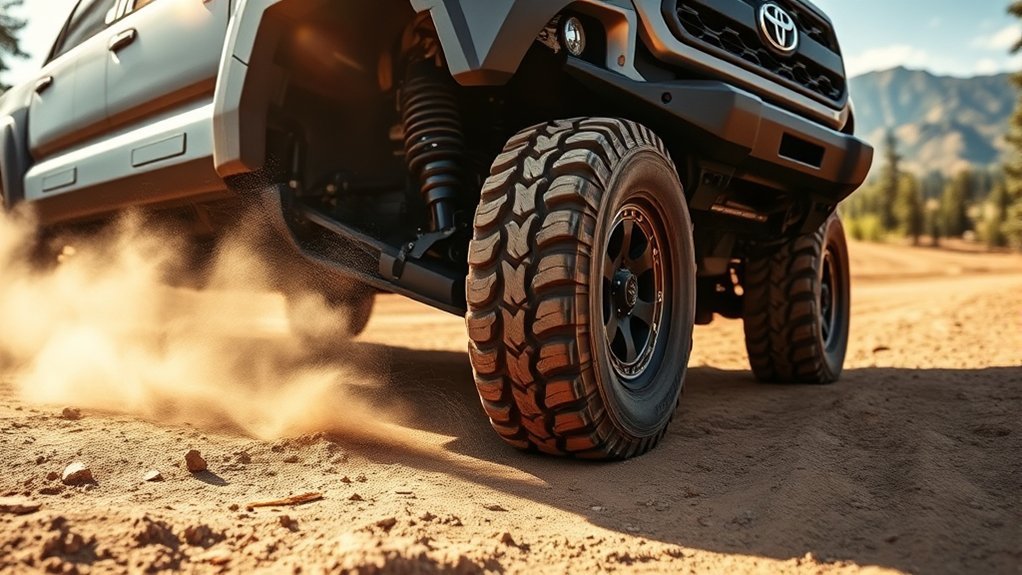
Bigger tires can make your Toyota Tacoma look tougher and perform better off-road, but they can also change how quickly the truck gets moving. The biggest changes come from taller overall diameter, extra tire and wheel weight, added rolling resistance, and a change in effective gearing.
Quick Answer
Yes, bigger tires can reduce Tacoma acceleration, especially when the new tires are taller, heavier, wider, or more aggressive than stock. A mild size increase may feel small, but a jump to heavy 33-inch, 35-inch, or 37-inch tires can dull throttle response, change shifting, reduce low-speed torque, and affect speedometer accuracy.
Key Takeaways
- Bigger tires make your Tacoma travel farther with each wheel revolution, which makes the truck feel like it has taller gearing.
- Heavier LT all-terrain or mud-terrain tires can slow acceleration more than the diameter change alone.
- A small increase near stock size is often manageable, while 35-inch and 37-inch setups usually need more planning.
- Re-gearing can restore low-speed response, but it is not automatically required for every tire upgrade.
- Always check load rating, tire pressure, clearance, rubbing, spare fitment, TPMS, and speedometer calibration.
At a Glance
| Best For | Tacoma owners comparing stock, 33-inch, 35-inch, and larger tire setups |
| Main Trade-Off | More ground clearance and off-road traction potential, but slower response and possible MPG loss |
| Checks Needed | Diameter, tire weight, load rating, wheel offset, rubbing, gearing, pressure, speedometer error, and alignment |
| Typical Fixes | Lighter tires, correct pressure, speedometer calibration, engine/transmission tuning, or re-gearing for larger jumps |
Warning: Do not choose a tire only by height. A tire that rubs, has the wrong load rating, overloads the spare location, changes braking feel, or throws off the speedometer can create safety and inspection issues. For major upgrades, have a qualified tire or 4×4 shop check fitment before you drive at highway speed.
How Bigger Tires Change Your Tacoma’s Acceleration
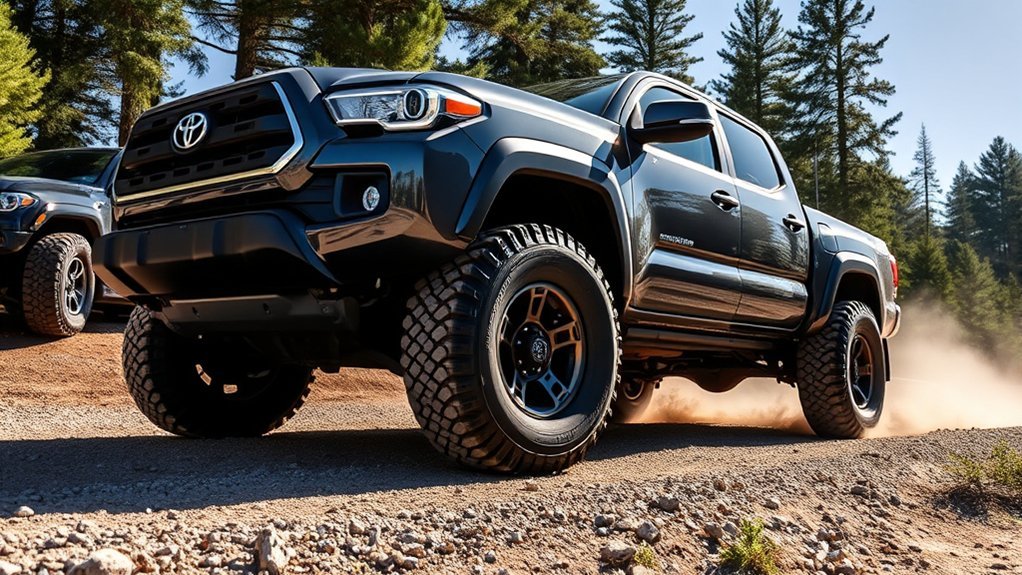
When you install bigger tires on your Toyota Tacoma, you change more than the look of the truck. A taller tire has a larger rolling circumference, so each wheel turn moves the truck farther. That makes the drivetrain act as if it has taller gearing, which can reduce the torque you feel at the wheels during takeoff.
The result is usually most noticeable from a stop, while climbing hills, when towing, or when the truck is loaded with camping gear. Your Tacoma may need more throttle, downshift more often, or feel less sharp when you press the pedal.
Tire weight matters too. A larger light-duty tire may feel acceptable, while a heavy LT all-terrain or mud-terrain tire can feel much slower even if the size increase looks modest on paper. Always compare the listed weight of the old tire, new tire, old wheel, and new wheel before assuming a size will feel fine.
Current Tacoma trim also matters. Toyota’s 2024 Tacoma lineup includes i-FORCE engines with up to 278 horsepower and 317 lb-ft of torque, while the i-FORCE MAX hybrid system is rated at 326 horsepower and 465 lb-ft of torque. A high-torque trim may hide the effect better than an older or lower-output truck, but it still has to turn the extra diameter and weight.
[Products Worth Considering]

Upgrade your Toyota tire setup with these corrosion-resistant, leak-proof valve stem caps designed to help protect the valve core from water, snow, and road grime. The caps feature a snug rubber seal and durable copper alloy construction to resist rust and oxidation while maintaining stable tire pressure. Ideal for replacing worn original caps and keeping your wheels looking clean and stylish.
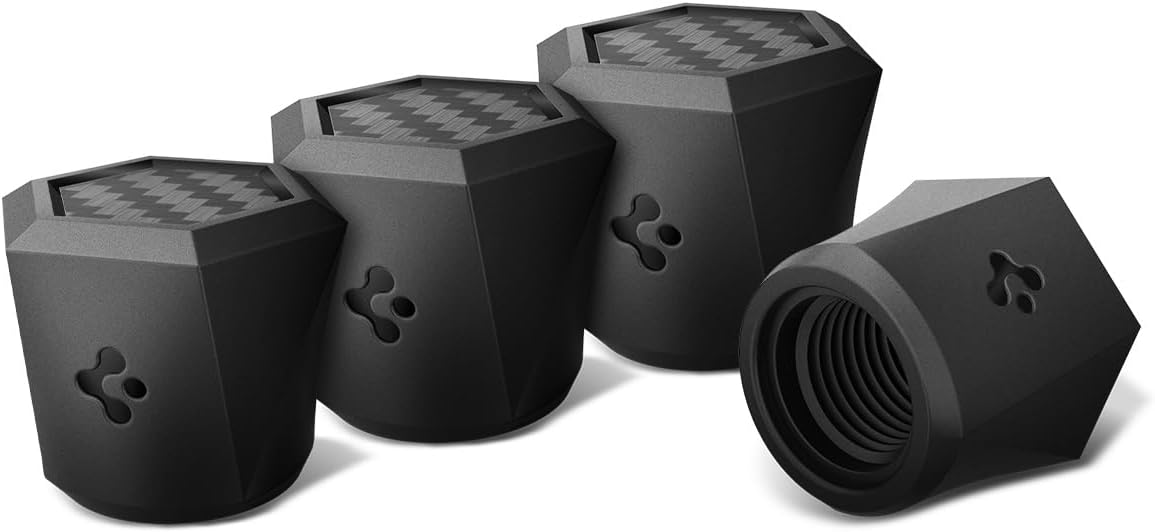
Spigen magnetic tire valve caps attach securely to metal surfaces so you never have to search for lost caps. Designed for Schrader valve stems, they install quickly, help protect against air leakage and corrosion, and feature a light magnet that won’t interfere with TPMS signals.

RVMATE dual-axle RV tire covers help shield your tires from sunlight, snow, rust, and dirt to keep them in better condition in harsh weather. Made with heavy-duty waterproof, UV-resistant 420D Oxford fabric, they provide strong shading and help reduce wear. They install easily by placing the cover on the wheel and fastening the rope for a stable fit.
How Rotational Mass Affects Performance
Rotational mass is the weight your engine must spin, not just carry. Tires and wheels are different from cargo in the bed because they rotate every time the truck moves. Extra rotating weight can hurt acceleration, braking feel, steering response, and suspension control.
Increased Rotational Inertia
A heavier tire and wheel package needs more energy to start spinning and more braking force to slow down. That is why two tire setups with the same outside diameter can feel different. A lighter 33-inch tire may feel more responsive than a heavier 33-inch tire with a stiffer LT construction and aggressive tread.
If you are comparing tires, look beyond size. Check each tire’s listed weight, tread depth, load range, and construction. Mud-terrain tires often weigh more and roll with more resistance than highway-terrain or mild all-terrain tires.
Torque Requirements Rise
Bigger tires raise the torque demand because the tire acts like a longer lever between the axle and the road. Your engine and transmission may still make the same power, but less of that low-speed punch feels available at the pavement.
This is why a Tacoma on 35-inch tires may feel slower than the same truck on stock tires, even before you account for tread pattern or tire weight. The truck may also shift more often because the engine is operating at lower RPM at the same road speed.
Acceleration Response Delays
Acceleration delay usually comes from a mix of five changes:
- Taller effective gearing: The truck travels farther per wheel revolution.
- More rotating weight: The engine works harder to spin the tires and wheels.
- More rolling resistance: Wider, heavier, or more aggressive tread can take more power to move.
- More wind and ride height drag: Tire upgrades often come with lifts or higher stance, which can reduce MPG.
- Speedometer error: If the tire diameter is not recalibrated, speed and distance readings can be wrong.
Pro Tip: Before buying, compare the new tire’s actual measured diameter and weight, not just the advertised size. Some “35-inch” tires measure closer to 34.5 inches, and the weight difference between brands can be large.
Torque Requirements for Improved Acceleration
To understand the torque change, focus on percentage increase instead of inches alone. A 2-inch jump from a 30-inch tire is a bigger change than a 2-inch jump from a 33-inch tire. The larger the percentage change, the more you change effective gearing and speedometer accuracy.
Here is a practical guide:
| Diameter Increase | Likely Acceleration Change | What to Check |
|---|---|---|
| 0% to 3% | Usually mild if tire weight stays close to stock | Speedometer, rubbing, load rating, and pressure |
| 3% to 6% | Noticeable loss in low-speed response on many setups | Tire weight, shift behavior, clearance, and calibration |
| 6% to 10% | Often slower takeoff, more downshifts, and lower MPG | Re-gearing, tuning, braking, alignment, and suspension fitment |
| 10% or more | Major change in drivability unless the truck is built around it | Professional fitment plan, gears, lift, trimming, spare solution, and speed correction |
For a simple speedometer estimate, divide the new tire diameter by the old tire diameter. If your old tire is 31.6 inches and your new tire is 33 inches, the new tire is about 4.4% taller. If the speedometer is not corrected, an indicated 60 mph may be closer to about 62.6 mph in real road speed.
Weight Distribution and Handling
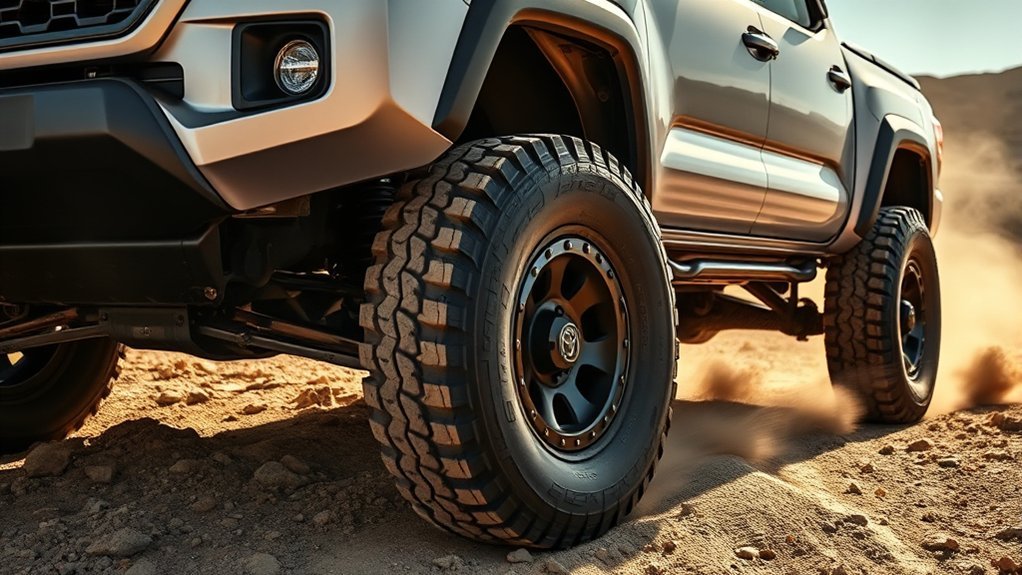
When you upgrade to larger tires, you can also change your Tacoma’s handling. Heavier tires add unsprung weight, which is weight the suspension has to control directly. This can make the truck feel less precise over bumps, in corners, and during quick steering inputs.
Weight Impact on Handling
Larger tires can help off-road by adding clearance and improving traction on loose surfaces, but the added weight can make the truck feel slower and heavier on pavement. You may notice:
- More effort needed to accelerate from a stop
- Longer-feeling braking response
- More steering weight
- More suspension movement over sharp bumps
- More tire noise if the tread is aggressive
Correct tire pressure matters here. Use a pressure that fits the tire, load, and vehicle setup. Do not simply inflate to the number molded on the tire sidewall, because that is not the same thing as the recommended operating pressure for your truck.
Suspension Dynamics Alterations
A bigger tire can also change suspension geometry and clearance. If the tire is wider or the wheel offset pushes it outward, it may rub the mud flap, fender liner, cab mount area, upper control arm, or sway bar. Rubbing can get worse when the suspension compresses or when you turn sharply.
After a tire upgrade, check alignment, steering clearance, brake-line clearance, and full-lock turning on flat ground and over mild suspension compression. If your Tacoma has driver-assistance systems, ask whether any calibration is needed after major tire, lift, or alignment changes.
Is Re-Gearing Necessary After Upgrading Tires?
Re-gearing is not always necessary after upgrading tires, but it can make a big difference when the tire jump is large. Re-gearing changes the axle ratio so the truck can recover some of the low-speed torque and shift behavior lost to taller tires.
You should consider re-gearing if your Tacoma:
- Feels weak from a stop after the tire upgrade
- Hunts between gears on hills or highways
- Tows, hauls, or carries overlanding gear often
- Runs heavy 35-inch or 37-inch tires
- Needs better crawl control for off-road driving
- Has poor throttle response even after tire pressure and tuning are checked
You may not need re-gearing if the tire change is small, the tire weight is close to stock, the truck still shifts cleanly, and your driving is mostly light street use. For newer high-torque Tacoma trims, especially i-FORCE MAX models, the truck may tolerate a moderate tire change better than an older lower-torque setup.
Note: Re-gearing can improve drivability, but it does not guarantee better fuel economy. It also adds cost and should be matched to tire size, axle ratio, transmission, engine, towing needs, and driving style.
Real-World User Experiences: Tire Size and Acceleration
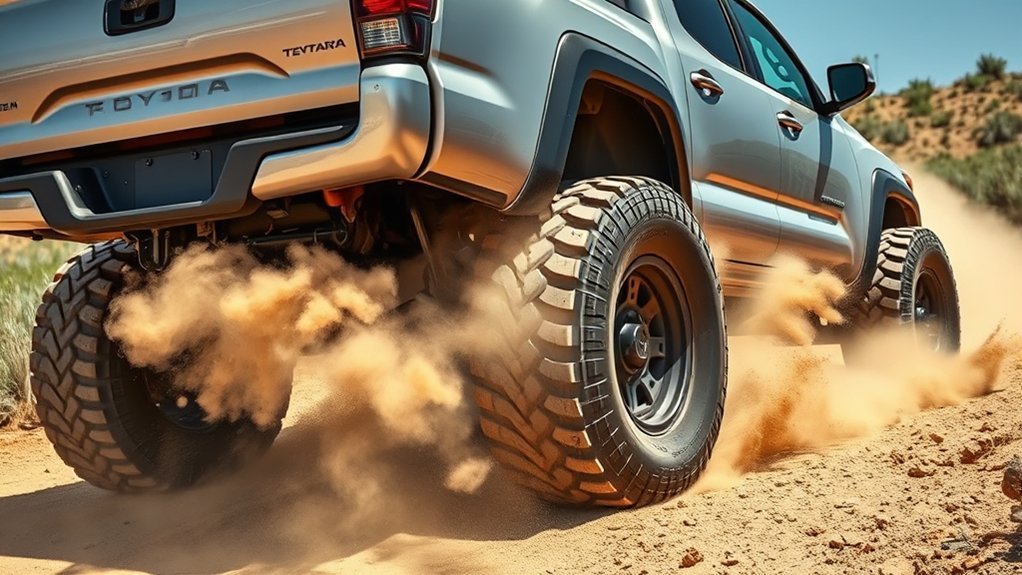
In real driving, Tacoma owners usually notice a bigger acceleration change when they move beyond a mild tire upgrade. A small increase may only feel slightly heavier. A jump to heavy 35-inch tires can make the truck feel slower off the line, especially with armor, a bed rack, a camper, or towing weight added.
| Tire Setup | What You May Notice |
|---|---|
| Near-stock tire size | Little change if weight, tread, and pressure stay close to factory setup |
| 33-inch tires | Often manageable, but heavy LT tires may reduce snap and MPG |
| 35-inch tires | Noticeable throttle softness, more shifting, more clearance work, and possible re-gear discussion |
| 37-inch tires | Major build territory, often involving gears, lift, trimming, stronger parts, and careful brake/speedometer checks |
Your experience will depend on the exact Tacoma generation, powertrain, factory axle ratio, transmission, tire model, wheel weight, lift height, and cargo load. That is why two trucks on the same advertised tire size can feel very different.
[Products Worth Considering]

This 100-piece tire repair screw plug kit provides a fast, self-service solution for punctures on the road. Choose the correct plug size, insert it into the break, and screw it in to help seal the puncture and temporarily restore tire pressure. Thickened threads and rubber-wrapped plugs improve bite and sealing while remaining compact and easy to carry.

This spare tire tool kit is designed for the 2004 to 2018 Ford F-150 to help you loosen and tighten wheel lug nuts and manage the spare tire and provided jack functions from underneath the vehicle. It includes the lug nut wrench and extension pieces plus a convenient storage carrying case for organized transport. The jack itself is not included.
Best Practices for Choosing Tire Sizes
Choosing the right tire size for your Toyota Tacoma is about balance. A tire that looks great but makes the truck slow, noisy, and hard to steer may not be the best choice for daily driving.
- Start with your factory size: Use the tire placard, owner’s manual, or current tire sidewall as your baseline.
- Compare actual diameter: Use the manufacturer’s measured diameter when available, not only the advertised size.
- Compare tire weight: A heavy tire can hurt acceleration even if the diameter change is modest.
- Check load rating: Choose a tire that can safely support the truck and your cargo needs.
- Plan for clearance: Check lift height, wheel offset, fender liner clearance, mud flaps, body mount area, and full-lock steering.
- Think about your use: Daily driving, towing, overlanding, and rock crawling all favor different tire choices.
- Correct the speedometer: Larger tires can make the truck travel faster and farther than the gauges show.
- Budget beyond tires: You may also need alignment, trimming, sensors, spare storage, tuning, or gearing.
Tips for Optimizing Acceleration With Larger Tires
If you want bigger tires without making your Tacoma feel lazy, focus on the whole setup instead of tire height alone.
| Tip | Why It Helps | Best Use |
|---|---|---|
| Choose a lighter tire | Reduces rotating weight | Daily drivers and mild trail trucks |
| Use the right pressure | Improves wear, handling, rolling resistance, and load support | Every tire upgrade |
| Correct speedometer error | Keeps speed, mileage, and shift logic closer to reality | Moderate to large diameter changes |
| Consider tuning | Can improve throttle and shift behavior when done properly | Trucks with drivability complaints after tires |
| Re-gear the axles | Restores mechanical advantage at the wheels | Heavy 35-inch or larger setups, towing, hauling, and off-road crawling |
Also keep the rest of the truck healthy. Worn spark plugs, dirty filters, old fluids, poor alignment, dragging brakes, or underinflated tires can make a tire upgrade feel worse than it really is.
Frequently Asked Questions
Do bigger tires reduce Tacoma acceleration?
Yes, bigger tires can reduce Tacoma acceleration because they usually increase rolling diameter, rotating weight, and rolling resistance. The effect is mild with small upgrades and more obvious with heavy 33-inch, 35-inch, or 37-inch setups.
Are 33-inch tires too big for a Tacoma?
Not always. Some newer Tacoma off-road trims come with 33-inch tires from the factory, but fitment depends on your generation, trim, wheel offset, suspension, and exact tire model. A heavy LT 33 can still feel slower than a lighter stock tire.
Do 35-inch tires require re-gearing on a Tacoma?
Many Tacoma owners consider re-gearing with 35-inch tires, especially if they tow, haul, drive in mountains, or off-road often. It is not automatic, but if the truck feels weak, hunts gears, or struggles at low speed, re-gearing may be the best fix.
Will bigger tires change my Tacoma speedometer?
Yes, a taller tire can make your Tacoma travel farther than the speedometer and odometer expect. If the new tire is 5% taller, your actual speed and distance can be about 5% higher than indicated unless the truck is recalibrated.
Can lighter wheels help acceleration with bigger tires?
Yes. Lighter wheels can offset some tire-weight gain and help the truck feel more responsive. Still, the tire’s diameter, tread, load range, and total mounted weight matter more than wheel weight alone.
Conclusion
Bigger tires can affect your Toyota Tacoma’s acceleration, but the impact depends on the whole setup. Tire diameter changes effective gearing, tire weight adds rotating mass, and aggressive tread can increase rolling resistance. Mild upgrades may feel fine, while heavy 35-inch or 37-inch tires often need more planning.
For the best result, choose the lightest tire that fits your use, keep the load rating and pressure correct, check clearance, correct the speedometer, and only re-gear when your tire size and driving needs justify it. That balance gives you the off-road look and capability you want without making your Tacoma frustrating to drive every day.
Sources
- Toyota USA Newsroom: 2024 Toyota Tacoma is the Ultimate Adventure Machine — Tacoma powertrain output, factory 33-inch tire context, payload, towing, and off-road trim details.
- NHTSA Tire Safety — tire pressure, load, tread, and general tire safety guidance.
- FuelEconomy.gov: Keeping Your Car in Shape — maintenance and tire-pressure guidance related to fuel economy.
- 49 CFR § 571.138 Tire Pressure Monitoring Systems — federal TPMS performance standard for applicable vehicles.

Related Articles
How Tire Weight Affects Toyota Tacoma Performance
How does tire weight influence your Toyota Tacoma's performance and efficiency? Discover the surprising effects that could change your driving experience.
Read More
Tire Noise Levels by Tire Type on a Toyota Tacoma
A comprehensive look at how tire types affect noise levels in your Toyota Tacoma reveals surprising insights that could enhance your driving experience.
Read More
How To Choose Tires for a Dual Use Toyota Tacoma
Unlock the secrets to selecting the perfect tires for your dual-use Toyota Tacoma, ensuring optimal performance and comfort on every adventure. Discover more inside!
Read More