
Correct Tire Pressure for a Fully Loaded Toyota 4Runner

Getting tire pressure right on a loaded Toyota 4Runner starts with one rule: use the cold PSI on your driver-door Tire and Loading Information label for stock tires, then verify any replacement LT tire setup with the tire maker’s load-inflation data. A fixed number like 33 PSI can be close for some 4Runners, but it is not a universal answer for every year, trim, tire size, or load.
Quick Answer
For stock Toyota 4Runner tires, set pressure cold to the PSI shown on the driver-door placard, not the tire sidewall. For many 2025+ setups that may be 33 PSI, but always verify your label. If you run LT285/70R17 or other replacement LT tires, use a load-inflation table before choosing a higher PSI.
Key Takeaways
- The correct stock-tire pressure is the cold PSI on the 4Runner’s driver-door Tire and Loading Information label.
- Check pressure when tires are cold: parked at least three hours or driven less than about one mile.
- Do not use the tire sidewall max PSI as your daily driving pressure; it is a maximum limit, not the vehicle recommendation.
- Heavy cargo, towing, and LT tire upgrades require load-limit awareness, not guesswork.
- Air down only for low-speed off-road use, then reinflate before returning to pavement.
At a Glance
| Time Required | 5–10 minutes for a normal check; 15–30 minutes if you are checking loaded axle weight or testing replacement LT tires. |
| Difficulty | Easy for stock tires; moderate for LT tire conversions because you must match load capacity. |
| Tools Needed | Accurate tire pressure gauge, air compressor, valve caps, chalk for optional contact-patch testing, and your vehicle/tire load information. |
| Cost | Usually free if you already own a gauge and inflator; about $10–$60 for a quality gauge or portable inflator. |
Find Your Baseline: Door Placard First, Not the Sidewall
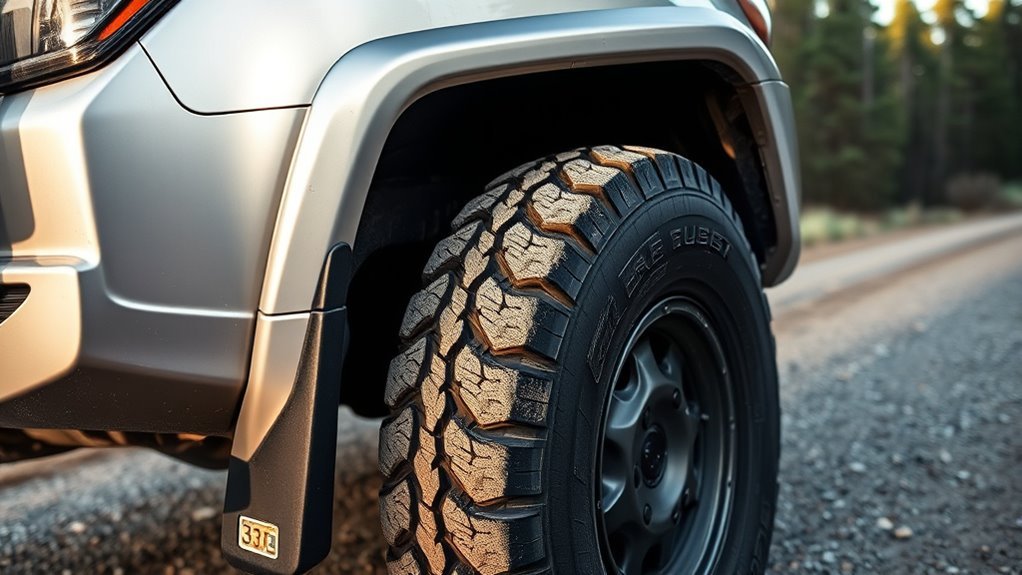
Your 4Runner’s baseline tire pressure is the cold PSI printed on the Tire and Loading Information label, usually on the driver-side door edge or door jamb. Toyota’s owner information points drivers to that label for the recommended cold tire inflation pressure and tire size, and NHTSA tire safety guidance says the correct pressure is the vehicle manufacturer’s pressure, not the number molded into the tire sidewall.
Warning: The tire sidewall number is a maximum cold inflation limit for that tire. It is not the recommended daily-driving pressure for your 4Runner.
For stock tires, start with the placard PSI. Some newer 4Runner configurations may show 33 PSI, while other years or tire packages may differ. The safest answer is not “always 33” or “always 40”; it is “match the label on your specific vehicle.”
| Setup | Cold PSI Starting Point | What to Check Next |
|---|---|---|
| Stock tire size and stock load range | Use the driver-door placard PSI. | Confirm tires are cold, cargo is within the vehicle capacity label, and the spare is checked. |
| Fully loaded but still on stock tires | Use the placard PSI unless Toyota or your tire maker gives a different load-specific instruction. | Do not exceed payload, GVWR, GAWR, tire load rating, wheel rating, or sidewall max PSI. |
| Replacement LT tires such as LT285/70R17 | Use a tire-maker load-inflation table to match or exceed the original load capacity. | Verify load index, load range, actual axle load, ride quality, tread wear, and contact patch. |
[Products Worth Considering]

EVOULTES heavy duty tire inflator with an integrated gauge delivers accurate pressure readings from 10–120 PSI, helping you inflate, deflate, and check tires in one tool. The 16.5-inch extended dual-head air chuck with swivel base reaches hard-to-access dual wheel valves on trucks and RVs. A brass trigger core and side-mounted air release valve make operation smooth, with standard 1/4" NPT threading and quick-connect compatibility for easy setup.

This portable cordless tire inflator delivers up to 160 PSI with fast 17 L/min airflow to help you quickly top up tires and get back on the road. It features dual power mode, running on a 21V rechargeable battery or a 12V DC adapter for convenient roadside use. An automatic shut-off with digital pressure gauge helps prevent overinflation, and a built-in LED light improves visibility in low-light conditions.

The JACO FlowPro Tire Inflator measures, inflates, and airs down tires up to 100 PSI with battery-free operation and ±2% accuracy after calibration. It features a glowing pressure dial for night visibility, a heavy-duty steel build with a hybrid hose, and a precision push-to-inflate thumb trigger. The patented Lightning Air Chuck locks on for a secure seal, and the kit includes quick-connect hardware for easy inline use with your air compressor.
Check It Cold: The 3-Hour Rule for Accurate PSI
You need to check tire pressure cold. That means the vehicle has been parked for at least three hours or has been driven less than about one mile. Heat from driving raises pressure, so a warm reading can hide a tire that will be low the next morning.
The basic routine is simple:
- Park the 4Runner for at least three hours.
- Find the cold PSI on the driver-door label.
- Remove each valve cap.
- Press a quality gauge firmly onto the valve stem.
- Add or release air until the pressure matches the correct cold target.
- Recheck the reading, reinstall the valve cap, and check the spare.
Note: A TPMS warning light is not a substitute for a manual pressure check. Use a gauge when adding or removing air, then let the TPMS update after driving.
Why Cold Pressure Matters
Cold pressure is the standard because it removes heat from the equation. According to USTMA tire-care guidance, inflation pressure can rise or fall by about 1–2 PSI for every 10°F change in temperature. That means a pressure that looked fine on a hot afternoon can be low on a cold morning.
Cold checks help protect fuel economy, tire life, steering response, and braking stability. They are especially important before a loaded trip because heavy cargo increases the consequences of underinflation: more sidewall flex, more heat, and more tread wear.
Morning Check Routine
The best time to check your 4Runner’s tire pressure is before driving. Keep a gauge in the glove box or cargo area, and check the tires before the sun warms one side of the vehicle. If you are leaving for a camping trip, towing day, or long highway drive, check pressure before loading when possible, then confirm again once the vehicle is packed and still cold.
Pro Tip: If one tire keeps losing pressure, do not keep topping it off and ignoring it. Inspect the tread, valve stem, bead area, and wheel, or have a tire shop check for a slow leak.
Loaded Down or Towing? Use Load Limits, Not Guesswork
A loaded 4Runner needs enough tire pressure to carry the load without excess heat, but more air is not automatically better. The right method is to stay within Toyota’s vehicle capacity limits and match the tire’s load capacity to the actual weight it is carrying.
Before a heavy trip, check these four things:
- Vehicle capacity label: Do not exceed the combined weight of passengers and cargo listed on your 4Runner’s label.
- GVWR and GAWR: Do not exceed the gross vehicle weight rating or either axle’s gross axle weight rating.
- Tire load rating: Make sure each tire can safely support its share of the loaded axle weight.
- Cold PSI: Use the placard for stock tires or a load-inflation table for replacement LT tires.
If you are towing, also account for tongue weight. Tongue weight presses down on the rear axle and can overload the rear tires even when the cargo area looks reasonable. A public scale or trailer scale is the best way to verify real-world axle loads.
Warning: Do not use extra PSI to “fix” an overloaded vehicle. If the 4Runner is over its payload, GVWR, GAWR, tire load rating, wheel rating, or trailer limit, remove weight or change the setup before driving.
Upgraded to LT Tires? Recalculate Before You Drive
Many 4Runner owners upgrade to LT tires for stronger sidewalls, better puncture resistance, and more confidence on rocky trails. The trade-off is that LT tires often need a different pressure than the original P-metric tires to carry the same load. That is why a simple swap from stock tires to LT285/70R17 tires should include a pressure recalculation.
Use this process:
- Write down your original tire size, placard PSI, and vehicle load limit.
- Find the replacement tire’s exact size, load range, load index, and maximum cold pressure on the sidewall.
- Use the tire manufacturer’s load-inflation table, such as Toyo Tires’ load and inflation table guidance, to match the load capacity of the original setup.
- Confirm loaded axle weight if you tow or carry heavy gear.
- Fine-tune for ride, handling, and tread wear without going below the required load pressure or above the tire/wheel limit.
For many LT285/70R17 4Runner builds, the on-road answer often lands higher than the stock placard PSI, but the exact number depends on the tire. A load range C tire, load range E tire, mud-terrain tire, and all-terrain tire can all behave differently even when the size printed on the sidewall looks similar.
Load Capacity Math
The goal is not to copy someone else’s forum PSI. The goal is to make sure the tire can carry at least the load your 4Runner places on it. If your original tire was a P-metric tire, federal tire-selection rules also recognize that passenger-car tire load ratings are reduced when used on multipurpose passenger vehicles, trucks, buses, or trailers. That is why replacement-tire decisions should be based on load data, not just tire height or sidewall appearance.
When you are unsure, ask the tire manufacturer or a qualified tire dealer for the correct pressure using your 4Runner’s year, tire size, load range, wheel size, and loaded axle weight.
Chalk Test Verification
A chalk test can help you see whether the tread is contacting the ground evenly, but it should not override load-table safety. Use it only after you have selected a pressure that meets the tire’s load requirement.
| Step | Action | What It Means |
|---|---|---|
| 1 | Mark a thick chalk line across the tread. | Use a clean, dry, level surface. |
| 2 | Roll forward one full tire rotation. | Keep the steering straight. |
| 3 | Check the chalk pattern. | Even removal suggests a balanced contact patch. |
| 4 | Read the wear pattern. | Center-only removal can suggest too much pressure; edge-only removal can suggest too little pressure or too much load. |
| 5 | Adjust only within safe limits. | Never drop below the load-table pressure needed for your actual load. |
Ride Quality Trade-offs
Higher LT-tire pressure can improve load stability and steering response, but it can also make the ride harsher and increase center tread wear if you go too high. Lower pressure can improve comfort and contact patch, but going too low for the load can create heat, sidewall flex, vague handling, and tire damage.
The best pressure is the one that supports the load, keeps the tread wearing evenly, and preserves predictable handling.
Decode Load Ratings: What C, D, and E Mean

Load range letters such as C, D, and E describe the tire’s construction category and maximum inflation capability, but they do not give a universal pound rating by themselves. A load range E tire is not automatically “better” for every 4Runner owner. It may be stronger, but it can also be heavier, stiffer, and less comfortable.
| Load Range | What It Usually Indicates on LT Tires | 4Runner Takeaway |
|---|---|---|
| C | Often a lower maximum pressure than D or E in the same LT size. | Can be a good balance for daily driving and trails if the load index supports your loaded axle weight. |
| D | Middle ground in many LT sizes. | Useful when available, but less common than C or E in some popular 4Runner tire models. |
| E | Often built for higher maximum pressure and heavier-duty service. | Can help with heavy loads, towing, and sidewall strength, but may ride firmer and still must be inflated according to load data. |
Look at the complete sidewall: size, service description, load index, load range, and maximum cold pressure. Then use the tire maker’s data. The letter alone is not enough.
Air Down for Off-Road: 20–28 PSI by Terrain
Once you leave pavement, lower tire pressure can improve traction and ride comfort by letting the tire conform to rocks, washboard, roots, and sand. That does not mean you should drive highway speeds at trail pressure. Airing down is for low-speed off-road use only.
| Terrain | Common Trail Starting Range | Caution |
|---|---|---|
| Dirt roads and washboard | 26–32 PSI | Keep speed moderate and watch tire temperature. |
| Rocky trails | 22–28 PSI | Lower pressure improves grip but raises sidewall and bead risk. |
| Sand or snow | 18–24 PSI | Use smooth throttle and avoid sharp steering to reduce debeading risk. |
| Slow technical crawling | Below 20 PSI only with care | Risk rises sharply without beadlocks, proper wheels, and trail experience. |
Warning: Reinflate to safe on-road cold pressure before highway driving. Low trail pressure can overheat tires, damage sidewalls, reduce steering response, and unseat the bead at speed.
[Products Worth Considering]

The Fanttik X10 Pro is a cordless portable tire inflator that reaches up to 150 PSI and can inflate an R15 tire in about 35 seconds for quick roadside or home top-ups. With AccuInFlate auto-stop and smart start/stop controls, it helps maintain accurate pressure and frees your hands once the target is reached. A high-visibility digital display and preset modes make it easy to set and monitor inflation for cars, motorcycles, bikes, and balls.

The AstroAI L7 Air Tire Inflator refills car tires quickly with up to 150PSI max pressure and a fast 1-minute inflation claim. It includes 5 preset modes for car, motorcycle, bicycle, balls, and manual use, along with an auto shutoff to help prevent overinflation. Designed for convenience, it features a digital gauge with unit switching, a top LED light with multiple modes, and USB-C/USB ports for backup power.
Read Your Tread: Wear Patterns Reveal Pressure Problems
Your tread can show pressure, alignment, rotation, and suspension problems before they become expensive. Check tread depth and wear pattern at least monthly when you check pressure.
The goal is not the highest PSI or the softest ride. The goal is enough cold pressure to carry the load, keep the tread flat, and keep the 4Runner predictable.
- Both outer edges worn: Often underinflation or heavy loading. Add air to the correct cold pressure and confirm load limits.
- Center strip worn faster: Often overinflation for the load. Recheck against the placard or load table.
- One shoulder worn: Check alignment, camber, toe, and suspension wear.
- Cupping or scalloping: Check balance, shocks/struts, wheel bearings, rotation history, and alignment.
- Cracks, bulges, cuts, or exposed cords: Replace or have the tire inspected before driving.
When tread reaches 2/32 inch, replacement is due. For rain, snow, mud, and off-road use, many drivers replace earlier because traction falls before the legal minimum.
Troubleshooting Common 4Runner Tire Pressure Problems
| Problem | Likely Cause | What to Do |
|---|---|---|
| TPMS light comes on in the morning, then goes away | Cold overnight temperature lowered pressure below the warning threshold. | Check all tires cold with a gauge and set them to the proper cold PSI. |
| One tire loses 2–5 PSI repeatedly | Slow puncture, valve leak, bead leak, or wheel corrosion. | Have it leak-tested. Do not rely on repeated top-offs. |
| Ride feels harsh after installing LT tires | Pressure may be too high for the load, or the tire casing may be stiffer. | Verify load-table minimum pressure, then fine-tune within safe limits. |
| Rear tires look squashed when towing | Tongue weight, cargo weight, or low pressure may be overloading the rear axle. | Weigh the rig, check GAWR/payload, and verify tire load capacity before driving. |
Frequently Asked Questions
What tire pressure should I run on a fully loaded Toyota 4Runner?
For stock tires, use the cold PSI on the driver-door Tire and Loading Information label as your baseline, even when loaded within Toyota’s capacity limits. If you use replacement LT tires or carry/tow near the vehicle’s limits, verify pressure with a tire-maker load-inflation table and actual axle weight.
Is 40 PSI good tire pressure for a Toyota 4Runner?
40 PSI can be reasonable for some LT tire setups, but it is too high for other setups and too low for others. For stock tires, follow the door placard. For LT tires, use the tire’s load index, load range, and load-inflation data rather than assuming 40 PSI is always right.
Should I inflate my 4Runner tires to the max PSI on the sidewall?
No. The sidewall PSI is the tire’s maximum cold inflation limit, not the recommended pressure for your vehicle. Use the 4Runner’s placard for stock tires or a tire-maker load-inflation table for replacement tires.
How much does temperature change 4Runner tire pressure?
A useful rule of thumb is about 1–2 PSI for every 10°F temperature change. Check pressure cold in the morning, especially after a large weather swing, before a long trip, or before towing.
Can I rely on TPMS instead of checking tire pressure manually?
No. TPMS is a warning system, not a precision fill gauge. It may not warn you until a tire is significantly underinflated. Check pressure manually at least monthly, before long trips, before heavy loads, and after major temperature changes.
Is 265 or 275 better for a 4Runner?
A 265 tire is usually closer to stock fitment and may preserve ride quality, fuel economy, and clearance. A 275 can add footprint and load options, but it may affect clearance, weight, speedometer accuracy, and required pressure. Choose by load index, fitment, wheel size, and how you use the vehicle.
Conclusion
For a fully loaded Toyota 4Runner, the safest starting point is not a universal PSI. It is the cold pressure on your driver-door placard for stock tires, or a verified load-inflation-table pressure for replacement LT tires. Check pressure cold, stay within payload and axle limits, inspect tread wear, and reinflate after off-road driving. Proper pressure keeps the tire carrying the load instead of overheating, flexing, or wearing itself out early.
Sources
- Toyota Owners: 4Runner Hybrid tire inflation pressure — backs the instruction to use the vehicle’s tire and loading information label for the recommended cold pressure.
- NHTSA TireWise tire safety guidance — backs placard pressure, cold checks, and tire-pressure safety basics.
- 49 CFR 571.138: Tire pressure monitoring systems — backs monthly cold checks, placard pressure, and TPMS not replacing proper maintenance.
- 49 CFR 571.120: Tire selection and rims — backs load-rating and GAWR considerations, including passenger-tire load reduction on multipurpose vehicles and trucks.
- U.S. Tire Manufacturers Association: Tire Care Essentials — backs monthly cold checks, temperature effects, tread-depth guidance, and TPMS cautions.
- Toyo Tires load and inflation tables guidance — backs using load-inflation data for optional or replacement tire sizes.

Related Articles

When to Switch From All-Season to Winter Tires on a 4Runner
Ineffective all-season tires in cold weather can jeopardize your safety—discover when to make the crucial switch for better traction and handling.
Read More
4Runner Tire Mileage: How Many Miles Should They Last
Curious about how long your 4Runner tires should last? Discover essential tips and factors that influence tire longevity.
Read More
How Long Do Toyota 4Runner Tires Typically Last
How long do Toyota 4Runner tires typically last? Discover the factors that influence tire longevity and essential tips for maintenance.
Read More