
Toyota Camry Tire Traction in Ice and Snow: A Practical Winter Driving Guide

Winter driving in a Toyota Camry becomes much safer when you prepare the car before temperatures fall and change your driving style when roads turn slick. The most important upgrades are suitable tires, correct cold inflation pressure, clear visibility, a healthy battery and cooling system, and enough following distance to stop without abrupt inputs.
Quick Answer
Prepare your Toyota Camry for winter by fitting four matching winter tires when temperatures stay near or below 45°F (7°C), checking cold tire pressure, battery, coolant, wipers, lights, and brakes, and carrying an emergency kit. On snow or ice, slow down, leave at least five to six seconds, and use smooth inputs.
Key Takeaways
- Use four matching winter tires with the three-peak mountain snowflake symbol when you regularly drive in cold, snowy, or icy conditions.
- Check tire pressure when the tires are cold and use the pressure on the driver-door placard, not the maximum pressure printed on the tire.
- Slow down, avoid cruise control, and increase your following distance to at least five or six seconds on slippery roads.
- Keep traction control on during normal winter driving. Disable it only briefly if your owner’s manual recommends doing so to free a stuck vehicle.
- AWD can improve start-off traction, but it cannot overcome tire grip or make your Camry stop sooner on ice.
At a Glance
| Time Required | About 30–60 minutes for a basic pre-winter inspection |
| Difficulty | Easy for visual checks; professional service may be needed for the battery, brakes, coolant, or tire installation |
| Tools Needed | Tire-pressure gauge, tread-depth gauge, flashlight, ice scraper, snow brush, and owner’s manual |
| Cost | Basic checks may cost nothing; winter tires, mounting, battery service, and repairs vary by Camry year, tire size, and location |
Why Winter Tires Are Essential for Your Toyota Camry

Winter tires are not legally required everywhere, but they are the safest choice when you regularly drive in sustained cold, snow, slush, or ice. Their rubber compounds stay more flexible in low temperatures, while their tread patterns and sipes are designed to create more biting edges. Transport Canada notes that all-season and summer tires begin losing elasticity below about 45°F (7°C).
Choose tires carrying the three-peak mountain snowflake symbol, and install them on all four wheels. Mixing winter tires with all-season or summer tires can create an imbalance in front-to-rear grip, making the Camry less predictable during braking or cornering. Match Toyota’s specified tire size, load capacity, and speed rating unless a qualified tire professional confirms an approved alternative.
Tread depth also matters. The 2/32-inch wear-bar limit used in many jurisdictions is a minimum replacement point, not a good target for snow. For meaningful winter traction, use a tread-depth gauge and consider replacement as winter tread approaches 5/32 inch (4 mm). A penny test cannot verify that winter threshold because it is designed only to indicate roughly 2/32 inch.
Warning: Never fit winter tires to only two wheels. Use four compatible tires, maintain the door-placard pressure, and follow the tire manufacturer’s speed limits and Toyota’s size requirements.
[Products Worth Considering]

EVOULTES heavy duty tire inflator with an integrated gauge delivers accurate pressure readings from 10–120 PSI, helping you inflate, deflate, and check tires in one tool. The 16.5-inch extended dual-head air chuck with swivel base reaches hard-to-access dual wheel valves on trucks and RVs. A brass trigger core and side-mounted air release valve make operation smooth, with standard 1/4" NPT threading and quick-connect compatibility for easy setup.

This roadside assistance kit helps drivers and passengers in urgent situations after an accident or breakdown, providing practical support while waiting for help. It includes a lightweight, compact tire inflator for fast inflation of standard vehicle tires, plus reinforced jumper cable protection for safer handling. Ideal for winter weather, road trips, camping, and travel, with everything stowed neatly in a trunk bag.

This car emergency kit keeps essential roadside tools organized in a durable, portable bag so you can respond quickly during common driving emergencies. It includes battery jumper cables, a bright LED headlight, first aid supplies, a tire pressure gauge, and safety essentials like gloves and an emergency poncho. Designed for trunk or storage use, it helps you be prepared for dead batteries, minor malfunctions, and unexpected roadside issues.
How to Prepare Your Vehicle for Icy Conditions
Preparation should cover traction, visibility, starting power, braking, fluids, and emergency supplies. Start with the exact recommendations for your model year in the Toyota owner’s manual library, because tire-chain clearance, tire sizes, fluids, controls, and maintenance procedures vary among Camry generations and trims.
| Task | Why It Matters | What to Do |
|---|---|---|
| Tire tread | Supports braking, steering, and snow evacuation | Measure several grooves with a tread gauge; replace winter tires near 5/32 inch (4 mm) |
| Cold tire pressure | Low pressure can reduce handling and damage resistance | Check monthly and before long trips; use the driver-door placard specification |
| 12-volt battery | Cold weather reduces available battery power | Have the battery and charging system tested if cranking is slow or the battery is aging |
| Wipers, washer fluid, and defrosters | Clear glass is essential for hazard detection | Use winter-rated washer fluid, replace streaking blades, and test front and rear defogging |
| Coolant, oil, and brakes | Incorrect fluids or worn brakes can cause reliability and stopping problems | Use only Toyota-specified fluids and oil viscosity; inspect leaks, hoses, pads, and brake operation |
| Lights and sensors | Snow and grime can block visibility and driver-assistance sensors | Clean all lamps, cameras, radar areas, mirrors, windows, and the roof before moving |
Wheel alignment does not create extra winter grip, but a Camry that pulls, has an off-center steering wheel, or shows uneven tire wear should be inspected. Misalignment can waste usable tread and make handling less consistent.
Check Tire-Chain Compatibility
Do not assume chains fit every Camry wheel-and-tire package. Clearance can vary by model year and wheel size, and local chain laws differ. Read the chain section in your owner’s manual before buying or installing anything. Use only the approved chain type and axle position, follow the chain maker’s speed limit, and remove chains when they are no longer required.
Note: Tire chains are for specific conditions and legal requirements. They do not replace four suitable winter tires, and the wrong chain can damage the tire, wheel, brake hose, suspension, or body.
Tips for Driving Safely on Snow and Ice
Even a well-prepared Camry has limited grip on snow and ice. Your safest tools are lower speed, more space, smooth control inputs, and a willingness to postpone non-essential travel when road conditions are poor. NHTSA advises drivers to slow down and increase following distance because slick surfaces make a vehicle harder to control or stop.
Maintain Safe Following Distance
Leave at least five to six seconds behind the vehicle ahead on snow or ice, and add more space when visibility is poor, traffic is heavy, or the road is glazed. Measure the gap by choosing a fixed roadside point, counting after the vehicle ahead passes it, and ensuring your Camry reaches that point no sooner than five or six seconds later.
Do not treat this as a fixed guarantee. Speed, tire condition, temperature, slope, road treatment, and the type of ice can change stopping distance dramatically. Begin slowing earlier than normal and avoid placing yourself where one sudden stop would require full available traction.
Smooth Driving Techniques
Accelerate gently, steer progressively, and complete most braking before entering a curve. Avoid abrupt lane changes and do not use cruise control on snow, ice, or slush. Watch bridges, overpasses, intersections, shaded areas, and ramps, which can freeze before nearby pavement.
On a downhill grade, reduce speed before the descent. Use a lower transmission range or increased regenerative braking only when your Camry’s owner’s manual allows it and only with smooth inputs. An abrupt downshift or sudden engine braking can upset the tires when grip is already low.
Brake Correctly With ABS
Modern Camrys use anti-lock braking. In an emergency, press the brake pedal firmly and continuously while steering toward a safe path. You may feel pulsing or hear noise as ABS works. Do not pump the brake pedal, and do not release it merely because it vibrates. ABS helps prevent wheel lock, but it cannot create traction that the road and tires do not have.
Recover From a Skid
If the Camry begins to slide, stay calm, ease off the accelerator, look where you want to go, and make small steering corrections. Avoid slamming the brakes or overcorrecting. If emergency braking is necessary, maintain firm pressure on the ABS-equipped brake pedal while steering. Once grip returns, straighten the wheel smoothly.
Utilize Winter Tires Effectively
Check winter-tire pressure when the tires are cold, meaning the vehicle has been parked for several hours. Cold weather lowers inflation pressure, so recheck after major temperature changes. Inflate to the pressure on the Camry’s tire-information placard, not the maximum molded into the tire sidewall.
Inspect tread, sidewalls, valves, and wheels at least monthly and before long trips. Use a tread-depth gauge instead of relying on the penny test. Rotate tires according to the schedule for your specific Camry and tire maker, because the correct interval can vary. Replace damaged tires or winter tires nearing 5/32 inch (4 mm) of tread before severe snow travel.
Pro Tip: Recheck tire pressure after the first major cold snap. The U.S. Tire Manufacturers Association notes that pressure can change by roughly one to two psi for each 10°F change in temperature.
Must-Do Winter Maintenance Checks for Your Camry
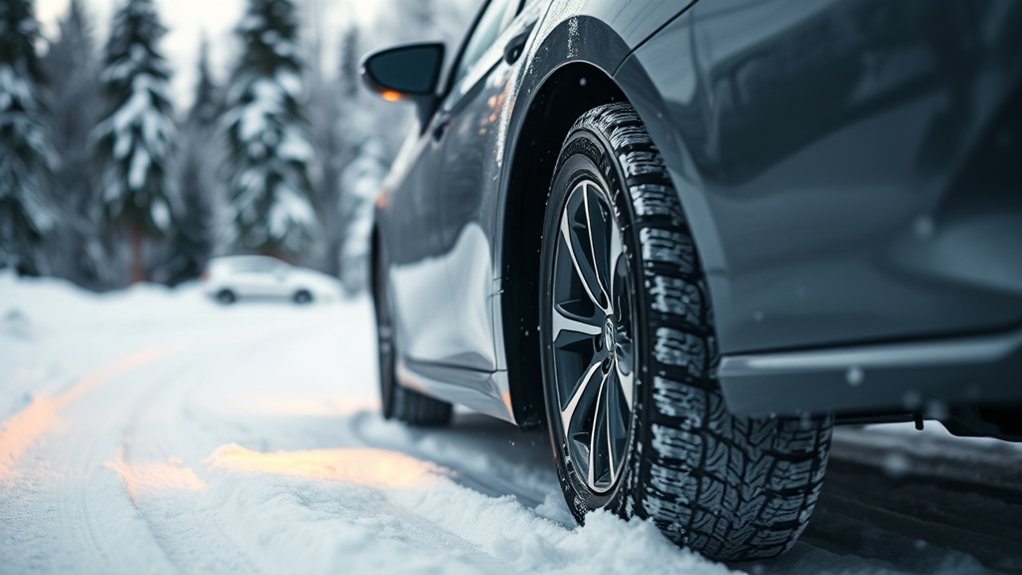
Complete these checks before the first storm rather than waiting for a warning light or no-start condition. If you find a leak, weak battery, brake concern, damaged tire, or persistent warning message, have the Camry inspected before winter travel.
Essential Tire Checks
- Pressure: Check all four tires and the spare, if equipped, with a reliable gauge while cold.
- Tread: Measure multiple points across each tire and look for uneven wear.
- Damage: Inspect for cuts, cracks, bulges, punctures, exposed cords, or bent wheels.
- Matching set: Confirm all four winter tires have compatible size, construction, load capacity, and similar tread depth.
- TPMS: Do not rely only on the warning light. A tire can be underinflated before the system alerts you.
Fluid Level Inspections
Check engine or hybrid-system coolant only when the system is cool, and use coolant that meets Toyota’s specification for your model year. Fill the washer reservoir with winter-rated fluid suitable for the expected temperature. Inspect for leaks and confirm the heater, windshield defroster, and rear defogger operate correctly.
Use only the engine-oil viscosity and specification listed in the owner’s manual. Do not switch to a thinner “winter oil” simply because the temperature drops. Brake fluid should be at the proper level, but low fluid can indicate pad wear or a leak and needs inspection rather than a simple top-off.
Most newer Camrys use electric power steering and do not have a power-steering-fluid reservoir. If you own an older Camry with hydraulic power steering, inspect the level and condition only as described in that model’s manual.
Battery, Visibility, and Brake Checks
- Test the 12-volt battery and charging system, especially if starting is slow or the battery is several years old.
- Replace worn wiper blades and test washer spray, front defrost, rear defogging, and mirror heaters if equipped.
- Clean snow and ice from every window, mirror, light, camera, radar area, the hood, and the roof before driving.
- Check headlights, brake lights, turn signals, hazard lights, and license-plate lights.
- Have the brakes inspected if you notice pulling, grinding, squealing, vibration, a soft pedal, or increased stopping distance.
Enhance Traction With AWD Features
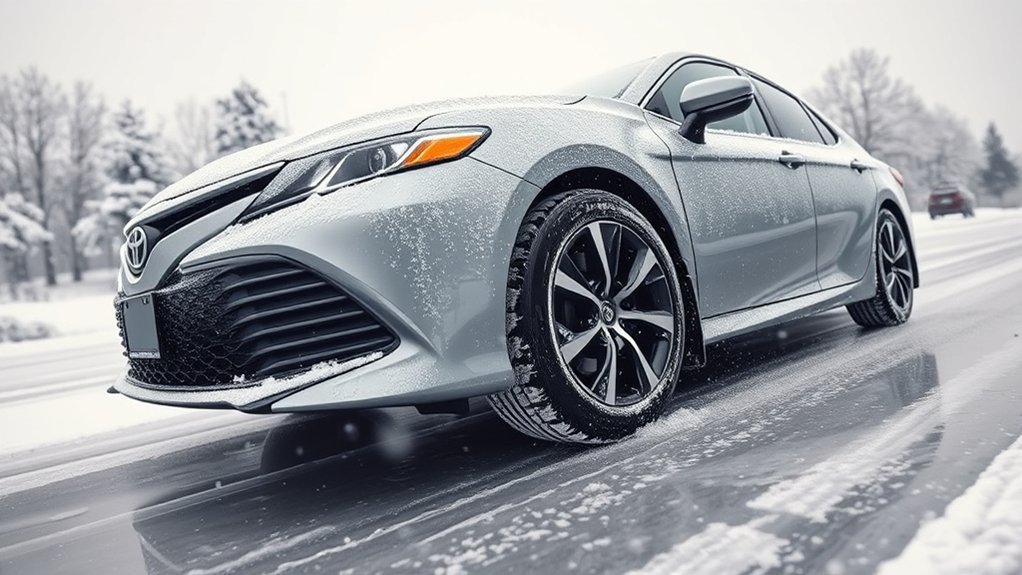
AWD is available only on certain Camry model years and trims. On current ninth-generation U.S. models, Toyota’s Electronic On-Demand AWD can send drive torque to the rear wheels when extra traction is needed. Toyota says the system supports start-off acceleration, handling, and stability when it detects slippery conditions or loss of tire grip.
That does not mean AWD shortens stopping distance. Braking and cornering still depend mainly on the grip available at the four tire contact patches. An AWD Camry can accelerate confidently enough to hide how little braking traction remains, so use the same low speed and long following distance you would in a front-wheel-drive model.
Current U.S. 2025 and 2026 Camry information lists Normal, Eco, and Sport drive modes rather than a dedicated Snow mode. Controls differ across years and markets, so verify your exact car instead of looking for a universal snowflake button.
AWD may help your Camry get moving, but winter tires and a cautious driver determine how well it stops and turns.
[Products Worth Considering]

The JACO FlowPro Tire Inflator measures, inflates, and airs down tires up to 100 PSI with battery-free operation and ±2% accuracy after calibration. It features a glowing pressure dial for night visibility, a heavy-duty steel build with a hybrid hose, and a precision push-to-inflate thumb trigger. The patented Lightning Air Chuck locks on for a secure seal, and the kit includes quick-connect hardware for easy inline use with your air compressor.

This compact capsule-style tire repair kit helps you quickly fix punctures and plug flats with minimal effort. The rugged stainless steel shell protects the contents for reliable roadside use, while the simple plug assembly makes repairs fast and tool-free. Suitable for motorcycles, cars, ATVs, UTVs, and even mountain bikes.
What to Do if Your Camry Gets Stuck
- Stop spinning the tires. High-speed wheelspin can damage tires and dig the car deeper.
- Turn on the hazard lights and check that the exhaust outlet is not blocked by snow.
- Clear snow from around the drive wheels and from beneath the front and rear of the car.
- Straighten the steering wheel and apply very light throttle.
- Place sand, non-clumping cat litter, or traction mats near the drive tires. Avoid corrosive ice-melt chemicals around the vehicle.
- If the owner’s manual permits it, briefly disable traction control to allow limited wheelspin. Turn it back on as soon as the Camry is moving.
- Rock the vehicle only as the manual allows, shifting fully between drive and reverse and pausing before each change.
- Call roadside assistance if the car is high-centered, near traffic, on a steep slope, or cannot be freed without repeated wheelspin.
Warning: Never stand directly in front of or behind a tire while someone applies power. A traction aid, ice chunk, or tire component can be thrown with serious force.
Pack Your Essential Winter Emergency Kit
A useful kit should help you remain visible, warm, hydrated, and able to handle minor delays. NHTSA’s winter guidance recommends carrying supplies for snow removal, traction, communication, first aid, and warmth.
- Snow brush, ice scraper, and compact shovel
- Sand, non-clumping cat litter, or traction mats
- Flashlight with spare batteries and reflective warning devices
- Jumper cables or a properly rated jump pack
- Tire-pressure gauge, work gloves, and basic tools
- First-aid kit and necessary medicines
- Blankets, warm clothing, hats, and waterproof gloves
- Drinking water and non-perishable food
- Charged phone, vehicle charger, and offline route information
- Extra winter washer fluid
- Spare tire, jack, and tools if equipped, or the factory repair-kit and roadside-assistance information
If You Become Stranded
Stay with the vehicle unless a clearly safer shelter is very close. Call for help, make the Camry visible, and clear snow from the exhaust outlet before running the engine. Run the engine only intermittently as needed for heat, and never sleep with it running continuously. A blocked exhaust can allow deadly carbon monoxide to enter the cabin.
Conserve phone power, keep occupants dry, and move periodically without overexertion. If the vehicle is stopped near active traffic, remain belted whenever possible and follow emergency responders’ instructions.
Frequently Asked Questions
How do I put a Toyota Camry in Snow Mode?
Do not assume your Camry has Snow Mode. Current U.S. 2025 and 2026 models list Normal, Eco, and Sport modes, not a universal snowflake-button mode. Check your exact model-year manual. If no Snow Mode is listed, use Normal mode, gentle throttle, winter tires, and normal traction-control operation.
Should traction control be on or off in snow and ice?
Keep traction control on during normal driving because it helps limit wheelspin and supports stability. If the Camry is stuck, the owner’s manual may allow you to switch it off briefly so the tires can spin enough to move through loose snow. Turn it back on immediately after you are free.
What are the three P’s of safe winter driving?
There is no single official three-P standard. A useful memory aid is Preparation, Patience, and Practice: prepare the vehicle and route, allow extra time and distance, and practice smooth braking and skid recovery in a safe controlled area when permitted.
Is an AWD Camry better than a FWD Camry in snow?
AWD can improve start-off traction and reduce front-wheel spin, especially on hills. It does not make the car stop faster on ice. A front-wheel-drive Camry with four good winter tires can be safer than an AWD Camry on worn or unsuitable tires.
Do I need winter tires on all four wheels?
Yes. Four matching winter tires provide balanced acceleration, braking, and cornering. Installing only two can create a large grip difference between axles and make the Camry more likely to understeer or oversteer.
Can I use tire chains on any Toyota Camry?
No. Chain clearance and approved installation positions vary by model year, trim, wheel size, and tire size. Check the owner’s manual and local law before buying chains. Using an unapproved chain can damage the vehicle or interfere with brakes and suspension.
Conclusion
Your Toyota Camry can handle winter travel more safely when you focus on the basics: four suitable tires, correct cold pressure, clear windows and sensors, a tested battery, proper fluids, working brakes, and an emergency kit. Drive below the pace you would use on dry pavement, leave extra stopping room, and keep every steering, braking, and throttle input smooth.
AWD and traction control can assist you, but neither can replace tire grip or good judgment. Check your exact Camry owner’s manual, monitor weather and road reports, and postpone non-essential travel when conditions exceed your experience or the vehicle’s safe limits.
Sources
- National Highway Traffic Safety Administration: Winter Weather Driving Tips — vehicle preparation, ABS use, tire pressure, emergency supplies, and stranded-vehicle safety
- Toyota Owners: Manuals and Warranties — model-year-specific controls, fluids, tires, chains, and maintenance instructions
- Toyota USA Newsroom: 2026 Camry — Electronic On-Demand AWD operation and current Normal, Eco, and Sport drive modes
- Transport Canada: Using Winter Tires — temperature guidance, four-tire installation, snowflake marking, and winter tread depth
- U.S. Tire Manufacturers Association: Seasonal Tire Care Tips — cold-pressure changes, AWD limitations, smooth inputs, ABS, and stuck-vehicle precautions
- North Carolina Department of Public Safety: Winter Driving Safety — five-to-six-second following distance, visibility, and skid response

Related Articles

Toyota Camry All-Season Tires Explained: What They Can and Can’t Do
In exploring Toyota Camry all-season tires, discover their benefits and limitations—are they really the right choice for your driving needs?
Read More
Do Toyota Camry Tires Need Snow Chains? When They Help and When They Don’t
How do snow chains enhance your Toyota Camry's winter driving safety, and when should you avoid using them? Discover the essential details inside!
Read More
When to Replace Winter Tires on a Toyota Camry: Tread Depth & Age Guide
Keep your Toyota Camry safe by knowing when to replace winter tires; learn crucial tips on tread depth and age that could save your life.
Read More