
Is LEGO the Largest Tire Manufacturer in the World? The Surprising Truth
LEGO’s “largest tire manufacturer” claim is a fun fact that only works when you define the category carefully. LEGO makes tiny molded toy tires in enormous quantities, so it can beat automotive tire brands by unit count. It does not compete with Michelin, Bridgestone, Goodyear, or other road-tire companies by revenue, tire size, vehicle use, load rating, or replacement-market share.
Quick Answer
Yes, LEGO can be called the world’s largest tire maker by unit count if you include toy tires. Older widely cited figures put LEGO at roughly 306 million small rubber tires per year. That does not make LEGO the largest automotive tire company or the leader in full-size road tires.
Key Takeaways
- LEGO’s tire claim is about unit count, not automotive market power.
- The often-cited 306 million tire figure comes from older LEGO production references, so it should be treated as a historical production benchmark rather than a confirmed current-year count.
- LEGO tires are real molded toy tires, but they are not pneumatic, road-legal, load-rated vehicle tires.
- Claims about recycled LEGO tires made from fishing nets, ropes, or engine oil should not be published unless LEGO provides a direct source.
- For accuracy, say LEGO is the largest tire maker by toy-tire unit count, not the largest tire company overall.
Is LEGO Really the Biggest Tire Maker?
Yes, but only in a narrow sense. LEGO has long been described as the world’s largest tire manufacturer by unit count because it produces huge numbers of small toy tires for cars, trucks, aircraft, Technic models, and other vehicle-themed sets. Older production references commonly cite about 306 million LEGO tires per year, and later Guinness-related comparisons have cited more than 318 million toy tires in a year.
The safe version of the claim is: LEGO may be the world’s largest tire maker by unit count when toy tires are included.
That qualifier matters. Michelin, Bridgestone, Goodyear, Continental, and other tire companies make road tires that carry real vehicles, meet strict transport standards, and operate in a completely different market. LEGO’s advantage is the number of tiny tires it molds, not the total amount of rubber used, tire revenue, or vehicle performance.
Note: If you use this claim in a post, headline, or social caption, include “by unit count” and “toy tires” so readers do not confuse LEGO with automotive tire manufacturers.
[Products Worth Considering]

This chemical vulcanizing cement promotes rubber vulcanization at room temperature, helping create durable tire repairs without heat. The included brush makes application easy, and the quick-drying formula with accelerators helps the repair cure faster for reliable patch or plug sealing. It’s suitable for cars, motorcycles, and bikes, supporting repairs for both inner tubes and outer tires.

CircleRoad RV wheel chocks are designed to be installed between two tires to prevent wheel movement and improve parking stability. Built with a rust-proof finish for weather resistance, they help keep your tire position secure during travel trailer and motorhome stops. The package includes a multi-functional ratchet wrench and hex socket for fast installation.

CKAuto tire repair plugs provide a quick, effective way to seal punctures on the road without removing the tire from the rim. Designed for tubeless off-road tires, they help you get back moving on cars, bikes, ATVs, UTVs, wheelbarrows, and mowers. The rubber repair strings are strong, reliable, and completely odorless for clean use.
What Counts as a Tire in This Comparison?
In this comparison, a LEGO tire counts because it is a separate molded ring that fits around a wheel element and gives a LEGO vehicle grip, shape, and movement. It performs a tire-like role in its intended toy application. That makes it reasonable to count LEGO tires as tires for a unit-volume trivia claim.
It is not reasonable to compare a LEGO tire directly with a passenger-car tire. A road tire is engineered for load, speed, heat, weather, braking, rolling resistance, tread wear, and safety regulations. A LEGO tire is designed for toy fit, durability, grip on play surfaces, and compatibility with LEGO wheel parts.
How LEGO Produces So Many Toy Tires
LEGO’s tire volume comes from the same strength that drives the rest of its manufacturing system: repeatable, high-precision parts made at large scale. Vehicle-themed sets use many wheel-and-tire combinations, from tiny city cars to large Technic builds. When millions of sets need tires, the annual part count rises quickly.
The older 306 million figure should be treated as a widely cited historical production benchmark, not a guaranteed current production number. LEGO’s current public reporting focuses more on revenue, factory expansion, carbon goals, and material sourcing than on publishing a fresh annual tire count. For an accurate article, it is better to say “widely reported at about 306 million per year” than to present the number as a verified current-year statistic.
Why LEGO Tires Count as Real Toy Tires
LEGO tires are real toy components, not printed decorations or fake molded shapes. They are separate parts that fit around LEGO wheels and help vehicle models roll, steer, and look more realistic. In that sense, they are tires within the LEGO system.
Real Toy Parts, Not Road Tires
The key is to keep the category clear. LEGO tires are real molded toy tires, but they are not pneumatic road tires. They are not designed to support a real vehicle, pass highway safety testing, or handle heat and speed like a passenger-car tire. Their job is to work reliably in a toy build.
Why the Unit Count Is So High
The unit count is high because LEGO tires are small and used across many sets. One real car usually uses four road tires. A single LEGO collection can include dozens or hundreds of small tires across cars, trucks, trailers, motorcycles, aircraft support vehicles, cranes, robots, and Technic models. That scale makes the LEGO tire fact surprising but understandable.
Warning: Small toy tires and wheel parts can be choking hazards for young children. Follow the age label on each LEGO set and review CPSC small-parts guidance when toys may be used around children under 3.
Are LEGO Tires Recycled?
LEGO is working on broader sustainable-material goals, but the tire-specific recycled-material claims need careful handling. Public reporting supports LEGO’s wider push into renewable and recycled feedstocks, including certified renewable resins, bio-based plastic for some elements, e-methanol research, and major investment in lower-carbon materials. However, current reliable public sources do not clearly confirm that LEGO tires are already being made from fishing nets, ropes, recycled engine oil, or a specific tire material called rSEBS.
That means the safest article wording is simple: LEGO is pursuing more sustainable materials across its product system, but a tire-specific recycled-content rollout should only be stated if LEGO publishes or confirms the exact tire material, set list, and implementation date.
Pro Tip: Do not turn LEGO-wide sustainability goals into tire-specific claims unless the source specifically mentions tires. A general material goal does not prove a specific LEGO tire formula.
[Products Worth Considering]
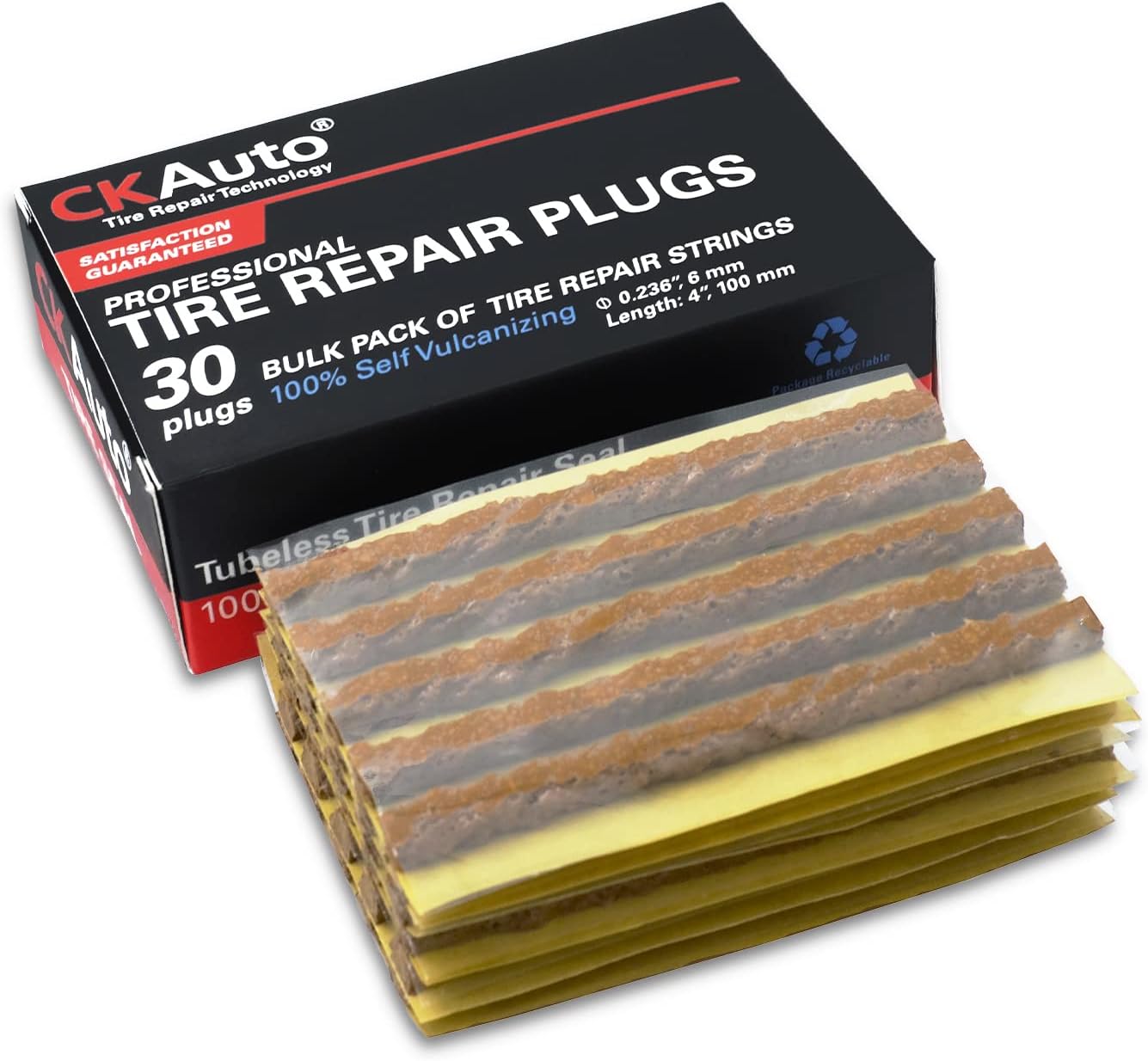
CKAuto tire repair strings provide a fast, reliable way to seal punctures in tubeless off-road tires without removing the tire from the rim. The rubber repair plugs are designed for quick roadside fixes and work across many vehicle types including cars, bikes, ATVs/UTVs, wheelbarrows, and mowers.

CKAuto 50 pack tire valve caps help protect your vehicle valves from dirt and corrosion while providing an airtight, leak-resistant seal. Each cap features an O-ring designed to help prevent air loss and keep out dust and debris. Universal sizing makes these caps suitable for cars, SUVs, bikes, trucks, and motorcycles, and the ridged grip design allows easy installation and removal for quick pressure checks.

Upgrade your ride with CKAuto anodized aluminum tire valve stem caps designed to protect valve stems from dust and corrosion while staying TPMS-safe. The rotating thread design makes installation and removal quick, and the universal fit supports most cars, trucks, SUVs, motorcycles, RVs, and bicycles. With corrosion-resistant performance and a durable black finish, these caps help keep your wheels looking clean and working reliably.
How LEGO Compares With Michelin, Bridgestone, Goodyear, and Hot Wheels
The LEGO tire claim makes sense only when you compare unit counts. In the real tire industry, companies such as Michelin, Bridgestone, Goodyear, and Continental dominate the production of full-size vehicle tires. Michelin, for example, is often described as making around 200 million tires globally per year, while also working toward more renewable and recycled tire materials.
| Company / Brand | What It Makes | Best Way to Compare |
| LEGO | Small molded toy tires for LEGO sets | Largest by toy-tire unit count, based on older widely cited production figures |
| Michelin | Passenger, truck, motorsport, aircraft, and specialty tires | Major real-world tire manufacturer by automotive use, technology, and global sales |
| Bridgestone and Goodyear | Full-size tires for cars, trucks, commercial fleets, and specialty equipment | Real tire-industry leaders, not directly comparable with LEGO toy tires |
| Hot Wheels | Die-cast toy vehicles, typically with plastic wheel assemblies | Not a clean comparison unless a source counts separate tire-like wheel parts |
Why LEGO’s Tire Claim Matters
The LEGO tire claim matters because it shows how manufacturing scale can look very different depending on what you measure. A company can lead by unit count without leading the automotive tire market. LEGO’s small tires are a perfect example: they are tiny parts, but they are produced across a huge global toy system.
The claim also teaches a useful fact-checking lesson. “Largest” always needs a measurement. Largest by units is not the same as largest by revenue, weight, market share, or performance. When the measurement is clear, the LEGO fact is interesting and fair. When the measurement is missing, the claim becomes misleading.
Frequently Asked Questions
Does LEGO produce more tires than Michelin?
LEGO may produce more individual tire pieces than Michelin if you count every tiny toy tire as one tire. Michelin remains the real tire-industry company in this comparison because it makes full-size tires for vehicles, motorsport, aircraft, and commercial use.
Is LEGO the biggest tire company in the world?
No, not in the normal automotive sense. LEGO can be called the biggest tire maker by toy-tire unit count, but it is not the biggest tire company by revenue, road-tire production, physical tire volume, or automotive market share.
Are LEGO tires real rubber tires?
LEGO tires are real molded toy tires because they are separate tire parts that fit around wheel elements and help models roll. They are not the same as pneumatic road tires and should not be compared with car tires for load, speed, heat, or safety performance.
Does LEGO use recycled material in its tires?
LEGO is working on broader renewable and recycled material goals, but tire-specific recycled-material claims need a direct LEGO source. Do not state that LEGO tires are made from fishing nets, ropes, recycled engine oil, or a named recycled polymer unless LEGO confirms that exact tire formula.
Who makes more tires, LEGO or Hot Wheels?
LEGO is the safer answer when the question means separate molded toy tires. Hot Wheels is usually discussed by toy car production, not by separate rubber tire production, so exact tire-to-tire comparisons are difficult without a source that counts individual wheel or tire parts.
Why do people call LEGO a tire manufacturer?
People call LEGO a tire manufacturer because the company produces huge numbers of small tire parts for its toy vehicles. It is a playful manufacturing fact, not a claim that LEGO competes in the automotive tire business.
Conclusion
LEGO can fairly be described as the world’s largest tire maker by unit count if you include toy tires. That is the important qualifier. Its tiny molded tires are real LEGO parts, and their production volume is impressive, but they do not make LEGO a real-world tire-industry leader. For the clearest and most accurate wording, use this version: LEGO is the largest tire manufacturer by toy-tire unit count, not by automotive tire sales, tire size, or road performance.
Sources
- The LEGO Group Annual Report 2024 — LEGO company reporting, sustainability context, and business background.
- Associated Press: LEGO sustainable-materials work — background on LEGO’s recycled PET trial, material research, and emissions goals.
- The Guardian: LEGO renewable and recycled materials plan — reporting on LEGO’s renewable and recycled material targets.
- U.S. Consumer Product Safety Commission: Small parts guidance — choking-hazard and small-parts safety context for toys.
- Car and Driver: Michelin tire production and sustainability context — background on Michelin’s real-world tire output and recycled/renewable material goals.
[Products Worth Considering]

CKAuto valve stem caps help protect tire valve stems with a corrosion-resistant design that combines plastic inner protection with a stylish anodized aluminum exterior. They feature a rotating thread for quick installation and removal and a universal fit for most cars, trucks, SUVs, RVs, motorcycles, bicycles, and other motor vehicles. The anodized and powder-coated finish is built for durability while keeping the cap color bright.

CKAuto Universal Tire Repair Kit provides a complete emergency solution for fixing flat tire punctures using plug-style repairs without removing the tire from the rim. The kit includes insertion/probe tools, repair plugs, lubricant, valve accessories, and a convenient carry bag for quick roadside use. Designed for tubeless tires across cars, SUVs, trucks, motorcycles, RVs, and more, it’s easy enough for anyone to perform a proper repair.

The Classic Racing Tire toy chest makes fast, fun cleanup for cars, toys, and everyday items with a classic racing design. Its reversible lid doubles as a hilly raceway for die-cast cars, encouraging imaginative play. The chest is easy to clean and can also be used as a laundry basket for added convenience.

Related Articles
Who Makes Kumho Tires? Brand and Factory Guide
From South Korea to global factories, find out who really makes Kumho tires—and why their production story may surprise you.
Read More
Are Michelin Tires Worth the Price?
Do Michelin tires justify their premium price, or are you paying for a badge; discover what really drives their value and decide for yourself.
Read More
Where Are Continental Tires Made?
Originating from a global network of advanced factories, Continental tires are made in surprising places—find out which plant could be behind yours.
Read More